There Are a Lot of Wrong Choices for Congress. Why These Two Are the Right Ones.
Monique DeSpain (CD4) and Patti Adair (CD5) on fraud, accountability and affordability
About this episode
Fraud in government programs is in the news almost every week. This hour, two Republican candidates for Oregon’s congressional seats talk about what accountability would look like, and what they say their opponents’ records show. Ballots are due November 3.
In the first half, Monique DeSpain, a retired Air Force colonel who spent about twenty years as a military attorney, explains why she is challenging Rep. Val Hoyle in Oregon’s 4th District. The conversation centers on La Mota, once Oregon’s second-largest cannabis chain. On October 15, a federal grand jury indicted co-founder Rosa Cazares on eight counts of failing to pay about $1.5 million in payroll taxes. An indictment is an allegation, and Hoyle is not named in it. Hoyle, then Oregon’s labor commissioner, oversaw a grant of about $500,000 to an apprenticeship nonprofit Cazares co-founded; she has said Cazares misled her. DeSpain presses on how long it took Hoyle to turn over her text messages, on Hoyle’s late STOCK Act filings, and on Hoyle’s vote against the National Fraud Enforcement Division Act, which passed the House 352 to 72.
Mark and DeSpain also look at what accountability looks like in practice: holding agency managers responsible, running government programs like a business, and tracking public money once it lands in a nonprofit.
In the second half, Patti Adair, a Deschutes County Commissioner and, according to her campaign, a CPA and former auditor, takes on affordability in Oregon’s 5th District, where she is challenging Rep. Janelle Bynum. Adair argues that spending more is not the same as lowering costs, and she wants the no-tax-on-tips, overtime and Social Security provisions made permanent. She and Mark discuss the national debt, improper payments in Medicare and Medicaid, Bynum’s support for Medicare for All, Oregon’s corporate activity tax, and the House vote to ban members from buying individual stocks.
They close on forest management. Adair talks about underbrush clearing, logging, the “burn bot” and goats, and says Congress needs a different approach to wildfire. Mark finishes with the stakes: the election is days away, and as we say every week, the best information does you no good if you don’t use it.
In this episode
The La Mota Case and Val Hoyle’s Role
Mark on fraud and why accountability matters. Then Monique DeSpain, retired Air Force colonel, on the La Mota story, the BOLI grant, and why she is challenging Rep. Val Hoyle in CD4.
Eleven Months of Texts, and a Fraud Bill
What a former military lawyer makes of a public official deciding which text messages are relevant, Hoyle’s STOCK Act filings, and her no vote on the National Fraud Enforcement Division Act.
What Accountability Would Look Like
Firing the unethical, running government like a business, nonprofits that take public money, and holding agencies to account, from Lane County to ODOT.
Affordability: Spending More Isn’t Lowering Costs
Mark introduces Deschutes County Commissioner Patti Adair, CD5 candidate. Mental health beds, permanent no-tax-on-tips and overtime, the national debt, SNAP fraud, and an auditor’s approach to spending.
The CAT Tax, Medicare for All, and Congress’s Stock Trades
Oregon’s corporate activity tax, improper payments in Medicare and Medicaid, Rep. Bynum’s Medicare for All support, the stock-trading ban, and pay during a shutdown.
Forests, Fire and the Underbrush
Forest management and wildfire, logging, the burn bot, goats, and why Adair says Washington needs a different approach. Then Mark’s close on the final days of the election.
Key questions about the candidates and the issues
What is the National Fraud Enforcement Division Act of 2026, and how did the House vote?
The bill would establish a National Fraud Enforcement Division at the U.S. Department of Justice to investigate and prosecute fraud against federal programs and taxpayer dollars. It is not an appropriations bill. The House passed it 352 to 72 (House Clerk roll call 309). Both Rep. Val Hoyle and Rep. Janelle Bynum voted no, according to their opponents' campaigns; neither has been reported explaining the vote. The Senate has not passed it: a request to move it by unanimous consent was blocked on October 1, per Hoodline. The administration has also created a fraud division administratively, though sources differ on when.
What are the latest developments in the La Mota case?
On October 15, 2026, a federal grand jury indicted La Mota co-founder Rosa Cazares and her company 503 Staffing on eight counts of failing to pay $1,542,413 in payroll (trust-fund) taxes between March 2020 and December 2021. Each count carries up to five years in prison. An indictment is an allegation, not a finding of guilt. Her partner Aaron Mitchell was not charged; Willamette Week reports he owes more than $7.9 million in state liens. Rep. Hoyle is not named in the indictment.
What was Val Hoyle's role in the La Mota-linked grant?
As Oregon Labor Commissioner, Hoyle's agency (BOLI) awarded a grant of about $500,000 in fall 2022 to an apprenticeship nonprofit co-founded by Cazares. Willamette Week reported the nonprofit's listed address was a storage unit in Beaverton, and that Hoyle and Cazares had dinner together in March 2021. After Hoyle left for Congress, her successor demanded unused funds back. Reporting shows it took Hoyle 11 months to turn over text messages after she screened them. Hoyle says Cazares misled her and that she returned La Mota-related campaign contributions.
Is Val Hoyle under federal investigation?
It has not been publicly confirmed. Willamette Week reported a January 29, 2024 federal subpoena to BOLI that appears to be tied to the probe that also touched former Secretary of State Shemia Fagan. A Hoyle spokeswoman said she had had no contact with investigators. The federal investigation of Fagan was closed in April 2025 with no charges. Hoyle's challenger Monique DeSpain says an investigation is ongoing; no prosecutor has said so publicly.
What is the congressional stock-trading bill, and how did Hoyle and Bynum vote?
H.R. 7008 would ban members of Congress from buying individual stocks. It passed the House 232 to 198 (House Clerk roll call 280); Patti Adair noted that 13 Democrats voted yes. Separately, Rep. Hoyle was found to have filed late disclosures on 217 stock transactions under the STOCK Act and paid a $200 fee; OpenSecrets found no prohibited transactions. Rep. Bynum's House Clerk financial disclosures show holdings that are mostly mutual and index funds, which a ban on individual stock purchases would not have touched.
What is the Fix Our Forests Act?
The Fix Our Forests Act would speed up forest-thinning, fuel-reduction and post-fire work on federal and some other lands. The House passed it with both Rep. Bynum and Rep. Hoyle voting yes, but as of August 2026 reporting it had not received a Senate floor vote and had not become law.
Links & resources mentioned
The Candidates
- Monique DeSpain for Congress (CD4 candidate)
- What’s Val Hiding? (DeSpain campaign site compiling sources on Rep. Hoyle and La Mota)
- Patti Adair for Congress (CD5 candidate)
- Adair: priorities (Patti Adair for Congress)
- Adair: news and statements (Patti Adair for Congress)
- Adair statement on Bynum’s fraud-division vote (Patti Adair for Congress)
- Adair on Bynum’s Medicare for All plan (Patti Adair for Congress)
- DeSpain calls on Hoyle to resign over text messages with La Mota CEO (DeSpain campaign, August 2024)
La Mota, Rosa Cazares & the BOLI Grant
- La Mota CEO Rosa Cazares indicted for federal tax fraud (Willamette Week, October 16, 2026)
- Oregon cannabis company failed to pay $1.5M in taxes, federal prosecutors say (KOIN)
- The power couple of Oregon cannabis bankrolled top Democrats (Willamette Week, March 29, 2023)
- La Mota is crumbling, the feds are circling (Willamette Week, December 20, 2023)
- Feds issue subpoena to state agency that gave La Mota-affiliated nonprofit a $500,000 grant (Willamette Week, February 12, 2024)
- Federal investigation into Fagan dropped, no charges filed (Willamette Week, April 21, 2025)
- Audit blasts the Oregon Bureau of Labor and Industries (Willamette Week, November 20, 2025)
- Bitter rematch: Oregon 4th District candidates clash (OPB, October 14, 2026)
- Hoyle and DeSpain primary results (OPB, May 20, 2026)
The National Fraud Enforcement Division Act
- House roll call 309 (House Clerk — the 352–72 vote)
- House passes bill creating a DOJ fraud division (Legis1)
- Democrats reluctantly hand Trump major victory on key program targeting Tim Walz (Fox News)
- Senate Democrats block anti-fraud division after House passed it 352–72 (Hoodline, October 2026)
- Statement of Administration Policy, H.R. 9576 (PDF) (White House, September 2026)
- Minnesota Medicaid housing fraud (Axios Twin Cities, July 24, 2025)
Congress, Stock Trades & Financial Disclosures
- House roll call 280 (House Clerk — the 232–198 stock-trading vote)
- House passes bill that would ban members from buying stock (6abc)
- Fact check: did 198 House Democrats vote against banning congressional stock trading? (Meaww)
- Hoyle violated STOCK Act by missing deadlines to disclose 217 stock transactions (Oregon Capital Chronicle, September 18, 2025)
- Hoyle stock reporting violated trading act (OPB, September 17, 2025)
- Rep. Janelle Bynum financial disclosure, 2025 (PDF) (House Clerk)
- Rep. Janelle Bynum financial disclosure, 2024 (PDF) (House Clerk)
- Bynum requests her pay be withheld during shutdown (Rep. Bynum’s office)
Affordability, Health Care & Government Spending
- Rep. Bynum touts universal healthcare proposal as Oregon mulls its own (InsuranceNewsNet, October 2026)
- Oregon’s Election 2026: the universal health plan and the Climate Protection Program (I Spy Radio, Show 16-42 — source of the $94 billion figure)
- Audit of Oregon COVID rent-assistance spending (OPB, January 5, 2024)
- Oregon’s housing authority disagrees with audit’s finding of $42.6M in untraced spending (KATU)
- Oregon gave millions in erroneous benefits for state health plan (OPB, April 4, 2026)
- Oregon, several states could face new costs over SNAP error rate (OPB, June 25, 2026)
Forests & Wildfire
- House roll call 25 (2025) (House Clerk — Fix Our Forests Act)
- H.R. 471, Fix Our Forests Act: all actions (Congress.gov)
- Can preventing wildfires be a rare bipartisan issue? (Deseret News, August 4, 2026)
- Bynum hears local wildfire concerns (The Nugget, May 13, 2026)
- Meet the two Republicans vying to flip Oregon’s 5th Congressional District (Oregon Capital Chronicle, April 22, 2026)
About the guests
Monique DeSpain is a retired U.S. Air Force colonel and attorney. According to her campaign, she spent about thirty years in the Air Force, roughly twenty of them as a military lawyer handling investigations, military justice and ethics advice to commanders, and has lived in Oregon for almost thirty years. She is the Republican nominee challenging incumbent Rep. Val Hoyle in the November 3, 2026 general election.
Patti Adair is a Deschutes County Commissioner and, according to her campaign, a CPA and former auditor who grew up on a family ranch in Heppner and is a fourth-generation Oregonian. She is the Republican nominee challenging incumbent Rep. Janelle Bynum in the November 3, 2026 general election. Oregon’s 5th District runs from the Portland suburbs through Salem and Albany to Bend.
Full transcript ▸
MARK: With all of the fraud that seems to be exposed on a practically weekly or even daily basis, we need more people in Congress who have professional experience dealing with ethics and fighting fraud — which is different from some people in Congress who have experience with unethical behavior and committing fraud, or at least enabling other people to do it by setting up massive spending programs and looking the other way.
When people, surprise, surprise, commit fraud, then of course they blame someone else. If fraud bothers you, you are clearly racist, because it can’t possibly be. These massive social programs that we keep pumping money into have such loose restrictions on who qualifies that it’s an open door to commit fraud on an industrial scale.
On today’s show, we have two such people committed not just to affordability, but to accountability. We’ll be talking with Patti Adair, running in CD5, in the second half of our show. But first: plenty of candidates talk about accountability. Monique DeSpain spent about twenty years as an Air Force lawyer, where investigations, ethics and accountability were the job. A retired colonel, she is now running in Oregon’s fourth district to bring some accountability to government. Monique, welcome. Thanks for joining us today.
MONIQUE DESPAIN: Thanks, Mark. Thank you. And Karla.
MARK: Yeah, Karla is my producer here, in case people forget that. So I’d like to actually start with why you’re running for CD4. And I think the person that you’re running against really deserves more exposure than Oregon’s media is willing to give her. One of the core aspects, to really sum up a lot of what has happened there, is the whole La Mota fraud case.
La Mota was Oregon’s second-largest cannabis chain. It was run by Rosa Cazares and her partner, Aaron Mitchell. In 2023, Willamette Week reported they owed millions in back taxes while giving generously to Democrats. Oregonians will likely remember that then–Secretary of State Shemia Fagan was forced to resign after it came out that she had a $10,000-a-month consulting side gig with them while her office was supposed to be auditing the cannabis sector. Initially, Fagan saw nothing wrong with having a side gig with a company that she was supposed to oversee, but eventually she did, in fact, resign.
Val Hoyle, who was then the state labor commissioner, had steered a grant of more than half a million dollars to an apprenticeship nonprofit Cazares co-founded. Now, on October 15th, 2026, just a few days ago, Cazares has been indicted on eight federal counts of failing to pay roughly $1.5 million in payroll taxes. Hoyle isn’t named in the indictment and says Cazares misled her. So what is your take on Val Hoyle’s involvement in all of this?
MONIQUE: Well, she’s deeply involved in it and complicit in the illegal activities of the La Mota leadership. But I just want to say that I have never aspired to politics. I’ve lived in Oregon almost thirty years, raised my kids here. And I would not be running if we didn’t have a problem with Val Hoyle. She’s the representative of my district, our fourth district, and she’s a crook and very dishonest. And she’s personally enriching herself at the expense of Oregonians. And we just deserve better.
I do believe I’m uniquely qualified. It’s this time in my life, with my kids up and out — I’m not looking for a second, third career. But I’m a problem solver, and I can deliver the integrity that this position deserves, and the honesty, and the representation of all Oregonians, regardless of party, who want a transparent, accountable government. So I wanted to just start with that.
If we didn’t have a problem — you know, Val Hoyle is no Peter DeFazio, right? She’s truly corrupt, and that’s just one of the stories. She violated the STOCK Act. She broke the law there. She violated election laws, lying about who I am and my positions in my campaign. So she’s just consistently — and she really was a disservice to Oregonians as commissioner of BOLI, which I’m sure we’ll talk about.
She claims to be for the working class. But while she was doling out favors to La Mota, which we’ll talk about, she had at least eleven La Mota employees — working-class people that worked for La Mota — with pending misconduct complaints against La Mota, while Val Hoyle was wining and dining with them, and steering federal grant money to them, and taking campaign contributions. This is not somebody who should be representing Oregonians or the people of the United States.
MARK: No. Absolutely not. Just to give people a little more background and history, in case they need a reminder: the reported political giving at the time was at least $225,000. La Mota gave mainly to Democrats — in fact, I think almost exclusively to Democrats, if I remember. Kotek got about $68,000 of that figure, Fagan got $45,000 of that, and PACs tied to Hoyle got just over $25,000. And there was some other dodgy stuff, too. The nonprofit that got that $500,000 grant — the foundation was formed just two weeks before they applied for it.
MONIQUE: That’s right.
MARK: And there was also no apprenticeship history. Sounds a little bit like Stacey Abrams.
MONIQUE: Oh, I know. And I’m pretty sure the physical location was a little U-Haul storage unit.
MARK: Yes, yes. That’s right. Not at all dodgy.
MONIQUE: And this is just the tip of the iceberg. You know, we’ve been hearing about fraud and theft of our tax dollars across the country, but it’s happening right here in Oregon. I mean, we could talk for hours. You know, the Uplifting Journey story that Jeff Eager covered.
MARK: Yes.
MONIQUE: But this — yeah. Our own congresswoman facilitated this same kind of shady transaction. And that $500,000 federal grant, funded with federal tax dollars, has not been clawed back. The first thing that got paid out was a generous salary to — it wasn’t Rosa, it was one of the other characters from La Mota. I’m drawing a blank on her name right now. But we, the taxpayers, have not gotten that money back. While Val Hoyle has doubled her personal wealth in the last three years, violating the STOCK Act.
MARK: Yeah. Well.
MONIQUE: But that’s just a side note. And just to make it easier for the listener, because it’s a lot of information — and I hope you have seen this, Mark — WhatsValHiding.com. It’s all sources. We didn’t make any of this up. This is the reason I’m running. Not to mention the fact that Oregonians are completely ignored on affordability, housing, the homeless, wildfires. But instead of addressing those issues, these shenanigans go on with our elected representatives.
MARK: Yeah, absolutely. You know, this isn’t a new scandal. As I said, it really broke in 2023, and Val Hoyle really got a pass, I thought, when this initially broke. But at the time I think it was very different in some ways, because now we’ve got all this fraud that’s being exposed. Maybe back then people were thinking, well, it’s just sort of allegations and so on and so forth. No — we’re seeing millions and billions of dollars being stolen from taxpayers through fraud. Can you tell us anything about where that investigation stands publicly, versus what maybe you’ve been told?
MONIQUE: The investigation into Val Hoyle?
MARK: Yeah.
MONIQUE: Well, what we know is that a federal grand jury has recently indicted Rosa Cazares, as you talked about. And we know the wheels of government and justice turn painfully slow, so these things take forever. But there is an ongoing federal investigation into everything that La Mota was doing, including their taking — and like I said, they still have not reimbursed — an unlawfully awarded federal grant. And that happened because of then–BOLI director, Commissioner Val Hoyle.
She still hasn’t turned over all the evidence. She hired a lawyer. She paid, I think, at least $17,000 of her campaign money for legal representation. She lies to the voters and says there’s no there there. I’ll tell you, when I’m your congresswoman and somebody alleges I’m under federal investigation, I will have the wherewithal and understanding of our country and our justice system to deliver a solid answer: not under investigation. She has not been able to produce that because she is under federal investigation. There are many tentacles to the various activities of La Mota and our governor and Shemia Fagan and Val Hoyle.
MARK: Yeah. And I’d like to talk to you some more about the transparency and the fraud, but we are up against the clock here, everyone. Stay with us. We’ll continue with Monique DeSpain. She’s running for CD4 here in Oregon. You can find out more about her at MoniqueForCongress.com. Stay with us.
MARK: And welcome back. This is the I Spy Radio Show. We’re talking today to Monique DeSpain. She spent thirty years in the Air Force and retired as a colonel, about twenty of those years as a military attorney. She is now running for Congress in Oregon’s fourth district.
I want to go back a little bit to what we were talking about in that last segment, because the idea of transparency, I think, is really key, especially if you’re in government. To me, fraud matters. It speaks to a candidate’s integrity, not just when they’re running, but in how they will then govern once in office. And allowing fraud to happen, in cases like Minnesota’s massive fraud scandals, shows a complete lack of integrity and lack of respect for both voters and taxpayers.
So one of the things that really jumped out at me, looking at what’s been alleged and at what Val Hoyle herself has done, is that she took eleven months to hand over her personal texts, and she decided which ones were relevant. If you were dealing with this as a member of the JAG Corps, is that typical — that you would allow a defendant to say, “Well, I’ll tell you what’s relevant and what isn’t”?
MONIQUE: I would pursue it like a pit bull. The taxpayers deserve accountability around this. She needs to turn over that information. It was also that she had a lawyer comb through it as well. So yeah, I would say that’s a red flag that she’s hiding something.
MARK: Well, what else jumps out to you that just kind of screams fraud?
MONIQUE: Well, it’s been determined — it was that grant. What I think probably happened is that all these favors were going on between La Mota and Val Hoyle. Quid pro quo: I’ll do this, you do that. She awarded that grant. You guys might remember, it seems like it was within sixty days after she was elected to Congress and left the job at BOLI that this came up. So I think a lot of people in BOLI probably knew that what happened was wrong and tipped off the new BOLI appointee that came in, because it was almost immediate that they clawed that back and deemed it illegal. So it was an illegal award of federal tax dollars. The stated mission of it was all contrived — we talked about that in the earlier segment. We’re not just guessing at this. It was an illegal transfer of federal dollars, an award of a grant that shouldn’t have been made.
I don’t know what the legal arguments are around intent, but we do have a congresswoman who’s in a very important job. And the common theme with her is that she’ll say she didn’t know. She didn’t know how terrible the La Mota executives were, although they were on record. They’d been pursued by the federal government for years before that. If you’re the BOLI commissioner, you should know that you’ve got an employer with a large number of complaints pending. We talked about that earlier: La Mota had at least eleven employees who had filed misconduct complaints against them as working people. BOLI commissioners should have a system in place so she knows she’s got an offender, a regular offender, in La Mota. But she just says she doesn’t understand. She violated the STOCK Act in this past year, and she’s again pointing fingers: I didn’t know, I didn’t do it on purpose, it was my husband’s portfolio.
MARK: And her broker made all those unauthorized trades. Gosh. Just, you know, as —
MONIQUE: Representing the people.
MARK: As the BOLI official, the head of that agency, it’s her job to know. So is she admitting that she didn’t do her job?
MONIQUE: She often admits that. She rarely agrees to meet for a debate. She turned down the one televised event, a debate that KVAL offered to us. But there have been two forums, out of many, many, many, that she’s agreed to. In fact, there’s another one tonight. But in the two that she has, she literally starts out by saying nobody ever expected much from her, but she really struggled to get a formal education.
MARK: Wow.
MONIQUE: And, you know, we need a responsible person who has demonstrated the ability to work and produce results in this job, who has demonstrated an understanding. Anyone going to Congress should know they’re going to the swamp. They’re going to defend Oregonians. They’re going to represent Oregonians. They’re not going to the swamp to make friends and be surprised that nobody’s your friend in D.C. Like they say, if you want a friend in Washington, D.C., get a dog.
So when she claims she doesn’t understand that she’s violated the STOCK Act, or she doesn’t know that she’s dealing with bad actors with this marijuana company — we can do so much better, Oregon. We need some mature adults, some adult supervision in Congress, not people that make excuses and say they just had no idea how dishonest people can be.
MARK: Right. So you bring a wealth of legal experience to this job. What could a House member actually do about fraud?
MONIQUE: Well, I would support any legislation that reduces the potential for fraud, the opportunity for fraud.
MARK: Didn’t your opponent vote against a fraud bill?
MONIQUE: Yes, the National Fraud Enforcement Division Act of 2026. It was just a few months ago. And thank goodness it passed, despite Val Hoyle voting against it without explanation. And it wasn’t more money or anything like that. It was not an appropriations bill. It just created a division that would be tasked with pursuing and prosecuting fraud against American taxpayers’ tax dollars. As we’ve all heard about Medicare, Medicaid, Social Security — so many trusts that are intended to have an intended purpose, to be a lifeline for our American citizens. She voted against a more organized division within the U.S. Department of Justice to pursue those crimes.
MARK: Do you know if that bill would have held bureaucrats and government officials accountable, or is it just more about the people doing the fraud itself? Because to me, a large part of why these fraud cases happen is that people within government just look the other way. Or, like in Val Hoyle’s case, she just didn’t know. You know, actually, before you answer that — we’re up against the clock here. We will answer that in the next segment. Everyone, stay with us. More with Monique DeSpain after this.
MARK: She spent twenty years as a military lawyer — investigations, military justice, advising commanders on ethics. Monique DeSpain, retired Air Force colonel and Republican candidate for Oregon’s fourth district. I’ve been talking with her about fraud, and going out of that last segment — that was entirely about fraud — is what can be done. So much of what we have seen over the years, really right from our very first year as we were keeping an eye on the Capitol, made it abundantly apparent that fraud can happen. A tremendous amount of waste can happen. Bureaucrats can just blow through a billion dollars and nothing ever happens. So what would accountability look like if you were to get involved?
MONIQUE: Well, first step is you fire the unethical representatives, the unethical people that have been elected. So voting is step number one. And we’re coming up on Election Day — twelve days out. It’s the responsibility of the citizens of Oregon to step up and vote, to inform themselves. I appreciate you having me on, because it’s all about informing voters so they can be discerning and know who’s representing them. So that’s step number one. And then we need people who are capable of drafting policy that reflects the will of the people of their district.
Now, I haven’t read all the details of this National Fraud Enforcement Division Act that Val Hoyle voted against. You’re asking me if there was accountability around government employees? I mean, yes, of course. And if there wasn’t, I certainly would have drafted an amendment to include that. Nobody should be above the law. And when you’re setting up these systems, when you’re doling out money or managing programs, you run it like a business, where every dollar does matter and it affects your profit margin, right? So anything that gets the government looking more like private industry is a good thing. That accountability should be inherent. Anywhere there are people, you know there’s going to be fraud. People are opportunists. And so we should build our systems to protect against them right out of the gate.
I’m running against Val Hoyle. She wants to abolish law enforcement. She wants to defund law enforcement. You know, these are white-collar crimes — there’s fraud like we’re seeing. And so you have to prioritize law enforcement. These are crimes, white-collar crimes, and people are stealing money from our public trusts.
MARK: Yeah.
MONIQUE: And so you have to draft legislation, and then you have to execute on that legislation. I don’t think a congressperson’s sole responsibility is just to send money to the district. I would like to ensure that the money is hitting the target. We have a huge problem right here in Lane County with the homeless, addicted and mentally ill, and there’s a lot of fraud around serving those people that need help — sobering services and mental health. There have been stories of fraud — I’m not going to call them stories, actual prosecuted cases — where the money intended to help those people and those programs is being stolen. So I would put accountability around every organization that is receiving tax dollars.
MARK: Well, one of the things too that we often see — and you certainly see it on the federal level, but here in Oregon as well — is that they continue to funnel taxpayer dollars into nonprofits. USAID — they’re spending a lot of money on these NGOs here in Oregon. They are now proposing spending about $94 billion of taxpayer money and dropping it into a nonprofit. Well, once you drop it into a nonprofit, it becomes very hard to track that money.
MONIQUE: And it shouldn’t be.
MARK: Absolutely. In my opinion, if you get a dollar of public money, we need to know how you’re spending it. But they’re making it harder and harder to be transparent and to see where that money goes, rather than making it easier.
MONIQUE: On purpose.
MARK: Yeah, absolutely. So do you have any thoughts on whether we need to reform how nonprofits get their funding, or make them have the same level of transparency that a private business would have if they got money?
MONIQUE: It begins with policies and laws that make sense. All right. So I’m running for this congressional seat. That’s a lawmaker position. I take those values of accountability that we’re talking about to that seat. So that is step number one. I mean, in the Oregon Legislature we have a problem with lawmakers that are pro-criminal and anti-victim, so that’s really important. But then there’s the execution of it, right? And we need accountability in every organization. You asked that question earlier: what’s their policy around holding people in these government agencies accountable? I mean, let’s just take the Department of Transportation, ODOT, for example. People should have been fired for having how many millions missing — a whoopsie, you know —
MARK: Well, they just didn’t know.
MONIQUE: It’s your job to know, and you have to find out if somebody has failed to do their job duties. They’ve got a job description and they just didn’t do it. This is what I did as a lawyer. You asked about, you know, as a JAG and as in-house counsel for companies: you counsel the person, you make sure they have adequate training. These supervisors and managers are so important to the success of an organization. So at every level there has to be training and oversight and accountability, and there need to be competent accountants — the bean counters. If everybody was doing their job — and there are organizations where everyone’s doing their job, where supervisors are hiring and firing and counseling and training — you should have a system where the red flags are raised when there’s a failure in meeting the objectives.
MARK: Yeah, absolutely. And to me, when it comes down to fraud, it’s not just theft from taxpayers. They are taking money from people who legitimately need it in many cases. Whether you’re talking Medicare or Medicaid dollars, or food for the poor through SNAP benefits, Social Security — there’s all sorts of fraud that is happening, and when it happens, they are taking it from people who genuinely need it. And I think that is the most offensive part of it. Monique DeSpain, I want to thank you so much for your time. People need to visit WhatsValHiding.com. We’ll link that up on ISpyRadio.com as well.
MONIQUE: Well, thank you, thank you. And go to MoniqueForCongress.com. I talk about a lot of these issues where we do need to eliminate fraud, the homeless, the addicted, mentally ill, and then the wildfires, forest management — we have so much opportunity to improve things.
MARK: Absolutely.
We are seeing more and more corruption within government. And wouldn’t it be incredible to have somebody with Monique DeSpain’s experience, who advised commanding officers on situations involving ethics, and how to apply ethics and the military code of justice to deal with personnel problems and hold people accountable? Up next, Patti Adair, running in CD4, whose job was all about financial accountability. And don’t we need that in Congress?
MARK: She spent years as an auditor, a person whose job it is to check the numbers. Patti Adair was a CPA. She is now a Deschutes County Commissioner and the Republican candidate in Oregon’s fifth Congressional District. Patti, it’s great to talk to you. Thanks for joining us.
PATTI ADAIR: Thank you so much for having me.
MARK: Yeah, absolutely. So in case people aren’t aware, the Fifth Congressional District goes from the suburbs of Portland down to Salem and Albany, and north of Eugene, and then all the way over to Bend. And I would encourage you to go to PattiForCongress.com — that’s F-O-R. Find out more about her and why you should vote for her.
So let’s start with affordability, which seems to be the main theme song for this election. But it wasn’t just this election, because back in 2024, when Janelle Bynum ran against Lori Chavez-DeRemer, she said the economic crisis of housing affordability was a top issue for Oregonians and that she would fight for funding for infrastructure projects to invest in high-quality, affordable housing options. And she said that in Congress, “I will push to invest in expanded mental health services, drug treatment programs, food assistance programs like SNAP and WIC, and job training programs.” So you’re on the front line of this as a county commissioner. Have you seen any results of Bynum’s time in Congress make a difference in your district to make things more affordable?
PATTI: Well, actually, because I’ve been working for years on mental health, we are opening shortly two mental health facilities in Redmond, sixteen-bed facilities. But I’ve been working for five years on the fact that the rule limiting them to sixteen beds is from 1965. In fact, this year the National Organization of County Commissioners — that was one of their top five bills. I was shocked it was there. But yeah, it’s sixteen beds. It needs to be thirty-six beds, eighty-four beds, whatever, sixty — with our mental illness in Oregon.
But on affordability, I don’t believe the congresswoman has actually fixed that. I think it’s still a huge problem for our district, but it’s bigger than that. Affordability — I mean, people just paying for groceries, buying gas. Affordability is really a crisis. And she did vote against the One Big Beautiful Bill, which was the largest tax break ever.
And what I am really striving for is to get no tax on tips, overtime and Social Security made permanent. Those expire in 2028. That is just way too soon. People deserve a permanent break. These are working people, and working people in Oregon need a break. I can do as much as I can on the federal level, and the state has got to step up. Because we are the second-highest-tax state in the nation, the state has got to do something way better. But I know this is my goal when I get back there: to please get those made permanent and actually raise the limit. People paid taxes to contribute to Social Security. Why are they paying taxes on top of the money they set aside?
MARK: Yeah. That is mind-boggling that they do that. I’d like to circle back around to the One Big Beautiful Bill later on. But in listening to her, both last time she ran and this time, it seems a lot of her suggestions are about simply spending more money. I don’t think anyone needs to be an accountant to figure this out, but how does taxing people more to spend more taxpayer money make things more affordable? It’s not about lowering costs; it’s just hiding the cost. And meanwhile, the price of everything goes up. Can you weigh in on that?
PATTI: Oh, truly. That’s what we see. It just keeps getting more expensive. And yes, I feel like we, the United States of America, with our debt at $40.5 trillion, we’ve got to really reevaluate and quit spending money. A lot of things have been funded by the federal government that has to stop. It’s going to be challenging, but if we don’t do it now, the debt is out of control, plus the interest rate. The interest is such a significant portion now of what we’re supposed to be paying.
MARK: Yeah, it’s a huge part. I think the service on the debt now outweighs what we spend on the entire military budget.
PATTI: It is $1.2 trillion, I believe.
MARK: I think it’s even exceeded Social Security, or it’s certainly headed that way. One of the programs that she had specifically mentioned back in 2024 was SNAP. And like many social welfare programs that Democrats support, SNAP has been shown to be riddled with fraud. So where does Bynum stand on supporting federal — or state, for that matter — efforts to find and stop fraud in SNAP or some of these other programs?
PATTI: I don’t believe she does. And I believe we need to — I don’t know if you just saw the news this morning on SNAP, that it was a West Coast ring, an excessive amount of SNAP fraud, people were copying and selling. It’s a big — they said it was Oregon, Washington and California. Huge, huge SNAP fraud. And it has to be a huge fraud. And yet, if someone is really food insecure — during that first shutdown, we Deschutes County commissioners were able to come up with $70,000 to help some of the food banks in our community. So I don’t want anyone that desperately needs food to go without. And yet fraud, waste and abuse has got to be eliminated. It’s eating a huge hole in our budget.
MARK: Yeah, absolutely. So you were an auditor, as I understand it.
PATTI: I was.
MARK: How would an auditor approach the level of fraud that we’re seeing now?
PATTI: Well, remember what happened to Elon Musk and the DOGE crew? The media, I believe, was really hard on them. And yet what they were doing was the right thing. We’ve got to clean up, and you’ve got to go back. I really appreciate Senator Ron Johnson, a CPA who is serving in Congress, who has said we need to go back to 2019, pre-COVID spending. And what you do is you can analyze between departments and see, okay, what is the percentage increase? Has it gone up 40 percent? Well, our population hasn’t gone up 40 percent. So you’ve really got to take that into account. And then what we have is that excessive, excessive inflation that we’re now dealing with, that happened between 2024. It’s twenty-five percent, I believe.
MARK: Yeah. And that’s where I don’t understand the mindset of people like Janelle Bynum, which is, well, we just need to spend more money. Before we get to this, let’s go ahead and take a break here. Everyone, stay with us. We’ll have more with Patti Adair. She is running for congressional district number four here in Oregon, looking to bring some actual accountability to Congress.
MARK: Patti Adair grew up on a family ranch in Heppner, became a CPA, and now serves as Deschutes County Commissioner. She is the Republican running in Oregon’s fifth Congressional District. Going out of that break, you were talking about the explosive growth of government spending, and that’s where I simply don’t understand the mindset of people like Janelle Bynum, which is, well, we just need to spend more money, and yet they think somehow costs are going to go down. I mean, when you spend money, especially when you’re in government, somebody has to pay for that. Let’s tap into your accounting background for a little bit. Did you ever come across a business that said, “Oh, we can lower our prices if only we spend more money on the supplies we need to make our goods”?
PATTI: No, it just doesn’t work. And the rules and regulations — they’re killing Oregon businesses, and the taxes. Oh, and that CAT tax is horrific — maybe not for the teeniest businesses, but the middle range, they are all being impacted. And it’s a sales tax.
MARK: Yeah.
PATTI: They keep pretending it’s not. But just because they called it the CAT tax, that does not mean it’s a CAT tax. It’s really a sales tax. And it makes those businesses uncompetitive with, let’s say, the same business in Washington state. We’ll lose the bid every time.
MARK: Yeah. And you said it really doesn’t necessarily hit the smaller businesses, but it also prevents a lot of smaller businesses from getting larger, because at that point those taxes kick in. You can certainly see how that discourages growth. And as you say, those types of taxes prevent other businesses from moving here. All across the states there is a boom in manufacturing and building, and we have missed out on all of that because we are so unfriendly to business —
PATTI: We are so unfriendly.
MARK: Yeah, absolutely. And it also seems that Democrats like Janelle Bynum, and certainly Governor Kotek, want to blame Trump for that. Well, in any state metric we usually end up at 45th, 46th, 47th, 49th, in some cases 51st when they include Washington, D.C. And the funny thing about all of those states that are doing better — on average, forty-five or more states are doing better than Oregon — Trump is the president in every one of those. So it’s not Trump.
PATTI: No, it’s not Trump, it’s Oregon. It’s clearly Oregon. And honestly, my whole closing speech the other day was all about 2017 to 2026, where they’ve taken us. Our economy was fifteenth in 2017. It’s now forty-eighth. I mean, businesses are just dying. They’re fleeing. They’re leaving. When you lose Dutch Bros, you know you’re in trouble. They were native. They loved Oregon. And yet they knew economically that they had to move.
MARK: They just couldn’t do it. Yeah. So for fiscal 2025, federal agencies estimated nearly $186 billion in improper payments. Medicare accounted for $57 billion. Medicaid accounted for $37 billion of that. Bynum has said she wants Medicare for All. In other words, universal health care — something Oregon is itself experimenting with — and that would require doubling taxes. It is so expensive that it would actually require taxing people in other states to pay for Oregon’s free health care, since it depends on getting about two-thirds of the money from federal sources. So has Bynum addressed the massive amounts of fraud in just those two healthcare programs, or has she insisted we’re simply not paying enough yet? Where does she line up on that accountability?
PATTI: I don’t think accountability is one of her strong suits. I don’t think it’s something she even dreams of. And, you know, we had a health benefit fund for Deschutes County, self-insured, that went down to a million during COVID. Do you think I lost sleep over that? Yes, I did. But I’m leaving my county — our fund is now back up to a very healthy $21 million. During COVID I lost sleep, because those are the things I worry about. You’ve got to figure out what we’re doing. And no, I don’t think that’s in it. She just thinks that Medicare for All is wonderful. And it will be just another tax burden for Oregonians who are already burdened. We are burdened. We’re right up there with Massachusetts.
MARK: Well, there’s another type of fraud that I think is rather indicative of the mindset of people in Congress, and that’s insider trading. It’s not just about getting rich; it’s about how they get rich. And it speaks to the ethics of the people that we elect, because members of Congress are overseeing these regulations and the companies that they regulate, and they are hearing confidential things told to them behind closed doors in these committee meetings, and then they go out and buy or sell stock based on what was said or what regulations they know are coming.
And from what I can see, a ban on Congress members buying individual stocks doesn’t look like it would have necessarily touched her personal portfolio, because she mostly has mutual funds rather than individual stocks. So then why did she vote against a bipartisan bill that would have banned insider trading?
PATTI: Why did she — when they have tried to promote that she is bipartisan? Thirteen Democrats actually did vote for that bill. Thirteen. And someone the other day told me that I had a very noble thought: when I became a county commissioner, I opted out of PERS. I saved my county $200,000. I did that because PERS is a mess. Is it still a mess? Yes, it is still a mess. Oregon clearly has a lot of things that need revamping, and I do believe Oregonians know that; they live and breathe it every day.
But going back to Congress, they have got to quit doing that. They cannot get paid when the government shuts down. You people in Congress should not be paid. That’s the first paycheck that should stop. And, you know, that is the way our government was formed by our forefathers: you needed to be there as a public servant. And somehow the public servant mindset has been lost. And I really want to bring it back. I really want to bring it back. No more of this insider trading. It’s just so wrong. I mean, come on now. People are following Nancy Pelosi’s stock picks.
MARK: Right. Yeah. And they’re making pretty good money when they mirror hers.
PATTI: Yes. They were doing really well, weren’t they?
MARK: Yeah, absolutely. So, speaking of the public servant mindset, we had said previously that Bynum voted against the One Big Beautiful Bill. So why was she against no tax on tips and no tax on overtime for working-class people, and against tax cuts for senior citizens? And yet, at the same time, she appears to be for insider trading for Congress members.
PATTI: Well, another thing I’ve come up with, as a CPA with an accountant’s mindset, is I don’t want any more of these bills over one hundred pages. I don’t know how I can do it, but oh my gosh, when you have eleven hundred pages, nobody has a clue what’s in it, and all the unintended consequences. That bill was really long. There were lots of things in it. And of course, you know, the governor to disengage with the depreciation — that was that $100,000 depreciation. So of course investors that were looking at Oregon said, “Oh, why would we go to Oregon when we can go elsewhere?” They just don’t get what people with money can do. They make choices. And if you want to keep taxing people in Oregon, guess what? They will move elsewhere. That’s what’s happened.
You saw what happened with Measure 110, which Janelle Bynum supported, you know — legalizing all drugs. Oh my gosh. And who were we losing during that period of time? People with assets, with income. They left. And who came to Oregon? So now, after testifying — I think I testified at least five times — about the fentanyl tragedies that we were facing, finally we did get some pushback on Measure 110. But clearly that experiment was a big failure. And just another sad thing that Oregon did that really didn’t help us, and helped put us where we are today.
MARK: Yeah, it sure was. And getting back to what you said about the people of means leaving because they are paying a larger share of the tax bill, it means the people that really can’t afford it are going to be hit even worse. All right, everyone, stay with us. We will wrap things up with Patti Adair. She’s running as the Republican in the fifth Congressional District. You can find out more by heading to her website, PattiForCongress.com.
MARK: And welcome back — in our final segment now. We’re talking today to Patti Adair. She was a CPA and an auditor and is currently the Deschutes County Commissioner. She is a fourth-generation Oregonian and the Republican candidate for Oregon’s fifth Congressional District. And that seems a great place for someone who has spent a career as an auditor and an accountant, I hope. Gone are the days when the solution to every problem is, let’s just throw more money at it.
And so, speaking of accountability, it seems to be a common theme on this week’s show that it’s always someone else’s fault. I think this is very true when it comes to things like forest management for Democrats. It’s not just someone else’s fault; it’s “we believe in climate change and believe the earth is getting hotter and drier, and we believe in the sanctity of nature, and therefore we don’t go out and manage any of these forests. It’s just all hands off, and it’s all climate change’s fault.” And from what I can tell, it seems that Bynum doesn’t really look at forest management as a fix to these kinds of fires. So what has she done in Congress to make this better? Because I know that Bend certainly sees a lot of these kinds of fires.
PATTI: U.S. Congressman Bentz and Senator Merkley actually had a joint bill together to help with the rangeland, the underbrush. They had legislation. And unfortunately, Congresswoman Bynum didn’t participate in that bill at all. She told me she had her own bill. But when you have bipartisan support, you would have thought she would have gotten engaged in that.
My really big push has been for underbrush clearance. And we’ve got to get back to logging. We’ve killed over three hundred lumber mills since 1980 — over three hundred. We’ve got to log our forests. Not clear-cutting; I’m not talking clear-cutting. Just log. Make our communities successful and healthy again — small communities that deserve that. It’s been a tragedy.
And then you saw where they were going to save the spotted owl, and the government came out saying they wanted to kill 450,000 barred owls, because that’s really who is killing the spotted owl. And thank goodness someone realized that was probably not a very good idea. But I asked some people, and I said, did you guys not study Darwin’s theory of evolution — survival of the fittest? And they said that the spotted owl was something different. So I’m not sure if it’s because it’s spots or what it is. What makes it different?
But we clearly have got to keep cleaning up our forests. Oregon right now is, of course, at the worst end of forest fires in the nation. And we’ve got to be proactive. When we know we’re going to have a lightning and thunderstorm across the state, get people ready to stop — stop, smash those fires before they become megafires. And the good news is, I did hear from our state — Michael Kern from the state agency — at a meeting the other day. Michael said the federal Department of the Interior’s consolidation actually did a better job, and they also complimented the U.S. Forest Service for stepping on fires faster, too.
But we did, of course, burn 2.5 million acres. And I had my second fire — they’re calling it an Irish twin fire here in Sisters. We had one last year, and then this year. You’ve just got to get things ahead. The fire last year was started by people camping where they shouldn’t have been, living where they shouldn’t have been. And we had a lot of fires from a region where I was really getting upset. And this last fire was started by Mother Nature.
MARK: Yeah, well, that does seem to be the mindset of far too many Democrats, I think — that as long as you think the main problem with our forests, and why there are so many forest fires, is climate change and not inaction by people who could be taking action, you’re always going to get it wrong. I mean, that’s just a fact of life. When you have the wrong assumptions, you will always have the wrong solutions.
PATTI: That is so true. We’ve really got to do something different. Honestly, I’ve been telling everyone about the robot called the burn bot. It clears the underbrush. And the University of Oregon came out with a study last year that smoke is causing dementia. Does anybody need any more dementia? No. And so for counties where they don’t run a lot of cattle, I would like to see them cleaning up with the burn bot or with goats. But let’s let the logging industry find a way back and actually keep Oregon at the top for producing lumber for homes. We’re still there, but it’s very challenging. And I’m just thankful we have some of our forests in private hands, because they actually do an excellent job maintaining and keeping their forests safe.
MARK: Yeah, it’s kind of funny — when you own the business, you want to make sure you don’t burn up the assets. So, unfortunately, we are up against the clock. Her website one more time: PattiForCongress.com — that’s F-O-R. We’ll link that up on today’s show page at ISpyRadio.com/16-43. Patti, thank you so much for your time, and good luck in these final days.
PATTI: Thank you so much. Thank you for having me.
MARK: Absolutely.
I think a lot of us would like to see more responsibility in Congress. For far too many people in Congress, it’s like an all-expense-paid vacation. They enjoy being there. They enjoy the spotlight, they enjoy the sights, but too little actually gets done. I don’t get the sense that either of these ladies are like that. They are there to get to work, to expose the corruption, and not just talk about it but do something about it. And I know that because they have done exactly that in the past.
We are quickly entering the final days of this year’s election, but that doesn’t mean they don’t need help. The money at the end could help beef up their advertising to reach people they wouldn’t ordinarily reach. And that’s the whole point of advertising: get the word out and reach people who aren’t already walking in your door. If you need their websites again, they are Monique for Oregon dot com — Monique is M-O-N-I-Q-U-E, Monique for Oregon dot com — and PattiForCongress.com. Patti is P-A-T-T-I, PattiForCongress.com.
And it’s not just money. They need help getting out the vote, making phone calls and collecting ballots. Visit those websites and see what you can do. Just sitting around and doing nothing is not the answer. Because, as we say every week, the best information is no good if you don’t use it. Reagan, what do you think?
Catch the show live
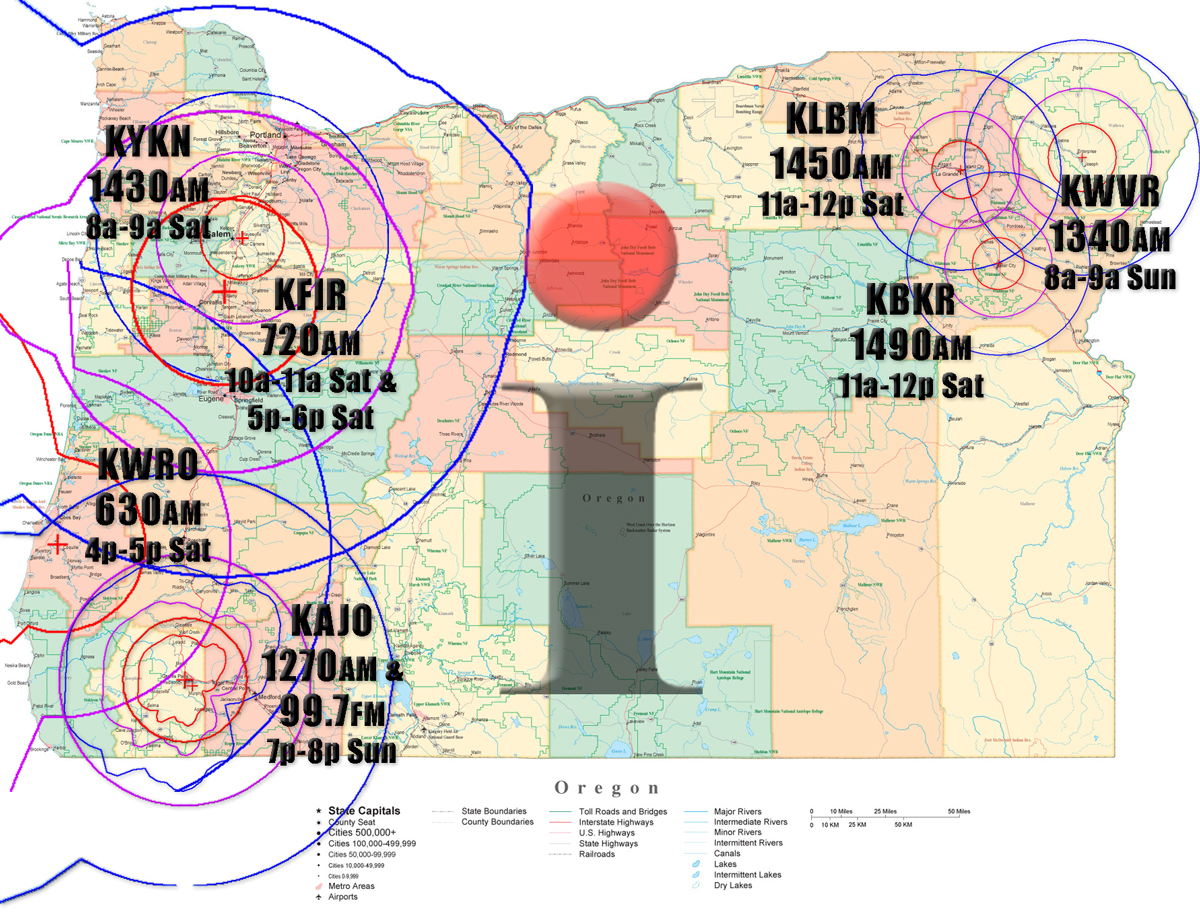
The I Spy Radio Show airs weekends — seven times across seven real radio stations, not internet-only streams. Listen anywhere through the stations’ live streams. See when, where, and how to listen for the full schedule.
Missed it? The podcast posts Mondays, after the broadcast stations air the show — here on this page or on your favorite platform.
★ Named to FeedSpot’s 30 Best Conservative Talk Shows. Thank you, listeners.