Foreign Interference & Foreign Money — So Much for Secure Elections
About this episode
Two attorneys, two doors into the same house: how foreign interests get into American elections. First, the data door — declassified intelligence on China and suppressed FBI reporting. Then the money door — foreign billionaires funding ballot measures and dark money reshaping local election offices.
Three weeks after President Trump’s primetime address declassifying years of intelligence on foreign election interference, attorney Peter Ticktin — lead counsel for Tina Peters and a lifelong friend of the President — returns to walk through what’s actually in the documents. China’s acquisition of voter files on 220 million Americans. A 2020 FBI intelligence report from the Bureau’s Albany field office, recalled and ordered destroyed within minutes because it would contradict Director Wray’s sworn testimony from the day before. And the accountability gap: a confessed Arizona hacker who walked away from prosecution, and a Justice Department that keeps losing in court — including right here in Oregon.
Then, Jason Snead, Executive Director of the Honest Elections Project and Private Sector Chair of ALEC’s Process and Procedures Task Force, joins Mark fresh off his presentation at ALEC’s Portland conference. He breaks down the foreign-money loophole that lets a Swiss billionaire pour hundreds of millions into American ballot measures completely legally, the network of dark-money groups embedding themselves in local election offices under the banner of “election excellence,” and the simple, common-sense fix — already in progress in several states — for keeping voters who’ve moved out of state off the rolls for years at a time.
In this episode
The Declassified Dump — What’s Actually in It
Mark’s opener on Cuban front groups and parasitic ideology, then Peter Ticktin on the four pillars of the White House release and China’s acquisition of 220 million American voter files.
The Albany Report — Suppressed to Protect Wray’s Testimony
The September 2020 FBI intelligence report recalled and ordered destroyed within a day of Director Wray’s Senate testimony — and what Nikki Floris’s “shadow government” email exposes her to.
The Accountability Gap — and Losing in Court
A confessed Arizona hacker who walked away from four separate prosecutors, and why the Justice Department keeps losing its voter-roll lawsuits — including in Oregon.
The Foreign Money Loophole
Jason Snead on how a Swiss billionaire legally poured $280 million into the Sixteen Thirty Fund, which spent $130 million swaying ballot measures in two dozen states — and the model law closing the gap in eleven states.
The Spending Gap, and “If You Can’t Vote For It...”
Montana and Missouri’s lopsided ballot-measure spending, the constitutional limits on residency-based donor restrictions, and the states still resisting a foreign-money ban.
Zuck Bucks 2.0 and Oregon’s Dirty Rolls
How Zuckerberg’s 2020 election grants live on through a new alliance of election offices, how to find out if your own county is involved, and the simple driver’s-license fix for voters who’ve moved out of state.
Links & resources mentioned
The Declassified Documents
- Election Integrity (The White House — primary document release, four pillars)
- Setting the Record Straight: President Trump Declassifies Intel on Foreign Election Interference and Deep State Coverup (The White House, July 17, 2026)
The Albany Report & FBI Suppression
- Grassley Releases Bombshell Records Showing FBI Headquarters Interfered With Alleged Chinese Election Interference Probe (Senate Judiciary Committee, July 1, 2025)
- Grassley Highlights Wray FBI’s Failure to Fully Investigate 2020 Election Concerns (Senate Judiciary Committee, July 2026)
Accountability & the Courts
- More Than 600,000 Voter Files Ripped Off Arizona Site in 2020 by Hacker, But DOJ Didn’t Prosecute (Just the News, Aug. 6, 2026)
- Federal Judge Dismisses Justice Department Lawsuit Seeking Oregon’s Voter Rolls (ABC News, Jan. 27, 2026)
Oregon’s Voter Rolls & the Judicial Watch Settlement
- Oregon Settles Lawsuit on Voter Roll Maintenance, Will Share Data (Judicial Watch, April 30, 2026)
- Oregon Settles Lawsuit Claiming It Failed to Properly Police Voter Rolls (OPB, May 7, 2026)
Jason Snead & the Honest Elections Project
- Honest Elections Project (honestelections.org — “Easy to vote. Hard to cheat.”)
Foreign Money in American Elections
- Over $2.65 Billion in Foreign Money Influencing U.S. Politics (Americans for Public Trust, Feb. 2026)
- Caitlin Sutherland Testifies Before Senate Committee on Banning Foreign Influence (Americans for Public Trust)
About the guests
Peter Ticktin is the founder and senior partner of The Ticktin Law Group, a team of legal strategists and trial lawyers with offices across Florida, practicing law since 1972. He has known President Trump for more than sixty years, since the two attended the New York Military Academy together as students. He currently serves as lead defense attorney for Tina Peters, the former Mesa County, Colorado clerk released this year after Colorado Gov. Jared Polis commuted her sentence. He is a recurring I Spy Radio guest.
Jason Snead is Executive Director of the Honest Elections Project, a project of The 85 Fund, and Private Sector Chair of ALEC’s Process and Procedures Task Force. He spent ten years at The Heritage Foundation, where he served as a Senior Policy Analyst and managed development of the Heritage Election Fraud Database. His writing has appeared in The Wall Street Journal, The Hill, and Fox News, and he testifies regularly before state legislatures.
Full transcript ▸
Segment 1 (00:44)
MARK: What's the difference between a “normal” parasite — whether something microscopic or something much bigger, like a leech — What's the difference between a normal parasite and a human parasite? You know, like a socialist or something much bigger, like a communist? Before I answer that … Recently the U S state department issued a report that a Cuban front group was organizing multiple organizations to oppose US policies. From inside the United States. Which gets me back to my comparison between parasites. A normal parasite knows to feed just enough from the host to not kill it. A human parasite like a socialist will kill their own host. So, given that Marxism (in any of its forms) is a parasite that only survives off the back of capitalism, you would think socialist groups like those Cubans would not try to interfere. Stay out of the way. Let America prosper. Because as long as we do, you will be able to bleed off money for your hellhole of a country. The same is true for the globalists who want to control everything. But to control everything, they need to destroy America. But therein lies the parasitic problem. Destroy America and you destroy your checkbook. Yeah, okay. You'll be ruling over the ashes—but they're still ashes. Wouldn’t you rather continue to dine at the finest restaurants and live in grand ruling class mansions? Democrat policies destroy economic activities. Look what Biden did in just four short years— we are still recovering from that. Look no further than Oregon. After forty years, Democrat policies have completely destroyed the economy here. It's an odd catch 22 isn't it? For the far left to succeed, the far left needs to not be in power. Because they are parasites that feed off people who are productive. You the taxpayer. And yet they will do anything they can to get into power and stay there. Thankfully, President Trump is doing his best to Stop them from retaking power. Three weeks ago, President Trump addressed the nation and did something no president has done before. He ordered the declassification of years of intelligence on foreign efforts to interfere in our elections, and the White House posted the actual documents online for anyone to read. The big networks largely downplayed it. Some even refused to air Trump's nationwide speech. But since that July speech, the documents have kept coming, with a new revelation just this week about how easy it was to hack into the “safest, most secure election ever” by some random guy in Arizona. And if he could do it, just imagine what China could do. To talk about all that we wanted someone who could walk us through not just what's in them, but what they mean, especially legally going forward. I'd like to welcome back Peter Ticktin, who has been a lifelong friend of President Trump since they attended the same military academy for high school. Peter is an attorney. He runs the Ticktin Law Group, and he's been in the middle of some of the biggest election integrity fights of the last four years, including as lead counsel for Tina Peters. Peter, it is great to talk to you. Welcome back to I Spy Radio.
PETER TICKTIN: Oh, I love, love being here. Thank you. Hopefully I can shed some light. I'm not sure I have all the answers.
MARK: Well, some answers is better than none as always. And especially like what the media does, they just make things up. The white House organized that release around four pillars electronic voting vulnerabilities, China's acquisition of voter data, the Michigan investigation, and noncitizens on the rolls. As an attorney who's been fighting these battles in courts. What was your reaction reading those actual documents?
PETER TICKTIN: Well, we were aware of a lot of those documents in the first place. And we know what's going on here. And it's a very difficult concept to get across to people because frankly, it's unbelievable, you know? I mean, if you made a movie, you know, in order for a movie to be accepted, you know, as a good movie, people have to be able to suspend their disbelief. And if this were made into a movie, it would be a lousy movie because people it's very hard to suspend your disbelief here that this is actually happening,
MARK: Yeah.
PETER TICKTIN: that that foreign countries are actually attempting to take over our country. And we're we're completely duped by it. I mean, we've gotten to the point now where the interference with America is, is extreme, you know, I mean—
MARK: Yeah. It's blatant. It's kind of weird, though, that the Democrats, who are all completely convinced that Russia had interfered in twenty sixteen, have suddenly decided that there is no such thing as election interference. And that, of course, is what the media really seize on is. They said, well, the white House had not claimed that votes were flipped. And so they've just basically decided to dismiss the whole thing. But what the documents establish is that our systems were and are vulnerable. And the CIA was reporting on the Maduro regime in Venezuela. They had developed methods to digitally alter vote totals in ways that could survive an audit. There was also intelligence assessments saying Russia, China, Iran and North Korea all have the capability to compromise U.S. election infrastructure. So is it more accurate to say that the president exposed election vulnerabilities rather than election fraud?
PETER TICKTIN: Well, I think that to a great extent, it's both. First of all, he he gave positive evidence that China is very much involved in our election system. You know, he basically explained that they have penetrated our systems to be able to get the voter identification, not just the number, but the voter information of at least two hundred and twenty million Americans. Okay. So, I mean, that's just about everybody —
MARK: Yeah. just astounding.
PETER TICKTIN: — that votes. And when you think about that, then you, you know, like, why do they need this? You know, if all they're doing is selling us toys and, and, uh, you know, manufactured goods and so on, why do they need the voter identification information from all of our voters? It's because they're doing far more than that. They want to defeat the United States. We are in a form of a war. And—
MARK: Yeah. You know, that's a really interesting point that you bring up is, why do it if you're not planning on doing something with it?
PETER TICKTIN: Yeah. And besides that, we don't. We know far more now. Now, there's a fellow named Eric Coomer, who Dominion gave a title of head of security and product strategy for the twenty twenty election. And we now have his testimony that he was involved with the machines. He was in Chicago at the time of the twenty twenty election, and there's a system called Win Editors. Have you heard of that by any chance? Or do you know what I'm talking about?
MARK: No, I can't say that I have.
PETER TICKTIN: Okay, so it's kind of like win for windows, capital W, capital I, capital N, and then election. Uh, um, I'm not sure what the D stands for.
MARK: Is it Elect Democrats System?
PETER TICKTIN: (laughs) Yeah. I, you know, I like the joke, but the reason I'm not happy with that joke is because it makes it sound like we're still dealing with Democrats and we're not. We're dealing with China and we're dealing with the World Economic Forum. We're dealing with forces that be that have an agenda that's horrible for what they want to have happen to us. So, I mean, we're only four percent of the world population. We have twenty seven percent of the GNP. And, you know, I mean, if you look at most things, like even the amount of oil we burn, we burn twenty million barrels of oil a day. The world burns four times that amount. So, you know, we're one quarter of the world's oil, coal consumption —
MARK: Yeah, well, they need the election fraud in order to keep the fraud going of things like USAID and all of this foreign money that just flows out the door. And and President Trump is putting a stop to that. And I, I think it's no coincidence whatsoever that he has cut off all of this fraud. And suddenly the national Democrats suddenly don't have money. And they've had to mortgage essentially their headquarters in order to get some loans. Um, getting, getting back to this interference here, because as I said, those documents prove that these foreign entities have the ability to compromise U.S. election infrastructure. So here's the thing. If we know that they have the capability to alter votes that could survive an audit, which is what they pointed out in those documents, and that's just what we know about their capabilities. How do we know then that they didn't alter those in ways that we can't detect?
PETER TICKTIN: That's what I was trying to explain. We know that they did because we have the testimony of Eric Coomer in the case of Coomer versus Byrne, where he's suing Patrick Byrne for saying that he had nothing to do with the the election of twenty twenty. That's what they do. You know, they get you charged with criminal offenses if they can. If not, they sue everybody so that everybody else will be afraid to even say their name. And it's working.
PETER TICKTIN: Fox news is not going to talk about Dominion or Liberty. Uh, even Max, uh, Newsmax isn't talking about any of that. They don't want to get sued. So the, the, the, the what they're doing is working.
PETER TICKTIN: But what happened in that deposition was Coomer admitted that he was basically the one that the Wynn editors system was sending all the information to.
MARK: Wow.
PETER TICKTIN: So in other words, here, here all the information comes from all the different voting centers that are counting the votes, and they're supposed to go directly to the different responsible agencies that basically then pass it on to the news and etc.
MARK: Wow.
PETER TICKTIN: and then it makes a stop along the way. It goes to Eric Coomer or people exactly like Eric Coomer is counterparts because he is not alone. And we have a list of his counterparts.
MARK: Yeah. And that's weird because a lot of the media coverage was saying, oh, this sort of thing never happens. And yet, there it is. Okay, it is time for a break. We'll be talking some more to Peter Ticktin. Coming up, we're going to be talking about suppression of some evidence by the FBI. Stay with us.
Segment 2 (10:59)
MARK: And welcome back. This is the I Spy Radio Show. We're talking today with Peter Ticktin. He's a Florida attorney and a lifelong friend of President Trump. They went to the same military academy together back in high school. He has been deeply involved in the election integrity movement, and we've been talking about the declassification of years of intelligence on foreign efforts to interfere in our elections. And the centerpiece of that really was China. They had access to two hundred and twenty million American voter files from at least eighteen states with a dedicated Chinese data exploitation unit assigned to the project. But the part that has stayed with me isn't what China did. It's what our own FBI did on September 24th, 2020, Christopher Wray, then director of the FBI, testified to Congress that the FBI had not seen any kind of coordinated national voter fraud effort in a major election. On September 25th, the very next day, the FBI's Albany, New York, Field Office issued an intelligence report that alleged (and this was raw intelligence) alleged that China was producing fraudulent U.S. driver's licenses to generate mail in ballots. The Albany Field Office disseminated that assessment—but then FBI headquarters almost immediately told them to withdraw that. An Albany official said there was no reason to recall that raw data. But minutes later, headquarters ordered it recalled, with instructions to destroy all copies and remove it entirely from the computer systems. An Albany analysts wrote that the most concerning part about all of that was that the reporting would contradict Director Wray's FBI testimony. So I'd like to get your take on this as an attorney. The FBI destroyed raw intelligence to protect his sworn testimony. I'm not an attorney, but that doesn't seem very lawful.
PETER TICKTIN: You don't need to be an attorney to know the difference between right and wrong and to to, to see that they're doing crazy wrong things. So, you know, you know. So why does it really tell us? You know, it tells us that there's really much, much more amiss here than we when we think
MARK: Yes.
PETER TICKTIN: like, you know, and if you want to think in terms of the f b I and, and what happened in the 2020 election, you know, recently, last September, which is recently, uh, over the course of things, they finally admitted that they had two hundred and seventy four agents at the Capitol on January six. Well, you know, I have actually recordings, uh, videos of the meetings that occurred by members of the Deep State and some NGOs where there were actually hundreds of people on these Zoom calls. And I have videos of the screens of these discussions where they were then calling for the breaking of the windows for people to go in January. Six, in other words, was planned in advance by the left. It was a psyop. It was part of the way of shutting everybody down, shutting everybody up. And it. And, you know, if you were to think of the people that responded to the call of the president to come to the Capitol, they were the people that knew that they weren't going to be fooled. The people that saw the election was rigged. You know, when they saw that the polls were all closed early, you know, the counting rather stopped, uh, before it was done. Now, in the history of the United States, no state has ever stopped the count of the ballots once they started.
MARK: Mhm.
PETER TICKTIN: And then all of a sudden on Election Day in twenty twenty, that night, four states where Trump was ahead, each one of them ended up, uh, stopping the count about the same time without them communicating about it. What a coincidence. And they think we're so stupid
MARK: Yeah. And suddenly. all of them ended up going for Biden instead of Trump. So, um.
PETER TICKTIN: Oh, yeah. Well, well, then you look at the graph of the votes that came in and not in a minute. Not in an hour, not not not in a period of time that would make any sense at all. But instantly, in one fraction of a second, there's a line that goes directly up
MARK: Yeah.
PETER TICKTIN: where all these votes got counted. For Biden, that changed the result of the election from Donald Trump to Biden.
MARK: Yeah.
PETER TICKTIN: In other words, it's not that it could be, but it would be very unlikely. It's absolutely impossible.
MARK: Yeah. Well, it's sort of like four states all suddenly winning the lottery. Uh, just I mean, that's about the statistical odds of that, that many votes would come in all for one candidate, uh, all at that same time. Um.
PETER TICKTIN: Yeah. In the same instant. How do you count more than one thing at the same instant?
MARK: Yeah. It's.
PETER TICKTIN: You know, unless they're already counted, it's just dumped into the computer.
MARK: Yeah, yeah. Well, that's a good point too. It would have taken time to count all those. And instead they just magically appeared. Uh, getting back to that Albany, New York, field office report. Nikki Flores, who we are learning more and more about her. She was the FBI's election security lead. She was among the headquarters officials that had requested that recall of that raw intelligence about the Chinese manufacturing these driver's license. She's the same official who wrote that she was basically running a shadow government across the FBI. So what does that language exposure to legally and her involvement in this? Because and the reason
PETER TICKTIN: Oh.
MARK: I'm asking this is because I think I speak for thousands of people in our listening audience who said, okay, it's great that we're exposing this, but when is someone going to be held accountable?
PETER TICKTIN: Right. That's all I hear from. From members of the base. I shouldn't say all I hear, but, I mean, that's the number one thing that I hear is people want people to be accountable. And it makes sense because how do you fix something if you're not going to acknowledge that it's broken?
MARK: Right.
PETER TICKTIN: And how do you fix this, this whole system? Because, you know, it's not just a question of Democrats winning instead of Republicans winning. It's a question of foreign nations taking over the United States. I mean, that's what happened for four years. You know, the twenty twenty election was rigged and the election and the country was stolen. You know, I mean, it doesn't matter what you think of Biden. The fact of the matter is he was an empty shell put
MARK: Yeah,
PETER TICKTIN: in position.
MARK: Well, the 2020 election was stolen. And then as a result of that, the next four years, trillions of dollars flowed out the door. I've said it many times on this show, is that in one bill alone, the Inflation Reduction Act, which had nothing to do with inflation, there was six hundred and thirty billion dollars dedicated to far left causes under the guise of climate change. That's why these elections matter, because there are literally trillions of dollars at stake. And if people are willing to commit fraud to steal millions of dollars from Medicaid and whatnot, as we have seen up there in Minnesota, just imagine what they would do if they could steal trillions of dollars. And that's why these elections matter. All right, everyone, stay with us. We're going to wrap things up with Peter Ticktin after this.
Segment 3 (18:17)
MARK: And welcome back. We're talking with Peter Ticktin. He's a Florida attorney. He is the co-founder and lead attorney at the Ticktin Law Group. He's also a longtime friend of President Trump. They both went to the same military academy in high school. And so I had asked you about holding people accountable because that, I think is the main thing. Because as long as nobody has ever held accountable, this is just going to continue. It's like never arresting bank robbers and then acting surprised that people just keep walking into the door and then walking out with money. So the White House, after this release, has directed the DNI, the DOJ, the FBI and the CIA to all investigate how this intelligence that they declassified was suppressed at the time and says that these investigations could lead to criminal charges. So what would an actual prosecution actually require here? And is it realistic that we might actually finally see some people charged and end up in jail as a result of this?
PETER TICKTIN: Well, I'm hoping and I've been pushing the Department of Justice to, to take this kind of action to actually pursue people and actually charge them for the for what they've done. You know, you know, but they're not facing, you know, because even they have a hard time believing what is actually occurring is that this is, you know, sedition, insurrection,
MARK: Yes.
PETER TICKTIN: or even, frankly, treason.
MARK: Right.
PETER TICKTIN: These people, you know, are committing major crimes against the United States. But so many have infiltrated us in so many ways. Our educational system, from grades from kindergarten all the way up is overtaken. Our media is overtaken. Most of our social media is overtaken. We have many states like Colorado, Michigan, uh, Oregon, where you are overtaken. And this isn't just by Democrats, this is by those that have interests in foreign nations and for the goals of the World Economic Forum.
MARK: Right.
PETER TICKTIN: And if you want to look that up and look about population reduction, etc., that gets very scary because
MARK: Yeah.
PETER TICKTIN: it's real
MARK: Yeah.
PETER TICKTIN: and
MARK: Well, the World
PETER TICKTIN: people
MARK: Economic
PETER TICKTIN: have a hard
MARK: Forum
PETER TICKTIN: time.
MARK: is definitely very scary. They are they are a horrible group. Um, getting back to the notion of accountability because I think this is what really crystallizes it for me. And this broke Thursday morning on just the news. And the article says that in twenty twenty, a man in Fountain Hills, Arizona, noticed his own voter ID was in the URL. That's the address bar in your browser. And he noticed that his voter ID just happened to be within that. And so he just randomly typed seven, uh, other numbers and kept typing until he got a hit. And it turns out he was able to land on somebody else's voting information. And so he wrote a script and pulled over six, six hundred and thirty three thousand voter registration files, including more than nine hundred that had protected information on things like domestic violence victims, judges, law enforcement officers, and more. So the FBI discovered he was doing this. He confessed to the crime. But then again, no accountability because the U.S. attorney in Phoenix, the Arizona attorney general, the Maricopa County attorney, they all declined to prosecute. They closed the case in twenty twenty three. So why is there this reluctance to prosecute actual examples and evidence that, yes, these election systems can be and were accessed.
PETER TICKTIN: You know, it all goes to the same thing. You have to understand that everything is connected, and this is a weakness in the basic system. And somebody sees the weakness, but he doesn't do it for profit. He's just amazed that he's able to get this kind of information. And he does it for the sake of getting the information in its own right. It's not as though it's a criminal mentality so much. You know, that what I can understand in terms of the the records that are not going to be able to, you know, where the states are not giving their voter records over to the federal government. Just think about it for a second. It's okay with the states that China has all of this information
MARK: Yes.
PETER TICKTIN: and they say, oh, it's information they would have anyway, which is a lie. They literally lie about it, because we all know that people's Social Security numbers are part of that. There's no way in the world that that's public information, and yet it's okay for China. It's okay for this fella you're talking about, but it's not okay for the federal government to look at these things just
MARK: Yeah.
PETER TICKTIN: to make sure things are on, on the up and up.
MARK: Oh, yeah. It's absolutely absurd that this is happening. So speaking of Oregon, it is one of more than twenty states that has been sued by the Justice Department there trying to get access to the voter registration list to look for people that shouldn't be on there, people that are dead, and so on and so forth. But the Justice Department keeps losing these cases right here. Recently, a federal judge in Oregon had dismissed the DOJ's suit back in January. They found that the government hadn't met the legal standards to proceed. In June, the Sixth Circuit. Sixth circuit became the first appeals court to rule and affirm the dismissal of a similar case in Michigan. So what is your take here? Is it the administration's legal theory is wrong, or are the judges wrong?
PETER TICKTIN: The judges. We have a terrible crisis going on in the United States right now in terms of the politicalization of the courts. We have so many judges, especially in a state like Oregon, once. And this is federal court. So this is probably a Biden, Obama, um, even George Bush and some of the early appointments by Donald Trump. Where where he was fooled into different people with
MARK: Yes.
PETER TICKTIN: the Federalist Society that he that he was trusting and wrongfully trusting. So, you know, we these people that just because they were in black robes doesn't mean that they're not traitors to our country. And, and this is what they're doing. They're in place to make sure that the, the left can succeed. And I'm not sure if I mentioned this to you before, I know not today, I didn't. But, you know, the scary scenario of what happens if those machines turn the Senate votes. There's twenty two senators up for re-election, Republican
MARK: Right.
PETER TICKTIN: senators. And if they change that, just think of the scenario.
MARK: Oh.
PETER TICKTIN: The House they meet on January fifth, sixty two days after the election is over.
MARK: Yeah. Absolutely
PETER TICKTIN: And,
MARK: horrid to think
PETER TICKTIN: uh,
MARK: that so.
PETER TICKTIN: yeah, yeah, I mean, Hakeem Jeffries will be the speaker of the House. They removed both not just Donald Trump, but also JD Vance. And then who's the president of the United States, Hakeem Jeffries. And it's all over for us. We will never, ever see freedom again in
MARK: Yeah,
PETER TICKTIN: the United States.
MARK: absolutely. Scary thought to end on. But unfortunately, we're up against the clock. Peter, thank you so much for your time.
PETER TICKTIN: My pleasure. Anytime.
Segment 4 (24:57)
MARK: And welcome back. In the first half of the show, we talked about foreign interference in our elections through stolen data, China acquiring files on 220 million American voters. But there's a second channel, and it doesn't require a single hacker — money. Jason Snead is the Executive Director of the Honest Elections Project and chairs ALEC’s — that’s the American Legislative Exchange Council's — Process and Procedures Task Force. I heard him lay out what you're going to hear today at a presentation by ALEC last week in Portland. And I want all of our listeners to hear this too. Jason, welcome. And it's great to talk to you today.
JASON SNEAD: It was great to be on the program. Thank you.
MARK: Yeah, absolutely. So I really enjoyed your presentation. Hence the reason why you're here. But so I have to ask you this before we get going here. The bio I have for you says that you spent ten years at the Heritage Foundation, where you served as a senior policy analyst and oversaw the development of the Heritage Election Fraud database and aggregation of proven instances of voter fraud nationwide. Which is weird because I thought that never happened. So how long did it take you to put in those one or two entries?
JASON SNEAD: Well, it took a fair bit of time because it actually turns out that there's more than one or two instances of fraud in American elections. It's actually a fairly common problem.
MARK: MM.
JASON SNEAD: There isn't a single election cycle that goes by in the United States where there isn't fraud on some level. And what we were trying to do with that database was disprove that narrative once and for all that that voter fraud is a non-issue. So we were pulling a sampling of of proven cases. These are cases that have actually gone to trial. People have been convicted or pleaded guilty, or there had been some sort of official finding that, in fact, fraud occurred. And we wanted to use that tool to, to show not only that it happens, but some of the various ways that it can happen. And that's been actually a very instructive tool for lawmakers because they can see examples in their own states. And it also helps to reveal where there are problems that that need to be addressed.
MARK: MM. Yeah. Well, I'm sure that's a shock to a lot of people in the media, but, um, maybe they ought to read that. So I'd like to start with a loophole that you mentioned at that presentation, because I think it's something that most people would just assume is already illegal. And it's this notion that foreign nationals can't give to candidates or superPACs. That's federal law. However, ballot measure campaigns are wide open. And you showed this slide with one Swiss billionaire whose name I'm not even going to try to pronounce. It looks like his last name is Weiss, sending roughly two hundred and eighty million dollars to the sixteen thirty fund, which then spent about one hundred and thirty million dollars on ballot measures in some two dozen states. And just to give people an idea of the scale, two hundred and eighty million dollars, that's the equivalent of two point eight million American citizens donating one hundred dollars each. So this one billionaire is outweighing two point eight million Americans. So how is this legal that a foreigner can be doing this? And why hasn't Congress closed this loophole?
JASON SNEAD: Well, it actually comes down to the way that the word election is defined in federal law. And what it means in the context of federal law is a candidate running for office. So ballot measures, these are initiatives or they are constitutional amendments that are referred from legislatures or issue campaigns, and they're not covered by federal law that we've had in the books for, for decades that bars foreign nationals from making contributions to influence the outcome of those candidate elections. And so one of the first things that I always get when I'm going and doing meetings with lawmakers or the public is, isn't this already illegal? You know what you're talking about this idea
MARK: Right?
JASON SNEAD: that a foreign national
MARK: Right.
JASON SNEAD: can put money into a group that then is spending exorbitantly on these ballot measures. And the answer is, is no. And so that's one of the big priorities that my organization has had for the last several years. Once we began to see the receipts, right, the actual money flow from this single Swiss billionaire, Hansjörg Wyss, into a left wing dark money group called the sixteen thirty fund, which then simultaneously was turning, turning around and spending more than almost any other group in the country on these highly influential ballot measures in twenty six states. So we actually developed some legislation to close that foreign influence loophole and to make sure that the same protections that we've had for decades on the candidate side apply to these highly, highly important constitutional amendments as well.
MARK: Sure. Absolutely. That's how you change state laws is through these types of ballot initiatives. In fact, we do that quite frequently here in Oregon. Our Constitution, I just found out this morning, has been amended two hundred and sixty times, which just seems astronomical. But as far as this foreign influence money coming in, how do you know that it's strictly limited to ballot measures? Because when you hand an organization one hundred million dollars and they spend fifty million of that on a ballot measure, they're suddenly flush with fifty million dollars that they could divert elsewhere, couldn't they?
JASON SNEAD: Well that's right. Yeah. Money is fungible. And this is actually one of the problems that we were contending with early on. And it was why we, we, we spent quite a bit of time developing the model legislation that has now been actually enacted in eleven states across the country, because we realized that if all you say is that a foreign national cannot make a contribution to a ballot measure campaign? Well, then it would be very easy for the sixteen thirty fund to continue accepting money from these foreign billionaires. Because to your point, if somebody like Hansjörg Wyss, if all they have to do is say, I like this organization, I like what you do, I'm going to give you one hundred million dollars, but I'm not going to tell you how to spend it. Well, then immediately you can start continuing to, to launder foreign money into these ballot measure campaigns
MARK: Right.
JASON SNEAD: and argue that it's not a contribution. So what we did is we said in the in the legislation that we've been advocating for all over the country, we say that an organization has to make a decision, and it's a decision that we're not going to force it to make, but it has to decide on its own. Are you going to play in ballot measure politics, or are you going to take money from foreign nationals? But you cannot do both.
MARK: MM.
JASON SNEAD: We're not going to tell you which way to go, but we want to make sure that we have protections in place so that the groups that are spending to influence these issue campaigns are not simultaneously taking huge amounts of money from foreign nationals, and that's been an effective strategy when we got this done in Ohio in twenty twenty four. That was the first state where we were able to get this done. The sixteen thirty fund was forced to stop spending. And as we have continued to expand the protection of that law across the country, we have seen the sixteen thirty fund walk away from other states as well. And so far this year at least, they haven't spent in ballot measures in any of the states that have been able to pass these bans. So we think this is an effective strategy. But it's also worth noting that there are other foreign sources of money and other organizations. The ACLU is another one, and we've actually seen in Missouri a couple of complaints filed against them for continuing to take money from foreign sources and then spending in these ballot measures. So Wyss and the Sixteen Thirty Fund is unfortunately just the tip of a very large iceberg.
MARK: Yeah, that's very unfortunate for sure. It is time for a break. It's all about election integrity on today's show. We're going to continue this with Jason Snead. He's the executive director for the Honest Elections Project.
Segment 5 (32:08)
MARK: Easy to vote, hard to cheat. That is the tagline of the Honest Elections Project, and we're talking with its executive director, Jason Snead. And, Jason, in that last segment there, we were talking about foreign interference and the foreign money coming into our elections. And you had mentioned some model legislation that's going to be preventing some of that influence going into the ballot measures. Is the next step there within that model legislation to move it so there is no foreign money coming in at all to any of our elections at any level?
JASON SNEAD: Well, that's certainly an idea that we're exploring and others are looking at too. And there's actually been legislation introduced in Congress at the federal level, not only to close the foreign funding loophole for ballot measures, but also to extend some of the same types of protections to groups that do things like, you know, generally electioneering, voter registration and get out the vote or GOtv and so forth. I do think that there's a lot of merit to that approach, and I think there's some room for states to act as well, because at the end of the day, you do not want foreign interests and foreign billionaires to be able to buy this kind of influence, either directly or indirectly, over the American political process. We call ourselves a self-governing people, and I think that that should extend throughout the entirety of an election.
MARK: Right?
JASON SNEAD: You know, from the point of voter registration and all of that, all the way to the end when people are actually casting ballots.
MARK: Yeah, absolutely. So. Really interesting slide deck that you had up there. And we're going to make sure that our listeners can see that as well. Just head to today's show page, Eyespy radio dot com forward slash sixteen thirty two, and you'll be able to find that. And as far as the influence is concerned, you showed some of the spending gaps on some of these these ballot initiatives. Montana had a twenty twenty four abortion amendment, eighteen point two million on the left against two hundred and twenty two thousand on the right. Missouri's minimum wage measure that was outspent sixteen point five million by the left to zero on the right. So is the answer more conservative money, or is the answer changing? Who is allowed to give it all?
JASON SNEAD: Well, I tend to think that when it comes to preventing, uh, you know, money from getting into these ballot measures, the finest and clearest line to draw is a distinction between what American citizens can do and what foreign nationals can do. Um, I certainly don't want to abridge the right of, of any American citizen to spend to support either candidates or causes that they back. And I don't want to, uh, to in any way abridge those free speech rights. So I know that there's a lot of concern about money and politics, but I think that the, the best and strongest way to approach issues like, you know, spending in these initiatives is to make sure at a minimum that we are not permitting foreign nationals to, to influence the outcome of those races. Those should be left to American citizens and American donors.
MARK: Well, extending that notion of interference, I have often thought that maybe there's a simple rule that if you can't vote for it, you can't fund it, you can't donate to it. Because right now, our elections, we can have people, not just foreigners, but people that are foreign to the states. You can have people from New York City donating to our races here in Oregon. They can't vote on them. So, I mean, we don't allow them to vote on it. So why should they be allowed to help steer that election and fund the fund, the people that are running for office or these ballot initiatives?
JASON SNEAD: Well, when you, when you take, uh, restrictions on the ability of folks to contribute to campaigns beyond something like what a foreign national can do versus a citizen, and you try to extend it to people that live outside of a particular jurisdiction or outside of a state, you pretty quickly run into constitutional, uh, restrictions. And the courts have not looked particularly favorably upon those sorts of rules and regulations. So you're on very dicey legal ground when you go that direction. I tend to think that we should focus on on preventing foreign influence, and we should focus our efforts there, where the courts have in fact, embraced those sorts of regulations. And it's a very common sense thing to say that, you know, there is a bright line between what a person who is not a citizen of the United States can do, versus what a citizen of the United States can do.
MARK: MM. Well, um, as far as enacting the bans on foreign funding, you said some states, I think you said seven have already enacted bans on on that foreign funding. So what's the argument that you hear back from states that won't enact such bans.
JASON SNEAD: Well, it's pretty interesting, actually. We've had a lot of success. We've actually had eleven states that have have enacted these bans. And in general, the arguments that we hear within those legislatures against this and in some of the legislatures where we haven't seen any action at all, uh, involves things along the lines of, you know, you really can't prove that this is foreign money. You don't have the receipts tying dollar for dollar, you know, this spend to that foreign national. It's stuff like that where they really sort of miss the forest for the trees. And frankly, there's often a very partisan political interest in some of the opposition, given that the spending is on ballot measures, that groups on the left obviously care a great deal about. They are very interested in some of the issues that the sixteen thirty fund has spent on over the years, rewriting election rules, being one of the big ones, and taking control of redistricting being another. In fact, there was so much money going into the Ohio redistricting measure back in twenty twenty four. That was was it was designed. If you actually read the rules of the measure, it was designed to basically force the state to immediately redistrict in a way that would have flipped anywhere from three to six congressional seats, from Republican to Democrat. That was basically written into the constitutional language. And there was so much money flowing into that that not a single Democrat in the Ohio State legislature voted in favor of this ban. So there's
MARK: MM.
JASON SNEAD: very clear partisan political interests that animate a lot of this. But then there's also a reality in a lot of these places that you can't be opposed to a foreign funding ban. So eventually we do get there. But in a lot of the legislatures that are controlled by the left, we haven't seen a lot of traction on this or we have seen them come back and say, well, we want full donor disclosure and we want to go after Citizens United. And, you know, all of these sorts of things. So rather than deal with the real issue of the way that the left has actually become addicted to foreign money, which is not happening on the right, it's worth noting this is happening on the left rather than deal with that issue. They sort of want to turn this into a way where they can weaponize campaign finance and donor disclosure rules to essentially stifle free speech and particularly stifle conservative free speech.
MARK: Yeah.
JASON SNEAD: So those are some of the concerns that we see surrounding this. But again, I think when you just get down to the very basics, should a foreign national be able to influence the laws of our state or our state constitutions? You know, that's the political DNA of each of our states. The answer is no. And there's really not much of an excuse for
MARK: Mhm.
JASON SNEAD: not passing this very common sense law.
MARK: Yeah. You would think so. All right, it is time for a break. Stay with us, though, because coming up next we're going to talk about dark money in our elections. That's next with Jason Snead from the Honest Elections Project.
Segment 6 (39:29)
MARK: And welcome back. In our final segment now with Jason Snead. He is the executive director for the Honest Elections Project. Easy to vote, hard to cheat. That's their tagline. And so, Jason, in this segment, I really want to get into the dark money aspect of this because at that ALEC presentation, you talked about how elections officials are working with dark money groups. And so, if I'm a county commissioner in Oregon or just a citizen who wants to know whether or not my elections office is in one of those dark money networks, how do you find that out?
JASON SNEAD: Well. So what's to explain to your your listeners here first what we're talking about.
MARK: Sure.
JASON SNEAD: You know, many, many folks will recall back in, in twenty twenty, uh, you know, Facebook CEO Mark Zuckerberg gave hundreds of millions of dollars to, uh, ostensibly support election administration. And he gave it to two left wing nonprofits, one of which was called the center for Tech and Civic Life. And they then turned around and they doled out hundreds of millions of dollars in private grants, completely unprecedented thing to election jurisdictions across the country. And what we really saw after
MARK: And
JASON SNEAD: we
MARK: and
JASON SNEAD: unpacked.
MARK: they all went to conservative organizations, right? Conservative districts.
JASON SNEAD: It. Believe it or not, even though this was was set up to help election offices respond to Covid, uh, the majority of the money went to presidential battleground states and went to, uh, to jurisdictions that ultimately voted disproportionately for Joe Biden. So
MARK: Shocker.
JASON SNEAD: I guess that, uh, I guess that if you're a presidential battleground, you're more likely to have Covid spread. I don't know if that's been proven. I don't know if that's in maybe Anthony Fauci's diary someplace, but, uh, at any rate, we saw all this money going out and what we really learned in the, you know, post twenty twenty, uh, environment is as we were unpacking what this program was all about, we saw a real attempt to use this financial hook to nudge election policies towards the left's preferred agenda. So, you know, juicing mail voting, unregulated ballot drop boxes and on and on. But it was also used by this group, the center for Tech and Civic Life, to begin to establish relationships with individual election offices and essentially set themselves up as a quasi election organization or quasi secretary of state. Now, about thirty states in the years after the scandal of twenty twenty, about thirty states passed laws banning private funding. Because, you know, you've got you've got money coming in from organizations. These are groups that often don't have to report their donors. You don't know where the money is coming from, going directly into the offices that run the machinery of our democratic process. There are all sorts of perverse incentives and conflicts of interest that are are readily apparent. And so you had a bunch of states passed these laws, many on a bipartisan basis, to say no more private financing of elections. That's something that should be done exclusively through the public domain, so that they are accountable only to the taxpayers, not to private interest groups. So what we immediately saw and my organization was, was all over this back in, in twenty twenty one was as those bands were being implemented, Ctcl was actively looking for ways to continue pedaling their influence and get around those, those laws. And so they joined with a number of other nonprofit organizations that set themselves up in the election space and claim to be nonpartisan. And they created a new program called the US Alliance for Election Excellence. And so in states without these private funding bands, they'll dole out grants sometimes in in the tune of several million dollars at a time. But in states where they cannot do that, instead, what they do is they position themselves as an unparalleled alliance of, of expert, nonpartisan organizations that just want to help your elections run better. And for a few thousand bucks, you can buy your way into our program. We'll convert that money into credits that you can then use to purchase services exclusively from our alliance. And then you can get embedded into this. We get embedded into your office. We get your data and we can help you, quote unquote, improve the way that you operate. So really, this is about setting up a massive influence campaign within election offices. And it's all under the guise of being non-partisan. And we've seen this pop up in in jurisdiction after jurisdiction across the country, many of them in states that have passed those bans. So we know what this is about.
MARK: Yeah.
JASON SNEAD: If you are concerned about this, then I would encourage folks to start asking your election officials or even file FOIA requests seeking any contact with that organization, the US Alliance for Election Excellence or the center for Tech and Civic Life or any of its partners. And actually on the Honest Elections website, Honest Elections dot org, we have an entire report, including a lot of material that we found several years ago when we first started FOIA, these programs. Um, and that can be a good starting point for the sorts of groups and organizations that might be in contact with your election offices. This program is still active, and I consider it to be a grave threat to the integrity of the election system and to its neutrality.
MARK: Well, we would love to have you back on sometime in the future to talk more about that. Before we let you go, we've only got about a couple of minutes here. One of the other things that you talked about was cleaning up the dirty voter rolls. And this is a huge issue here in Oregon. Recently, a Judicial watch had sued the state of Oregon, and they conceded that, yes, there's eight hundred thousand people on there that don't belong on there. You had a really interesting solution. I thought when somebody moves to a new state and gets a new driver's license, the DMV takes their old driver's license. So why not just have this simple database where the voter registration is tied into that? So that way when that old driver's license is canceled. So is that voter registration?
JASON SNEAD: Well, that's exactly right. We want states acting on information that they receive from other states, indicating that somebody has changed residence and then immediately moving to cancel the voter that has now left the state. Usually you wind up having to wait a couple of election cycles
MARK: Yes.
JASON SNEAD: if all
MARK: For
JASON SNEAD: you're
MARK: years.
JASON SNEAD: doing is sending a right. Exactly. You know, usually what states will do is they'll wait for you not to vote. Then they'll send you a postcard, and then they'll wait two two election cycles before they cancel you. And many states drag their feet even on that process, right? As if, you know, waiting four or five years isn't long enough. But what we've actually been working on is getting states to pass information back and forth between one another so that when somebody moves from, say, Oregon to Washington and you register to vote in Washington, Washington will tell Oregon, hey, this person just moved here, just registered to vote here, and then Oregon can cancel them immediately. It's a way to help keep up with the the incredible bloat on our voter rolls
MARK: Yes.
JASON SNEAD: and make sure that only people who are on those rolls are people who are actually eligible to vote in the state, are still residents
MARK: Yeah.
JASON SNEAD: of the state.
MARK: Yeah.
JASON SNEAD: But there's a lot of data that states are not using to clean up their roles, including things like the save database to go after non-citizens or people who have died out of state jury records. You know, so forth. There's just a lot of data out there, and states should be doing better
MARK: Yeah,
JASON SNEAD: to to clean up their roles.
MARK: absolutely. I would have loved to have talked to you about that. Save tools that are out there. Unfortunately, we're gonna have to save that for next time. Jason said he is with the Honest Elections Project. Find out more about them at Honest Elections dot org. Jason, thank you so much for your time.
JASON SNEAD: Thank you. It's great to be with you.
MARK: As long as there are massive amounts of money to be had — where you can literally vote your side of the aisle trillions of dollars, the gateway to those dollars, elections, will continue to be a major battlefield. If you heard last week, you heard what's truly at stake here in Oregon as Democrats fight for socialized medicine. The government in charge of your health. Environmental laws are how they control industry. Health care is how they control people. You need to take this fight seriously. You need to be in this fight—because as we say every week, the best information that you no good if you don't use it. Reagan, what do you think?
Catch the show live
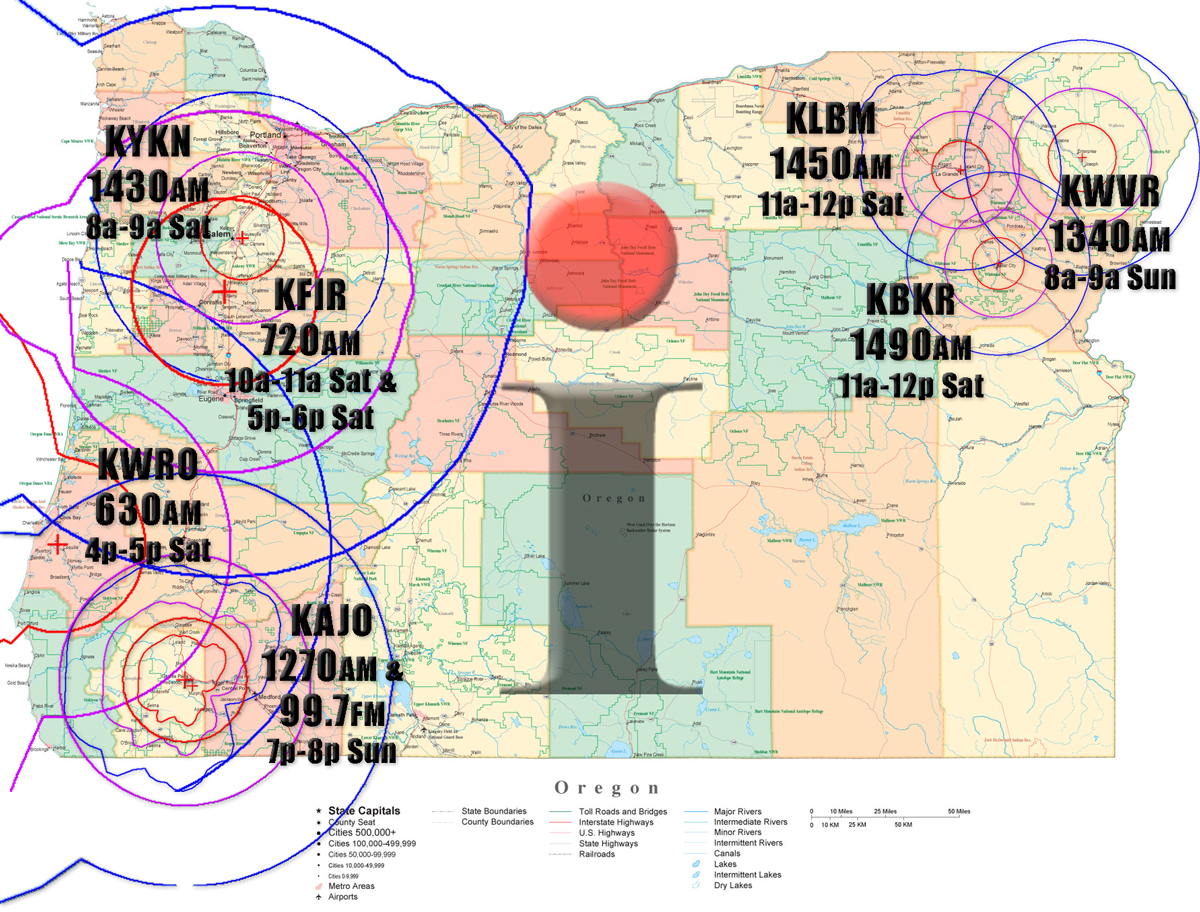
The I Spy Radio Show airs weekends — seven times across seven real radio stations, not internet-only streams. Listen anywhere through the stations’ live streams. See when, where, and how to listen for the full schedule.
Missed it? The podcast posts Mondays, after the broadcast stations air the show — here on this page or on your favorite platform.