Sixteen Years in the Making — Oregon’s March to Socialized Medicine
About this episode
For sixteen years this show has been telling you what was coming. We are now standing on the threshold of it. In seven weeks, a board appointed entirely by Governor Kotek delivers Oregon a blueprint for state-run health care — and the numbers are on the state’s own website.
Independent health insurance broker Lisa Lettenmaier of Health Source NW returns for the full hour — and this one may be the most important conversation we have had with her. Mark opens by tracing the ten-step path Oregon has walked since 2011: the bills that created the Coordinated Care Organizations and then exempted them from state and federal antitrust law, the “global budgets” that pour money from every source into a single pot where no one can follow it, and the nonprofit structures that shield those books from public view.
Then the payoff. Because voters passed Measure 111 in 2022, health care is now a right written into the Oregon Constitution — and proponents argue the Legislature is therefore obligated to deliver it. The next year, Senate Bill 1089 created a nine-member Universal Health Plan Governance Board, appointed by the Governor and confirmed by the Senate, and gave it a statutory deadline: September 15, 2026. By law, every member of that board must agree with the objective before they can be appointed to it. There is no seat for a skeptic.
Lisa walks through what the plan would actually cost a household. A 10.1% health care personal income tax stacked on top of Oregon’s existing 4.75%–9.9% rates, kicking in above 200% of the federal poverty line — a threshold a full-time minimum wage earner in Portland has already crossed. A 9.6% employer payroll tax on any business with more than $500,000 in firm-wide payroll, which is a landscaping company with a couple of crews, a small restaurant, a dental office. Plus three points on the corporate income tax and a bump to the corporate activity tax, which is levied on gross receipts, not profit. Total new Oregon revenue: $16.9 billion a year. The other $68 billion has to come from Washington.
And that is before the history. Vermont passed the nation’s first single-payer law and then killed it when the real tax numbers came back at 11.5% on employers and up to 9.5% on individuals — a Democratic governor walked away from his own signature achievement. Oregon is proposing a comparable payroll tax and a higher income tax. And Oregonians have already voted on this once: in 2002, Measure 23 proposed single-payer funded by income and payroll taxes and lost 78.5% to 21.5%.
The hour closes where it has to. In Canada, assisted dying has moved from a mandatory 48-hour waiting period to same-day — and a study has projected savings in the hundreds of billions, with the largest figures under non-voluntary scenarios. Oregon’s own board has adopted five governing principles, and one of them reads: during public health emergencies, protecting community health may temporarily take priority over individual preference. When the government is the only payer, the government decides what your care is worth.
The report lands September 15, delivered to the Legislature’s interim health committees and to the Governor. Whether it becomes law falls to the 2027 session — the Legislature seated by the November 3 election — and under the Oregon Constitution, a tax package needs three-fifths of both chambers. Democrats hold 37 of 60 House seats and 18 of 30 in the Senate. Two House seats, or one Senate seat, is the whole margin.
In this episode
Ten Steps to Socialized Medicine
Mark lays out the sixteen-year path — from duping Republicans in 2011 to the final step Oregon is standing on now. Then Lisa on where the 2027 rates landed, the carriers walking away, and Oregon taking over the insurance marketplace from HealthCare.gov.
The Money You Can’t Follow
Why Oregon switched off the antitrust laws for health care, what a “global budget” really does to accountability, and the meeting where Lisa first heard the state pitch buying air conditioners with health care dollars. Plus the cost-shift almost nobody understands.
$85 Billion a Year — and Where It Comes From
CareOregon’s billion-dollar reserve, the California merger Oregon’s own DOJ found unlawful, and then the tax table itself: 10.1% on income, 9.6% on payroll, and what 200% of the poverty line actually means for a family of two.
Vermont Tried This — and Oregon Already Voted No
The projections that killed Green Mountain Care, the 2027 session versus a 2028 ballot measure, and Measure 23’s 57-point defeat in 2002. Plus Medicaid recertification, and the hospital tax Lisa calls a shell game.
The Lies They’re Telling — and the $68 Billion Wish
The state’s own calculator says most households pay less. Lisa explains what it leaves out — what happens to private plans, to provider pay, to wait times, to snowbirds and travelers — and why the whole thing rests on $68 billion a year from a federal government that has not agreed to any of it.
Customer or Liability — and What a “Right” Actually Is
Designed for fraud, or merely indifferent to it? Then Canada’s trajectory, the Oregon board’s own principle that community health may override individual preference, and Mark’s closing argument on why no one has a right to another person’s labor.
Links & resources mentioned
Lisa Lettenmaier & Health Source NW
- Health Source NW (independent health insurance & Medicare brokerage — Oregon & SW Washington, no cost to clients)
Oregon’s Universal Health Plan — Read Their Own Paperwork
- Universal Health Plan Governance Board — About the board (State of Oregon — the mission, the five adopted principles, and the September 2026 timeline)
- Finance and Revenue Committee — Revenue Proposal Summary (PDF) (UHPGB, March 3, 2026 — the 9.6% payroll tax, the 10.1% income tax, and the $16.9 billion target)
- Public Enterprise Launch Canvas (PDF) (prepared by a board Transition Committee member, June 2, 2026 — the $85 billion figure, the $21 billion reserve, and a list of what still has not been built)
- ORS Chapter 751 — Universal Health Plan Governance Board (the statute — note 751.001, which requires every appointee to support the board’s objective, and 751.002(4), the September 15, 2026 deadline)
- UHPGB board meetings, agendas and materials (third Thursday of each month, 9 a.m., open to the public)
- Submit public comment to the board (before the September 15 report goes to the Legislature)
Who Is Pushing It — In Their Own Words
- This Scholar Takes Oregon’s Universal Health Care Dreams Seriously. Should We? (Willamette Week, May 20, 2026 — board member Chunhuei Chi on the taxes, the ERISA problem, and his prediction of a 2028 ballot measure)
- Health Care for All Oregon — The Plan for Oregon (the advocacy group’s own roadmap through the 2028 ballot)
- Portland DSA — “Care Corps” universal healthcare campaign (the Democratic Socialists of America chapter organizing alongside HCAO)
The CCOs — Antitrust, Global Budgets & CareOregon
- ORS 646.735 — Exemption for coordinated care organizations (the antitrust exemption, in Oregon statute, from HB 3650 in 2011 and SB 1580 in 2012)
- OHA — Coordinated Care Organization financial information (audited financial statements for every CCO — look for yourself)
- CareOregon’s wealth in spotlight as merger nears key review (The Lund Report — the $1 billion built on Oregon Health Plan dollars)
- Proposed CareOregon merger was unlawful, state lawyers concluded (The Lund Report — Oregon DOJ on the undisclosed executive pay raises)
- CareOregon merger proposal scrapped amid opposition, concerns (OPB, February 15, 2024)
- OHA works to protect quality health care across Oregon (Oregon Health Authority, October 17, 2025 — the 10.2% CCO rate increase, and the 1.4 million Oregonians on OHP)
The 2027 Rates, the Carrier Exodus & the State Marketplace
- Oregon Division of Financial Regulation — 2027 health insurance rates (the official filings and actuarial review)
- Oregon Releases Provisional 2027 Health Insurance Prices, and They’re Not Pretty (Willamette Week, June 8, 2026)
- Providence to end most of its health insurance business (OPB, May 20, 2026)
- Oregon’s health insurance market is shrinking — what Providence’s exit means for you (KGW Straight Talk, June 4, 2026 — including the 2027 state marketplace transition)
- The Cover Oregon Debacle (Citizens Against Government Waste — $305 million, and not one person enrolled online)
It Has Been Tried Before
- Oregon Measure 23 (2002) — Healthcare Finance Plan (single-payer funded by income and payroll taxes — defeated 78.5% to 21.5%)
- Six Reasons Why Vermont’s Single-Payer Health Plan Was Doomed From The Start (Forbes, December 21, 2014 — the 11.5% payroll tax that ended Green Mountain Care)
- The Rise and Fall of Vermont’s Single Payer Plan (Cornell Policy Review — a sympathetic post-mortem)
Medicaid, the Provider Tax & What Comes Next
- OHA — Oregon Health Plan changes, late 2026 to 2028 (work requirements, six-month renewals, and the road ahead)
- Oregon lawmakers confront ballooning Medicaid costs (OregonLive, January 14, 2026 — the $564 million gap)
- DOJ sues New York over $10 billion Medicaid home care program (Just the News, June 16, 2026)
About the guest
Lisa Lettenmaier is an independent health insurance broker serving Oregon and Southwest Washington, and the owner of Health Source NW — an agency that helps individuals, families, and seniors navigate individual health insurance and Medicare plans at no additional cost to the client. She has been in the market since before the Affordable Care Act took effect, sat through the rollout meetings, and watched Oregon’s individual market shrink from roughly fifteen carriers to three.
She is a recurring I Spy Radio guest and the show’s go-to voice for common-sense answers on Oregon’s health care system.
Full transcript ▸
MARK: Today's show is really the culmination of sixteen years of telling you what's coming. We are now on the threshold of it being here.
Democrats are, and have been for some time now, creating the conditions for systemic health care failure — and the “only way to save it” will be full-blown socialized medicine.
How did we get here?
Step one, from way back in 2011: begin the transition toward socialized medicine by duping Republicans to vote for it, by convincing them it will save money — and getting them to focus so much on “it will save money” that they put their blinders on and ignore that it violates the free-market system those same Republicans claim to support.
Step two: violate the free market by removing free-market safeguards. Like awarding the newly created CCOs — Coordinated Care Organizations, the ones you just duped them into voting for — monopoly power in their regions by exempting them from antitrust laws.
Step three: accumulate huge amounts of cash, co-mingle funds into a global budget, so watchdogs, forensic accountants, and other fraud investigators would have a hard time telling how the money and which money from which sources are being spent. Do so by hiding the cash flows behind the legal protections of a nonprofit. Ignore that said nonprofits are accumulating billions of dollars while using money from the federal government intended for the poor and elderly — nonprofits that can spend what was originally taxpayer money for the poor on leftist ideology, and not have to disclose where it goes, how it is spent, and on what.
Step four: having removed normal market safeguards, demand more money from taxpayers by increasing costs of health care. Such as…
Step five: expand who qualifies to get free health care. Raise the income threshold so more people get, and get used to, not paying. Add more clients into the system — like illegal immigrants. Hire more health care workers who do not actually do anything health care, like navigators and bureaucrats. Spend millions on websites and insurance markets — money spent before anyone even gets to see a doctor. Lower the quality of health care, like giving physician assistants the same authority as a full doctor.
Step five-A: act shocked — shocked! — that health care costs are exploding. Demand more money to cover the increased cost that you created by creating the system that you did.
Step six: spend enormous amounts on drugs, overpaying for them, because it's rewarding the people that help you bring down the system by inflating the costs. Ignore alternative care options, demonize them, and focus on the symptoms, not the cure. After all, sick customers are repeat customers. And add more things under the already massive health care umbrella. Things like climate change. Climate change is health care. And housing. Now anything that impacts the human condition is health care.
Step seven — and there are plenty more steps, I'm just fast-forwarding to a recent step that far too many people ignored, a step that easily duped voters voted for. Pass a ballot measure to declare health care a human right, a universal right, and that health care will be provided to all people in Oregon regardless of citizenship. That was Ballot Measure 111 in 2022.
Step eight: create a commission to implement “the will of the people” — to study how to implement universal, single-payer, full-blown socialist medicine. A board appointed entirely by the far-left Democrat governor, and backed by statute. The statutes that govern this board require that every member on it agree with the goal to implement socialized medicine before they can be appointed to that board. No disloyalty. No alternatives. No skepticism. If you don't agree to it, you can't be on that board.
And that is a fundamental principle of socialism. No one must be allowed to think differently, or have alternative solutions that might work.
Step nine: bask in the glory — just not publicly — that you have fully created the conditions for failure and total collapse.
Step ten: finish it. Get Democrats fully in charge, and shove it through. We're on the threshold of that final step.
What is encouraging — the only small light in a room of darkness — is that Republicans learned their lesson. Not one Republican voted for the bill that created that board. Republicans got duped back in 2011, but they have since learned their lesson. Senator Cedric Hayden said he opposed it because its goal is a single-payer system.
That is why it is so critically important to stop this in its tracks and get Republicans in office — in every office possible in Oregon.
To talk about this, I'd like to welcome back Lisa Lettenmaier. She is our go-to expert whenever we need some common-sense answers to the insanity of what they are doing to health care here in Oregon. Lisa, welcome back — thanks for joining us today.
LISA LETTENMAIER: Well, thank you for having me.
MARK: So the last time we talked, we ran out of clock with a lot still on the table. I want to pick up just a bit of what we had to leave off, and then we're going to get into where we hoped we would never have to go: Oregon socialized medicine. It is scary just even looking at this. It makes you sick.
So when we talked previously, the provisional 2027 rate filing had just landed — a seventeen percent average increase request for the individual market. Where did those rates actually end up landing, and what does a family buying its own coverage need to brace for on November 1st?
LISA: It came in pretty much where they were at. The seventeen average — first of all, what many people probably don't realize is we're going to be down to effectively three carriers. It looks like four. We're going to go from, in theory, having six carriers listed down to four. But BridgeSpan is a subsidiary under Regence Blue Cross, so it's kind of the same, and there are very few people on BridgeSpan.
So you've got Kaiser, who filed for a 12.2% rate increase, Regence who filed for 12.2%, but Moda filed for a 25% rate increase — coming into an average of seventeen and a half. That's why it looks so high, because Moda threw those numbers off.
Why we only have four left is because, as a lot of people have gotten letters, Providence Health Plans is terminating their coverage for individual at the end of the year, and any Providence group is going to terminate at the end of the contract. Any Providence Medicare Advantage, we're waiting to see — apparently that book of business is being sold to another company, but we don't know who yet. PacificSource has announced that they are also leaving the individual market effective 12/31. They're going to maintain in the group market if you're on a specific employer plan, and they're going to maintain in Medicare Advantage — we just don't know the footprint yet. But they are leaving the individual market.
The problem people need to understand is, number one, a company doesn't leave a market if they're doing well. So the idea that these companies are just rolling in it is wrong.
Health insurance is not an easy market, and we are seeing across the nation carriers leaving markets, either completely or reducing their footprint. They don't do that because they're doing well and making a ton of money. It's a tough business to be in, for lots of reasons we've always talked about before. So you've got a lot more pressure on the remaining carriers out there, because two carriers are leaving the market and the rest are going to have to absorb that risk.
MARK: And you're leading us right where the whole point of this show is going: Oregon's socialized medicine. Hearing you talk, you can just see these steps that we're taking toward a fully government-run health care system — which is why I want to pick up on a theme from last show. Oregon announced then it will take over the health insurance marketplace. They're taking it over from HealthCare.gov, and now Oregon will run that starting in 2027. The state will run the exchange itself. So what does that change for the person buying a plan, and what does it change for you as a broker?
LISA: It's kind of interesting, because there are three different models. There's where states run their own completely. There's what we've been, which is a hybrid, where the state has a website or a landing page, and then behind the scenes, when you apply for subsidies, it goes to the federal exchange — so we've been using that software. And then you've got states that just use the federal exchange, period. They don't have their own landing page.
We've been running as a hybrid ever since — as a reminder, back in 2013, right before we were supposed to move everybody over to the Affordable Care Act plans, Cover Oregon announced that they had failed and did not produce a working website, even though they had spent hundreds of millions of dollars. Cover Oregon went down in flames in that first year. That's why we've had this hybrid, where we have a landing page and we are really using the federal exchange.
What we're transitioning to for this coming year is moving to an Oregon-based plan. They're using software that is being used in nine other states, so the hope is that we're not going to have the problems we did last time, where we get to the day of and they're like, yep, there's no working website. So this is different to the extent that the website we're going to be using is the same software nine other states are using — a lot of the bugs have been worked out.
For the consumer, they are going to need to be aware that they're going to get a letter from the federal exchange letting them know that coverage is ending through the federal exchange, then another letter from the state saying, hey, we're taking over, and here's your access number. And they might be getting letters from their carriers, especially if their carrier is one of the ones leaving the market. So they're going to get a lot of notifications from multiple companies or agencies.
Pay attention. Read those letters, and don't just read the first line — read the entire letter, and then call whoever you're using now, whatever professional, to help you walk through that. Once we get people into it, I think it will look easier. It should be somewhat seamless eventually. But any time you're making a big transition, there are going to be questions and confusion. People just need to pay attention to their mail, for sure.
MARK: This notion that we're now down to three carriers, and they're taking over — as if anything the government ever takes over is going to be improved or less expensive. And we're heading into, like I said, the whole point of this week's show, which is that we need to warn people what's coming: universal health care, single payer, if you want to call it that, or socialized medicine, or nationalized health care. In this case it's just Oregon doing it, so I guess it's state-ized health care.
When this system was built — House Bill 3650 in 2011 and Senate Bill 1580 in 2012, the bills that created the Coordinated Care Organizations — that was really the launch of this takeover. And unfortunately, the Republicans could have stopped that. If you remember, it was a 30-30 tie at that point. Those Republicans were sold on it was going to save all this money. It was going to save eleven billion dollars over ten years. Fourteen years later, are we paying less?
LISA: No. In fact, I've done this even recently, where I can pull up brochures from back in 2012 and 2013 and look at the same carrier and a comparable plan. So I'm looking at carrier A, B, C — I'm not going to name names — and I look at a plan, and I look at this year's plans, same carrier, comparable plan as far as out of pocket, and it's quadrupled.
So no, we haven't done better. And this is nationwide, this isn't just Oregon — but Oregon seems to just aspire to find ways to drive costs up. One of which is really doubling down on putting as many people as possible on government assistance, the first one being Medicaid in our state.
MARK: They had claimed it was going to save eleven billion dollars over ten years, roughly a billion a year. But now, what's coming with the Democrats' plan to fully take over health care and move it into socialized medicine, it's going to cost seventeen billion dollars a year in new state taxes alone. And that's just what the state will pay — meaning you, the taxpayers of Oregon.
Let's take a break. We're going to come back on that with Lisa Lettenmaier. Better brace yourself — this may make you sick.
MARK: And welcome back. This is the I Spy Radio Show, talking today about socialized medicine coming here fast and furious to Oregon. We're doing that with Lisa Lettenmaier — she's an independent health insurance broker serving Oregon and Southwest Washington, and the owner of Health Source NW. If you need help figuring this all out, visit them at HealthSourceNW.com.
So, Lisa, what is happening now in terms of the takeover of Oregon's health care system and moving it toward single payer? All of it started with those two bills passed back in 2011 and 2012. They were designed to destroy the free-market safeguards that would ordinarily lower costs through competition and other free-market forces, and that pushes us toward a massive, incredibly expensive system where the only way to pay for it is to have government take it over.
And the reason costs were never going to go down is because they exempted the Coordinated Care Organizations from antitrust laws, and made them immune from federal antitrust laws as well. The whole reason you have antitrust laws in the first place is to stop monopolies and price fixing, to force competition that would lower prices. But Oregon deliberately switched those safeguards off.
And the other truly damning aspect is that they run on what's called a global budget. Effectively, they dump all of the money from all of the sources — from Medicaid and from Medicare and other state and federal funding of health care — into one pot, making it hard to track the money.
And this is what I find so terribly galling: some of those CCOs built up billions of dollars in profits, profiting from Medicare and Medicaid money intended for the elderly and the poor. And you have no idea whether that money intended for the poor and elderly ever actually gets to them, because they are shielded behind the wall of secrecy of nonprofits. You can't even see how that money is being spent.
LISA: Correct. So I can tell you — and I can't remember what meeting it was, because it was just so long ago — but I went to a ton of meetings as the Affordable Care Act was being… you know, it was passed in 2010, and all this language is in there, all this stuff was in there.
And then as we were getting closer to 2014, I went to a ton of meetings, and in one particular meeting I remember them talking about this and how awesome this was going to be. Now, since we have such a diverse state — you've got your metropolitan areas, and you've got your rural areas, and you've got ag, and you've got coastal — what we're going to be able to do, folks, is for those areas, for these Medicaid dollars, which again, sometimes it's Medicare and Medicaid if you've got dual eligibles, somebody who's on Medicare and Medicaid… those areas are going to be able to do what's best for their people in that area.
So to your point, not a lot of oversight, because all the guardrails are off. And literally what they were saying to us back then was: hey, for example, if we're in eastern Oregon and we've got somebody who's having health issues, and it turns out it's because their house is too hot, we can buy them an AC.
Which, I'm going to tell you, sitting in a room of people — that sounds lovely, doesn't it? Because we know that people can actually pass away from heat. However, these are health insurance dollars. Health care dollars.
At what point does it get so gray that we're going to buy an AC, or buy a heater, or whatever the case may be? Everything should have been a focus, and you should have been accountable. And how many times in the last six months have we seen clearly that the Medicaid programs around the country are not accountable? We don't know where these dollars are going.
MARK: No. And I think that was a large part of this plan to begin with — it was designed to commit fraud. So much of what the left does…
LISA: In my opinion.
MARK: Well, yeah, it's my opinion — but we're seeing evidence of that. The Medicaid dollars that were being wasted there in Minnesota, we're now seeing that being exposed in California as well, and that's going to make Minnesota look like small potatoes. It's just on and on.
Whenever you design a system that makes it hard to track the flow of money, combined with the massive amounts going out the door from the government, it creates the conditions to make fraud that much easier — to the point one could say it was designed specifically to commit fraud. It's going to inevitably involve fraud. Minnesota fraud estimates run nine to ten billion dollars, and I expect that number to keep climbing — probably twelve billion dollars in Minnesota alone.
LISA: Yeah. And a lot of those organizations that ponied up to do these have all started withering back. Even some of the big carriers are pulling back from some of their Medicaid programs — a lot of the big carriers were running these, were part of these CCOs and running them, and they're pulling back.
Just like I said in the first segment of our show today: why would a company get out of a particular sector of business, or shorten their footprint, or leave completely, if they're doing well? They don't. So read the room. The writing's on the wall.
We have just continued to do things in this state that make no sense. When we started the Affordable Care Act, we had a very, very large market for individual health — it was something like ten carriers, and it got beefed up to, I think, fourteen or fifteen carriers right before 2014.
Two of those carriers were co-ops. Co-ops were government-funded companies — they were just going to start a new company with government dollars to sell health insurance. They were earmarked for states that didn't have multiple carriers, that had like one or two carriers. But hey, here we are over here as Oregon with ten or twelve carriers. Let's give you two more companies that are government funded.
Now, what we have — again, we started with fourteen or fifteen carriers right before 2014. We now have BridgeSpan, which is basically a hundred people on that plan underneath Regence. So we really have Regence, Moda, and Kaiser, because Providence and PacificSource are leaving at the end of the year. We're down to three. What does that say? It's not viable.
MARK: It's not viable. And it means they're really lurching toward a single-payer system. That's the goal.
LISA: But let's talk about why it's not viable. The number one thing that's happening that people don't get is that when you've got somebody on Medicare or Medicaid, the providers and hospitals are getting paid lower than they normally would from a private insurance carrier — that's employer group, individual health plan.
So those companies are paying anywhere from a hundred and fifty to two hundred and fifty what Medicare pays. I want to give you some perspective. If you're a private company selling insurance to an individual or an employer group, when you go to pay claims, you're paying between a hundred and fifty and two hundred and fifty percent over Medicare. Then Medicare is much lower. And on top of that, Medicaid pays further down. Further down.
So here we are in the state of Oregon. As we sit from the end of 2025, our population was 4.27 million people. Little bitty state, 4.27 million people. One point seven million are on Medicaid. That is forty percent of our state on Medicaid, which is paying below Medicare, which is paying below what the private market pays.
So do you wonder now why your premiums are going up seventeen percent on average? It's because the carriers have to pay more and more, because we've got more and more people on Medicare and Medicaid. And the Medicare is going to happen no matter what. But Medicaid should not be outpacing the rest of us. It shouldn't be.
MARK: It's almost as if they are designing it to fail, and to drive these people out…
LISA: Yep.
MARK: …so that we would have to get down to single payer. Okay, stay with us. Coming up: just how bad can this all be? It's just all tax the rich, right? You better stick around.
MARK: And welcome back. This is the I Spy Radio Show, talking today about socialized medicine and what is coming here to Oregon. We're going to go through some of the numbers here in a bit.
But Lisa, I said in that last segment that one of the reasons I believe Democrats take over the things they do is because they intend to commit fraud. We saw that in Minnesota — billions of dollars out the door just in fraud alone, and I think that's on the low side.
But here's something else. This is CareOregon — a nonprofit CCO running on Oregon Health Plan dollars. It accumulated more than a billion dollars in cash and investments by the end of 2022, a lot of that from pandemic-era profits on that taxpayer-funded pot of money.
But then it tried to merge into a California company. And Oregon's own Department of Justice concluded that the deal violated CareOregon's own bylaws. On top of that, the CEO — who sat on the board — plus four other board members had all failed to disclose that they stood to receive substantial pay raises out of the merger.
And so it's things like that: the amount of money being spent on health care, combined with the level of difficulty they've built into the system to make it hard to find how that money is being spent, that I think leads to this kind of situation. Especially when you think that these are nonprofits, which should not be rolling in so much cash that they grow so big that these kinds of deals are even on the table. If the profits of nonprofits were as low as they ought to be, because they're not pocketing massive amounts of money, then there would be no massive profits that would make these kinds of deals necessary or even desirable.
The point of making these a nonprofit — these CCOs — is not to stop you from making profits. It's to hide your profits. Because of the laws shielding nonprofits' finances, you can't see where this money is coming from, or really know where it's going.
And if it's bad now, imagine what will happen when universal health care skyrockets to eighty-five billion dollars per year in Oregon. And we're on the threshold of that now, because these final pieces of the puzzle have been put into place.
Because voters passed Ballot Measure 111 in 2022, and that establishes health care as a universal constitutional right here in Oregon. And because of that, the proponents of it now argue that the legislature is obligated to impose socialized medicine. SB 1089 in 2023 created the nine-member Universal Health Plan Governance Board — the members of which were appointed by the governor, the Democrat governor, and confirmed by the Senate, the Democrat Senate — to find the means to make it all happen.
And so these numbers they came up with are pretty astonishing. Eighty-five billion dollars per year to run this. Of that, sixteen point nine billion, almost seventeen billion, is what Oregon will have to come up with. And the rest of that eighty-five billion is going to be coming from the federal government — so sixty-eight billion dollars from them.
I know you've got the numbers there that I sent you, so walk us through where Oregon plans to get that money from in terms of the tax increases to pay for free health care.
LISA: That's the biggest thing, and what people need to pay attention to. Number one, and the one that's going to hit everybody immediately if this goes through — and this would look to be apparently established in 2032, I think is the year they're looking at — there would be a health care personal income tax.
Right now, people in the state of Oregon pay anywhere from 4.75% to 9.9% on their state income tax. Everybody's very aware of that. But this is going to add a 10.1% additional state tax specifically for your health care personal income tax. I'm going to say that again. Ten point one.
MARK: In addition.
LISA: In addition. That's not combined. That's in addition to what you're… so whatever you pay to the state of Oregon now, add 10.1% to that. And if you're at or below 200% of the poverty line, you apparently pay nothing.
I want to give your folks a perspective of that. Currently, this year, 200% of poverty would mean you're making $31,920. Okay, that's a family of one. A family of two — you're disincentivized to become married, because if you're a family of two, 200% of the poverty mark is $43,280. So it doesn't double to sixty-two like you think it would. It's forty-three thousand. So you're hit even harder, really, to get some kind of financial assistance.
And in further perspective, minimum wage just went to fifteen dollars ninety-five cents in the Portland metro area. If you times that by an average forty hours a week over the course of a year — 2,080 hours is forty hours a week for a year — at the new minimum wage, your gross income this year would be $33,176. So if you're an individual getting minimum wage at forty hours a week this year, you're already a thousand dollars over the 200% poverty mark where it's all free for you.
So do we see what's happening here? First of all, is this going to hit middle America here in Oregon drastically? And secondly, it's going to completely incentivize you to become poorer to get the assistance, because you're not going to be able to pay ten percent of your gross income.
And that's nothing compared to your employer. On top of the current payroll tax rate of 0.9% to 5.8%, add 9.6% to your employer's payroll tax. Almost ten percent that the employer is going to go up.
So your employer is not going to buy you insurance anymore, because they're paying ten percent more on you in the payroll. And by the way, folks, do you think that your goods and services stay the same, or go down in cost, or go up in cost? Because in addition to the almost ten percent payroll tax, they're going to increase the corporate income tax by another three percent. And the corporate activity tax, which is a tax on gross income — not net, gross income — by another point ten percent.
Every single time we drive taxes up on businesses, more businesses leave. The businesses that are here and struggling have to charge you more money for your services and goods. And on top of it, you're going to now be paying ten percent. But don't worry, folks — when you get to the doctor, the hospital, according to their plan, it will all be free.
And that is the scariest word you will ever hear coming out of a government official's mouth. The word free.
MARK: Yes, it should be. And also, so people understand those employer payroll taxes — that's not on just the big multibillion-dollar companies like Nike. That's going to hit any payroll that has five hundred thousand or more in firm-wide payroll. So you're paying ten people twenty, twenty-five bucks an hour, plus your payroll, you're over that five hundred thousand dollar minimum. Landscapers are going to be hit by that because they've got multiple crews out there. Small restaurants. Dental offices.
These are not just the big mega-corporations that Democrats constantly want to say, oh, we're going to tax the rich. No, no. This is going to hit everybody.
Okay, let's go ahead and take a break there. Let's give everybody a chance to breathe. We're going to come back to this. Everyone stay with us — more with Lisa Lettenmaier, talking about socialized medicine that is coming unless the Democrats are stopped.
MARK: We're talking today to Lisa Lettenmaier. She's the owner of Health Source NW — you can find them at HealthSourceNW.com. We'll link that up on today's show page, which is 16-31. IspyRadio.com, forward slash 16-31.
And so, Lisa, I want to go through those numbers again, because I would imagine there are a lot of people out there thinking, I could not have heard that right.
So an employer payroll tax — it will be going up, and this is in addition to what is already being paid — it's going to be going up 9.6%. They'll be adding on 10.1% on health care personal income tax. The corporate income tax will be going up three percent. The corporate activity tax is going to be going up 0.1%, the lodging tax 0.2%. They estimate that that's going to raise about sixteen point nine billion dollars.
One of the things I'd like to point out here is that they have already tried this in other states — in Vermont. They were looking at doing this in a 2014 study. That study was projecting new taxes of 11.5%, and again, these are additional taxes, increasing the rates by 11.5% and up to 9.5% for individuals.
The Democrat governor cited those exact projections as why he withdrew the plan. He was saying there's no way we can make this fly, we can't make this work. And now Oregon is proposing these same kinds of massively higher payroll taxes and higher income taxes — but even worse, the Vermont 2014 study's personal income tax numbers were triple their original estimate from their 2011 study. So I doubt these are even the final numbers of what Oregon will project.
LISA: What we know is that the board — that nine-person board — is going to be presenting their findings to the legislature coming up here in mid-September. Obviously, they'll be looking at that and reviewing it, to discuss it and potentially vote on it in the 2027 session.
There are two thoughts. One is, does the legislature try to push it through, as you just said, but then they own it? Or do they not want to own it, and they take it to a public vote, which would hit our voters in 2028? So that's what we're up against. Either they ram it through in session, which they could do, or they take it to a public vote.
Right now, the talking heads are thinking that they're going to probably take it to a public vote, just because they don't want to be the ones owning this whole thing if it doesn't work out. And then again, the projection is this would hit 2032. So, just around the corner.
MARK: And again, the final nail in this coffin, unless we can stop the hammering, is because of that ballot initiative that was passed by the public — Measure 111, back in 2022 — that guaranteed health care is a constitutional right here in Oregon. So they're going to have to fix that. If that's the case, they're going to have to withdraw that.
But I would imagine they're either going to rely on the public's ability to be massively under-informed and just vote for wishful thinking, or they're going to do what they did with Obamacare, which is they rammed it through and then had to deem it passed. And I could certainly see an emergency session for these Democrats if they think they're going to lose that election. I could see them doing something similar here.
So the other thing I think people need to remember is, as far as universal health care is concerned, we have already voted on this once. I'd forgotten this until I started doing some of the research. Back in 2002 there was a measure, Measure 23, and it advocated single payer — no deductibles or cost sharing, funded by income and payroll taxes. It lost 78.5% to 21.5%. A fifty-seven-point defeat.
And that was back when Oregon had some common sense. I don't know that that public referendum would fail the next time around. I don't know that we have that kind of common sense anymore like we did back then.
LISA: It's been twenty-four years, and we have literally put way too many people onto government assistance and kept them there on purpose, in my opinion.
And again, when we're looking at these Medicaid numbers — forty percent of our state, Medicaid. Think about that, folks. Forty percent of the people are on Medicaid. That means they're at such low income that they're getting zero cost for their health plan, zero cost when they show up. And that's just egregious. We can't support that. We don't have the means.
And where we got to that number was, partially it was the Affordable Care Act, because they incented states to expand Medicaid eligibility, and we were one of those expansion states. And then on top of it, during COVID there were all kinds of incentives to expand Medicaid, keeping people on Medicaid. They didn't recertify for almost four years. We were, I think, the state that was coming in last on recertifying people.
We used to have a recertification once every year, to prove that you still needed Medicaid assistance. After COVID, when Oregon was one of the last states to unwind all those people that had not been certified in almost four years, Oregon pushed it to two years. But right now, because of the big beautiful bill, the feds have said no — we want people recertified every six months. Which makes sense, because lifestyles can change. You could lose your job and get re-employed in two months, or a month, and you're fine, you've got coverage again. So we don't need to keep people on Medicaid if they don't need to be there.
But that six-month unwinding isn't going to start until 2028, because they just recertified everybody in '25 for a two-year thing. So here we are. That's why we've got so many people, and you can't sustain those numbers.
As I was saying, the providers themselves are grossly underpaid, but they're relying on these extra dollars from the feds. And then there's this fun little thing, like a hospital tax, where the state taxes hospitals to get money to pay their portion of Medicaid. So it's like this Ponzi scheme, this little shell game.
Well, that tax is going to start drying up here really quick, because the feds have said enough is enough. You need to put up your own money to match our money — which is, I think it's like a one to five. And what the states, and not just Oregon, but multiple states are doing, is they were taxing hospitals and saying, we're going to tax you, but don't worry, when we get the federal money we give you the tax back plus some. That is literally a shell game. And that's starting to close down. So we don't have the funds to do what they're talking about doing.
MARK: No. Not even close. In fact, the only way this happens is with federal dollars. And we'll talk about that next, along with some lies they're telling you to try to make you believe that this could possibly work. Stay with us — more with Lisa Lettenmaier.
MARK: And welcome back. This is the I Spy Radio Show, talking today about what the Democrats are planning to do to our health care system — and that's move us all to socialized medicine. We're talking about that with Lisa Lettenmaier, owner of Health Source NW. You can find her at HealthSourceNW.com.
So, Lisa, I'd like to talk about some of the lies that they're telling. One of the things they're saying — this is according to the board — when they do a calculator of status quo versus the universal health care plan, it shows most middle-income households paying less. An individual at seventy-five thousand dollars goes from thirty-six twenty-seven to just over eleven hundred dollars. A family of four at a hundred and five thousand goes from ten thousand six down to eight hundred ninety.
But the problem, of course, is I don't know if that number actually includes that ten percent rate increase on your taxes, or what your employer is having to pay. So good luck getting a raise next time, if your employer suddenly has to pay nine percent and change.
When somebody is saying government health care is cheaper, really what they mean is that somebody else is paying for it — and that somebody is the person with the private plans. Is that correct, or are private plans going to totally disappear at this point?
LISA: Well, if you look at this, there's no way that a private plan wouldn't disappear.
MARK: Exactly.
LISA: Because number one, if you're paying ten percent of your income for this health care tax, you're not going to go buy an individual health plan. If you're an employer and you're paying 9.6% in payroll taxes, you're not going to keep paying for an employer group plan for your employees. That doesn't make any sense. So yes, effectively this kills everything.
The question is what happens to the Medicare beneficiaries, because they've got to swoop them in. And that takes federal approval, and that's a whole 'nother mess. I've not seen anything clear on that yet.
On top of that, the thing they're not talking about a lot — and they're using very ambiguous terms — is what happens if you've got an Oregonian who, I don't know, wants to go on a trip? I myself love to go to Disney all the time, I probably go every other year or so. So what happens if I leave and I have a medical emergency?
They're saying potentially they're going to try and come up with some national contract, some access to a national network. Because understand, their proposal here is that there will be no provider network — you will be able to be seen by any practicing medical provider who's licensed and in good standing in the state of Oregon. There's no network. Just walk in, get your free services, and the state will get the bill and pay for it.
But when you leave Oregon, what does that mean? What if you're traveling? What if you snowbird? I work in the Medicare market. A big chunk of my population is living outside of the state of Oregon for four to six months per year, because they can — because they want to enjoy a drier climate, a warmer climate in the middle of winter, because it makes them feel better physically. So what do you do then? There are no defined answers.
They haven't defined how much they're going to pay these providers. There's a lot of talk, and it seems probable that they're looking at somewhere in the Medicare rate, or maybe slightly above Medicare. I just told you that our private-pay carriers are paying an average of a hundred and fifty percent to two hundred and fifty percent above Medicare to our providers — so about a hundred and fifty to two hundred seventy percent above Medicare for providers, about two hundred percent above Medicare for hospitals, and about two hundred and fifty percent above Medicare for outpatient services, which is where most people get their services these days.
None of this is free. So if you've got a private-pay market that's been propping up Medicare and Medicaid now, and we go and say, oh, by the way, all providers are going to get something near Medicare or slightly above Medicare — first of all, are you waiting for care now? I think most people are.
Do you think if a provider is going to get less than they've been getting, that they're going to keep working? Or are they going to retire, or leave our state? You've got literally waiting lines now for care in our state because we don't have enough providers. And that's a whole 'nother issue, with Oregon not making it easy for providers to come in here and maintain or expand here. That's an issue that needs to be addressed.
But now you're going to say, hey, if you live here six months or more, whether you're a legal citizen or not — if you live here and you can prove residency for six months or more, you get free health care. Of course it's not free, because we're paying taxes. But you walk in anywhere. Do you think the lines are going to be longer? Do you think you're going to get the same level of care?
These are questions that people need to ask themselves. Because, again, you've said eighty-five billion is what they're projecting for the year, and we're coming up with sixteen billion of that with taxes. So we're then relying on the feds to fund over sixty…
MARK: Sixty-eight billion.
LISA: Sixty billion — excuse me, not million. Billion.
MARK: Yeah, sixty-eight billion. So the numbers are eighty-five billion per year, just under seventeen billion by Oregon's new taxes, and then the remainder, sixty-eight billion, by the federal government.
That kind of reminds me of something we had talked about years ago with the Klamath dams being removed. There was one guy that was holding that up, and he was Representative Tom McClintock out of California. And he said, as long as he's on that committee, they are never getting the funding for it. But the problem was, once Biden got into office, suddenly they had the funding to remove those. And sure enough, they pulled the dams out.
And that's my fear — that as long as Trump's in office, there's no way he's paying Oregon sixty-eight billion dollars per year for universal health care. It's just not going to happen. But you look what happens when the next Biden gets involved. They spent six hundred billion dollars just on one Green New Deal bill.
All right, we're going to wrap things up with Lisa Lettenmaier. Stay with us.
MARK: And we're back in our final segment now with Lisa Lettenmaier. We've been talking about socialized medicine. Her website, you want to go visit that, is HealthSourceNW.com.
And so, Lisa, in the time that we have left — one of the things we have mentioned repeatedly on this particular show is that a lot of what the Democrats do, whether it's socialized medicine or climate change, is designed to commit fraud. And the easiest proof for that is that you would not design the system that you have unless you want to commit fraud. If you wanted it to be open and transparent, you wouldn't be using nonprofits to shield these monies behind. This is designed to commit fraud, because otherwise you would design it differently if it wasn't about fraud.
LISA: I agree. Again, as I've said to you before in our personal conversations, when you look at some of the policies that our politicians here have passed — whether you're talking about Metro, Portland Metro, or you're talking about the state in general — and you look at the outcomes, business after business either closing or leaving our state. Other states love us. They're getting so much business from us.
So you see these policies over and over again, and you think to yourself, can you really be that stupid? Are you really that stupid, that you literally create a policy that drives businesses out, drives costs up, drives our infrastructure up, our electricity, all of our energy? Are you really that dumb, or are you benefiting somehow?
Because I find it hard to believe that these people are this dumb. So then the only other answer is, it's fraud. It's pocketing — their books, or their pockets, somehow. I'm sorry, I can't see it any other way.
MARK: No, I don't either. And it's not that they're that stupid — it's that they depend on other people to be that stupid, to be that uninformed.
Just again, the numbers here real quick. This is going to cost eighty-five billion dollars per year, seventeen billion by Oregon's new taxes. And just to recap those, it means your employer payroll tax will be going up 9.6% — that's an additional 9.6%. Your income tax will be going up 10.1%. And the corporate income tax will be going up three percent as well.
So when you look at these numbers, I don't see how this does anything but attract more people that will depend on this system, and drive out the people that just refuse to pay these kinds of numbers when they can just go across the border to another state that does have common sense.
LISA: Correct.
MARK: And of course, the other aspect of this is that these are the starting numbers. When you look at ODOT and their budgeting, when you look at this budgeting — there is no way this is only eighty-five billion dollars per year.
LISA: Correct. So we're starting at these numbers.
And by the way, I know I sometimes probably sound harsh when I talk about how we've got to get people off Medicaid, but I mean that lovingly. I don't want to see people living in poverty. I want to see people lifted up. I want to see a state that encourages business, that brings in more business, more jobs and more growth, so that people can lift themselves out of poverty by having a good job that pays a good wage, and that they can further themselves.
Having a situation where you're driving business out, which creates a worse and worse job market and higher and higher goods and services, and then saying, let's add some more government programs on top — it's like this constantly recurring theme of bad policy. More taxes, more money being spent, and worse outcomes. More businesses leave, over and over again. Services and goods go up. People cannot get ahead.
So I don't want people on Medicaid because I don't want them to live that way. I have clients that come to me to pay full price for an individual health plan so that their loved one doesn't have to use Medicaid, because they're not able to get to the doctors and specialists that they want to see. Because quite frankly, those doctors don't want to take the Medicaid rate. So I don't want people on Medicaid, not because I'm mean — it's because I want them to live better. That's what I want.
But we aren't doing this as a state. We're literally driving business and money away. I don't know what else to say.
MARK: Yeah. And at a time we're spending more. You know, the last time we talked, we talked briefly about Canada, because this is where this ends up. I know people think that it's great that we all have free access to health care, but that system runs out of money. The waiting periods are massively increased — nine months or more for a surgery.
Even more recently, the assisted suicide, it went from a mandatory forty-eight-hour waiting period to the same day. And they've even commissioned a study that projects savings of one point two seven trillion dollars if you then move into non-voluntary scenarios — just out there killing people that are the undesirables.
And just to connect that: Oregon's own board has adopted five governing principles. One of them, under the headline “Maximize Health,” says that during public health emergencies, protecting community health may temporarily take priority over individual preference — or, in other words, individual rights. And that's the truly scary thing.
LISA: Right. Again, people, read the room. Connect the dots. Canada is actually crunching numbers on how they're going to save money because they're accelerating people who want to commit suicide. Think about that.
MARK: And that's the problem. When government is the only payer in that system, they are the one that decides what your care is worth.
LISA: Exactly.
MARK: Lisa, this is scary stuff. We'll have to have you back sometime in the near future to talk about this some more. It's not going away until the Democrats do.
LISA: No, but we need to educate ourselves. So thank you for having me on.
MARK: On this notion of health care being a right. No one has a right to health care.
A right is not something someone else is obligated to provide you. You have a right to grow your own food, build your own shelter, provide your own health care. But if someone else has to do that for you, that's when it stops being a right.
You're not entitled to someone else's labor. You don't have a right to have servants. People who believe they're entitled to someone else's labor to provide for them — what they're really demanding is slavery.
Don't think that the high price tag to this will stop Democrats from trying to push it through. We are one step away from that final step: finish it. Unless they are driven out of office.
Because here's what you need to know.
The September 15 report goes to the current Legislature's interim committees and to the governor.
Remember, the board's plan is a tax package. And a tax package needs three-fifths of both chambers.
Right now, the Democrats already have three-fifths — supermajorities — in the House and Senate. If that does not change this November, that means Democrats could pass this all by themselves, even if every Republican votes against it.
After that September report, there are three possibilities.
First is to call a special session. The Governor, or a majority of both houses, can call a special session any time. This is dangerous. But cornered Democrats are dangerous.
Don't think that would happen? Remember: they already called a special session to ram through the gas tax — using their supermajorities in the House and Senate — when doing so seemed political suicide. And let's not forget they moved the election date from November to May.
If Democrats believe there's a good chance they will lose the governor and control of the House and Senate, then they might just ram it through in a special session. And hope they keep just enough majorities in House or Senate — and maybe even the governor — to prevent it from being overturned by Republicans.
Second, do nothing and punt it to the next legislature, that will be elected November 3rd. If the gas tax of a few cents per gallon was so massively unpopular, think how massively unpopular a 10% increase on income taxes — and a nearly 10% payroll tax on top of it — would be. That's why I suspect lying low and punting is the most likely path. Democrats will hope they get re-elected and maintain large majorities, or even their supermajorities in the House and Senate, by hoping no one notices the report, and hoping no one — especially the media — talks about it. Which is why you better notice, and why you better talk about it. Use this as a tool to defeat them in November.
But there's a third possibility, and this is perhaps the most dangerous one. Refer it to the voters. Rely on people's love of “free” — no matter how expensive — and on their being uninformed, emotional voters. This is what they did with Measure 111, that landed us on the threshold of this final step.
Because if they can dupe the voters again, a Republican governor can't stop it. That's “the will of the people.” They don't have time to do it for a November vote, so the next realistic opportunity is 2028, in the next May primary or November general election.
That's why we need better leadership.
The legislature and governor that will decide whether to implement single-payer, government-run, socialized medicine will be elected on November 3, 2026. We will need a strong legislature and governor to provide leadership to persuade Oregon voters not to commit suicide in 2028.
To deny the three-fifths, Republicans need to net just two House seats or one Senate seat. At a minimum. Every House seat is on the ballot. Only 15 of the 30 Senate seats are on the ballot. But let's not do the minimum. Let's get every one if those that we can.
This has been sixteen years in the making. They’re not going to just stop.
Change begins with the belief you can do it. And we can do this. Remember what we accomplished with a six-cent tax increase. Not just no, but 83% hell no. Now imagine what we can do with Democrats proposing ten percent increases to income and payroll taxes.
But the surest way to failure is to do nothing.
Because as we say every week, the best information does you no good if you don't use it. Reagan, what do you think?
Catch the show live
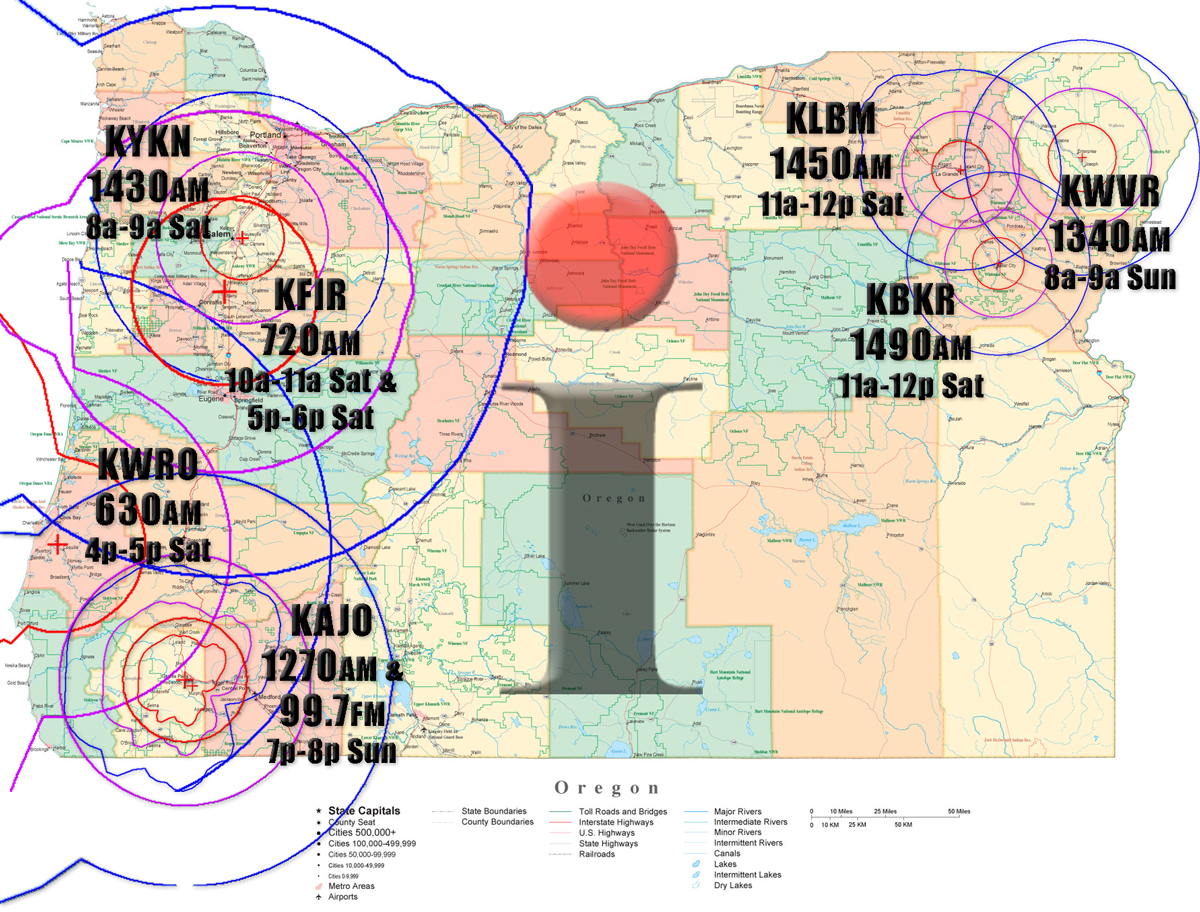
The I Spy Radio Show airs weekends — seven times across seven real radio stations, not internet-only streams. Listen anywhere through the stations’ live streams. See when, where, and how to listen for the full schedule.
Missed it? The podcast posts Mondays, after the broadcast stations air the show — here on this page or on your favorite platform.