Vote: Here’s What They’ll Do If They Win
Oregon’s 2026 election, the universal health plan, and the Climate Protection Program
About this episode
If you live in Oregon, your ballot is in hand or on the way. Before you fill it out, here is what the people asking for your vote have planned for after the polls close — and how close they are to being able to do it without a single Republican vote.
Democrats hold 37 of 60 House seats and 18 of 30 Senate seats. That is already three-fifths, enough to pass any tax bill alone — which is how the gas tax got through before voters threw it out 83% to 17%. At 40 and 20 they reach two-thirds. Oregon requires two-thirds for a quorum, so the minority’s last procedural tool, the walkout, stops working. And two-thirds is enough to override any governor’s veto, so a Republican governor could veto a bill and watch it become law anyway. Mark opens the hour on why this election is closer to the edge than most Oregonians realize.
Independent health insurance broker Lisa Lettenmaier of Health Source NW takes the first half on Oregon’s universal health plan. The Universal Health Plan Governance Board’s own October draft cites its consultant’s estimate of $77.4 billion to $94.0 billion a year by 2032 — more than the entire state budget — and needs $30 billion to $39 billion a year in new revenue. Its first revenue option pairs a 9.89% employer payroll tax with a 12% “Household Health Care Contribution” on income above 200% of the federal poverty level. The draft also says Oregon “does not need to generate new funding,” and that its forecasts do not include start-up costs or reserve funding. The law required the plan by September 15. The board chair confirmed in writing that Governor Kotek and legislative committee leaders approved moving it past the election, and an analysis from the Office of Legislative Counsel provided to Rep. Dwayne Yunker says they had no authority to do so.
Lisa explains what she is seeing on the ground: Providence and PacificSource leaving Oregon’s individual market, Medicare Advantage carriers shrinking in Portland Metro, and why she says a market propped up by underpaid Medicaid and Medicare claims is starting to break. Then the question nobody on the board has answered: whether private insurance survives. Employer plans can’t be banned under federal law — but employers who keep them still pay the new payroll tax. And whether insurers can keep selling individual and small business plans at all, the board’s own brief says, “was not discussed.”
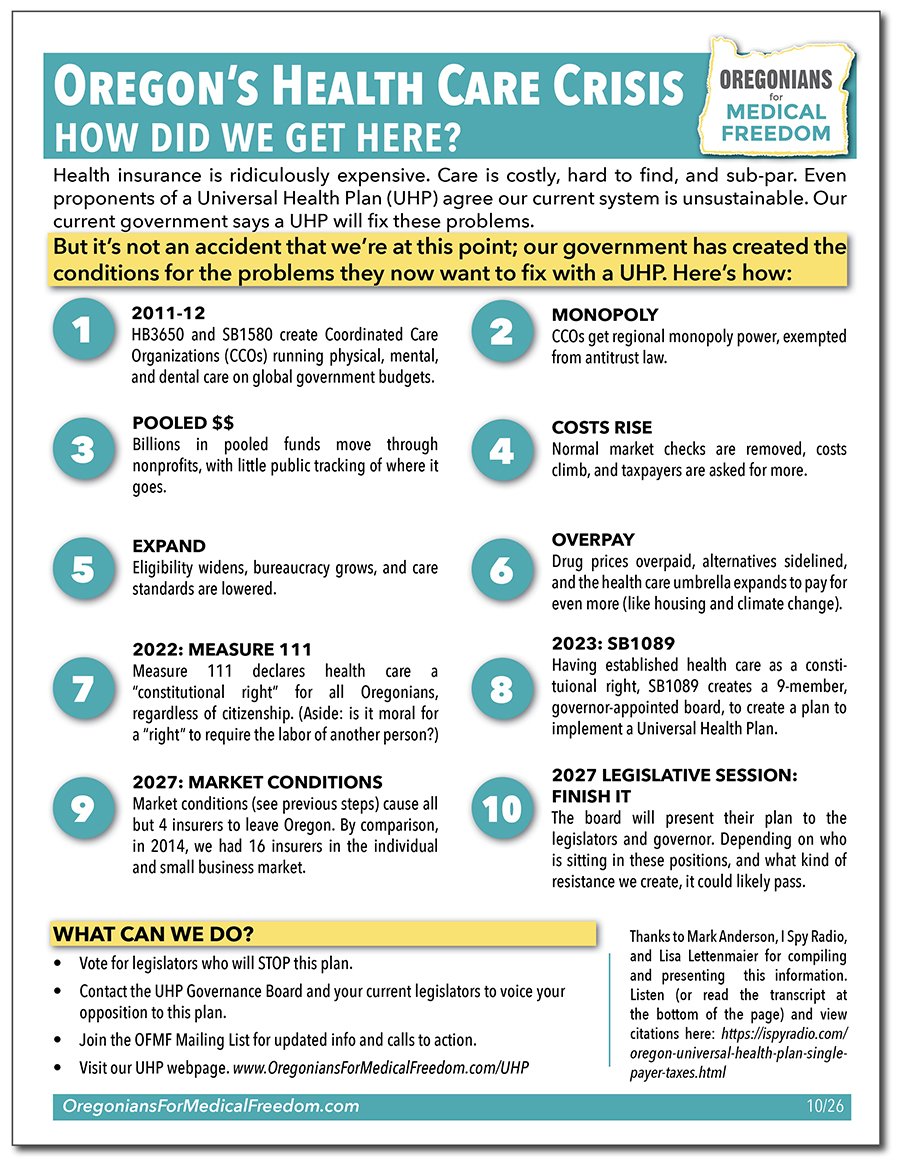
View full infographic →
In the second half, Jen Hamaker, president of Oregon Natural Resource Industries, returns on the Climate Protection Program — a cap-and-trade program for fuel suppliers that was never voted on by the Legislature. It grew out of Governor Kate Brown’s 2020 executive order, was struck down by the Court of Appeals in 2023, and was re-adopted by the Environmental Quality Commission in 2024. The cap tightens every year. Companies that go over can buy Community Climate Investment credits, and that money goes to CALSTART, a California nonprofit — not through the State Treasury or a legislative budget. Christine Drazan has pledged to end the program on day one. Mark’s warning: at two-thirds, Democrats can write it into statute and override her veto.
And the find that stopped Jen cold. Oregon is a full member of the International Carbon Action Partnership (ICAP), a Berlin-based network whose stated mission is a functioning global carbon market. Who signed Oregon up? Governor Ted Kulongoski, who signed ICAP’s founding declaration in Lisbon on October 29, 2007 — years before the Climate Protection Program existed. What Oregon has agreed to since, nobody on this show could find in writing.
Two programs. Both enormous, both built by appointed boards and agency rules, and both timed so the details arrive after your ballot is counted. The best information does you no good if you don’t use it. Vote — and bring someone with you.
In this episode
The Two-Thirds Line — and a Market Built to Break
Mark on quorum, vetoes, and why national Democratic groups are targeting Oregon. Then Lisa on underpaid Medicaid and Medicare claims, carriers leaving the individual and Medicare Advantage markets, and whether private insurance survives the universal health plan.
A Nonprofit the Size of the State Budget
A public corporation “modeled after SAIF” to run it all, the $94 billion top of the range, the 12% household contribution and 9.89% payroll tax, the Cover Oregon flashback, and the report that was moved past the election.
Who Gets Care, and Who Doesn’t
“Fair distribution of medical resources,” the old Oregon Health Plan prioritized list, residency rules and people moving in for coverage, federal money the plan is counting on, and what happened to catastrophic coverage.
A Cap on Emissions, No Cap on Cost
Where the Climate Protection Program stands, what a metric ton of CO2 looks like at the pump, the 2028 true-up and phase two, and the Community Climate Investment money headed to a California nonprofit.
ICAP: Oregon’s Seat in a Global Carbon Market
What the International Carbon Action Partnership is, who it counts as members, the roughly $80 billion carbon markets took in last year — and the answer to who signed Oregon up, delivered live.
No Paper Trail, No Economic Analysis
No mention of ICAP in the program’s own documents, a consultant study that leaves out the ripple effects, and the lack of transparency both programs share. Then Mark’s close: the gas tax math, and why this election matters.
Key questions about Oregon’s 2026 election
What would a two-thirds supermajority mean in the Oregon Legislature?
Two-thirds is 40 of 60 House seats and 20 of 30 Senate seats. Oregon requires two-thirds of members for a quorum (Oregon Constitution, Article IV, Section 12), so a party at two-thirds can conduct business even if every minority member walks out. A governor’s veto can be overridden by two-thirds of the members present in each chamber (Article V, Section 15b). Democrats hold 37 House seats and 18 Senate seats — three and two short. They already hold the three-fifths needed to pass revenue bills (Article IV, Section 25).
How much would Oregon’s universal health plan cost?
The board’s October 2026 draft report cites its consultant Milliman’s estimate of $85.5 billion in 2032, within a range of $77.4 billion to $94.0 billion, before projected savings. After federal and state funding, the draft puts the new revenue needed at $30.0 billion to $39.0 billion a year. The draft states that its forecasts do not include start-up costs or health plan reserve funding.
What taxes does the universal health plan propose?
The draft lays out five revenue model options. Option 1 combines an employer payroll tax of 9.89% on payroll above the first $500,000, a Household Health Care Contribution of 12.0% on income above 200% of the federal poverty level, and add-ons to the corporate income and corporate activity taxes. Earlier drafts called the household tax a “Health Care Personal Income Tax.”
When is the report due, and what happens next?
State law set a September 15, 2026 deadline. The report was moved to December 1, 2026 — after the November 3 election. The board’s October 15 presentation lists a November 19 meeting with a press release and a presentation to the House and Senate health committees. Paths the board discussed include a single bill in the 2027 session with a 2028 referral to voters, the same in 2029 and 2030, or a two-step approach that passes a framework in 2027 and defers financing specifics — including tax rates — to the 2029 session.
Would it eliminate private health insurance?
Not by law, for employer plans: federal ERISA law prevents Oregon from banning them, and the draft says employers could keep or drop coverage. But employers that keep their plans would still pay the new payroll tax, and the draft assumes some employers will voluntarily discontinue coverage. For individual and small business plans, which the state does regulate, the board’s legislative brief says whether commercial insurance should be allowed to operate once the plan is in place “was not discussed by the Board.”
What is Oregon’s Climate Protection Program?
A cap on greenhouse gas emissions from fuel suppliers and large industrial sources that tightens every year. It grew out of Governor Kate Brown’s Executive Order 20-04 in 2020 and was adopted as rules by the Environmental Quality Commission, not passed by the Legislature. The Oregon Court of Appeals invalidated it in December 2023, and the commission re-adopted it in November 2024. Companies can meet part of their obligation by buying Community Climate Investment credits; in July 2026, DEQ selected CALSTART, a California-based nonprofit, to administer that money.
What is ICAP, and when did Oregon join?
The International Carbon Action Partnership is a Berlin-based forum of governments that run or are designing emissions trading systems. Governor Ted Kulongoski signed ICAP’s founding declaration for Oregon in Lisbon on October 29, 2007, alongside the governors of California and New Mexico and the premiers of British Columbia and Manitoba. ICAP lists Oregon as a full member.
Links & resources mentioned
Our Guests
- Health Source NW (Lisa Lettenmaier — independent health insurance & Medicare brokerage, Oregon & SW Washington)
- Oregon Natural Resource Industries (ONRI) (Jen Hamaker, president)
- Oregonians for Medical Freedom — Universal Health Plan page (home of the “How Did We Get Here?” infographic)
The October 15, 2026 Board Meeting — Read Their Own Paperwork
- UHPGB Legislative Report, draft (PDF) (Universal Health Plan Governance Board, draft dated October 13, 2026 — cost ranges, revenue options, “What Remains to Be Done”)
- Executive Summary (PDF) (UHPGB, October 15, 2026 — the public corporation “modeled after SAIF”)
- Legislative Brief: In Response to the Legislature’s August 17, 2026 Request (PDF) (UHPGB, October 14, 2026 — ERISA, employer plans, and the commercial insurance question “not discussed by the Board”)
- Appendix FR: Expenditure and Revenue (PDF) (UHPGB, draft October 13, 2026 — how the revenue target is built)
- Appendix Scenarios: How Much Will I Pay? (PDF) (UHPGB, October 12, 2026 version — household examples under each revenue option)
- Board meeting presentation (PDF) (UHPGB, October 15, 2026 — one-step vs. two-step legislative paths, and the November 19 rollout)
- Board meeting agenda (PDF) (UHPGB, October 15, 2026)
- All 2026 board meeting materials and public comments (Universal Health Plan Governance Board)
The Delay, the Deadline & the Cost
- Kotek pushes big health care plan behind closed doors (Oregon Catalyst, September 9, 2026)
- Rep. Yunker: Single-payer healthcare scheme hides details (Oregon Catalyst, September 29, 2026)
- Rep. Yunker questions Kotek’s unlawful healthcare report delay (Oregon Catalyst, October 5, 2026 — the board chair’s written response and the Legislative Counsel analysis)
- Rep. Yunker: Problems with Kotek’s health care plan (Oregon Catalyst, October 9, 2026)
- Oregon universal health care board punts single-payer report over funding uncertainty (Oregon Capital Chronicle, August 6, 2026 — “What we have is not a comprehensive plan”)
- Oregon Universal Health Plan Group Hastens to Meet Deadline (Willamette Week, October 9, 2026)
- Was Delay of Universal Health Plan Report Unlawful? Does It Matter? (Willamette Week, October 12, 2026)
- Milliman final report to the board (PDF) (the consultant cost estimates behind the $77.4–$94.0 billion range)
- Midterms Have Revived Universal Healthcare Debate. These States Are Ahead of Everyone. (KFF Health News, October 2, 2026)
Oregon’s Shrinking Insurance Market
- Providence and PacificSource exit Oregon individual market as 2027 rates climb (Insurance Business, June 10, 2026)
- Oregon Division of Financial Regulation — 2027 health insurance rates (the official filings)
- Sixteen Years in the Making — Oregon’s March to Socialized Medicine (I Spy Radio, Show 16-31, August 1, 2026 — our earlier hour with Lisa Lettenmaier)
The Climate Protection Program & CALSTART
- Community Climate Investments (Oregon DEQ)
- DEQ selects a California-based nonprofit to lead its climate investment program (Jefferson Public Radio, July 12, 2026)
- Oregon’s Climate Protection Program moves one step closer to delivering community investments (Climate Solutions, July 17, 2026 — the advocates’ view)
- Oregon reinstates emissions trading program (ICAP — the 2023 court ruling, the November 2024 re-adoption, and the $129 credit price with its 4.5% fee)
- OAR 340-273-0400 — Generation of compliance instruments (Oregon Secretary of State, Oregon Administrative Rules)
- Oregon’s Climate Protection Program Costs Far More Than Other States—and Is Far Less Accountable (Willamette Week, April 3, 2026 — the Alliance of Western Energy Consumers’ $4.9 billion estimate for natural gas customers over 11 years)
ICAP — The International Carbon Action Partnership
- ICAP Political Declaration, Lisbon (PDF) (October 29, 2007 — signed for Oregon by Governor Theodore R. Kulongoski)
- ICAP Members & Observers (ICAP — Oregon listed as a full member)
- About ICAP — mission and activities (ICAP)
- Emissions Trading Worldwide: ICAP Status Report 2026 (ICAP, 2026 — nearly $80 billion in carbon market revenue worldwide in 2025)
- USA – Oregon – Climate Protection Program factsheet (PDF) (ICAP — how ICAP tracks Oregon’s program)
- ICAP Governance Framework (PDF) (ICAP, 2024 revision — membership application and political declaration)
- EU-funded ICAP capacity-building program briefing (PDF) (ICAP)
- Scientific and technical support for the ICAP Secretariat, 2015–2018 (adelphi — the Berlin think tank behind the Secretariat)
The Supermajority Math
- Oregon Constitution (Article IV, Section 12 — two-thirds quorum; Article IV, Section 25 — three-fifths for revenue bills; Article V, Section 15b — veto override)
About the guests
Lisa Lettenmaier is an independent health insurance broker serving Oregon and Southwest Washington, and the owner of Health Source NW, an agency that helps individuals, families and seniors find individual health insurance and Medicare plans at no additional cost to the client. She has worked Oregon’s market since before the Affordable Care Act took effect, and she is I Spy Radio’s go-to voice for common-sense answers on Oregon’s health care system.
Jen Hamaker is president of Oregon Natural Resource Industries (ONRI), which advocates for Oregon’s natural resource industries and the communities that depend on them. She has spent years researching the Climate Protection Program’s rules, costs and structure, and she is a recurring I Spy Radio guest.
Full transcript ▸
MARK: If you are in Oregon, by the time you hear this, you will either have your ballot or it's on the way. And I want to tell you there's a chance you may not be taking this election seriously enough. Because as I have talked with people — and I talk with an awful lot of them — many people don't realize what's actually at stake.
Democracy is always in danger. Which is why you always hear the phrase, “This is the most important election of our lifetime.” Because it's true. Every election is the most important election — because all it takes is a majority of the votes cast in that election to change the direction of a city or county or state or entire country. And many times that can be for the worse. Especially when people stay home.
On this week's show we're going to be talking about two major issues that will make that ODOT gas tax bill that 83% of Oregonians said no to look like a bargain. The universal health plan currently under consideration would more than double the yearly state budget. The other issue is the Climate Protection Program — an executive order from the current governor, and nobody knows exactly how much it will cost. Right now, looking just at the fuel sector, it will cost $20 billion over 11 years. If Democrats win. These are finally starting to get a bit of attention.
But there's another issue that is even more important, and here is where I think people just aren't taking this election seriously enough.
Right now, national Democrat organizations have been targeting Oregon. That's no surprise. But what is a surprise is they not only want to keep the current seats they have at three-fifths majority, which gives them the means to pass any tax that they want — like that gas tax — without needing a single Republican vote to do it.
It turns out they want to expand the majority. Here's why.
At two-thirds majority, the Democrats would take away the one legislative tool the minority party has: a walkout. Deny quorum. Two-thirds is quorum. They don't need a single Republican in that building. And Democrats can do anything they want, pass any kind of bill. Like universal health care. And change that Climate Protection Program from an executive order to a law.
It also means that even if Oregon elects a Republican governor, two-thirds is a veto-proof majority. Christine Drazan could veto everything they send at her and it wouldn't matter — they can just override it and make it law anyway.
Oregon is in real danger right now. We are that close to going over the edge. You need to take this election seriously. Make sure you vote — but you have got to get other people to vote as well. Find ways you can do something to help Republicans prevent complete disaster.
To talk about the first part of that, the universal health plan, I'd like to welcome Lisa Lettenmaier. She is our go-to expert whenever we need some common-sense answers to the absolute insanity of what Oregon has done, is doing, and plans to do to its health care system. Lisa, thanks for joining us today.
LISA LETTENMAIER: Well, as always, thanks for having me on.
MARK: And I should mention that you're the owner of Health Source NW. It's a company that helps people find the best insurance or Medicare plans for them. People can visit that at HealthSourceNW.com.
There is so much more information about this from the last time that we talked. Last time we talked was on August first, and then five days after that show aired, suddenly the governor's board decided they were not going to drop that September fifth meeting like they were supposed to have and announce, these are our grand plans. They've moved it until after the election, conveniently enough, into the middle of December. There was a meeting last week, and now there's another big one this week as well. And just going through some of the documentation that they put up there, it's pretty astonishing.
But before we get to that — you are dealing with this right now, as some of these health insurance companies are pulling out of the market. So what are you seeing with literally boots on the ground here?
LISA: Boots on the ground is that Oregon has set it up so that we are slowly but surely making it untenable for health insurance carriers to operate here. And the biggest chunk of that, in my opinion — or at least one of the biggest chunks — is that we have become so reliant, with so many people on the Medicaid system, which was done on purpose, that you have providers being consistently underpaid.
Because the dirty secret in our country that people just do not know, or do not want to recognize, is that if you are being seen by a medical provider and you're on Medicaid, they're getting about fifty to sixty cents on the dollar of what they need to do their job. If you're being seen by a provider and you're on Medicare, it's an average of seventy cents on the dollar.
Now, back in the day, when you had five, ten, fifteen percent of the state or country on Medicaid and Medicare, that was somewhat feasible, because the doctors just don't walk away from that loss. They turn around and they look at the commercial market — that's the employer group, individual health — and they say, hey, since we're contracting with you and we get to negotiate with you — we can't negotiate with Medicare and Medicaid, but we can negotiate with you carriers — we want more money to make up our loss. And that's been the game.
Well, right now in our nation, over forty-three percent of the population is on Medicaid and Medicare. The majority of that number is Medicaid. Here in Oregon, we are over fifty-two percent of our population on Medicare and Medicaid. And again, the majority is Medicaid. So you've got a massive portion of the population where, when they get seen, the doctors or facilities are underpaid, and they have to turn around and find that loss with the commercial market. And guess what? There's only so much you can push that.
So if you're worried about your rates going up, it's because the carriers are being — not asked — insisted, demanded by these provider groups that are going down in flames. They're losing money, and they need to make it up on the backs of the carriers. And at some point there's a breaking point.
So in the individual health market for this coming year, we're going to go from basically five carriers — Kaiser, Regence, Moda, Providence and PacificSource — down to three carriers in the individual market: Kaiser, Regence and Moda. In the Medicare Advantage market, which is where I do a lot of my work, we here in Portland Metro currently have eleven insurance carriers selling plans. Again, because of contract negotiations and just the untenable situation of not being able to make this work, we are going to have eight carriers left for people to choose from.
So that means we've got people losing coverage, both in the individual market and the Medicare Advantage market, and they have to do something. They've got to find a new plan. At the same time, when you're looking at these insurance carriers, whether it be individual or Medicare Advantage plans, their networks are shifting significantly, very quickly. We just got another notice last night that another one of our carriers was notified by Legacy that they're going to drop them immediately. So here you are trying to find a plan for a client that works for their current providers — and they might be seeing providers across multiple clinics or hospital systems. And what do you do if there is no carrier left?
But they created this. It feels genuinely like this was planned. When I watched Oregon try to go to universal health care before the state or the feds went to the Affordable Care Act — that's what I thought back then, which is when you and I met, and this is what I felt the whole time. If you looked at this and had any forethought, any ability to forecast and budget out, then you could see the writing on the wall. And here we are.
And now they're saying, well, it's the fault of the carriers, so we're going to come save you. I don't want to be saved by the people that created the problem.
MARK: That's right. It's pretty clear that they've had this in the works for decades now. Everything that we predicted back in 2011 has come true. In fact, we have a great infographic done by a friend of mine, Lisa Carroll. She works with Oregonians for Medical Freedom, and you can find that on this week's show page, 16-42, at ispyradio.com. Just to see, real simply, how we got here.
One of the things that we did not know the last time that we talked was whether or not private insurance will continue. And it looks like employer plans can't be banned, because there's a federal law that governs those employer benefit plans, and that would block the state from being able to do that. However, the employers that do keep their own plans still have to pay the new tax on top of it. So guess what? They're going to squeeze them out.
But then on the other side of things are the individual and small business plans. They're a different story yet. The legislative brief out today says that whether commercial insurance should be allowed to operate in the state once the universal health plan is in place was not discussed by the board. So it's something else they're putting off until after the election, and they probably won't even really discuss that for another couple of years. Because they're going to have to squeeze those out of the market to force everybody into the universal health care plan.
LISA: Yep. If you make the market start to collapse — boy, doesn't universal health care look good? And it's already starting to collapse. You did that. You created the situation that we're in, and then you get to come in on your white horse and go, but look at us. We don't have it all figured out. We have no idea how we're going to pay for it. In fact, there's a huge funding gap. But you know what? Pat ourselves on the back, because we're going to be the first state in the nation to have universal health care.
California hasn't been able to figure it out, multiple times. Vermont, blue as blue, couldn't figure it out. But you know what? Oregon. We've always got to be the ones at the top of the list. And here we go. Point to any government program that's been run by a not-for-profit, or quasi-government private sector, that's not got problems. That's not hiding the ball, hiding the money. Show me one that works well.
MARK: They don't.
LISA: So here we are.
MARK: In fact, I'd like to talk to you about that nonprofit thing coming up in the next segment. Stay with us. We'll talk more about the universal health care plan that Oregon Democrats are trying to shove through.
MARK: And welcome back. This is the I Spy Radio Show. We're talking today to Lisa Lettenmaier. She's an independent health insurance broker serving Oregon and Southwest Washington, and the owner of Health Source NW. Find them at HealthSourceNW.com.
Lisa, going out of that break, we were talking about this notion of a nonprofit. And this is really important, because when you look at the executive summary from the meeting that they had on Thursday, the universal health plan would be administered by an independent nonprofit public corporation modeled after SAIF. So there you go. It's a nonprofit. It's CCOs on steroids.
And that's a big problem with how this is funded now: you have these exclusive monopolies in their regions, but then all of the money is dumped into a global budget, and it's shielded by nonprofit laws that protect them from public scrutiny in terms of how that money is all spent. Well, now you're talking about a giant nonprofit that could be getting up to ninety billion dollars. We already know there's a tremendous amount of fraud now with Medicare and Medicaid. Imagine a nonprofit where you can't look behind the door other than in limited glimpses, and suddenly they've got ninety billion dollars. Do you think there might be just a little bit of fraud happening there?
LISA: No comment, right? Truly, I've known that there's been fraud. I've watched it. I've told people about it. And I find it fascinating that in the last year or two, everybody's like, oh my gosh, look at the fraud. And I'm like, how did you not see it before? And more importantly, why are our elected officials not watching the purse strings? Either you are just a complete idiot, or you are criminally negligent. In my opinion, there's only two choices.
Because, for example, I have actually served on many nonprofit organization boards — for insurance industries, and 4-H, and different things like that. And I have always taken my role as a board member incredibly seriously. A lot of times, because I have an accounting background, I would actually be the one to volunteer to do the financial statements. And I insisted at every single meeting that we went through those financial statements with a fine-tooth comb — to the ire of my board members a lot of times. They didn't want to do that. But we did it, because we were fiduciarily responsible for the donations and the membership fees that were coming in. We had to prove what came in, what went out, what's our plan. If we're going to do a new project, we better have the money to do it, because that's our responsibility.
Now, that's a small, itty-bitty nonprofit board. You're talking, like you just said, about these organizations that get so big and so clogged up with administration and layers upon layers of people, and then they're hiding the ball. And again, either it's just because it's so fraught with overregulation and administration costs, or they're doing it — I believe sometimes, like we've seen in some of the cases coming out federally — on purpose.
Because you should never be allowed to take dollars from taxpayers and then just not be responsible. And once you find fraud — I don't care if it's a dime, that's fraud. You are stealing from Oregonians, or the American people. So if you waste ten cents, I'm going to be upset about it. That's me, though.
MARK: For those that don't understand, this is not just nickels and dimes. This is a massive spending program. The last time that we talked, they were thinking it might be about eighty-five billion dollars per year. And that's really expensive, especially when you consider the fact that the entire state budget is about seventy billion dollars. So this is more than doubling the amount of money that the state would spend.
LISA: I believe one of their consultants said that even if we do nothing, we're currently at about forty-four billion on health spending, but it's projected, if we do nothing, to go to seventy-six billion. So again, we've messed this up ourselves by encouraging the enrollment numbers that we have on programs, whether that's Medicaid or WIC or SNAP. And I'm not saying that those are not good programs for people that need it. I am saying they're fraught with fraud, waste and abuse.
MARK: Oh, absolutely. Well, now the projections are that this could get up to ninety-four billion dollars a year when it kicks off in 2032. That's the top of their own consultant's range. Now you're talking a good twenty-four billion dollars past the entire state budget in order to get there.
We're talking about a twelve percent state income tax on top of the existing one. Some of the information I saw this morning, it looks like they're looking at raising the top income rate from roughly ten percent — I think it's 9.9% — up to fifteen percent. And then there's an additional twelve percent state income tax on top of the existing one. There's also a 9.89% payroll tax on employers. So what they're trying to come up with is between thirty and thirty-nine billion dollars a year in revenue.
And what they're saying is, well, don't worry, we don't need to necessarily raise taxes — other than the ones they just mentioned that they need to raise. Because you're not paying your health care premiums, that will replace that, and so it'll be a wash, essentially. Except when you look at the numbers, they admit that they don't even know exactly how much any of this is going to cost. So how can you then say that we don't need any new taxes if you don't even know how much it costs?
LISA: Well, remember, they've already started talking about raising the gross sales tax — the corporate activity tax. There's all kinds of other little things in there. The bigger ones that we're looking at are the income tax increase and the payroll tax.
In fact, our own board here in the state of Oregon has already told the governor, hey, we're not competitive with our neighbors. We are not a business-friendly climate. So why don't we just add another 9.8 in payroll taxes, and increase the corporate activity tax, the gross sales tax? Why don't we do that, on a system that we have no idea has any chance of working?
Because mind you, back in 2013, it was Kitzhaber, who was running for election, hiding the ball on the Cover Oregon debacle. We were literally promised a website, and there was no website when we got to the enrollment date of October first. And he hid it from everybody so badly that once he got elected, he got run out of office, and Cover Oregon fell apart. Hundreds of millions of dollars spent on that creation, to have it fold — not even get off the ground.
MARK: Wasted. Yeah. And the same thing is happening this year. Kotek knew how bad this was, and the board knew how bad it was. And so Kotek actually signed off on pushing the report past the election, even though the law required the plan by September fifteenth. They moved it to at least December first — now it's looking like December sixteenth, if I remember right. But Legislative Counsel said they had no authority to do that.
All right, everyone, stay with us. We will wrap this up with Lisa Lettenmaier after this.
MARK: And welcome back. Talking about Oregon's universal health plan, coming at you fast, especially if the Democrats get reelected — and really, especially if they get that two-thirds supermajority I mentioned in the opener.
So, Lisa, in the time that we have left here, there are a couple of things I think are really important to know. Some of the things that they've talked about in this executive summary are things that we've argued about, that they've argued about, for sixteen-plus years. And one of them is a fair distribution of medical resources. That is an acknowledgment — even though they won't quite acknowledge it — that they just don't have unlimited money. Nobody does.
So when everyone shows up with million-dollar health problems, who gets it? Because the system has limited money. If everybody's got these million-dollar health problems, and we're going to get flooded with people from other states, you then have to decide who gets the benefits and who doesn't.
And when I saw that, I thought, that reminds me of Governor Kitzhaber when he was shoving through Oregon's health care transformation. He denied for years that there would be these death panels. Because that's what people would say: well, you've got limited funds, somebody is not going to get the care that you say they're going to. Oh, no, we would never have death panels. And then years later he said, oh yeah, I guess we will need those.
LISA: Well, as you and I were talking before — I was a newer agent, but certainly very much involved in this stuff, and I think just because of the accounting background, I always crunch numbers. And I remember reading a report on how OHP was operating based upon his direction. You would just look at the medical services, a whole list of them. And then, depending on how much money the state was going to have in Medicaid dollars that year, they would literally draw a line somewhere down the list. Everything above the line was going to be covered. Everything below the line wasn't going to be covered.
And some of those items that I read that were below the line were cancer treatments. Now, granted, they were really significant cancer treatments that were really hard. But what was above the line was drug and alcohol treatment. So I thought to myself back then, why is it that we're going to deny cancer treatment — even though it might have a limited ability to change the outcome — but we're going to cover somebody with drug and alcohol abuse? That was just something that stood out to me.
I just don't trust it. As you just said, it's going to be taxes, whatever they want to call it — that health care contribution thing. I don't care what you want to call it, it's a tax. And you're relying on federal dollars that you do not know are going to keep coming in or not. Already the feds are — not changing the rules, they're reinforcing the rules that were there. So our Medicaid dollars are shrinking, and Kotek's panicking over that as if it's Trump's fault. It's not. We're going back to the rules that should have been enforced in the first place.
So you're relying on federal dollars. You're relying on people staying in the state to pay these rates. And if you've got any kind of means — if you're a business, you're leaving. If you're an upper-end income earner, you're leaving. But what you're going to invite — and I've already seen it in public comments, like on KGW articles, I read those comments — you've already got multiple people saying, well, if they don't do this in Washington, I'm going to move to Oregon. Because I believe it's somewhere in the area of a six-month residency and, boom, you get free universal health care. So how do you think this is going? You're going to run out of money. So who's going to get care, and who's not going to get care?
MARK: Well, and that's the thing. It's so expensive. They've already acknowledged that they're going to need somewhere around seventy billion dollars of federal money. It's so expensive that not only are they taxing other people's money, they're taxing people in other states to pay for this. That's where federal dollars come from.
LISA: Well, let's give you some perspective. In 2024 — I looked it up — the state of Oregon spent five million, excuse me, billion dollars on Medicaid. The feds spent twelve billion. So it's like thirty percent state, seventy percent feds. And that was twelve billion in 2024. Now they're saying to the feds, we're probably going to need like seventy billion dollars. Really?
And we haven't even addressed things like, what if you live in Oregon but you travel, or you snowbird, like our Medicare beneficiaries? Because what they're not telling you is that to make this work, they've got to get a pass from the feds to take over the Medicare dollars, to take over the Medicaid dollars — plus all these taxes that they're going to charge. And they don't really know what it's going to actually take until they're in the middle of it, after they've collapsed everything else. So you're relying on that.
And what about those people that travel, or snowbird, or work remotely? What happens to them? What, by the way, are the doctors going to get paid to make this work? We already know that Medicare and Medicaid underpay providers, which is why our system is so lopsided — because we're now up-charging. So what are you going to pay everybody?
MARK: Right. And we're going to lose all the good doctors, because they'll move to a state where they get paid more.
LISA: Correct.
MARK: You know, earlier you talked about breaking the system as far as insurers go — they made it more and more difficult, and sure enough, all of these insurers start up and leaving. And it was interesting: in some of the public comments on Thursday's meeting, I happened to open the very first one, and she said in there, no one should go bankrupt over catastrophic health events. And yeah — that's what catastrophic health insurance was for.
LISA: Correct.
MARK: So remind me, what happened to catastrophic insurance? Could it be that Oregon and Obamacare got rid of that? Isn't that strange? The one tool that you had to protect yourself, and they removed it. Isn't that just weird?
LISA: Well, they did, but then they've actually brought it back. If you look at the plans now, they're allowing for catastrophic plans, because the prices are so high that you can't afford anything but that. And again, I want to remind people: the evil carriers are not making money hand over fist. If they were, they wouldn't be leaving the market.
MARK: That's right. Funny how that worked out. Take away the one insurance people actually needed and wanted, and now it's back. Kind of like, whoops.
Well, unfortunately we are up against the clock here with you. We'll have a lot of information up on ispyradio.com, forward slash 16-42. You can go through these documents yourself and find out the path toward the destruction, and so much more. Lisa, I want to thank you so much for your time today.
LISA: Again, thank you for having me on. Our hope is that people think and start conversations.
MARK: And vote.
LISA: Pay attention to the details, and vote.
MARK: Yes, absolutely. All right, stick around for the second half of the show. Coming up: the Climate Protection Program, and what else they aren't telling you about this one until after the election.
MARK: I talked in my opener about the two massive issues facing Oregonians that are coming up, but that you won't really get to know about until after the election. First up was the push for socialized medicine here in Oregon, which will require more than doubling the entire state budget to pay for it. The second is what we're going to talk about now: the Climate Protection Program.
I'd like to welcome Jen Hamaker back to the show. She is the president of ONRI — O-N-R-I, Oregon Natural Resource Industries. Visit them at ONRI.us. And Jen, this is again just one of these programs where you just cannot believe that Oregon is even considering hitching itself to this.
JEN HAMAKER: I can't believe what we're going to be uncovering today. It's crucial for Oregonians to understand this.
MARK: Absolutely. And this is another one of those things that's kind of like a Russian nesting doll. You peel off the first layer, and then there's something else, and then there's something else below that, and something else below that. The more you know about this, the worse it gets.
So Oregon has already implemented the Climate Protection Program. This was an executive order. It actually started under Kate Brown, and it was thrown out by the court. But the state never challenged that. Instead, Governor Brown just reinstituted it and created a new one. There is a lawsuit right now by the natural gas companies to try to challenge that. So can you remind our audience exactly where we are in all of this? What's already been enacted, and where are things right now?
JEN: So the CPP is the most punitive and expensive — it's a cap and trade, but it's the most punitive and expensive climate protection plan in the United States, if not the world. This is going to be increasing prices and costs across the board on manufacturing and industry, specifically with gas and diesel, propane and natural gas. It's a cap on emissions, but there's no cap on the cost of this.
MARK: And that's the shocking part. Not only is there no cap on the cost of this, but it's also not going to do anything. As we discussed a couple of weeks ago with our guest, you can add all the carbon dioxide you want to the atmosphere, and it doesn't change the temperature, because it's absorbed by the hydrological cycle — that Chuck Wiese was kind enough to put us on to. We'll put a link to that on this week's show page as well, 16-42.
As far as the expense is concerned, just to give people an idea of this: there is currently a lawsuit by the natural gas companies. They are suing the state of Oregon to try to stop this. And they are saying that if this goes through fully — and the fees on natural gas kicked in after the election — it will cost Oregonians $4.9 billion over eleven years. And that's just one sector of the much larger fuel sector. When you look at those numbers, the entire fuel sector could cost about twenty billion dollars — and that's just an estimate — over eleven years. And again, that's just one of the many different aspects that are being taxed.
One of the ones that we talked about previously is further down the road — again, after the election. I think it kicks in in 2028: it starts adding fees onto steel and concrete and timber and glass. And what are some of the ingredients that go into building a house — the affordable housing we're supposed to be putting in? What are some of the ingredients in that?
JEN: Yeah, exactly. All the building materials.
MARK: As I said, this is an executive order. Christine Drazan has said that on day one, she will throw this out. But the problem again, as I outlined in the opener, is that two-thirds majority. If Republicans don't take this seriously and get involved in any way they can — find somebody to donate twenty dollars, a hundred dollars, whatever you can; volunteer, get out there, door knock, whatever it is that you can do — and if nothing else, bring more people with you to vote. Make sure they vote as well. Because if Democrats get to that two-thirds majority in the House and the Senate, then it doesn't matter if it's an executive order. It doesn't matter if she throws it out, because they can pass it legislatively and it becomes a law. And at two-thirds, she can't veto it.
JEN: That's crazy.
MARK: It's absolutely scary.
JEN: It's super scary.
MARK: I know that you've done some research into this. And of course, the metric for how they are assessing these fees is one metric ton of carbon dioxide emitted. Give us an idea. What is a metric ton? Help us visualize that.
JEN: One metric ton of CO2 is approximately one hundred gallons of gasoline. If you fill up your tank with one hundred gallons of gasoline and you run that vehicle until it's on empty, that equals about one metric ton of CO2. And they're selling these allowances for — sorry — one hundred and thirty-two dollars per metric ton, which will increase. But that's over the amount that you're allowed to emit in a year. So if you have to buy an allowance to make up for one metric ton over what you're allowed, it would raise prices in Oregon on gas one dollar seventeen cents per gallon.
And all of this is coming. It's going to be trued up in 2028. Right now we are in phase one of the CPP, and in 2028 we enter into phase two. That's when it becomes extremely punitive. And all of 2025 to 2027 is trued up in 2028. So all of these fuel suppliers are going to have to pay for what they emitted during 2025 to 2027.
MARK: I did not know about the retroactive side of things. That is news to me. But the other thing is, as time goes on, that cap that they are allowing the emitters to put out there gets smaller every year —
JEN: Yes.
MARK: — and there are fewer credits issued each year, which means that you're going to have higher and higher costs for fuel suppliers, and that's definitely going to show up at the pump, and in natural gas as well.
JEN: Well, and the other aspect of that — this is a nuance to the whole thing — they're called CCIs. Inside of the CPP, you can buy extra allowances if you go over your emissions cap, and you pay through the CCI. And that money goes to a California-based nonprofit. So it does not stay in Oregon. It goes to California, to a nonprofit with no accountability and very little oversight.
MARK: Because it's not even going through the Treasury. It just goes straight to that nonprofit. All right, we will talk a little bit more about that nonprofit when we come back with Jen Hamaker. She is the president of ONRI — ONRI.us. Go visit them.
MARK: And welcome back. This is the I Spy Radio Show. We're talking today to Jen Hamaker. She is the president of ONRI, Oregon Natural Resource Industries. Their website is ONRI.us.
Jen, going out of that break, we were talking about the Climate Protection Program, and also the fact that this California nonprofit is going to be handling the money from these Community Climate Investment funds. Those are the indulgences that you have to pay to keep polluting. And of course, as we mentioned with our last guest, when you start putting money into these nonprofits, it makes it very hard to track, because of privacy laws. It's not like you're paying a regular for-profit business. They have auditing; they're forced to open their books. Nonprofits, not so much. And I would think it's even more difficult when this is an out-of-state nonprofit.
But there's another element of this, too, and I know that you've done a lot of research on this. So tell us what you know about ICAP.
JEN: Oh my gosh. Okay. So Oregon is listed as a full member of ICAP. There are different levels of membership, and Oregon has gone all in. ICAP stands for International Carbon Action Partnership. It is located in Berlin, Germany, and ICAP's stated mission includes facilitating the development of a functioning global carbon market. So they are literally the architects, and have the technical blueprints, for government-created carbon markets — especially the ones they seek to expand. And they don't care about Oregonians. They are in Germany. This is all about money.
MARK: Well, and its membership also includes the European Commission, Germany, as you said, the UK, California, Washington, Oregon. There's a couple of provinces up in Canada, I believe, and a number of other jurisdictions. So as far as ICAP itself is concerned — and again, that's International Carbon Action Partnership — it just seems a little odd, doesn't it, that a state like Oregon could involve itself in what is effectively an international treaty? It's not really so much a treaty per se. It's really the funding model for that. But does that strike you as odd, that a state could just up and do that?
JEN: I would like to know when Oregon entered into ICAP, how much it costs, what they get from our revenues. I have a lot of questions. When we uncovered this, it was just a gut punch. We thought that the cap was horrible. And then we uncovered that we're paying possibly billions of dollars to a nonprofit down in California, taking our money out of Oregon, giving it to California. And now we're understanding that Oregon is a full member of ICAP, which is an international carbon market scheme.
MARK: Well, in an email to us, you were wondering who authorized Oregon's membership. And it turns out I have an answer for that.
JEN: Okay.
MARK: It was Governor Ted Kulongoski.
JEN: No way.
MARK: He signed it. And he didn't just sign it — he signed ICAP's founding declaration in Lisbon on October 29, 2007, alongside Schwarzenegger, Richardson and two Canadian premiers. So Oregon didn't just sign on. They are a founding member, fourteen years before the CPP even existed.
JEN: Oh.
MARK: I was blown away by that. I don't ever recall hearing about ICAP. And of course, it's Ted Kulongoski, so I wasn't exactly paying attention to him anyway. But I had no idea that we were a founding member of that.
JEN: Me neither. I had no idea. Oh my gosh. This whole cap needs to go away. And if we don't elect Drazan, we are in a heap of hurt.
MARK: And not just Drazan. Like I said, with that two-thirds majority —
JEN: Doomed?
MARK: — I think Oregon has lost at that point. If you get a two-thirds majority in both the House and Senate — and again, all they need is two seats in the Senate and just three seats in the House to get to two-thirds of both of those — Oregon is sunk.
JEN: Super scary. We need to vote. We need to get out and we need to vote. Period.
MARK: Absolutely. As far as ICAP is concerned, in your investigation — first of all, did you ever find out how much money they get, how much they have sitting in their banks? And did they explain where that money eventually goes?
JEN: From what I can see, there is eighty billion dollars in revenue from last year in their carbon markets. ICAP is involved in about twenty-six percent of the entire carbon market. They're wanting to expand. That's why they're going into governments, not just businesses. They want governments. They want big. But eighty billion dollars in revenue was generated last year through ICAP in those carbon markets.
MARK: Wow.
JEN: Yeah. Big business.
MARK: I'm sure they're doling a lot of that money out to far-right organizations. And to the NRA, and to pro-life organizations.
JEN: Right.
MARK: And I'm sure that none of that goes to far-left organizations.
JEN: Oh, I'm sure. And I'm sure that the nonprofit down in California is exactly the same way.
MARK: Oh, absolutely. So, getting back to your research: were you able to figure out what exactly Oregon has agreed to? I know it's kind of the funding model, and I know they've set up the blueprint for other states to do this. Arizona, I think, has signed on to that somewhat recently. But do we know what exactly they're getting from us, other than the cash derived from the CO2 emission caps?
JEN: I have connected some dots. Basically, when you enter into ICAP, when you become a member, then you are able to talk to other members — what they ran into, what their pitfalls were, what worked in their situations. All that kind of stuff. So it's like a snowball effect. You get more and more effective and efficient at building these schemes, these scams, within governments.
And I'll tell you something. The only entity that benefits from this type of scam — this cap and trade, this carbon market — is governments. It's not the people. What's the benefit to the people? It's higher costs. It's uncertainty. When you have a business that is trying to operate and they don't know what their financial future looks like, because of policy passed through these carbon markets and these schemes and scams from the government — how can you plan for the future?
MARK: Well, I guess the one benefit is that everybody that supports it can think they're doing something about a nonexistent problem.
JEN: Right.
MARK: I guess that's it. Psychological, anyway. All right, everyone, stay with us. We will wrap things up with Jen Hamaker after this.
MARK: And we're back in our final segment. We're talking today to Jen Hamaker. She is the president of ONRI — that's Oregon Natural Resource Industries. Their website is ONRI.us. And we've been talking about the Climate Protection Program, and one element of that in particular: ICAP. That's the International…
JEN: Carbon Action.
MARK: Thank you. International Carbon Action Partnership. I just love all those acronyms. So one of the things we were talking about during the break was the complete lack of transparency on this. We don't know what benefits we're allegedly getting from them. It looks like they're just the blueprints for how you would then enact this and get credit schemes going in other states. But there's really no paperwork there. ICAP didn't show up anywhere that you saw in any of the paperwork that the CPP itself has.
JEN: That's right. I've been researching the CPP for years, taking real deep dives and going down some real deep rabbit holes, and I cannot find anywhere in the Climate Protection Plan that Oregon has implemented anything that talks about ICAP. But we know that they're the architects. They're the ones that create the architecture, or the framework, for our carbon schemes — for the carbon markets. So I couldn't find it anywhere. And that screams even bigger. That speaks volumes to me.
MARK: Right. And one of the other things that has come to light — and we talked a little bit about this, I think, in the last show — is that there has been no true economic analysis of how the CPP will affect all of these other businesses and industries outside the fuel sectors, and the wider economy. Because if you start adding fees to things like natural gas — okay, so your utility bills are going to go up. But then the company that has to pay those extra fees: what does it do to their pricing, and how do they pass it on to customers? Because when you get all these taxes, it doesn't mean, oh gosh, we'll just keep our prices the same. No, you have to raise your prices. And then there are all of these other industries that they haven't even done any assessment on.
JEN: Yep.
MARK: There have been no economic projections on that in terms of the ripple effects. And we mentioned earlier concrete and timber and glass and steel, all the things that go into houses. There's no way they could be more affordable if this goes in.
JEN: That's right.
MARK: So how do we even start untangling that? Because again, this is something that has been pushed off until after the election. So people are being asked to vote for a politician not knowing at all what one of her signature programs would even do.
JEN: We have to remember also, back when Kate Brown enacted this, it was just shoved down our throats in an emergency. It was during COVID. She had this executive order because she could pass anything that she wanted, and so she did. And this is the result of that. It was government shoving this down our throats without us having any say in it. We had previously stopped cap and trade twice.
MARK: Yes.
JEN: Then she shoved it down our throats. This is cap and trade.
And on the economics — they're supposed to have economic projections in there. They hired this company called ICF, which is a U.S.-based consulting company. They mostly deal with climate issues and analysis of climate issues. And they did an analysis and projections related to the cap and the impacts, and it is incomplete. It does not include any of the ripple effects. It doesn't include what it's going to do to industry. Basically, it just shows what the costs are going to be within the framework that they are working with right now. But it does not show any of the ripple effects.
MARK: No. And that's the problem. We don't have any idea how much this will impact people until it's already in place. Because if you reelect Kotek and the Democrats, this will go into full effect. It will be passed into law. So it's no longer just an executive order, which makes it that much harder to untangle.
JEN: Well, I want to add to that, Mark. Because once we are actually in the market starting in 2028 — if Oregon is dumb enough to elect Kotek, we will enter into the market in 2028. And that will obligate us. And I don't know how to get out of it at that point.
MARK: It is a scary prospect, for sure. And I keep coming back to the lack of transparency. That's a buzzword the left just absolutely loves. They love to have transparency. Except the problem is when you set up your structure to have the money going to a nonprofit — and it's the same for the Climate Protection Program and for the universal health plan, which is going to be administered by a ninety-billion-dollar nonprofit, with all that funding being dumped in there — you can't see where that goes once you put it behind the wall of a nonprofit. And something is just fishy when they hide something. It's not only that they don't want you to look. They make it so you can't look.
JEN: That's right. So CALSTART, down in California, that nonprofit — transparency and accountability is what comes to mind. And we have neither one of those.
MARK: Absolutely not. Well, Jen, buckle up. We're just a few short weeks from Oregon's elections. Let's hope that the voters get out there and realize the stakes here. And don't just vote — drag other people to the ballot box as well, because we have got to stop them. Otherwise, Oregon really is finished.
JEN: I agree with you.
MARK: Well, thanks, Jen. Thanks for joining us today.
JEN: It was my pleasure. Thank you so much for helping people become aware of this.
MARK: That gas tax that Oregonians rejected by 83%? That would have added about six cents per gallon of gas. But here's something. If burning 100 gallons of gas is a metric ton of carbon dioxide emitted, and the climate fee to emit a metric ton is $136 — $136 divided by 100 gallons would add one dollar thirty-six cents to the price of a gallon of gas. That is about 22 times more expensive than that ODOT bill.
Take this election seriously. Do whatever you can in these final few weeks. Find a candidate to help: donate money that they can use to hire door knockers, or do some more advertising, or help collect ballots. Oregon's future is at stake. Don't sit on the sidelines. Because, as we say every week, the best information does you no good if you don't use it.
Reagan, what do you think?
Catch the show live
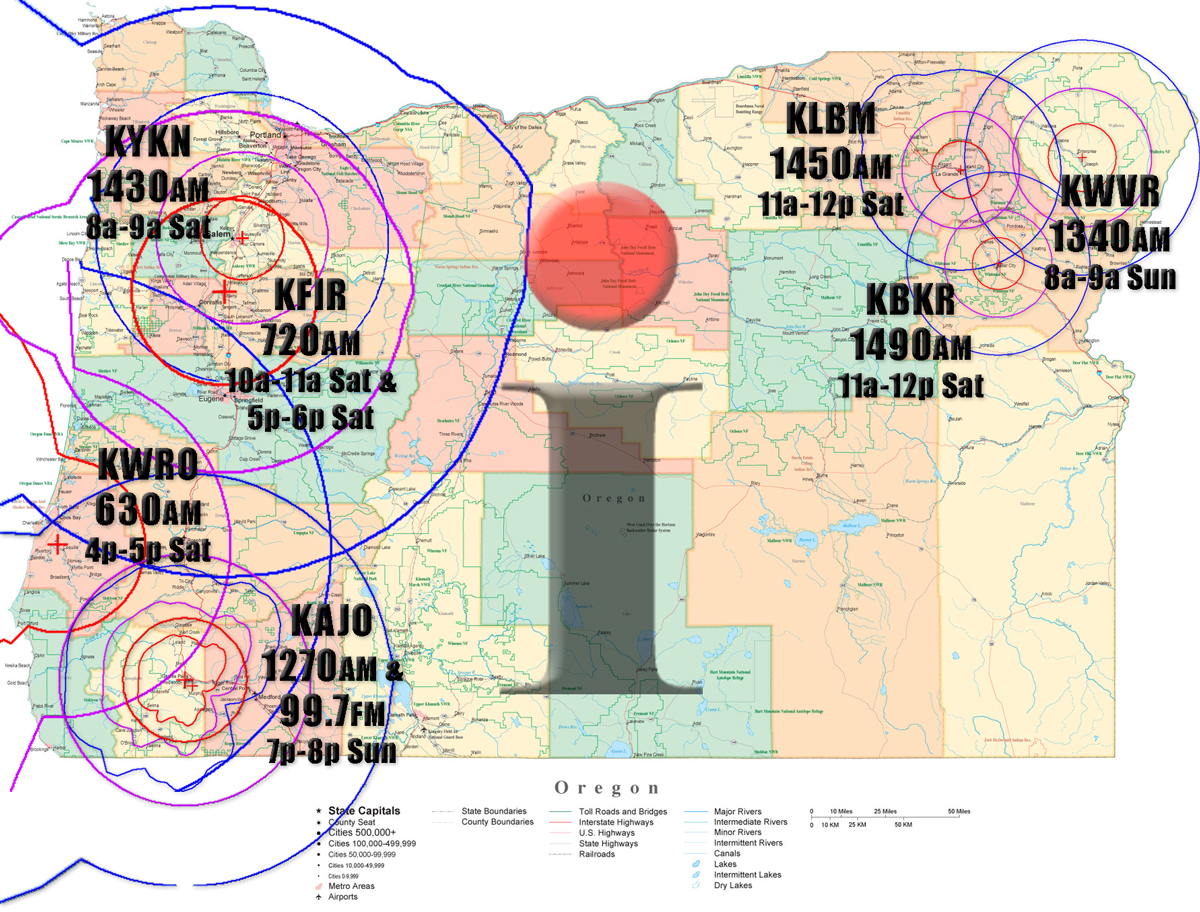
The I Spy Radio Show airs weekends — seven times across seven real radio stations, not internet-only streams. Listen anywhere through the stations’ live streams. See when, where, and how to listen for the full schedule.
Missed it? The podcast posts Mondays, after the broadcast stations air the show — here on this page or on your favorite platform.
★ Named to FeedSpot’s 30 Best Conservative Talk Shows. Thank you, listeners.