Red Flags, Media Spin, and What’s Next: Chuck Wiese on Questioning Our Elections
Meteorologist Chuck Wiese on the questions he says remain about the 2026 election, and why he says “trust us” is not an answer
About this episode
Oregon's results are in, and the official line is that the election was safe and secure. This week, meteorologist Chuck Wiese and Mark take the other side of that conversation: not “it was stolen,” but “show us.” Their position is that trust is built by transparency, and that when officials resist audits, open records and voter-roll cleanup in court, the public is right to keep asking questions.
Chuck says he is suspicious of Gov. Tina Kotek's win of roughly nine and a half points, and he is candid that he has no proof, “yet.” He blames vote-by-mail and says the Oregon Secretary of State did not live up to a commitment on voter rolls. (That commitment is a settlement with Judicial Watch; see the resources below for what it covers and what Oregon says about it.) Mark and Chuck then take on what they call media spin, including a Trending Politics piece about a Democratic messaging network, and Chuck's criticism of Senate leadership over the SAVE America Act.
In the middle of the hour they turn to what they see as anomalies: the “20 million new voters” claim that has circulated nationally, a vote-share pattern Chuck finds suspicious, why he says only cast vote records would let anyone run a proper statistical test, and a Nevada vote-count chart he describes as proof of fraud in that district. Mark adds his own observation: during the May primary, the “active voters” figure on the Oregon Elections page kept changing, which moved the turnout percentage. These are the guests’ characterizations; the page below links the primary records so you can check them for yourself.
The last half of the show is about access and accountability. Chuck and Mark discuss who has standing to challenge an election, Tim Sippel’s effort to examine the tabulation database in Washington County, the difference between an audit and a recount, who should carry the burden of proof, and why Mark sees a chain-of-custody problem once a ballot is separated from its envelope. Chuck says he would return to precinct voting. They close with Oregon’s Climate Protection Program, the natural gas utilities’ warning about its cost, and Chuck’s argument that CO2 cannot drive the climate the way models assume because water does most of the work.
This show is about asking questions. We link the primary records, court filings and statutes wherever we can, plus a range of sources that take the skeptics’ side seriously, so you can read for yourself and ask your own questions.
In this episode
Oregon’s Results: Questions About a Nine-Point Margin
Mark and Chuck open with last week’s Ed Diehl interview. Chuck says he’s suspicious of Gov. Kotek’s margin of roughly nine and a half points, says he has no proof yet, and points to vote-by-mail. Plus his views on the Oregon Secretary of State’s voter-roll record.
Propaganda, Short Memories, and the SAVE America Act
A Trending Politics piece on a Democratic messaging network, Iran and fuel prices, and why Chuck faults Senate leadership for not passing the SAVE America Act.
Anomalies: Statistical Patterns, Cast Vote Records, and Shifting Numbers
The “20 million new voters” claim, a voting-pattern analysis Chuck finds suspicious, why cast vote records matter, a Nevada chart, and the shifting active-voter denominator Mark saw on Oregon’s elections page in May.
Standing, the Sippel Case, and the “Black Box”
Who has standing to challenge an election, why Chuck wishes Christine Drazan had gone to court, and Tim Sippel’s attempt to examine Washington County’s tabulation database.
Audit vs. Recount, Chain of Custody, and Vote-by-Mail
Who carries the burden of proof, the difference between an audit and a recount, what happens to the chain of custody once a ballot leaves its envelope, and Chuck’s case for precinct voting.
What’s Coming: The Climate Protection Program and Chuck’s Case on CO2
The Climate Protection Program’s reported cost, Chuck’s argument about water vapor and the hydrological cycle, and Mark’s close.
Key questions about election audits, records and Oregon’s 2026 results
What is the difference between an election audit and a recount?
A recount re-tabulates the ballots in a contest, usually because the margin is close or a candidate requests one. An audit checks whether the equipment and process produced a correct count, typically by comparing a sample of ballots, counted by hand, against the machine totals. A recount can repeat the same ballots through the same process; an audit tests the process. Oregon law (ORS 254.529) provides for a post-election audit, and Oregon Secretary of State Directive 2021-2 does not allow alternative post-election audits outside that process. Chuck Wiese and Mark Anderson argue on the show that independent audits and access to the underlying records are essential to public trust.
What are cast vote records, and why does Chuck Wiese want them released?
A cast vote record (CVR) is a ballot-by-ballot digital record of how each ballot was tabulated. Researchers use CVRs to test results with statistical methods such as Benford-type analyses and to compare machine totals against the ballots. Chuck says no such records have been released for this year’s election, and that without them the statistical questions he raises cannot be tested. A public CVR database compiled by academic researchers (Kuriwaki et al., Scientific Data, 2024) shows that CVR release has been practiced in some jurisdictions. Anomaly claims based on partial or unsourced data should be treated as questions, not conclusions.
What did the court decide in Washington County v. Sippel?
Tim Sippel asked to examine Washington County’s election database used with its ClearBallot tabulation system. Chuck Wiese describes the case as the county and the state suing to keep a public-records request from being fulfilled. In Washington County v. Sippel (Or. Ct. App. No. A180918, decided September 11, 2024), the Oregon Court of Appeals affirmed the trial court’s ruling that the requested file was conditionally exempt from disclosure. The trial judge was Janelle F. Wipper. The primary opinion is linked in the resources below.
What are inactive voter registrations, and why do they matter in the voter-roll dispute?
Inactive registrations are records the state has flagged because mail has come back undeliverable or the voter has not responded to address-confirmation notices. Oregon says voters on the inactive list are not sent ballots. Judicial Watch announced a settlement with Oregon that requires the state to provide five years of annual voter-roll data, and Secretary of State Tobias Read has not conceded that the state was out of compliance. Chuck says the state did not follow through; Judicial Watch’s announcement and the state’s response are linked below so listeners can read both.
What did the Carter-Baker commission say about mail voting?
The 2005 Commission on Federal Election Reform, co-chaired by former President Jimmy Carter and former Secretary of State James Baker, said that absentee ballots remain the largest source of potential voter fraud. The report did not call for ending mail voting. It recommended safeguards for absentee voting instead. The full report is linked below.
How much has the Climate Protection Program been estimated to cost?
Oregon’s natural gas utilities have told customers that the program is expected to cost them about $4.9 billion over its first 11 years (2025 to 2035). Willamette Week reported on April 3, 2026 that the figure came from the Alliance of Western Energy Consumers, that the Oregon Department of Environmental Quality had made no estimate of its own, and that DEQ says per-ton comparisons with other states’ programs can mislead. On the show, Mark says Oregon’s contribution to global emissions is about 0.18%; Chuck argues the program cannot affect the climate.
Links & resources mentioned
Our Guest
- Thielman v. Fagan: complaint (federal court record; Chuck Wiese is a named plaintiff)
The Court Records Behind the Questions
- Washington County v. Sippel (Oregon Court of Appeals, September 11, 2024; the Sippel public-records case)
- Wong v. Fagan: case summary (Civil Rights Litigation Clearinghouse; 2022 federal suit by Mei Wong and Dana Hindman-Allen, dismissed 2023)
Oregon Election Records to Pull and Compare Yourself
- Oregon election statistics (Oregon Secretary of State)
- May 19, 2026 primary turnout statistics (Oregon Secretary of State; active-voter counts are updated daily)
- Election results portal (Oregon Secretary of State)
- ORS 254.529: post-election audits (Oregon Revised Statutes)
- Directive 2021-2: post-election audits (Oregon Secretary of State; prohibits alternative audits)
- Oregon’s audit law, summarized (Verified Voting)
Chain of Custody and Mail-In Ballot Security
- Building Confidence in U.S. Elections (Carter-Baker Commission report) (2005; U.S. Election Assistance Commission)
- The Carter-Baker Commission, 16 years later (Baker Institute)
- Safeguarding Our Elections 2026 (Honest Elections Project)
Voter Rolls
- Oregon voter rolls: Judicial Watch announcement (Judicial Watch; read alongside the state’s position that inactive registrations are not sent ballots)
- Clean up America’s voter rolls (Honest Elections Project)
- Public Interest Legal Foundation (voter-roll litigation and research)
The SAVE America Act
- Senate floor debate, March 17, 2026 (Congressional Record)
- Thune: proof of citizenship and voter ID shouldn’t be controversial (Senate Republican Leader’s office)
Media Spin
- “Now It Can Be Told”: Van Jones reveals the Democrats’ coordinated messaging machine (Legal Insurrection, November 8, 2026 (opinion; the traffic figures are Van Jones’s own, as read from his notes))
Cast Vote Records (for the data-minded)
- Cast vote records database (Kuriwaki et al., Scientific Data, 2024; raw dataset on Harvard Dataverse)
The Climate Protection Program and Chuck’s Climate Case
- Climate Protection Program news (Cascade Natural Gas; the $4.9 billion estimate over 11 years)
- Oregon’s Climate Protection Program costs far more than other states, and is far less accountable (Willamette Week, April 3, 2026)
- Climate Protection Program (Oregon DEQ)
- CO2 Coalition (climate and CO2 research and education)
- Oregon’s Election 2026: the universal health plan and the Climate Protection Program (I Spy Radio, Show 16-42)
- Sixteen Years in the Making: Oregon’s March to Socialized Medicine (I Spy Radio, Show 16-31)
About the guest
Chuck Wiese is a meteorologist and an Oregon State University graduate, a longtime climate-science skeptic, and a regular guest on Lars Larson's nationally syndicated show. He has testified before the Oregon Legislature on PFAS in wind and solar infrastructure and has challenged the attribution of Pacific Northwest weather events to climate change. In federal court filings he is identified as a retired meteorologist and airline pilot, and he is a named plaintiff in Thielman v. Fagan, an Oregon election case.
He joined Mark to talk about the 2026 election, election security and the Climate Protection Program.
Full transcript ▸
MARK: Last week, we got the perspective on the election from a soon-to-be-former politician, Ed Diehl, in particular. What now for Oregon’s elected Republicans, given that Democrats expanded their three fifths supermajorities and are now just one seat shy of two thirds supermajorities in the House and Senate?
Which is strange really. They expanded their lead and retained the governor’s seat, despite how poorly Oregon is performing in nearly every state-to-state comparison, averaging roughly forty fifth or worse in every metric. Economy, jobs, education, housing costs, tax burden, and dead last in mental health.
And yet, voters looked past Democrat failures. Failures that Oregon voters are personally living through and blamed Republicans for what’s happening in Oregon despite Republicans not being the ones in charge.
So... the cat knocked the glass off the table—but punish the dog for it.
Worse, Democrats took control of the House and Senate at the federal level, and that fact will embolden Oregon’s Democrats to go further than they ever would have dreamed of otherwise. Oregon Democrats have already pledged to raise billions in more taxes now that the election is over and to remove barriers that stop government from raising taxes.
Like if you thought property taxes were already too high. Well, Democrats think they’re not high enough. Just remember, when Democrats raise your taxes, it’s the Republicans fault. This week, we’re going to get the perspective of a voter and everyman sort of take on things, albeit a well-informed everyman. Chuck Wiese. Chuck is a trained scientist, meteorologist, and a fearsome global warming debunker. Chuck, thanks for joining us today. How are you doing?
CHUCK WIESE: Well, I think I feel a little bit like you do, Mark. I’m a little—very disappointed would be putting it mildly—in how things turned out in the elections. But I’m not sure what’s going to be done about it yet.
MARK: Yeah. It’s the what’s going to be done about it. I think that will be really interesting. I think going into the election, I actually had some pretty high hopes. I saw the polls and didn’t really trust those because polls have proven to not be reliable recently. But I really thought that Oregon, we had a really good shot at the governor’s race.
I, in fact, I thought this was probably the best shot that we’d had in decades, certainly since I’ve been here in the late nineties, in the sense that we had a horrible governor that most people, even on the Democrat side, really hated. And yet we voted for a horrible governor that we all hated. Anyway, I don’t get it.
CHUCK: Well, I don’t get it either, but that’s one of the things that makes me very suspicious of Oregon’s entire election system. And we could have quite a discussion going back in time as to problems that surfaced with this, that, from what I know, nothing has been corrected in it at all. And one of the things that really shocked me about this year’s election in Oregon for governor was that Governor Kotek won over Christine Drazan by a nine point five percent margin.
And that’s the largest in Oregon’s history, other than one other election that occurred back in nineteen ninety eight. And that was when John Kitzhaber was going up against Bill Sizemore, and he won that by thirty four percent. But Bill Sizemore was an outlier because he had a lot of baggage that Oregon voters were aware of. And that caused a huge turnout against Sizemore. So he really isn’t a fair comparison to other elections like we had this year. And so if you if you exclude Sizemore, she is the largest percentage of win over her opponent.
And given the record, given her record and given what we know about her, what she’s done since she’s held the reins of power, that’s very hard to believe that voters are that stupid, that they would come back and vote that big of a margin to put her back in power. I just I don’t understand that at all.
And it makes me very suspicious that there’s ballot stuffing going on, and it may very well be no proof, of course, yet, but it makes me wonder whether or not Oregon cheaters, the ones that do this sort of thing or would do it, were padding and were stuffing ballots because they stuffed too many of them and overplayed their hand because they thought this race was going to be a lot closer than it actually was. So we end up with this big margin. Now that’s something that’s going to have to be looked into.
I don’t have any proof of it, and neither does anybody else. But you’re not going to get the proof if you don’t start looking into things. And that’s what I think disappoints me so much about Oregon. We just keep settling for this. And I think that there’s a lot wrong with our voting system. Vote by mail is the big problem. It’s a huge problem.
And as you remember, when you looked, you know, when you look in this year’s events, the Department of Justice sued, you know, the state of Oregon to clean up its voter rolls and made an agreement with them to do just that. But from last week’s interview that I had listened to with Dr. Douglas Frank, who looks into a lot of this vote by mail, the tallies and keeps track of registered voters, he was saying that Tobias Read did not get rid of near the number of dirty registered voters that he was supposed to do in the agreement that he had with the DOJ, that they had a settlement agreement and he didn’t live up to his part of it.
But nobody’s saying anything about that. And then after these elections were over, Harmeet Dhillon, who was in charge of the Justice Department and was and basically would have had to look into all of this, she suddenly quits and doesn’t give a reason. Just she just says, I think I’ve done all I can do for the DOJ and then leaves. But yet this mess, This huge mess was still there and needs to be looked into and nothing was done about it. Why? That’s the big question.
Well then why? Why do we have Kotek win by such a big margin with all the problems she had? And there was nothing in Christine Drazan record that would have caused voters at the last minute to turn against her. You’re either going to vote for her because you believe in what she was going to bring to the table as a new governor, or you’re going to go back and say, now we’d rather just have the same of Tina Kotek. And we know the disaster. She has already tried to shove down voters throats here in Oregon, yet a nine point five percent margin. Come on.
If it was one percent or two percent, I could understand. Perhaps. Maybe, the people in this state still want this sort of thing. It’d be more believable, but a nine point five percent margin makes no sense to me.
MARK: It is a little suspicious in terms of exactly how large the margin was, and we’ll come back to the election fraud a little bit more. As far as why they won. Can you think of anything as a Republican? Let’s say that you were in any B that would have made you want to vote for Democrats this year? I mean, normally I would think someone would say, wait a minute, Oregon is at the bottom of the tank here. Why would I want more of this? Did you see anything from the Democrats that might have persuaded you to think that Democrats were the better choice?
CHUCK: There’s nothing that would have been persuasive to me. And as you know, my biggest objection to Democrats in this state was the horrifically bad and fraudulent climate policies they’re trying to shove down people’s throats that are going to be extremely costly to the price of energy in Oregon and the price of gas. Once this climate protection plan of Kotek’s takes off. And we have to remember, we voted down the gas tax, but she substituted it and made an executive order for the climate protection program so it wouldn’t die.
And now I think there’s enough Democrats in the House and Senate in Oregon to where she’s very likely. One of the first things she’ll do is she’ll make that law to where it can’t be challenged legally. Once she has her Democrat cohorts do that and we’re headed for a disaster with that, it’s going to be absolutely disastrous. And then you know what, what the plan is with health care. They’re going to try to go single payer. It’s going to be just like Canada in Oregon.
And that’s another big reason why even Democrats and if not Democrats, certainly independents should have said, no, we’re not going there. We’re not going to have our health care system destroyed, and we don’t want to pay this kind of money for the price of energy in this state. Those are the two biggest reasons for me, why I wouldn’t even pay attention to anything else. That’s enough for me right there to say there’s no way I’ll vote for these people.
MARK: Well, it’s not just the lack of positive messaging in terms of why I would want to vote for Democrats. That is confounding to me. But there may be an explanation for that, and we will talk about that in the next segment. Stay with us.
MARK: And welcome back continuing our conversation with Chuck Wiese. He is a trained meteorologist and a fearsome global warming debunker. And but he’s also an informed voter. And so today we’re talking about what happened from an everyday voters perspective. And so, Chuck, one of the things that I talked about going out of that break was that there may be some explanation as to why Democrats won this so badly, because that was one of the things that really surprised me. Okay. I could see that, you know, they flipped some seats here and there.
And I, a lot of people were thinking, okay, well, they may take over the House or the Senate on the national level, but it won’t be by much. a few votes and stuff. So effectively flipping what we’d had. But there were some big wins in the House, in the Senate. So they’ve taken control by pretty good margins. And I just came across a really interesting article. It’s from Trending Politics, and the title of it is CNN reveals Dems secret online propaganda ring used in midterms.
And I just came across this last night and it has some really interesting perspective. And it was a coordinated effort by the American Accountability Network, and Van Jones claimed on CNN that the operation generated an extraordinary volume of online activity, including thirty two point five million daily Instagram hits. And these are daily numbers eighty eight point eight million on X and one hundred and eighty five million on Facebook, helping Democrats control the economic conversation.
He said this, quote, driving the kitchen table affordability message and tying that to Democrats on a positive and Republicans on a negative. So it’s it was very much a I mean, it’s like a massive media campaign every single day. And when you look at that, you think, okay, well, now I can understand maybe a little bit as to why people that would normally have looked at things and said, well, if Democrats can empower, there’s going to be all this massive move to socialism rather than keeping Republicans in control saying, you know, I don’t really agree with how they’re doing some of these things, but at least they’re not going to destroy America.
What are your thoughts on that?
CHUCK: Well, some of that makes sense. I mean, you can propagandize. And if they put that much propaganda out there and a lot of the stuff that I saw prior to the elections that I that you’re talking about that you would see online was just B.S. just a lie because you knew what the truth was. But, you know, whether somebody else recognizes that to be a lie or the truth depends on how much they’re into keeping track of what these people do.
But what I don’t understand about that is that we know why people got rid of them in the last election cycle, when Joe Biden was in the White House because of the horrifically bad things they were doing. They were the ones that allowed the border to become wide open. Millions of people flooded across the border. They did nothing to stop it. They were told people wanted to have it stopped. And yet they didn’t stop it.
And then all the other things they did that caused the price of energy to rise in, in this country because they believed in the same sort of climate nonsense. Oregon is passing. And then, of course, they discovered that Joe Biden was senile and this was being held from the public. He wasn’t really up to running. That’s why they kept him in the basement during the 2020 election, to where people couldn’t see how bad he is and how he couldn’t debate anybody. So you put all that together and people started to see, you know, that, hey, this guy is bad.
He’s got to go. So they did. The voters got rid of him in 2024. And now here we are just a short time later because of the war. Was it because of that? I don’t know. I’m guessing that might have had something to do with it, but why would people have such a short memory looking back on what horrifically bad things these people were doing, and a lot of them are the same Democrats that want power back? Why would that be given to them if this was a fair election? I don’t I can understand some seats being lost because not everybody thinks the same way.
But to the degree this happened makes me highly suspicious of of the outcome of it. Just like I’m suspicious of things that have been happening here in Oregon. That part of it I don’t understand. are people that really are they that tuned out to where they’ll listen only to this propaganda? Not, not widen their view of things and get the other perspective from the White House and things that were being said.
From my point of view, the only thing that I think hurt, the Trump administration was the cost of fuel did go up during the war and the length of time that the president kept telling people he was going to be engaged with Iran was going to be horrifically short. He would end it just like he did Venezuela. And it didn’t work out that way. Iran has, I think, been planning for this themselves for a long time and had ways that they’re probably instigating now to hang on to power, even though he destroyed their military. There’s nothing left of that.
But they’re not going to surrender. This regime is probably hiding out somewhere. They probably stored food. Been stacking it away, thinking that the day may come where a country like the United States, or maybe even with the help of Europe, was going to challenge, they’re trying to build nuclear weapons or acquire nuclear weapons. And if that happened, they wanted to assure they would survive.
So I think they’ve been socking food away and supplies to where even with their currency tanking that the U.S. has done to them, they’re still able to hang on to their power because they’re armed and they can still eat. That’s an important thing. And Trump hasn’t been able to stop that. So that part of it, and then the price of energy going up might have turned some voters against him because there, there were certainly people that didn’t believe in wars, didn’t want one started. And Trump has always said, I’m not a person to start a war.
But he did start one with Iran.
MARK: I think the you kind of hit on it earlier is, I really think a large part of what is wrong with how we vote is the uninformed voter. And you said that they have short memories. Well, it’s not just have a short memory, but they’re just uninformed on the issues as well. But when you have something, the scale of what they’re talking about there, where they’ve got tens of millions of hits, one hundred and eighty five million hits a day on Facebook, helping to Democrats control the economic conversation. that just makes disinformation that much more possible when you’ve got that many people all saying the same thing.
And that’s why I really don’t like social media very much, because it is so easily manipulated. You can kind of control who’s in your feed and who’s not. But when you’ve got multiple people all saying the same things and the Republicans are at fault for the economics, forgetting the fact that the economy is actually doing pretty well. We just recently, we broke a record in terms of the lowest number of people below the poverty line. Ever since they started recording those numbers. We also had the highest median wage ever.
So people are doing better economically, and yet somehow Republicans are at fault. The gas price and everything else. Republicans were just overwhelmed with the messaging. And somehow we’ve got to figure out a way around that. And I get worried that social media is going to just make things worse until we figure that out.
CHUCK: Yeah. And then the other thing that I didn’t mention yet was the fact that we have Republican leadership in the Senate that’s been a real thorn in the side to what President Trump has wanted. One of the biggest things that John Thune, who was the Senate majority leader, failed to do and just refused to do. Never gave a good reason was to pass the Save America Act, which may have stopped a lot of what we just saw happen in the election. If you want to blame somebody for a any part of this, of what happened, you can lay it right at the foot of John Thune.
And I think that disgusted some Republican voters as well.
MARK: Yeah, it absolutely just fed into the narrative that, well, the Republicans just made these promises and they didn’t fulfill them. So. All right, everyone, stay with us. We’ll continue this conversation with Chuck Wiese after this.
MARK: Talking today to Chuck Wiese, talking about what happened in this last election from an every day but well-informed voters perspective. Chuck Wiese is a trained meteorologist and a fearsome debunker of climate change alarmism. And so, Chuck, I’d like to talk about climate change coming up in the next segment or two. We had talked previously in that segment about the overwhelming margin of victory in some of these. And whenever you have a shift that large, it to me is very suspicious.
One of the bigger ones, I think, is the fact that we had twenty million voters just kind of appear out of nowhere. And if you look back over the last few midterms, you can see kind of a pattern there where Republicans are getting about between fifty three and I think, fifty five million votes in each one of those. And the Democrats would would get roughly the same. And then all of a sudden, they had nineteen million more votes this year than they did previously.
And that ties in very closely to twenty million voters that got registered from states that had no voter ID requirements. So looking at things like that, do you see potential evidence of election fraud? And again, they’re just still kind of looking at things. They haven’t really announced anything that any formal investigations. But there is a lot of allegations of things that just look suspicious. You are mathematically trained. So what are some things that kind of raise some alarm bells for you?
CHUCK: Well, those twenty, you know, extra twenty million voters obviously raised a red flag. And I don’t understand why the DOJ was sitting back and saying nothing about this unless somehow this was kept from them until, you know, very close to the election. That’s one thing. But there’s another statistics that showed up, and I’m not sure who has done it, but there is a predictor, like there was in the 2020 election that you could have the total votes cast and the separation between them in every state stay within a fifteen percent bandwidth or margin by just allowing all the candidates to get eighty five percent of Trump’s votes, it causes the Democrat vote to go up and the Republican vote to go down since the twenty twenty four election.
And so that is very suspicious in a in an in and of itself. But it doesn’t prove there was fraud. But it sure says you’ve got something statistically here that needs to be looked into. And I understand the Trump administration is aware of that, that work that was done. But then the other thing that I would want to see to back it up to, to further call for a forensic investigation and look into the voter fraud significantly, or that the possibility of it is to do a Benford distribution type study, which we did in 2020 when Joe Biden won, and you need the cast vote record in order to do that, to get the sequence of of votes for Trump, votes for the Democrats.
That sort of thing. With all of Trump’s people that he wanted to win the election, you need to look at that distribution from the cast vote record. And I haven’t seen anybody yet that in any state that’s actually released it. So that needs to be looked into. And if it couples with what we know, with this fifteen percent band, then you’ve got to start doing forensic evaluation state by state of all these places where you’re highly suspicious that things are going on. You’re going to have to do this.
If you just ignore this, you’re going to invite another disaster in 2028. And one of the things that was even more suspicious, that was actual proof. We do have proof in one area, that there was voter fraud. It was a Nevada district for, I’m not sure of the seat. I’m not sure if Lone Raccoon is what he calls himself online, but he’s basically, Mike Lindell’s election expert that looks at all of this stuff and he was reporting in Nevada District four. He actually plotted it out where the.
At the start of the counting in Nevada district four, there was a sharp rise in the in the vote tally, which you would expect there to be. And the Republicans were ahead in that district all the way up until the votes started to level off. And then all of a sudden, out of nowhere, the vote tallies start to decrease. And when they decreased, there was a crossover where the Republicans fell behind the Democrat. And in the end, after they shaved a bunch of votes off the Democrat in that district won. Now, that just doesn’t happen in reality.
That that right there is proof of fraud, at least in that one particular district. So now we’re going back to looking at, since that was a machine tabulation, and we’ve said this many, many times before, the machines are a disaster and you really got to get rid of them. And this is one good example of why that would be so. Why this happened? I don’t know, but it’s got to be fixed. Hopefully they’re going to look into this and say, yeah, this election and this district has to be done all over again. You can’t rely on these results.
You don’t go shaving votes off of candidates and then cause a flip in who wins this when the Republican was ahead all all up until the time that, shaving of the vote started to occur. And then all of a sudden there’s a flip.
MARK: There’s something similar to that that happened here in Oregon back in May. I happen to be watching the late returns during the primary because I was following that race very closely. And the online page for the Oregon Elections Division kept fluctuating in terms of the denominator of active voters.
So you look at the ballots returned versus the active voters that gave you the percentage of ballots cast, except what would happen was there would be fluctuations where suddenly there’d be one hundred thousand more active voters than there were like an hour ago. And then a little while later, there’d be like two hundred thousand less than there were at that point. And it was these wild swings. And I have as yet to hear a valid excuse for that. There was an article recently that I saw on Facebook.
He was saying, well, he contacted the elections division and their explanation was, well, those are never static numbers. They’re always constantly being added, added to and subtracted from as people become active voters or they don’t vote. And so they moved into inactive. And okay, so I can understand some of that and that would make sense that okay, so somebody that hasn’t voted in a while suddenly shows up at the elections department and says, hey, I didn’t get my ballot. I like to cast a ballot this year. Fine.
They’re now added back to the active voters. However, in the middle of an election, it makes no sense to be taking them off the active roll because how do you know that somebody is not going to cast a ballot that that year you haven’t finished counting all the ballots. You haven’t even accounted for all of them coming in. And also, we know that they will allow some coming in up to seven days late as long as they have the postmark. So you don’t know that somebody that was active is suddenly now inactive.
So if anything, the number would go up but have it swing wildly down. That makes no sense.
CHUCK: Well, there were two candidates, Mark. And to, uh... you’re right about this whole thing because there were two candidates in 2022 elections. Midterms elections, right here in Oregon that saw this very same thing happen to them as they were watching the votes come in. One of them was Mei Wong, who ran for the Metro Councilor District two in Clackamas County, and then the Clackamas County Commissioner that was running was Dana Hindman-Allen, and both of them were watching the returns come in and Mei actually saw on the TV screen.
And she took pictures of it. So she’s got proof that it was happening where the vote tallies were going up for her. She seemed to be doing okay and suddenly the vote tallies started decreasing and they never came back. She watched them go all the way down until it flipped and she lost. And they fought this thing, and they did everything they could to try to make the claim at the end of that election that those things had to be redone. They just weren’t going to accept the results.
And they both of those two took the initiative because they didn’t have a lot of money. They filed a lawsuit, pro se, and it went through the Oregon courts, but the courts did the same thing they had done to all the lawsuits. In fact, the one that we had going, as you recall, it goes into the chain of the court system in Oregon, and the courts just don’t want to have anything to do with it. And they use standing as an issue to throw everything out.
MARK: But now any candidate has standing. So I just looked at the clock. We are way past our time. So everyone stay with us. We’ll continue this discussion about election fraud and what may or may not have happened this time with Chuck Wiese. Stay with us.
MARK: And we’ll come back and talk about what happened this time around when the election. We’re doing that with Chuck Wiese. He’s a trained meteorologist and also fearsome climate change debunker. We’re going to hopefully get around to that. But this discussion on the election fraud and potential for it anyway has been really fascinating.
So, Chuck, we went a bit long in that last segment there, but I think there’s still some things to talk about because we’re looking at some of these suspicious activities, certainly here in Oregon as well, in terms of how these things are reported online. And they’ll say things like, well, it’s they’re not really one hundred percent accurate because the various machines are feeding things at various times and the machines aren’t directly connected. It’s somebody getting information from one machine and then posting that online.
So I guess they’re trying to say human error or something. Possibly. But regardless, when you see things like your vote totals going down like that, and they try to get this through the court systems, as you mentioned, they kept going to the courts and the judges kept saying, well, you don’t have standing. Well, that is no longer the case. Now any candidate has standing, and they are able to immediately challenge these things. However, I’m not seeing anybody doing that yet.
CHUCK: No, I’m not either, and I’m very disappointed in Christine Drazan. She could do this. I think a lot of the candidates are scared of becoming sore losers. If they challenge something when a lot of people say, well, from the outside, this looks really clean, but you’ve got to as a candidate, knowing the problems that have been with these tabulation machines and everything else. If I was a candidate and lost, I would be saying no matter what, that you got to look at the entire system and make sure that everything was done correctly.
And if I won, I would say the same thing, because I’ve always been a believer that we’ve got to straighten the election system out. And I would do that with the risk that maybe I could lose. I don’t know, but you’ve got to straighten it out. You can’t just sit back and accept these results with all the suspicious circumstances that we’ve seen going on in the past and right here in Oregon, you know, we had such a case back in 2022. It was a Tim Sippel case. And Sippel was not a candidate that ran, but he was just a guy that wanted to see the machines.
He wanted to see ClearBallot tabulation machines on a test vote that they ran with ballots. And then a result cast by the machine. He wanted to see how the algorithms and the machine worked, and tried to get a hold of the of the SQL database in that test run. And Kevin Barton, who was the D.A. at the time, gave him permission to do it. And no sooner did he get permission to look at this, that Washington County turned around and sued him.
And no sooner than that did Ellen Rosenblum, the district attorney at the time for the state of Oregon, through the secretary of state, intervened and joined that lawsuit. And we watched that thing go all the way through the courts. And some of the reasons and rulings that this judge made, because it wasn’t a jury trial. The judge decided the whole case. Some of the things she decided were just stunning. I mean, it just made you want to pull your hair out.
And one that I’ll never forget is we had forensic expert on elections, Douglas Frank, who was going to testify at that trial, and he was told by the judge, the judge bought into the explanation from the other side in Washington County that Douglas Frank is not qualified to discuss this because he doesn’t have a PhD in political science. Are you kidding me? I mean, that is so ridiculous. But those are the kind of rulings that this judge gave. And then in the end, it turns out that the state won the case. Tim was never able to look at it.
And so the machines remain a mystery. They’re the big black box that nobody knows about or is able to look into, to see and make sure that tabulations are done correctly. So here we are, and nothing’s changed.
MARK: And that whole case didn’t make any sense from the standpoint that what Tim Sippel was asking for was access to the SQL database. SQL is commonly called that, so people understand what that is: it’s a way of querying a large database. And so you’ve got four million voters. You know that’s too big for something like Excel or anything like that. What SQL does is it, it accesses the database in the sense of, okay, so I want active voters that have this many. You can query it any number of ways that you want.
So it’s kind of like the secret sauce in terms of how they would access that database. So there shouldn’t be anything nefarious about that in an elections. It’s just simply saying, okay, which voters are valid voters to vote and this ones. And did they or did they not vote? The other aspect of that too, was they considered that proprietary.
CHUCK: Yes. That’s right. They consider it proprietary. And the judge signed off on it. And there was nothing proprietary in it because in that agreement that Washington County had with ClearBallot, they can do anything they wanted with that data. And that’s all Sippel was asking for. He wasn’t asking for their operating codes or anything else. He was simply asking to see that database and how the machines processed it. And the and the judge sided with the state saying, no, it’s proprietary. It would hurt the public for the public to learn about this.
That is so ridiculous. It’s like I said, you wanted to pull your hair out with some of these decisions that they were making, and it makes you suspicious that our courts are not working for the people when it comes to this. They protect the state rather than letting the people kick the tires and look under the hood. And that’s all Tim Sippel was asking to do.
MARK: Yeah, but if the public would be harmed by the truth, then something’s wrong with the truth. All right, stay with us. More to unpack on that potential for election fraud. And then coming up, we’ll also be looking at the amount of damage Democrats are about to do to Oregon. But of course, it will be the Republicans fault.
MARK: And welcome back. We’re talking about this recent election. We’re doing that with Chuck Wiese, a trained scientist and meteorologist, and also a tenacious climate change debunker. And we’ve been getting his perspective as a well-informed voter on this election. He is also actively involved in the election integrity movement and was part of a couple of lawsuits. And I really think that that’s a large part of what we’ve been talking about today.
As it comes down to trusting elections, there is some suspicious activities out there, twenty million voters suddenly appearing and all of them voting for Democrats. That I think is suspicious. There’s some statistical analysis issues too, as well with some of these other ones. But as far as election integrity, because that to me is the heart of any election, is you’ve got to be able to trust it. And yes, you do. It shouldn’t have to be on us to prove that there’s fraud. It should be on the government to prove there isn’t fraud.
And because that’s really the whole aspect of of an audit is that, you know, the IRS says, well, hey, you did something wrong with your with your taxes. And so we want to audit you. So yeah, they from their perspective, they’re looking for potential fraud. But but then the point of going through that is, again, to prove that there wasn’t fraud happening, that there wasn’t something wrong with the taxes. And I think it’s that same thing with these elections is, is that you’ve got to be able to prove that there wasn’t fraud.
And, and I think they should be happy to do that. And the fact that they’re not happy to do it, that’s a real concern.
CHUCK: Yeah, you’re absolutely right, Mark. That’s the way the government should be looking at this. If somebody is suspicious, it’s up to the government to show us that, no, there really isn’t any reason for you to be suspicious. And here’s why. And then to show you and and if the public inquiry is satisfied that way by letting us look. It’s like I say, kick the tires and look under the hood. That’s all the public wanted to do that had suspicions about this. The government should have bent over backwards to help anybody, to do this.
And instead they threw up defenses and they sued, and they sued their way into not having to demonstrate anything to the public under their false claim that it was going to harm the public. It isn’t going to harm the public at all. All it does is make people mad. When you have a problem that you want to get looked at and make, and to make sure that, any results that made you suspicious were anomalies rather than real problems, it was their job to show us there was no real problem. It was statistical anomalies.
And they’re explained away by them demonstrating that there’s nothing wrong with these machines. And they never did it right and they refused to do it. I have a feeling if somebody tried to do this again today, you’d get the same result. You’d get slapped with another lawsuit, and they would block you by just getting the courts to agree with them.
MARK: And that in itself is very suspicious. If there’s nothing wrong there, then you should say, come on in, take a look. We’re happy to show you. We’ll show you anything that you want. Exactly. And in doing so, that will help us prove to everybody else that there was no fraud, that these elections can be trusted. And the fact that they will sue you for even asking questions. That is highly suspicious right there.
CHUCK: Yes it is. And they went against D.A. Barton. Kevin Barton told Tim Sippel, you are allowed to look at this. He looked at the legal aspects of it and said, it’s all above board. You’re allowed to do it. And then it was Washington County that turned right around and said, oh, no, we don’t agree with that. We’re going to sue him. And they did. And then they got Ellen Rosenblum to stick her nose into it, along with the secretary of State. And they joined the lawsuit and just tried to bury us and bury Tim Sippel so that he couldn’t look at anything.
And Judge Wipper sided with the whole thing. It was ridiculous. Some of those rulings were just crazy. But we had to had to live with it because that’s our system. We’re supposed to trust our judges and yeah, and get good rulings. But then you see things like this happens and it really makes you lose faith in the system. When you see the kind of rulings that we saw in that. Yeah. And that and today’s elections are still carryovers to it because we never got the answers to things we had sought.
MARK: Well, I certainly think that every election ought to be audited. And just to be clear, an audit is different than a recount. A recount just counts the ballots that are already in the box. I’d like to know how those ballots got in that box in the first place.
And I think that is a large part of why it’s hard for me to trust these elections: once that ballot is separated from that envelope, you no longer have any means to tie that ballot back to an actual voter. We’ve got a million ballots in this box. But how do you know how they got there? It’s a chain of custody issue. One of the reasons they do that, of course, is because they want to maintain the secrecy of the ballot, while secrecy is how you get fraud in the first place.
CHUCK: Yes, it absolutely is. I mean, if somebody said, you solve this thing, then if you don’t think that what we’re doing now is fair, I would say, okay, vote by mail is going. The machines are going, and we’re going to go back to the way we used to do things, which was a good way to do things, which is what they do in France. The country of France abolished voting, machine voting because they knew there was fraud.
And so I would go back to where you have the individual precincts, and there’s a whole bunch of them in each county, and you have to show up at the precinct that you were assigned with your voter registration. That’s where you’ll get a ballot. But you have to show your identification to get the ballot. The people that count at those individual precincts are from both parties. You got Democrats and Republicans both to watch each other, make the count at each precinct.
And then when those are tallied, the ballots are bundled up and they’re sent back to the the county and they remain that way. They’re not just, you know, undone and then put into another tally machine where they’re all mixed up. They stay at the precinct level so that if there needs to be an audit, it’s a lot easier to get that done when you tally votes that way and there’s less chance of error.
That’s the way we used to do things in Oregon, and then everybody’s gone to this vote by mail now, where everything now with that action became centralized, where the ballots show up at the county, they’re processed by these huge machines at the county level. They’re all mixed up. And there’s all kinds of opportunity for the machines to do wrong and for people to do wrong with loss of chain of custody and everything else with vote by mail, it’s a horrible system. We should have never done it. And in my opinion, there’s no there’s no defense to it.
It needs to be stopped. If you want to assure there’s going to be free and fair elections, you can monitor things a lot more carefully. If you have the system, go back to the way it was. But it does mean if you’re going to do that, you’ve got to have the gumption as a voter to go down to your polling place, oh, poor you, you’re going to have to get into a car. You’re going to have to get to a polling place. Well, if you don’t have the gumption to do it, then you shouldn’t be voting anyway. Yeah, that’s the way I look at it.
MARK: Yeah, absolutely. All right, everyone, stay with us. We’ll wrap things up with Chuck Wiese coming up. The fraud that giveth and giveth and giveth.
MARK: And welcome back in our final segment now with Chuck Wiese, we’ve been talking about the election, and now I’d like to switch over a little bit into the aftermath of the election in terms of what’s coming next. We do have some pretty good indicators of what the Democrats plan to do here in Oregon. They are almost one hundred percent certain to try to push the climate protection program away from an executive order and make that into actual law, and they can do that, being that they’re so close to a supermajority of two thirds.
So, Chuck, if that moves forward, this is going to cost Oregonians literally tens of billions of dollars. And in fact, it’s so expensive, they haven’t even given any economic impact in terms of the amount that will cost Oregonians. There is one indicator with the natural gas companies, they have warned people that this is going to cost ratepayers four point nine billion dollars over eleven years, and that’s just one small segment. So I’m guessing over eleven years you’re probably going to be closer to twenty to thirty to maybe even fifty billion dollars.
This is going to cost Oregonians. And all of this based on a false premise of climate change due to CO2 in the atmosphere. And you gave us a really great explanation for the hydrological cycle. When I interviewed Jen Hamaker a few shows ago. Talk to our audience about that.
CHUCK: Well, Mark, it’s been understood all the way back to the founding principles of atmospheric science, that CO2 doesn’t have any ability to control the Earth’s temperature or climate. We’ve had that understanding for a long time on the principles and scientific calculations done to prove that have never been disproven, and that’s extremely important in science. You have to disprove something if you’re going to throw it out.
And the unfortunate thing that happened here is part of the computer age when we got computers that can do a lot of additional calculations, suspicion that maybe CO2 could change the climate came into the realm of things. So they started making a computer model of the Earth’s atmosphere and which is impossible to predict the climate with. There’s so many things that can go wrong with that.
And they just ignored all those ran their models and the models showed that, oh, wait a minute, CO2 can change the climate and it can’t change the climate because of the fact that we are a water rich planet that, you know, eighty five to ninety percent of the Earth’s greenhouse effect is caused by having water on planet earth, be it clouds, be it water vapor, and the various phase changes that this goes through with its own thermodynamic properties and the range of temperatures that we see on the earth.
And it was done a long time ago, an experiment set up where we wanted to see what would happen just with water vapor alone. What if you didn’t have any CO2? You just put an amount of CO2 into the atmosphere, into a model atmosphere that you do calculations with by hand, and you see how the temperature will change in the vertical. If you do that without any transfer of heat from the ground to the atmosphere, you just let radiation do all the work.
If you do that, you reach the atmosphere, reaches an impermissible state where it’s going to automatically have to overturn to restore hydrostatic stability. And when it does that, it creates convection. The convection will cause the air to cool as it rises, and the water vapor in it will then condense and form a cloud. And that process keeps going and keeps going and keeps going until you reach an equilibrium temperature higher up in the atmosphere.
Well, what you’re talking about there is a cumulonimbus tower, a thunderhead that that is a hydrological cycle. You took water vapor, you condensed it into liquid droplets, you cause precipitation, and then the sunlight gets blocked coming in to try to stabilize things. And that becomes a self mitigating thing. And it proves that if you added CO2, CO2 wouldn’t have any ability to change anything because it only absorbs that same infrared radiation over a very small wavelength band, and it can’t overpower it in any sort of way.
So the most you could expect it to do is to just add to the hydrological cycle in a very small way. And that’s that’s what we discovered years ago. And nothing has changed with that. The only thing that changed was models. And the result and output of these models is an abject failure. They have extremely overestimated rise in temperature. And I don’t even think they know what it came from.
They say it came from CO2, but I don’t think that that we have any we have no proof of this at all, because you can’t project the climate accurately with these models anyway. So I could get into—
MARK: In the time that we have left here, we only got a couple of minutes here. So if we were to say double or triple or quadruple the amount of CO2 in the atmosphere, effectively due to the self-regulating effect of the water vapor and the hydrological cycle, it wouldn’t matter because any potential heat would be offset by the water vapor. Is that correct?
CHUCK: That’s right, that’s right. You you would you could you could possibly increase evaporation a little bit. But guess what. Evaporation removes heat from the surface where they say the temperature would rise. All you’re doing is is contributing to a hydrological cycle that’s controlled by its own thermodynamic properties, and that CO2 cannot overpower. That’s the gist of that whole thing. There was never an expectation that CO2 can control the Earth’s climate and temperature and cause severe weather and all the other lies these people make up.
It’s just preposterous how they twisted this around. In other words, they’re saying the tail wags the dog rather than the dog wags the tail. When you take a look at the relative power of both of these constituents. They’re not. CO2 is not able to control anything. And what they’ve done with this climate protection program is, is just it’s based it’s based upon not only this lie, but even if you believed all that stuff and said, oh, well, this is true.
CO2 can change the climate, the effect that you’re going to get by the climate protection program, even if they wiped all of Oregon’s emissions out by this ridiculous regulations they want to make and what it’s going to cost people to produce energy. You’re talking about zero point one eight percent of the global total that’s emitted by humans per year. And we know now we don’t even contribute one hundred percent of that to what actually grows in the atmosphere.
MARK: I think that’s the amazing thing is you could quadruple or more the CO2, but you could also remove all of it, and neither one of those would have any effect at all. Chuck Wiese Unfortunately, we’re up against the clock. Thanks for joining us today.
CHUCK: You’re welcome Mark.
MARK: Imagine if Democrats announced that they have a plan to capture the bogeyman who doesn’t exist. But they don’t mention that last part about the boogeyman not being real. To capture the boogeyman, all we have to do is spend trillions of dollars on a global scale. If we can just spend all that money, we’ll be safe from the boogeyman. Now, if Democrats came to you with that obvious of a proposal, would you really vote for them? Elect us and will save you from the boogeyman. And all it will do is cost you tens of billions of dollars right here in Oregon.
Would you vote for that? But what if they convinced you that the boogeyman was real. That’s how they’ve gotten here. They’ve convinced gullible voters of a fear that doesn’t exist, that is based on nothing. And not just doesn’t exist. It can’t exist. Doing so would violate the laws of physics. If you need gullible voters, is it any wonder our education system is so terrible? And let’s not forget that teaching climate change is now mandated in Oregon classrooms.
This is the kind of information that is missing in places like the online environment and missing from the dinosaur, the fossil media. Because if your side depends on a lie to get elected so that you can make money from that lie, what wouldn’t you lie about? Remember when Trump got elected, he was a massive threat to their fraud operations, including green energy and climate change. And one of the first things they announced after winning was they were going to restore funding for climate change and green energy.
Don’t stay silent because as we say every week, the best information does you no good if you don’t use it. Reagan, what do you think?
Catch the show live
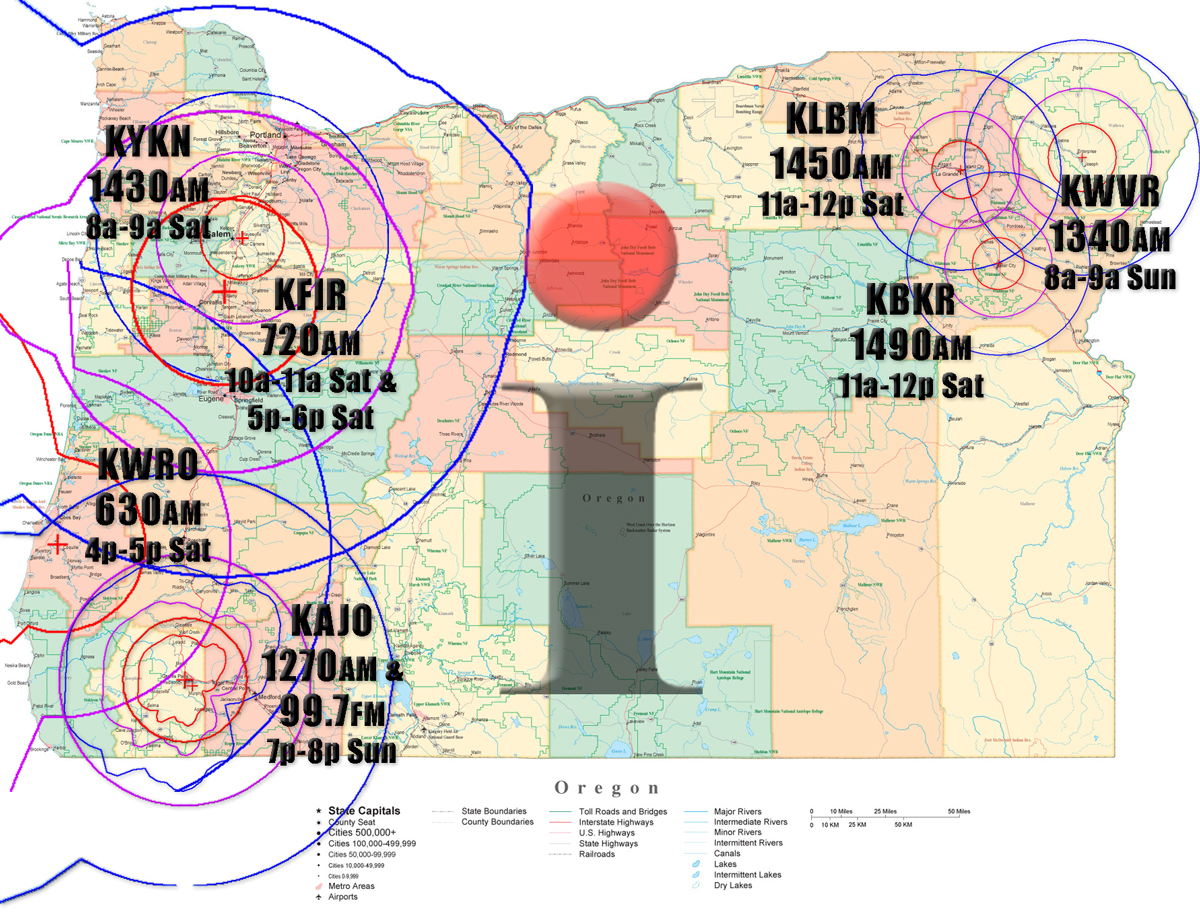
The I Spy Radio Show airs weekends — seven times across seven real radio stations, not internet-only streams. Listen anywhere through the stations’ live streams. See when, where, and how to listen for the full schedule.
Missed it? The podcast posts Mondays, after the broadcast stations air the show — here on this page or on your favorite platform.
★ Named to FeedSpot’s 30 Best Conservative Talk Shows. Thank you, listeners.