Tag: basic economics

Show 16-05 Oregon Democrats vs. Your Wallet: Blocking Trump’s Tax Cuts to “Protect” You?

Show 16-05 Oregon Democrats vs. Your Wallet: Blocking Trump’s Tax Cuts to “Protect” You?

Oregon Democrats vs. Your Wallet: Blocking Trump’s Tax Cuts to “Protect” You?

Release Date: January 31, 2026

Episode Subtitle: Oregon’s economy burns under Democratic policies—now they’re sabotaging Trump’s tax cuts. Connect the dots before it’s too late.

Duration: 47:55

Host: Mark Anderson

Guests: Jonathan Williams, President and Chief Economist of American Legislative Exchange Council, the nation’s premier state policy organization dedicated to to the principles of limited government, free markets and federalism.


About This Episode

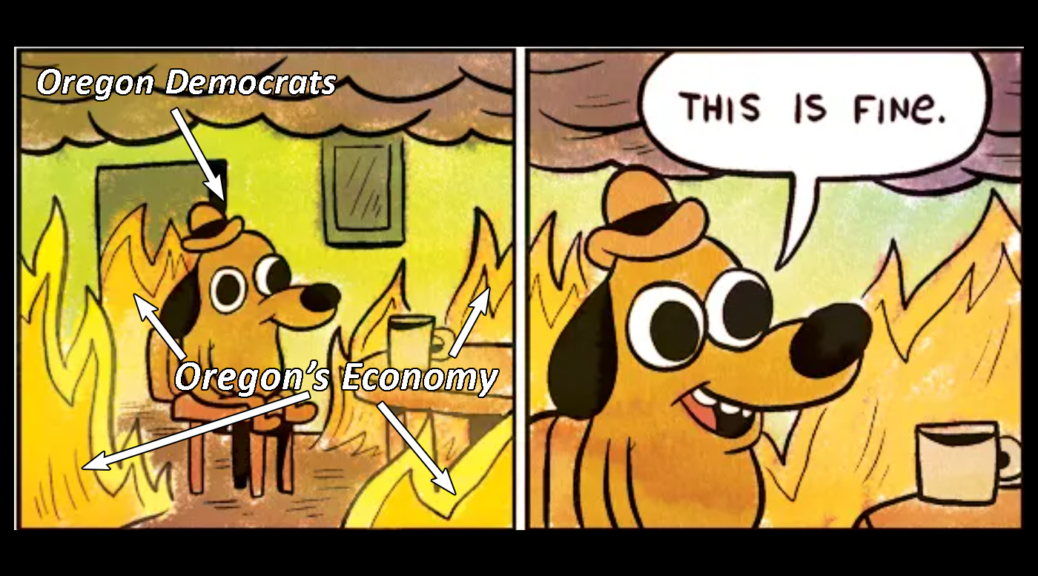
Oregon’s economy is already smoldering under punitive taxes and regulations—now Democrats want to pour gasoline on the fire by decoupling from Trump’s tax cuts in the One Big Beautiful Bill.

Proven free-market policies work every time they’re tried. So why is Oregon—dead last in business environment—stubbornly choosing the opposite? Full Democratic control (super-majorities in both chambers, Governor’s office, all statewide positions, even the Supreme Court) prioritizes left-wing ideology over results, crushing businesses and citizens alike.

This episode connects the dots: How bad economic policies create bad economies—and why voters need to fill in the right ones on their ballots. You’ll gain more insight than most state legislators, just in time—because Oregon is running out of clock before the flames spread.

No math, just facts and real-world examples. Tune in to see how ideology is burning down the state… and what can still be done.

Show Notes

  • 00:00 – Intro to some basics, like the single-most important factor whether someone buys something—and why higher taxes don’t mean more money for the state.
  • 05:10 – Simple example why raising taxes doesn’t work that every legislator should learn
  • 09:14 – Other factors that people and especially businesses consider when relocating. Elections have consequences: a new state enters the race to the bottom and seems determined to beat Oregon to it.
  • 16:37 – Oregon as the example and warning for other states what not to do. Breaking the mindset of raising taxes every time a state feels pinched.
  • 21:24 – Why Oregon Democrat’s bad economic policies are so critical at a time like this. What is happening that could damage Oregon for decades.
  • 25:23 – Oregon media got excited that more moving trucks arrived in Oregon than left. But what those moving trucks surveys don’t mention.
  • 28:55 – Oregon Democrats are about to make a massive mistake. Those moving vans might be turning around.
  • 34:03 – The regulation Trump just repealed that will save U.S. businesses well over $1 trillion per year. Connecting the dots and why that’s so important. One Big Beautiful Bill tax cuts people will see this year.
  • 39:57 – It’s not just no tax on tips and no tax on overtime. Connecting the dots between a huge new tax rule for businesses that will grow economic activity. And why left-wing politicians will hate it and try to stop it.

Transcript

Opener:

Here’s a question for you. What is the single-most important determining factor whether or not someone buys something? The one reason that is generally more important than all of the others.

If you said price, you were correct. And you have a better sense of economics than the overwhelming majority of Oregon’s elected democrats.

This comes directly from a theory in microeconomics — although it’s not really theoretical, it’s a known fact — so we’ll say, a “principle” known as the law of demand. All things being equal, the price of a good or service is the main factor that determines how much consumers will buy of those goods or services.

I mention this because on today’s show we’re going to take a look at what Oregon Democrats’ recklessness is doing and will do to Oregon If they get their way to raise prices and worse to take money out of your pocket which is the same as raising prices.

Because they don’t seem to understand this basic concept.

Because here’s a related issue. The more money you have to spend, that you must spend, the less money you have available for other things. Again that’s pretty simple. If your rent goes up and your income doesn’t change, the less money you have for other things. Food, utilities, kids’ clothes, or like actually putting money aside or investing it so you’ll have more for the future.

And, also again, this simple economic principle is one that the overwhelming majority of Oregon’s elected Democrats can’t seem to grasp. If your taxes go up the less money you’ll have for normal economic activity. Paying for the things you need to and buying things you want.

Right now the only economic principle that Oregon’s Democrats seem to believe is that if you have money you are stealing it from the government. How dare you keep your own money?

Don’t believe me? We’ve said several times over the last few months that Oregon Democrats right now want to decouple Oregon’s tax code from the federal tax code. Previously it was just an idea — scheme, really — being talked about behind closed doors. Now they’re talking openly about it. Oregon Democrats want to block Oregonians from getting the tax cuts trump gave them in the one big beautiful bill. No tax on tips, no tax on overtime.

And how are Democrats trying to spin taking away more of your money by blocking Trump’s tax cuts? Speaker of the House, Democrat Julie Fahey said, they want to shield Oregon families from harmful federal policies.” And the democrat-friendly media is spinning it this way: quote, “The bill includes tax cuts that could mean more money in Oregonians’ pockets at the state’s expense.” There it is. Keeping your own money, that you earned, is at the state’s expense. That implies that money originates with the state. It belongs to the state.

Well this November Oregonians have a chance to send a giant goodbye to Democrats and remove that kind of thinking from Oregon.

Download the Show

Don’t use podcast platforms? No problem! Download Show 16-05. That link will open in a new tab where you can listen right in your browser or download it if you prefer.

Additional Show Notes

  • Jonathan Williams is the president and chief economist organization at American Legislative Exchange Council. Find out more at ALEC.org.
    • Encourage your representatives to join ALEC! There are state and city memberships. Help elected officials understand economic problems and the real solutions available to get out of them. Send them this link: https://alec.org/membership/.
    • And you too can join as a private-sector member!
    • Follow Jonathan on Twitter at @TaxEconomist.
  • Head to Rich States, Poor States to see how your state is doing — 2026’s edition will b e released on tax day, April 15th.
  • Oregon taxpayers are getting hammered with the highest effective income tax burden in the nation (Ed Diehl, Facebook post, January 13, 2026)
  • Outrageous! What elected Democrats think of your money: “Oregon lawmakers return Feb. 2 facing budget hole, tax fight and transportation fallout” (Central Oregon Daily, Jan 25, 2026)
    • Democrat Speaker of the House Julie Fahey: “We’re focused on…shielding Oregon families from harmful federal policies.” Apparently, you need to be “shielded” from federal tax cuts that would let you keep more of the money you earned.
    • Also in that article: “The bill includes tax cuts that could mean more money in Oregonians’ pockets at the state’s expense.”
  • Many Virginia voters are developing buyer’s remorse after Democrats are pushing a TIDAL WAVE of tax surges on citizens following the most recent election (Eric Daugherty, X post, January 29, 2026)
  • Moving Company migration surveys
    • U-Haul’s 2025 survey shows Oregon had a net positive for trucks coming into Oregon vs leaving (50.3% inbound)

Subscribe:
Apple PodcastsSpotify | iHeart | Amazon | TuneIn | And every major podcast platform — just search for “I Spy Radio Show”

If you enjoy our content, help others discover the show! Give us a like and subscribe or leave us a review below. That really helps us get a bump up in the ol’ algorithms when platforms suggest shows to others.

It’s the Economy, Stupid – But What Kind of Economy?

It’s the Economy, Stupid – But What Kind of Economy?

Show Summary: Economics is always a strange business. But like so much else of American life, the Left is corrupting the economy and using it for their own means. Especially by involving the government. And now, with the Ukraine situation, we’re seeing private businesses waging a private war against Russia — when we’re not even at war with them. Combined with what happened in Canada, is this a foreshadowing of what will happen to our economic freedoms and liberties?

Coverage Map of I Spy Radio Show broadcast areas, as of June 2021
Current I Spy Radio broadcast areas. Click for full-size map.

The I Spy Radio Show airs weekends, six different times, on seven different stations. Listen anywhere through the stations’ live streams! Check out when, where, and how to listen to the I Spy Radio Show. Podcast available Mondays after the show airs on out network of stations.

Original Air Dates: March 5th & 6th, 2022 | Guest: Jonathan Williams

This Week

To quote Bill Clinton, “it’s all about the economy, stupid.”

We take a look at the state of the union speech, the competency of those in charge and their agendas, the economy, and also the economic policies that politicians can win on this year. Even here in Oregon. Plus, with the war in Ukraine, we’re seeing an entire new kind of warfare being waged. Economic warfare on a scale we haven’t seen in ages and in ways we’ve never seen. Private companies waging a private war against a country we’re not actually at war with. Combined with what we saw in Canada, what does this mean for our economic freedoms and liberties?

READ: Jonathan’s terrific article about Utah and why they’ve stayed #1 in ALEC’s Rich States, Poor States for 14 years in a row. What are they doing that other states should be doing. And what could go wrong to knock Utah off its perch?
Get this article to your favorite candidate!

We talk with Chief Economist, Jonathan Williams, from ALEC (American Legislative Exchange Council) about what is going on. We talk about the SOTU speech, the competency of those in charge, and private companies blocking you when they don’t agree with your politics. And we’ll look at true economic policies to win on in 2022. Even right here in Oregon.

And don’t miss the discussion about what is happening, on economic terms, in the war between Russia and Ukraine. And what it means for our future economic liberties and freedom.

The I Spy Radio Show Podcast Version

Trapped under a heavy object? Missed the show? Don’t worry—catch the podcast version. I Spy Radio is now available on your favorite platform, or you can grab it right here. See the full list of podcast options.

Links Mentioned Research, & Additional Info

Jonathan Williams is the Chief Economist and Exec VP at American Legislative Exchange Council. Visit ALEC.org to find out more about what they do and how you can get their policies to your politicians.

The Democrats’ War on Economics: Tax Explosions and Spending Sprees

The Democrats’ War on Economics: Tax Explosions and Spending Sprees

Show Summary: A radical shift is underway as democrats shove America away from reality-based economics towards an economy where normal monetary policy is abandoned, taxes are imposed on the “undesirables”, and public monies are used to reward themselves and their allies. Think it’s not possible? It’s already underway. Find out what’s coming.

Coverage Map of I Spy Radio Show broadcast areas, as of November, 2018
Current I Spy Radio broadcast areas. Click for full-size map.

Five Different Times, on Seven Different Stations. Listen anywhere! All stations stream live!

Saturdays
10a – 11a: KFIR 720AM (entire Willamette Valley) | Direct Link to KFIR Live Stream
11a – noon: KLBM 1450AM (Union County) | Direct Link to KLBM Live Stream
11a – noon: KBKR 1490AM (Baker County) | Direct Link to SuperTalk Live Stream
7p – 8p: KWRO 630AM (Oregon Coast & Southeastern Oregon) | Direct Link to KWRO Live Stream

Sundays
8a – 9a: KWVR 1340AM (Wallowa County) | Direct Link: KWVR Live Stream
7p – 8p: KAJO 1270AM or 99.7FM (Grants Pass/Medford) | Direct Link: KAJO Live Stream

Mondays
After the show airs on our network of radio stations, you can listen to our podcast either here on our site or your favorite podcast platform. We are now on Apple podcasts, Spotify, Stitcher, TuneIn, and more. See the full podcast list.

Original Air Dates: Apr 10th & 11th, 2021 | Carl Wilson & Jonathan Williams

This Week: When we were kids it was exciting to be handed a quarter thinking about how and where to spend it. And we learned that a quarter was wonderful, but a dollar was even better. Except maybe those lessons of having and handling money are being lost in the age of debit cards, or electronic purchases.  Because the tangible feel of money and its worth is somehow getting lost. A coin or a dollar in the hand reminds a child of its temporary nature, and once spent it’s gone—versus money “out there” in the cloud somewhere, where there’s always more of it.

Basic economics are under attack.

Non-Reality-Based Economics

As politicians supposedly grapple with debt, it is somehow made mystical in the world of zeros and ones with digital accounts. Not surprising when computer modeling and predictions take over reality. But is there a point of reckoning that will be no longer be possible to bury or ignore?  Basic economic principles would say yes.

This week, we work to uncover those economic principles that so many Left-leaning politicians wish us not to examine.  (Especially in an AOC world where if the computer doesn’t say it, then it’s not so.) It is becoming painfully obvious that those in charge of America’s economics, and raising and spending the public’s money have no grounding in basic economics or business.

Central Assessment

We start off with Carl Wilson, former Oregon state representative, and owner of KAJO, out of Grants Pass, that airs I Spy.  We discuss the new threat to local radio stations as Oregon decided to shift them into a new taxing scheme called “central assessment.”

To date, Oregon is the only state imposing this new taxing methodology on local radio stations. Instead of local counties determining their taxes, now a state central system will determine what their assessed value is.  This potentially opens the door to a punitive system that large communications operations might be able to absorb, while hurting the mom’s and pop’s segments.  Something far left democrats seem to do all too often while making policy decisions.

And don’t miss who is getting special carve-outs. Is this a backdoor way to collapse conservatives’ dominance in talk radio?

Economics 101? Or No Room for Reality?

economics doesn't matter any more. Everything is infrastructureThen we talk to Jonathan Williams, Chief Economist for American Legislative Exchange Council, or ALEC.  He brings us up to date on the spending that Biden’s administration is zeroed in on.  We discuss what is happening with the dollar and a possible move by China to do more harm to America’s economy.

We’re only a few months into the Biden administration. But there is already a worrisome economic forecast on the horizon possibly coming our way in the next few years. We are spending trillions upon trillions, with more than $6 trillion planned just in the first 4 months. Which doesn’t even cover the “normal” government spending of $4.5 trillion per year.

Where is this coming from?

It can only come from wishful, magic money. Where it never has to be paid back.

Economics + Monetary Policy = Coming Crash?

In economics, just like in life, you ignore reality at your peril. See the links section below for some concerning videos that are warning about a potential and massive crash. Which, they claim, is all but certain. One of the most concerning is from Harry Dent. Harry Dent warns that globally, financial assets (stocks, bonds, etc.) are massively over-valued: $520 trillion which is 6.2 times global GDP of ~84 trillion. He says it normally is only about 2 times.

With so many warnings from well-respected economists and analyses, maybe it’s time to protect yourself.

The I Spy Radio Show Podcast Version

Trapped under a heavy object? Missed the show? Don’t worry—catch the podcast version. I Spy Radio is now available on your favorite platform, or you can grab it right here. See the full list of podcast options.

Links & Info

Carl Wilson (Segments 1–3)

  • Basic definition of central assessment: “The state assesses the property value of a business, rather than a local county assessing the value. The difference is the central assessment uses the company’s entire, statewide worth (even if they’re not a statewide company), including all property, equipment, brand value, and more. Even equipment decades old is lumped in—at original retail costs—rather than its current depreciated value.
  • Central assessment: A great writeup from Eric J. Kodesch: Oregon Supreme Court Finalizes DOR’s Complete Victory in Central Assessment Dispute (Journal of Multistate Taxation and Incentives, Volume 29, Number 3, June 2019)
    • This is the kicker: “the Oregon Supreme Court agreed with the Department’s position that property is new property if it is “newly added to an account on the assessment rolls.” In other words, in addition to property purchased or constructed by the taxpayer, new property includes the decision by the Department to centrally assess property.
    • Further, the new property consisted of all of the property moved to the new account, and not just the property not previously subject to tax, such as the intangible property.”
      • In other words, its new if we say it’s new
    • This is rather alarming. It’s taxable if the govt decides it’s taxable and no pesky law designed to protect from the government can protect you
  • Oregon Supreme Court Provides Definition of “Data Transmission Services” for Central Assessment Purposes (Stoel Rives, LLP, Oct 2, 2014)
    • “As in most states, central assessment” (or “state assessment”) generally means that the value of taxable property is determined “centrally” by the state’s Department of Revenue rather than by the local county assessor.
    • In Oregon, however, a major additional consequence of central assessment is that intangible property of a centrally assessed business is subject to tax, while the intangible property of a locally assessed business is not.
    • Furthermore, central assessment is based on the value of the taxable “unit” of property, as allocated and apportioned to Oregon taxing jurisdictions by formula. For these reasons, central assessment can, at least in theory, use the entire worldwide brand value of a business, including goodwill, as its starting point, as well as all of its real and tangible personal property.”

The bill to exempt radio stations from this onerous tax scheme is HB2331

Jonathan Williams (Segments 4–6)

Additional Economics and Financial Links

  • Worrisome: Harry Dent: Stock Market 40% Crash in April, Nothing Can Save You (YouTube, Feb 8, 2021). “A 40% correction is coming for the stock market, this according to Harry Dent, New York Times best-selling author of Zero Hour. ‘The Fed is losing absolute control’.”
  • Monetary Policy in Action — Prices of Everything Is Going UP – Value of Everything Is Going DOWN (Peter Schiff on Tucker Carlson, Apr 5, 2021)
  • Retail Apocalypse: $100 Billion In Losses Trigger New Wave Of Bankruptcies & Mass Store Closures (Epic Economist, YouTube, Apr 7, 2021)
  • About that “hot” housing market. It may no be what it appears… Krystal Ball: The Next Housing CRISIS Is Here And The Villains Are Exactly Who You’d Expect (The Hill, Apr 6, 2021)
  • Peter Schiff: People Don’t Know What’s Coming (Mar 27th, 2021)
  • Peter Schiff: Fed is trapped. It will either Bankrupt the Government or the American People (Link)
  • Luxury Stores Default ($200M in Rent) Along Manhattan’s 5th Ave (John Williams, YouTube, Apr 7, 2021)
  • Foreclosures BANNED until 2022?! (John Williams, YouTube, Apr 7, 2021)
  • Bank Meltdown Is Here! Commercial & Household Debt Lead To Worst Bank Apocalypse In All U.S. History (Epic Economist, Apr 2, 2021)