Category: Economics

Oregon’s Universal Health Plan: The $85 Billion Tax Bill | Show 16-31

Oregon’s Universal Health Plan: The $85 Billion Tax Bill | Show 16-31

I Spy Radio Show | Keeping an Eye on Big Government
Show 16-31

Sixteen Years in the Making — Oregon’s March to Socialized Medicine

Aired  August 2026

Runtime  48:00
Host  Mark Anderson
Guest  Lisa Lettenmaier
Listen  See our network of stations, areas, times and livestream options

Listen to this episode (Available Mondays after airing on our network of stations)


Player block is self-contained and swappable. When the site goes static,
replace this <audio> element with the Podlove Web Player to get chapter
navigation and transcript sync — the chapter data below already feeds it.

About this episode

For sixteen years this show has been telling you what was coming. We are now standing on the threshold of it. In seven weeks, a board appointed entirely by Governor Kotek delivers Oregon a blueprint for state-run health care — and the numbers are on the state’s own website.

$85B
Total annual cost
9.6%
New employer payroll tax
10.1%
New personal income tax
Sept 15
Plan due to Legislature

Independent health insurance broker Lisa Lettenmaier of Health Source NW returns for the full hour — and this one may be the most important conversation we have had with her. Mark opens by tracing the ten-step path Oregon has walked since 2011: the bills that created the Coordinated Care Organizations and then exempted them from state and federal antitrust law, the “global budgets” that pour money from every source into a single pot where no one can follow it, and the nonprofit structures that shield those books from public view.

Then the payoff. Because voters passed Measure 111 in 2022, health care is now a right written into the Oregon Constitution — and proponents argue the Legislature is therefore obligated to deliver it. The next year, Senate Bill 1089 created a nine-member Universal Health Plan Governance Board, appointed by the Governor and confirmed by the Senate, and gave it a statutory deadline: September 15, 2026. By law, every member of that board must agree with the objective before they can be appointed to it. There is no seat for a skeptic.

Lisa walks through what the plan would actually cost a household. A 10.1% health care personal income tax stacked on top of Oregon’s existing 4.75%–9.9% rates, kicking in above 200% of the federal poverty line — a threshold a full-time minimum wage earner in Portland has already crossed. A 9.6% employer payroll tax on any business with more than $500,000 in firm-wide payroll, which is a landscaping company with a couple of crews, a small restaurant, a dental office. Plus three points on the corporate income tax and a bump to the corporate activity tax, which is levied on gross receipts, not profit. Total new Oregon revenue: $16.9 billion a year. The other $68 billion has to come from Washington.

And that is before the history. Vermont passed the nation’s first single-payer law and then killed it when the real tax numbers came back at 11.5% on employers and up to 9.5% on individuals — a Democratic governor walked away from his own signature achievement. Oregon is proposing a comparable payroll tax and a higher income tax. And Oregonians have already voted on this once: in 2002, Measure 23 proposed single-payer funded by income and payroll taxes and lost 78.5% to 21.5%.

The hour closes where it has to. In Canada, assisted dying has moved from a mandatory 48-hour waiting period to same-day — and a study has projected savings in the hundreds of billions, with the largest figures under non-voluntary scenarios. Oregon’s own board has adopted five governing principles, and one of them reads: during public health emergencies, protecting community health may temporarily take priority over individual preference. When the government is the only payer, the government decides what your care is worth.

The report lands September 15. It goes to the Legislature seated by the November 3 election — and under the Oregon Constitution, a tax package needs three-fifths of both chambers. Democrats hold 37 of 60 House seats and 18 of 30 in the Senate. Two House seats, or one Senate seat, is the whole margin.


In this episode

00:00
01

Ten Steps to Socialized Medicine

Mark lays out the sixteen-year path — from duping Republicans in 2011 to the final step Oregon is standing on now. Then Lisa on where the 2027 rates landed, the carriers walking away, and Oregon taking over the insurance marketplace from HealthCare.gov.

00:00
02

The Money You Can’t Follow

Why Oregon switched off the antitrust laws for health care, what a “global budget” really does to accountability, and the meeting where Lisa first heard the state pitch buying air conditioners with health care dollars. Plus the cost-shift almost nobody understands.

00:00
03

$85 Billion a Year — and Where It Comes From

CareOregon’s billion-dollar reserve, the California merger Oregon’s own DOJ found unlawful, and then the tax table itself: 10.1% on income, 9.6% on payroll, and what 200% of the poverty line actually means for a family of two.

00:00
04

Vermont Tried This — and Oregon Already Voted No

The projections that killed Green Mountain Care, the 2027 session versus a 2028 ballot measure, and Measure 23’s 57-point defeat in 2002. Plus Medicaid recertification, and the hospital tax Lisa calls a shell game.

00:00
05

The Lies They’re Telling — and the $68 Billion Wish

The state’s own calculator says most households pay less. Lisa explains what it leaves out — what happens to private plans, to provider pay, to wait times, to snowbirds and travelers — and why the whole thing rests on $68 billion a year from a federal government that has not agreed to any of it.

00:00
06

Customer or Liability — and What a “Right” Actually Is

Designed for fraud, or merely indifferent to it? Then Canada’s trajectory, the Oregon board’s own principle that community health may override individual preference, and Mark’s closing argument on why no one has a right to another person’s labor.

Links & resources mentioned

Lisa Lettenmaier & Health Source NW

  • Health Source NW (independent health insurance & Medicare brokerage — Oregon & SW Washington, no cost to clients)

Oregon’s Universal Health Plan — Read Their Own Paperwork

Who Is Pushing It — In Their Own Words

The CCOs — Antitrust, Global Budgets & CareOregon

The 2027 Rates, the Carrier Exodus & the State Marketplace

It Has Been Tried Before

Medicaid, the Provider Tax & What Comes Next

About the guest

Lisa Lettenmaier
Owner, Health Source NW

Lisa Lettenmaier is an independent health insurance broker serving Oregon and Southwest Washington, and the owner of Health Source NW — an agency that helps individuals, families, and seniors navigate individual health insurance and Medicare plans at no additional cost to the client. She has been in the market since before the Affordable Care Act took effect, sat through the rollout meetings, and watched Oregon’s individual market shrink from roughly fifteen carriers to three.

She is a recurring I Spy Radio guest and the show’s go-to voice for common-sense answers on Oregon’s health care system.

healthsourcenw.com

Full transcript

Transcript is being prepared and will be posted shortly. Auto-generated from the episode audio, then cleaned for names, agencies, figures, and natural paragraph breaks.

Catch the show live


Map of I Spy Radio broadcast areas and air times

The I Spy Radio Show airs weekends — seven times across seven real radio stations, not internet-only streams. Listen anywhere through the stations’ live streams. See when, where, and how to listen for the full schedule.

Missed it? The podcast posts Mondays, after the broadcast stations air the show — here on this page or on your favorite platform.

I Spy Radio  —  Keeping an Eye on Big Government


16-29 Breaking the Spell — Mike Gonzalez on the Rise of Socialism in America

16-29 Breaking the Spell — Mike Gonzalez on the Rise of Socialism in America

Breaking the Spell — Mike Gonzalez on the Rise of Socialism in America

Aired  July 18–19, 2026
Runtime  ~48 min
Host  Mark Anderson
Guest  Mike Gonzalez, The Heritage Foundation
Listen  See our network of stations, areas, times and livestream options

About this episode

Mike Gonzalez fled Communist Cuba with his family when he was twelve years old. Now a senior fellow at The Heritage Foundation, he joins Mark to explain why socialism is winning young voters who’ve never lived under it — and why that’s no accident.

Mark and Mike Gonzalez, the Angeles T. Arredondo E Pluribus Unum Senior Fellow at The Heritage Foundation and co-author of NextGen Marxism, trace how a cultural takeover of institutions like the Smithsonian is reshaping how young Americans see their own country, and how billions in taxpayer dollars — from USAID to the Corporation for Public Broadcasting to a $2.8 billion “climate justice” grant program — have quietly subsidized the activist ecosystem behind it. They dig into whether socialist candidates actually win head-to-head races against Republicans or whether vote-splitting and ranked-choice voting are doing the real work, and bring it home to Oregon: the primary upset of a sitting Democratic state senator, an open Portland House seat, and a sitting DSA incumbent since 2022 — plus Portland DSA’s open push for single-payer health care here in Oregon.

The back half of the show is built around what Mark calls “breaking the spell” — a set of direct, personal questions aimed at disarming committed socialists, including two on-air hypothetical tests: would they personally give away 90–95% of their own income today, and would they accept a nine-month wait for surgery under the kind of socialized medicine they’re proposing for everyone else? The show closes with Gonzalez’s practical, on-the-ground advice for pushing back — at school board meetings, at the ballot box, and in conversations with friends and family who’ve bought into the utopia.

In this episode

00:44
01

Fleeing Cuba — From Journalist to Fighting Socialism Full-Time

Gonzalez on leaving Cuba at twelve, his path from the Wall Street Journal to Heritage, and how the Smithsonian became his current fight. Plus: the deep-blue primary playbook behind Darializa Chevalier’s win over a three-term incumbent in New York.

10:29
02

Why Socialism Is Winning Now — and the Smithsonian’s $1.1 Billion Question

The Cold War generation gap, the manufactured “Hispanic” census category, and the White House’s 160-page report on the National Museum of American History — plus whether institutions that keep indoctrinating should lose public funding.

18:08
03

Follow the Money — USAID, CPB, and the $303 Billion Question

How defunding USAID correlated with seven straight conservative wins in Latin America, the OMB’s push to do the same thing domestically, and the $303 billion a year flowing to more than 100,000 NGOs — compared to what conservative causes receive.

25:51
04

Do They Win Head-to-Head? Vote-Splitting, the Democratic Civil War, and Oregon

Why every headline socialist win is a safe-seat primary, the academic case for ranked-choice voting as a deliberate DSA strategy, and whether establishment Democrats like Shapiro and Fetterman can actually stop the party’s leftward drift.

33:20
05

Breaking the Spell, Part 1 — The Hypocrisy Tests

What actually disarms a committed socialist, Gonzalez’s own family history with envy and expropriation in Cuba, and Mark’s two on-air tests: giving away your own wealth, and waiting nine months for surgery — plus Oregon’s own push for single-payer health care.

40:46
06

Breaking the Spell, Part 2 — What Actually Works

Practical, local-level advice for pushing back — school boards, syllabi, parent-teacher nights — plus whether “communist” is the right line of attack given capitalism’s own sliding favorability numbers, and Gonzalez’s closing message to young Americans.

Links & resources mentioned

Mike Gonzalez & The Heritage Foundation

  • Mike Gonzalez (heritage.org staff bio)
  • The Heritage Foundation
  • NextGen Marxism: What It Is and How to Combat It (with Katharine Gorka, Encounter Books, April 2024)
  • The Plot to Change America: How Identity Politics is Dividing the Land of the Free (Encounter Books, 2020)

The Smithsonian & “Saving America’s Story”

Follow the Money

Elections, Vote-Splitting & Oregon

Oregon’s Universal Health Care Push

  • Right to Health Care constitutional amendment (Measure 111, 2022) — Universal Health Plan Governance Board created by HB 1089 (2023); single-payer plan due to the Legislature by September 2026

About the guest

Mike Gonzalez
Angeles T. Arredondo E Pluribus Unum Senior Fellow  ·  The Heritage Foundation

Mike Gonzalez fled Communist Cuba with his family as a child. A former journalist who wrote for the Wall Street Journal, he is now the Angeles T. Arredondo E Pluribus Unum Senior Fellow at The Heritage Foundation, where his current work centers on the Smithsonian Institution and the census’s racial and ethnic categories. He is co-author, with Katharine Gorka, of NextGen Marxism: What It Is and How to Combat It (Encounter Books, 2024), and author of The Plot to Change America: How Identity Politics is Dividing the Land of the Free (Encounter Books, 2020).

heritage.org/staff/mike-gonzalez

Full transcript

Segment 01 · Fleeing Cuba — From Journalist to Fighting Socialism Full-Time · 00:44

Mark:

Let’s say that you wanted to destroy America, but you didn’t want America to know that you wanted to destroy America. How would you do it?

Well, one of the first things you would need to do is figure out how to get money. A lot of money. And nothing bothersome like going out and earning it, or developing a billion-dollar company — that’s a lot of hard work. Besides, you’re going to need much more than that, because destroying America is going to require reprogramming people, distorting their view of reality, and getting them to believe a lie.

We’ve talked about that before — we interviewed one of the co-authors of the book Disinformation. This was a Soviet program back when the Soviet Union was still around, and that kind of disinformation is a key part of socialism or communism, if you prefer — they’re the same thing. But to do that, you need a tremendous amount of resources and money, because doing it on a country-wide scale is not easy or inexpensive. And you’ll need allies — the media, universities, clever marketing slogans. So you need a lot of money.

Now, what’s the largest business in America with practically a bottomless checkbook? No, it’s not SpaceX or Google or one of the new AI companies. It’s the American government. They spend trillions of dollars every year — so much they can barely keep track of it. You don’t need a trillion dollars every year, that would be too obvious. But you do need to bleed off money by the billions — hundreds of billions of dollars every year.

And that’s easy — fraud, or setting up imaginary problems like Climate Change, telling people if we don’t do something the world is going to end. You scare people into believing things that simply aren’t real. And you need enemies — what better enemy than America itself, since that’s what you’re trying to destroy. But you can’t make it too obvious that you’re just voting to give Democrats money. Instead you need a network of shell companies — nonprofits. And you need laws to protect how all of that public money gets sent to them, and how it’s spent, and who they give it to.

On today’s show, we’re taking a deeper look at socialism. The goal today is to give you some idea of what you’re facing, because it’s coming here — especially right here in Oregon — unless people wake up and realize what the stakes are and do something about it.

As we say all too often here on I Spy Radio, the fight for freedom is an everyday fight. So to talk about the rise of socialism in America, I’d like to welcome Mike Gonzalez, the Angeles T. Arredondo E Pluribus Unum Senior Fellow at The Heritage Foundation. That is quite a mouthful, but it’s great to have you. Thanks for joining us.

Mike Gonzalez:

Mark, thanks a lot for having me on. Arredondo — it is a mouthful, but it’s a very nice family name.

Mark:

Oh, yeah, I have no doubt about it. So, we know you’re busy getting ready to testify in front of Congress, so we really appreciate you joining us here. As I understand things, you and your family left Cuba — so how old were you when that happened?

Mike Gonzalez:

Oh my God, it’s so long ago — I was twelve years old when I left. That’s not exactly last week, if you look at me.

Mark:

So do you have any memories of it yourself, or is most of what you know entirely secondhand, from your family and what they’ve told you over the years?

Mike Gonzalez:

No, no, no — I have many, many memories, most of them very bad, because communism is a horrible thing and we shouldn’t be inviting it into this country. But there you are. I still have searing memories of what that was like in the sixties.

Mark:

Well, the owner of one of the stations we air on grew up back in Romania when it was still behind the Iron Curtain, and he left when he turned twenty-one, if I remember right. So in terms of what you experienced, are there details that have really stuck with you as you’ve gotten older and started studying socialism for a living — things that just jump out and say, oh my gosh, people really need to know this?

Mike Gonzalez:

Well, socialism has evolved from the socialism that I experienced — I experienced a revolution, like the communism it used to be. You talk about your friend in Romania — we all have war stories to trade. I was just in the Czech Republic two weeks ago; we say we’re members of a club nobody wants to be a member of. So it’s socialism today, and I’ve written a few books about how this has undergone an evolution — a huge change that’s more cultural. It affects our cultural institutions. The work I’m occupied with right now is the Smithsonian. The Trump administration, quite rightly I think, has focused on the Smithsonian Institution, which is the world’s largest museum complex, and cultural Marxists have taken it over. They’ve tried to use history and these museums that the nation has entrusted to them for societal change — that’s what cultural Marxists do. They try to use the culture, the educational system, to change how people think from within. It’s no longer a revolution like my family experienced — but if you change how people believe, then you have millions of voters voting for someone like Zohran Mamdani, or for Katie Wilson, or for Graham Platner, or for Darializa Chevalier. And they’ve been told by their cultural institutions that this is good, that this is how society needs to change — that American culture needs to change. That’s what I’ve gained through my studies, not through personal experience.

Mark:

Well, I think so much of what today’s socialists think — when it comes to why they want socialism — is because they have no experience with it. It’s really very much this imaginary utopia. So what’s the reaction of today’s socialist wannabes when you tell them, hey, have you ever lived in a socialist country or experienced it? Because my family has.

Mike Gonzalez:

Well, they don’t, really. First they’ll say platitudes like, “that wasn’t really socialism,” or “it’ll be different this time, we know what we’re doing.” Or they’ll say what happened in Cuba was actually pretty good — it was an attempt at equality, and you’re just a malcontent, you should go build socialism in Cuba. They’ll say a number of things that evade reality. To quote scripture, they know not what they do.

Mark:

Yeah, or what they espouse. You’ve got a recent book out with Katharine Gorka, NextGen Marxism, and I got a really interesting review from a Manhattan Institute fellow saying it shows readers the nature of the beast, and how to fight it. I’d like to come back to that in more depth later in the show — but for now, can you give our listeners a preview? What are some of the things that work to stop the socialists?

Mike Gonzalez:

Well, I think what Trump is doing — you have to take the cultural institutions back. You have to clean out the universities, clean out the Smithsonian, and that’s what’s being done right now. The administration looks serious about taking back an institution that belongs to the American people, not to these Marxists. I’m testifying in Congress twice next week on this issue. So all of these things — fighting the universities, the Smithsonian, the K-through-12 school system, bringing down the Department of Education, fighting the teachers unions — all of it matters. That’s the way to do it. But you also have to run candidates against these people. Darializa Chevalier is going to be elected — she’s in a very deeply blue district in New York. She won the primary because nobody turned out to vote except her followers. She beat Adriano Espaillat, a working-class guy who’d held that seat for three terms, was an appropriator, brought a lot of bacon to his district. And yet her very organized, very disciplined followers were able to beat him in the primary. And once you win a Democratic primary in a deep blue district, you win. She’s going to win the election. She’s going to be in Congress.

Mark:

Absolutely. Okay, stay with us — today’s show is all about socialism and defeating it. Coming up: why is socialism gaining so much ground in today’s America?

Segment 02 · Why Socialism Is Winning Now — and the Smithsonian’s $1.1 Billion Question · 10:29

Mark:

Our guest today is Mike Gonzalez, senior fellow with the Heritage Foundation, and we’re talking about the rise of socialism — later on we’ll ask him about stopping it. So, Mike, socialism isn’t new — Bernie Sanders has been selling this since the 1980s. So the question isn’t whether socialism exists in America, it’s why it’s suddenly appealing and gaining ground, especially with people under thirty. I’ve got a theory on this: I don’t think this current push for socialism would have gone anywhere in the years right after the fall of the Soviet Union, when most adults had grown up in the shadow of the Cold War and understood personally what the fight against communism actually was. Young people today just don’t have that reference point. Do you think that’s one reason this is working now — that they just have no clue what they’ve actually fallen in love with — or is there something else driving it?

Mike Gonzalez:

This is a variety of things. Yes, we were fighting the Soviet Union — American people saw that the Soviet Union and the countries behind the Iron Curtain lacked freedom and were economically backward, all the things that happened under communism. But these things were also taught in school. In the 1970s, in high school, I was taught a class — Americanism versus Communism — it was mandatory. People were taught the nature of communism; immigrants were taught to assimilate. All of these things have disappeared. The left has won a number of key, very important victories that have left us without any weapons to fight communism. So all of this has to be reversed. I’m about to get busy trying to get rid of the racial categories in the U.S. census — categories like “Hispanic,” for example, are fake, synthetic categories the left created in the 1970s to balkanize the nation, to drive us apart, to make sure we had no assimilation ethos anymore. We have to be serious about getting rid of all of these things.

Mark:

Well, I know that Hispanics used to be considered Caucasian, and then that got split out, as you say —

Mike Gonzalez:

There were no Hispanics. There are no Hispanics. There’s no Hispanic cuisine, no Hispanic food, no Hispanic culture, no Hispanic history. If you were a person of African descent from the Caribbean or South America, you were considered a person of African descent. If you were of European descent, you were considered a person of European descent. This is what the left did — they were very methodical about it. They created “Hispanic” in 1977 through the Office of Management and Budget, and then they said, we’re going to retroactively change history. For example, we celebrated the 250th anniversary of America, and people were talking about Bernardo de Gálvez, a general who won many victories on the side of the colonists, and people were saying, well, there’s your Hispanic general. No — he was not a Hispanic general, he was from Spain. My own ancestor, who fought alongside him at Baton Rouge and Pensacola, was from Cuba. Hispanics did not exist at that time. But the left is very clever — they talk about Hispanic participation in the Civil War. How could there be Hispanics? The category hadn’t been created yet.

Mark:

Well, just to get back to what you talked about, because I think this culture war is so important — that’s one of the reasons this is taking hold. You had a really interesting article, and I think you were on Fox News talking about this too — the White House put out a report called “Saving America’s Story,” accusing the Smithsonian’s National Museum of American History of — well, we talked about that in the previous segment, but it really strikes me that this is so key to why socialism takes hold: they have to erase the past, or rewrite it, to cast America as the villain instead of the hero. That’s not an accident — it’s standard operating procedure for socialism, communism, Marxism, whatever form it takes, because they need villains. That’s part of good story-crafting — you’ve got to have a villain to rise up against. So they’ve recast America as the villain, and they need people not to know how good things used to be, when socialism inevitably failed. Is that a fair read?

Mike Gonzalez:

I urge everybody listening to my voice right now to go to the White House website and find this report on the Smithsonian and read it, because it’s a really important report — a hundred and sixty pages long, five hundred and fifty-two endnotes. It quotes the leaders of the Smithsonian, and all of them say they want to use the Smithsonian — not just Smithsonian history itself, but history as a tool for change. They want to change America systemically, and they’re going to use this huge museum complex, and history itself, the past, to create societal change in America. And they’re doing this with our money — 1.1 billion dollars of our money that we give them every year.

Mark:

Yep, I was just going to point that out — this is what they’re doing with America’s tax money, to rewrite America’s history. There was a really interesting line from an article by the Victims of Communism Memorial Foundation that called schools and universities, quote, “the epicenters of indoctrination.” And if that’s true — getting back to funding — should schools and universities that keep doing this lose all public financing, including things like research grants?

Mike Gonzalez:

Yeah, absolutely. With the Smithsonian — we defunded the Corporation for Public Broadcasting last year, and it should have been defunded, because they were using taxpayer money for biased reporting, and we don’t need to pay a news outlet to do that. However, we can’t do the same thing with the Smithsonian. The Smithsonian is really important — societies and cultures need national museums. They need museums that preserve, collect, and curate national history and heritage to transmit it to future generations. Museums play a key role in that. When Africa became decolonized, the first thing those countries did was create national museums. When the communists took over mainland China in 1949, the Nationalists saved hundreds of thousands of artifacts from five thousand years of continuous history across all the dynasties and brought them to Taipei — I’ve been to that museum — so that the Chinese in the future would know what Chinese culture and heritage was. So we cannot just defund the Smithsonian. We just need to fire the leadership.

Mark:

Yeah, absolutely. Okay, I do want to come back to the money side of things and how we are funding our own demise. That’s next, with Mike Gonzalez, senior fellow at the Heritage Foundation, talking about the dangerous rise of socialism.

Segment 03 · Follow the Money — USAID, CPB, and the $303 Billion Question · 18:08

Mark:

And welcome back — this is the I Spy Radio Show, talking today to Mike Gonzalez, senior fellow with the Heritage Foundation. His family fled Cuba after socialism, or communism, took over there — doesn’t matter what you call it, there are different degrees of the same immoral system that doesn’t recognize individual rights, the very thing America was founded on. And now socialism is on the rise right here. In the last segment we talked about the money and the public funding of organizations that hate America — the Smithsonian, public schools out there trying to change not just history but how people learn and think about America. I think that’s really endemic to why socialism keeps growing — we’re funding our enemies. And aside from the fact that socialism itself is a parasite, a tick that can only survive by feeding on the back of capitalism — when we talk about the public funding of these organizations that hate us, it’s much more than just these institutions. For decades we’ve been funding things like green energy and climate change, and none of that money ends up on the right — it’s all going to the left, and we’re talking trillions of dollars. Al Gore himself said that about six hundred billion dollars from the Inflation Reduction Act — one bill from the Biden administration — was going to give them six hundred and thirty-some billion dollars, and it’s actually even more than that, because some of those tax credits would have kept going forever had the Trump administration not pulled them. One estimate I saw was over one point two trillion dollars that would have gone to the left. Do you think the Trump administration is finally wising up to the fact that we’ve got to stop giving taxpayer money to people within the country who hate the country?

Mike Gonzalez:

This is something the left has been very, very good at, and the right just doesn’t know how to do — and we shouldn’t do it either. But the left has created a machine for giving taxpayer money to its pet causes and pet organizations. The main example of this is USAID, the U.S. Agency for International Development. When Trump, Marco Rubio, and Elon Musk came in in January 2025, one of the first things they did was dismantle USAID. Since then — and a good paper is waiting to be written on the correlation — we’ve had seven victories in a row by conservative candidates in Latin America. I was just an hour ago with the new foreign minister, who’s about to become the new president of Colombia, taking over from the communist Petro. When Petro ran in 2022, our government sent thirty million dollars through USAID — sent it straight to the left in Colombia. We did this constantly. Now that USAID is no longer there to finance their institutions, they’ve lost seven presidential elections in a row. We need to get wise. And we’re doing this internally too, by the way — OMB, the Office of Management and Budget, has just proposed a rule to do the same thing with domestic funding — to dry up the funding for these institutions domestically, not just internationally.

Mark:

Well, I’m really encouraged to hear that, because feeding taxpayer dollars to the left and these organizations eventually filters down to campaigns. I came across one non-profit research group that found at least thirty-five thousand nonprofits get half or more of their revenue from federal taxpayers, and that taxpayer financing provides roughly three hundred and three billion dollars a year to more than a hundred thousand NGOs. That’s a tremendous amount of money — and I don’t know of any funding at all that goes to the NRA from U.S. taxpayer dollars, or to pro-life groups, or to conservative evangelical churches, getting even one billion dollars. And here you’ve got three hundred and three billion dollars a year going to a hundred thousand NGOs. That’s pretty hard to overcome.

Mike Gonzalez:

Right, and we have to stop doing that. I think this is another great thing President Trump — he’s not perfect, but he’s doing a lot of intelligent things, and the people around him are doing a lot of intelligent things too. One of them is getting rid of this machine that funds the left with money collected from all Americans — the CPB, the Corporation for Public Broadcasting, money from all Americans going to fund radio and TV stations that were inimical to the wishes and interests of the average American citizen. No more of that.

Mark:

Well, that’s so encouraging to hear that Trump is finally waking up to that — and I think he’s surrounded himself with much better, more competent people this time around than he had in his first administration.

Mike Gonzalez:

Absolutely.

Mark:

I think it’s places like Congress, in both the Senate and the House, that seem to be resistant to this. I’d like to think they’re finally going to start pulling the plug on this, because there’s another one I came across too — I mentioned the six hundred and some billion dollars from just one bill, the Inflation Reduction Act. There was a separate two-point-eight-billion-dollar Environmental and Climate Justice program tied to funding groups like the Climate Justice Alliance, and those payments are currently on hold because it’s tied up in the courts. But if this isn’t fixed legislatively — and it’s got to be fixed legislatively, not just administratively —

Mike Gonzalez:

Well, I agree with that — things are going to have to be codified by Congress. For example, that OMB rule I just mentioned will have to be codified by Congress too. In the meantime, the president is going to have to act through executive orders. You see how difficult it is just to pass the SAVE Act, even though Republicans have had majorities in the House and the Senate. This should be a gimme by now. And by the way, it’s not just people on the Hill opposing the president — there are people deeply embedded in the bureaucracy who are still there. For example — and I think we’re going to hear more about this, breaking new ground here — money is still going out from the State Department to fund some of these leftover programs. I’m not the guy doing that research, but I know people who are. If that’s true, that’s career officials deeply embedded at the State Department trying to do what they can to sabotage and subvert the policy of the elected government of the United States.

Mark:

Yeah, that is absolutely shocking, and yet not surprising. Socialism is the opposite of America’s founding, so in order to pull it off here, you’ve got to have people on the inside taking it down from within. All right, it’s time for a break — coming up, we’re going to talk more about how socialism wins at the ballot box. Stay with us.

Segment 04 · Do They Win Head-to-Head? Vote-Splitting, the Democratic Civil War, and Oregon · 25:51

Mark:

Mike Gonzalez, senior fellow with the Heritage Foundation, is our guest today. We’re talking about the rise of socialism here in America, which was founded on the exact opposite values of what socialism’s values are, if you can call them that. Mike, we talked earlier about them winning elections, and you’d mentioned that when a socialist wins in a deep blue district, it’s an automatic shoo-in that they’re going to win the election.

Mike Gonzalez:

If they win the primary — if they win the primary.

Mark:

Right — if they win the primary, then it’s a shoo-in for them to win the general, and boom, they’re in Congress, or whatever office at the state level. So I went looking for a single documented case this cycle of a democratic socialist beating a Republican head-to-head in a genuinely competitive district — not a safe seat, and not a multi-candidate plurality like when Mamdani won against two other opponents. I couldn’t find one. Every headline win is a Democratic primary in an already safe blue seat. Are you aware of any cases where they’ve actually won against a Republican in a general election?

Mike Gonzalez:

Well, they beat the Republican in New York.

Mark:

Well, yeah, but that was a plurality — I’m talking about a head-to-head.

Mike Gonzalez:

No — he got over fifty percent of the vote.

Mark:

Yeah, I wasn’t clear there — I meant a plurality of candidates, not a plurality of the vote totals. There were three candidates in that race, and I was wondering if you knew of a place where there was a real head-to-head in a competitive district — someplace like New York City, which was never going to be competitive for Republicans anyway. I mention that because what we’re seeing here in places like Oregon — there was a real push last year to get ranked-choice voting; Portland is actually using it now — and there’s some genuine academic research behind this. It goes back to things like Duverger’s Law and Arrow’s Impossibility Theorem, which show that once you’ve got three or more names on a ballot, that election can be manipulated, and a candidate with genuine minority support can win outright. Do you think that’s the actual mechanical reason DSA has been pushing so hard for things like ranked-choice voting and multi-candidate strategies — not idealism, but simple math and statistics?

Mike Gonzalez:

What I’ve seen — the people who put that strategy together, for example, there was a guy named Daniel Moraff, one of three people who helped build it. He wrote a long piece for In These Times, a communist magazine, about nine years ago, laying out the strategy. The strategy was to win in the primaries in very blue districts. They figured out the Green Party doesn’t win, the third party never wins. But if you take over the Democratic Party with a socialist candidate, a DSA candidate — and this is a takeover, by the way, a zombie takeover of an existing party — and you win in these blue districts, then you’re assured of winning. We’ve got another example in the Democratic primary in the city where I am right now — the mayor was DSA, the one who won, I forget her name. There’s no doubt in my mind, or in anybody’s mind — I’m not a betting man, but I’m not going to bet against her being elected in November, because ninety-four percent of Washington voted for Kamala Harris. Let that sink in — that’s not ninety-four percent of any one race, that’s all of D.C.’s voters. Ninety-four percent voted for Kamala Harris. You’re telling me they’re not going to elect the socialist mayor? No — they will elect the socialist mayor. So the blueprint this guy Moraff set up, I think, is working really well for them.


Mark:

Well, one of the things I hear on occasion is people like James Carville out there aghast at what’s happening — that the socialists are starting to win. I’m not sure how seriously I take that, because the Democrats have been lurching left just fine for a couple of decades now. Ever since Clinton left office, they’ve been marching steadily to the left, and now all of a sudden they’ve got these socialist candidates and — surprise, surprise — they’re winning. Well, you’ve been telling them for the last two decades that that’s perfectly fine. So do you think there’s an actual struggle within the Democratic Party — that they’re genuinely concerned about these democratic socialists — or are they perfectly fine with this?

Mike Gonzalez:

Well, the governor of Pennsylvania, Josh Shapiro, is fighting this. Rahm Emanuel is fighting this. One of the senators from Pennsylvania, John Fetterman, is fighting this. God knows Chuck Schumer and Hakeem Jeffries are not fighting it, but you have enough Democrats of renown — I just named four of them — who are saying, no, we cannot allow the DSA to take the party over. It’s going to be a lot of fun watching what they do.

Mark:

But at the same time, you’ve got, as you mentioned, D.C. voting ninety-four percent for Kamala Harris. So I question whether the average Democrat is really going to say, “I am so committed to fighting socialism within our own party that I’m willing to vote for a Republican instead of a socialist,” when it comes to the general.

Mike Gonzalez:

Oh, no, no, no — that’s not going to happen. That, in my opinion, will not happen. They will not vote for a Republican. I’m looking out the window at the Capitol right now, in the city where I am — they will not vote for the Republican. Let me take that to the bank, man.

Mark:

Right. But in the broader national sense, do you think enough Democrats will say we need to take this seriously enough that we will, in fact, vote for a Republican over a socialist?

Mike Gonzalez:

No, that’s not going to happen. What some of them will do is fight internally — the people I just mentioned, Shapiro, Rahm Emanuel, John Fetterman, they’ll fight internally. When it comes to final election day, Republican versus a DSA candidate, maybe some will stay home. I don’t think we’re that divided right now — the Democrats have really energized against Trump, the same way we’re energized for Trump. And the reason for that is Trump gets things accomplished. The reason people love him is he gets things accomplished, and the reason people hate him is he gets things accomplished.

Mark:

Our guest today is Mike Gonzalez from the Heritage Foundation. Coming up, we’re going to pick his brain on how to deprogram a socialist — we know some people break away. What works, and what doesn’t.

Segment 05 · Breaking the Spell, Part 1 — The Hypocrisy Tests · 33:20

Mark:

There’s a saying that goes something like, “those who don’t understand socialism are socialists, and those who do understand it are not.” Our guest today is Mike Gonzalez — his family escaped Cuba when he was twelve, and he’s now a senior fellow at the Heritage Foundation. Is there a specific question, or a specific thing you say to a committed socialist, that you’ve found genuinely disarms them — where you can actually see the light switch on behind their eyes about what socialism really is?

Mike Gonzalez:

Look — if you’ve been taught by the schools, the universities, the cultural institutions, the media, that this country is systemically racist, that it’s structurally oppressive, that slavery and Jim Crow delegitimize this country from the beginning, and that’s become your faith, and you believe in a worldly utopia — there’s not a lot that can be said to convince you otherwise. But I have seen people convinced in socialist countries — when they get sent to the gulag, or when their father gets shot by a firing squad, or when their wife or husband goes to the authorities and spies on them. When you come up against the reality of socialism — the gulags, people snitching on you, people taking your farm or your cows away — then you can become convinced. But in terms of rhetoric, we have to take the institutions back — I keep coming back to that. We have to take the cultural institutions back, the universities back, the K-through-12 schools back, the museums back, the art houses and entertainment houses back. Because once people are indoctrinated, nothing will change — unless they end up in a gulag in Siberia.

Mark:

Well, there’s a whole field of study about changing people’s minds once they’ve been made up, and I like how you framed it — it really is its own religion, and trying to get somebody to change their religion once they’ve grown up in it is very difficult. So is the process to just chip away at their beliefs — does that work?

Mike Gonzalez:

I’ll just say what I said — no, you have to actually put them on a train to Siberia.

Mark:

Well, I’d hope that would wake them up, although for some people I’m not entirely sure. But let’s do a little brainstorming — here’s a test. In terms of messaging, if somebody wants to redistribute the wealth of the rich, what about asking them if they’d personally be willing to give away ninety-five percent of their own income starting today, with no complaints? If you confront somebody with a scenario like that — where the rich and wealthy give up ninety percent or more of their wealth, and eventually that wealth runs out and they have to turn to people like the person you’re talking to — are you willing to give up ninety percent of your income? Does that have any effect?

Mike Gonzalez:

I have strong memories from the sixties — I don’t think a lot of people were bothered that my family’s house and everything else was taken away. This envy is behind a lot of this, but we rarely write about envy, and yet it’s a driver of a lot of these policies and politics. I remember a lot of people who quietly went along and thought it was good that they took the farm away, good that the country took it away, good that they took the car away. Sorry to reveal the human condition to you, but there it is.

Mark:

Yeah, it’s socialism at its core — it’s really completely self-centered. They promote it as something great for all of society, but it’s very selfish — it’s “me first, you’ve got things, I want it.” I think Margaret Thatcher was the one who said it’s the politics of envy and greed, and I think that’s exactly right. So when you look at places like the socialized countries — Canada, the UK, so much of the EU — they’ve got nationalized health care, and that’s a big thing happening right now here in Oregon too. In fact, the Portland chapter of the Democratic Socialists of America is now openly pushing for a switch to single-payer, universal health care, free access for everybody, right here in Oregon. It’ll only cost eighty-three billion dollars a year — but that’s beside the point. So again, to try to chip away at their mindset: based on what happens in these socialized countries, ask them — if they needed a serious operation, would they be willing to accept a nine-month to a year-long wait, and let other people go first, the way people generally do under socialized medicine in Canada and elsewhere? Would that shock them into some kind of sense of reality?

Mike Gonzalez:

No — again, no. If you’re in Canada right now and you want to leave, you have to pay an exit tax. So say you have a portfolio — a million dollars made up of American companies, Amazon, General Motors, Toys R Us, whatever — you have to act as though you’re selling that portfolio and pay the Canadian government the tax on it before you’re allowed to move. And Canadians are okay with that.

Mark:

Well, they’re trying that same thing in California — Newsom wanted some kind of exit tax too, because so many millionaires were leaving, and he wanted them to pay an extra tax on the way out. I think that stalled, but last I knew he was at least trying it.

Mike Gonzalez:

Yeah, because that’s what happens — why did the Berlin Wall go up? When governments do these things, people flee. Why did my parents flee? Marx wrote about this in the Manifesto — he said people are going to react badly when their property is taken away, and that’s why he said himself there will be a need for “despotic inroads.” That’s the English translation — there’s going to be a need for despotism, because people don’t react well to having their stuff taken away.

Mark:

Yeah, you know, in some ways it’d be nice if schools actually taught the Communist Manifesto for what it really says, not just what people imagine it says.

Mike Gonzalez:

Right.

Mark:

Okay, let’s take a break. Then we’ll wrap things up with Mike Gonzalez, senior fellow with the Heritage Foundation, talking about breaking the spell of socialism. Coming up: some of the practical things you can do.

Segment 06 · Breaking the Spell, Part 2 — What Actually Works · 40:46

Mark:

And welcome back — our final segment now with Mike Gonzalez, senior fellow with the Heritage Foundation. We’ve been talking really since the start of the show about how to defeat socialism, and your book review, as I said, promised readers would learn how to fight it. In your experience, can you give our audience some practical steps — things they can be doing? What actually works to push back against this at the local level, maybe with friends and neighbors or family members — a lot of families are dealing with this too — and what tends not to work?

Mike Gonzalez:

I think you have to monitor what your children are studying. You have to ask inquisitive questions — “what did you learn today, let me see your homework.” You have to attend the Board of Education meetings. You have to go to parent-teacher night. You have to look at the syllabus your kid has for a class at Cornell or Penn State. You have to not abdicate your role as a parent — you have to follow these things very closely.

Mark:

Well, definitely — knowing what your kids are being taught is absolutely key to stopping this at the next generation. So, in terms of political strategy — because we’ve got three now, well, there was one Democratic Socialists of America candidate already, she’s been that since 2022. And now we’ve got two districts where they flipped the incumbent — one was a sitting incumbent, and the other was the handpicked successor to a retiring incumbent — and those are both now DSA candidates, and they’re going to win because they’re in deep blue districts. Trump, Vance, and NRCC Chairman Richard Hudson have all leaned hard into calling this movement communist ahead of the midterms, but Hudson said the Democrats are making it easy for us. I kind of think that’s a bit naive, because there’ve been polls showing capitalism’s favorability among adults down to fifty-four percent overall, and only forty-two percent among Democrats. Do you agree that this line of attack — leaning into “communist” and assuming this is a shoo-in because Democrats are going so far left — is going to work? Or if not, how should they change their strategy?

Mike Gonzalez:

That’s a good point. Capitalism — nobody defends capitalism anymore, not even the right. The right is beginning to attack capitalism too. If even conservatives don’t defend capitalism, well, the left surely isn’t going to defend it. So capitalism isn’t winning right now, because people don’t understand — first of all, “capitalism” is the left’s word for it. It’s the word the left came up with to describe our free-market system, our system of freedom. I own this phone in my hand right now — I can sell it to you for whatever I want, you can offer whatever you want, we agree on a price, you walk away happy, I walk away happy. There’s no victim there — there are two winners. If you explain things like that to people, they get it. But I do think you make a good point that we need to keep calling them communists — we need to insist on calling them Marxists and communists, we can’t back away from that. But then we also have to talk about everything else that comes with communism — the imprisonment, the gulags, all of the soul-killing that comes with it.

Mark:

Yeah, absolutely. So, final question — I’d like to bring this back to where we started. Knowing everything your family went through in Cuba, what do you most want Americans, especially young Americans, to understand before they cast a vote for any socialist?

Mike Gonzalez:

Marx and Engels did not make a distinction between socialism and communism — to them it was the same thing. I’ve heard people defending the DSA saying, “this isn’t the socialism of gulags.” No — it’s always the socialism of gulags. Always. Because of what Marx said — that when you take people’s property away, people get upset, and you need to introduce despotism. So there will always be repression, there will always be — freedom of speech will have to go, all of our basic freedoms will be suppressed. That’s baked into the system — that’s not a bug, that’s a feature. Communists like Marcuse will tell you this when they have a moment of candor — they’ll tell you.

Mark:

Yeah. Unfortunately, it’s time for us to go. Thank you so much — we really appreciate your time today.

Mike Gonzalez:

Thank you — thank you very much. Bye, guys.

Mark (close):

Socialism often starts in poor and poorly run countries, because people see the few rich and believe it’s those rich — and the political system — holding them down. Which is why it’s a little odd to think that socialism is gaining ground here in America.

Until you understand how the left is undermining America’s success and our future generations. Because kids today have it easy — by and large, they don’t have to work, unlike when we were kids. And because of that, they don’t develop a real sense of how hard it can be to earn a dollar.

People who know how hard it is to earn a living are far less likely to want to take away somebody else’s living. The left knows that — that’s why they push higher and higher minimum wage laws, twenty dollars or more. You don’t start at the bottom — you start out at forty thousand dollars a year with no skills and no training. You start out middle class. There’s no reason to work to get ahead — you’re already ahead.

So their early thinking isn’t informed by an appreciation of hard work — it starts instead with, why aren’t I getting even more? It’s unfair that I’m not.

Our guest today talked about how it seems the only way to truly get through to a wannabe socialist is to send them to a concentration camp, the gulags. Then they’ll understand what an all-powerful government can and will do to citizens who only have the rights government gave them — not rights from God, rights from the government.

And let’s not forget — that’s exactly what the left and the Biden administration wanted to do back during COVID, to send people who wouldn’t take the vaccine off to concentration camps. So to think this could never happen here is a mistake. Remember, it almost did. Which is why you need to take this seriously.

Because as we say every week, the best information does you no good if you don’t use it.

Reagan, what do you think?
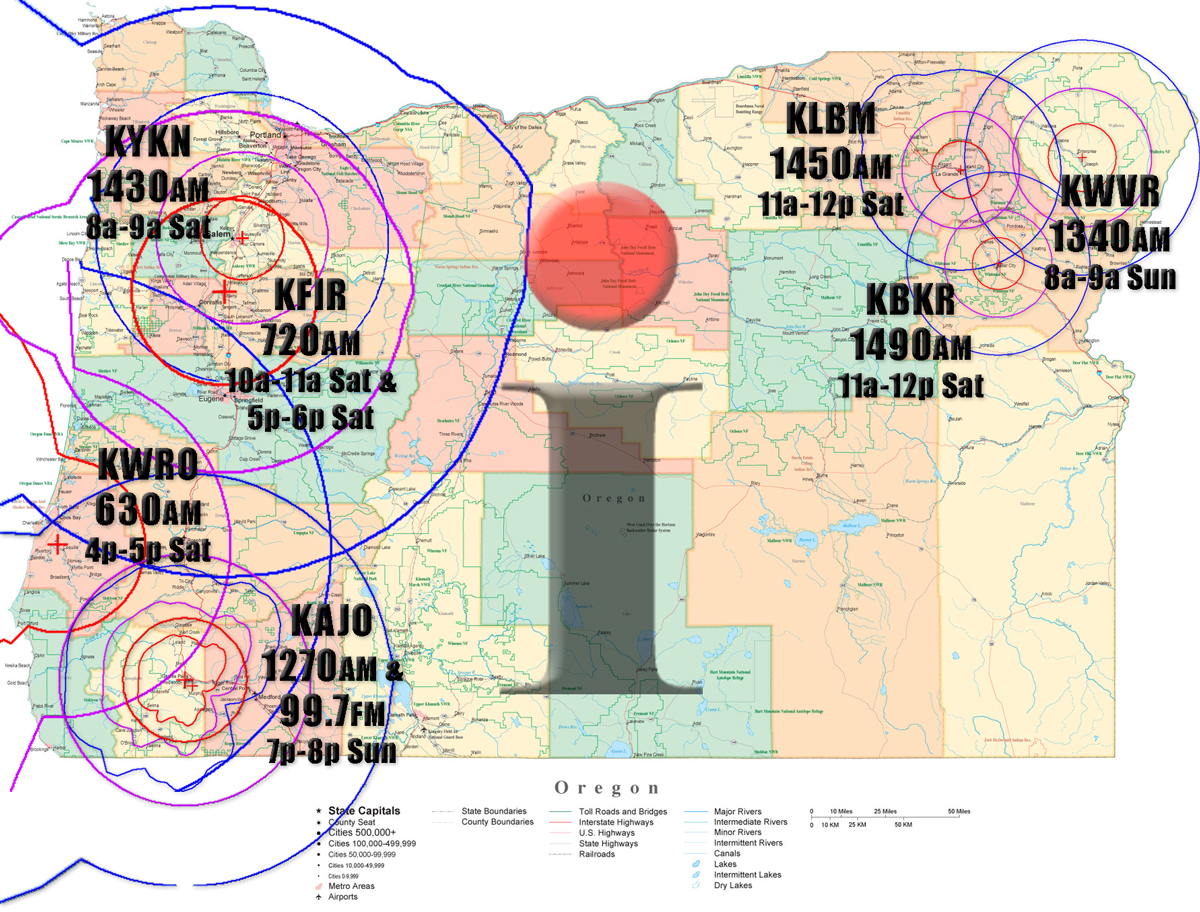
Catch the show live


Map of I Spy Radio broadcast areas and air times

The I Spy Radio Show airs weekends — seven times across seven real radio stations, not internet-only streams. Listen anywhere through the stations’ live streams. See when, where, and how to listen for the full schedule.

Missed it? The podcast posts Mondays, after the broadcast stations air the show — here on this page or on your favorite platform.

Music: Codename Dougwood by Shane Ivers — https://www.silvermansound.com


16-28 Some Battles You May Not Realize You Won — Title IX at the Supreme Court, and Climate Hysteria’s Retreat

16-28 Some Battles You May Not Realize You Won — Title IX at the Supreme Court, and Climate Hysteria’s Retreat

Some Battles You May Not Realize You Won — Title IX at the Supreme Court, and Climate Hysteria’s Retreat

Aired  July 11–12, 2026
Runtime  Added Monday
Host  Mark Anderson
Guests  Kimberly Hermann & Craig Rucker
Listen  See our network of stations, areas, times and livestream options

Listen to this episode (Available Monday after airing on our network of stations)


STAGE 2 — swap [INSERT_MP3_URL] for the compiled Blubrry-hosted file Monday.

About this episode

A landmark Supreme Court ruling on Title IX came down the same season as the birthright citizenship fight — and got almost completely buried. We dig it back out. Then we turn to a run of quiet climate-policy retreats that add up to more than any one headline suggests.

On June 30, 2026, the Supreme Court ruled 6–3 in West Virginia v. B.P.J. (consolidated with Little v. Hecox) that states may reserve girls’ and women’s school sports for biological females — and, in a 9–0 holding that got even less attention, that doing so does not violate Title IX at all. Kimberly Hermann, President of the Southeastern Legal Foundation, joins Mark to unpack what the ruling actually does (and doesn’t do), how Title IX went from guaranteeing women equal access to being used to justify men in women’s locker rooms, and why she says the Court just handed litigators like her the roadmap to sue the 23 states and the school districts in all 50 that are still allowing it. Along the way: her own daughter’s school assignment, the Obama-era memos that quietly rewrote Title IX’s definition of sex, and a quick bonus take on the Court’s birthright citizenship ruling.

Then the show turns to energy and climate with returning guest Craig Rucker, Co-Founder and President of CFACT. Renowned climate skeptic Dr. Judith Curry just shut down her influential blog, Climate Etc., declaring “victory against climate stupidity” — Craig explains why that may be true, and why it may also be premature. From there: New York quietly gutting its own landmark climate law, a new study on why blue-state electricity bills are climbing faster than red-state bills, and why Duke Energy just walked away from a major offshore wind lease in favor of nuclear and natural gas.


In this episode

00:00
01

The Title IX Ruling You Probably Missed

Kimberly Hermann on the Supreme Court’s June 30 ruling in West Virginia v. B.P.J. and Little v. Hecox — a 6–3 win on equal protection and a unanimous 9–0 win on Title IX itself — why some analysts call it narrow, and the roadmap it opens for lawsuits in the 23 states still allowing boys in girls’ sports.

00:00
02

How Title IX Got Hijacked

Hermann untangles the 6–3 and 9–0 numbers — the Title IX question was decided unanimously, while the Equal Protection reasoning split the Court 6–3 across two consolidated cases — then walks through a Title IX complaint SLF just filed for a mother whose special-needs daughter was required to share a restroom with a male classmate. Also: Justice Thomas’s concurrence on gender dysphoria, drag-show content aimed at children, and cases in California and Colorado where parents have lost custody disputes over refusing gender-transition treatment for their kids..

00:00
03

Bonus: The Birthright Citizenship Ruling

A quick final take from Hermann on the Court’s separate 5–4 ruling on birthright citizenship — closer than most expected, and, in her view, far from the end of that fight either.

00:00
04

RIP Climate Etc.

Craig Rucker on Dr. Judith Curry closing her 16-year climate blog and declaring “victory against climate stupidity” — her path from mainstream climate scientist to skeptic, the funding gap between well-funded green groups and the skeptic side, and whether the retreat in media climate coverage is really about audience interest or dried-up federal marketing dollars.

00:00
05

New York Guts Its Own Climate Law

How New York quietly rewrote its 2019 climate law’s hard 2030 mandate into an unenforceable 2040 goal, the wave of blue states walking back net-zero mandates, and a new study tying blue-state electricity price hikes directly to renewable and net-zero policy choices — plus a look ahead at Oregon’s own Climate Protection Program.

00:00
06

Duke Walks Away From Offshore Wind

Duke Energy’s $129 million federal buyout to abandon its Carolina Long Bay offshore wind lease in favor of nuclear and natural gas, what the underperforming Vineyard Wind project says about the technology, and what practical climate adaptation — forest management, dams and reservoirs, and the urban heat island effect — could look like instead.

Links & resources mentioned

Kimberly Hermann & Southeastern Legal Foundation

Craig Rucker & CFACT

About the guests

Kimberly Hermann
President  ·  Southeastern Legal Foundation

Kimberly Hermann is President of the Southeastern Legal Foundation, a national nonprofit constitutional litigation firm founded in 1976 with an 80% win rate at the U.S. Supreme Court. She has been with SLF since 2009 and represented Moms for Liberty and Young America’s Foundation in the 2024 Kansas federal court case that halted the Biden administration’s Title IX rewrite. She attended President Trump’s February 2025 White House signing of the executive order protecting women’s sports, and is a recurring guest on I Spy Radio on Title IX and constitutional litigation.

slfliberty.org

Craig Rucker
Co-Founder & President  ·  CFACT (Committee For A Constructive Tomorrow)

Craig Rucker co-founded CFACT with David Rothbard in 1985 and currently serves as its President. He is co-producer of the films Climate Hustle (2016) and Climate Hustle 2 (2020), has attended roughly 30 United Nations climate conferences as an observer, and is a frequent commentator on Fox News and OANN. Craig is a recurring guest on I Spy Radio, last appearing the week of May 28, 2026.

cfact.org

Full transcript

Transcript posts Monday, once the compiled episode audio is finalized and timestamps are added. Check back after the show airs on our full station network.

Catch the show live


Map of I Spy Radio broadcast areas and air times

The I Spy Radio Show airs weekends — seven times across seven real radio stations, not internet-only streams. Listen anywhere through the stations’ live streams. See when, where, and how to listen for the full schedule.

Missed it? The podcast posts Mondays, after the broadcast stations air the show — here on this page or on your favorite platform.

I Spy Radio  —  Keeping an Eye on Big Government


Oregon’s 17% Health Insurance Hike & Britain’s Collapse | Show 16-25

Oregon’s 17% Health Insurance Hike & Britain’s Collapse | Show 16-25

I Spy Radio  ·  Keeping an Eye on Big Government Show 16-25

When Governments Fail Their People — Oregon’s Health Care Crisis and Britain’s Collapse

Aired  June 20 & 21, 2026 Runtime  47:50 Host  Mark Anderson Guests  Lisa Lettenmaier · Simon Hankinson
Listen to this episode
Player block is self-contained and swappable. When the site goes static, replace this <audio> element with the Podlove Web Player to get chapter navigation and transcript sync — the chapter data below already feeds it.

About this episode

The cost to stay healthy in Oregon is about to climb again — and across the Atlantic, a country that gave us free speech and common law is unraveling in real time. This week, two conversations about what happens when government systems reach their breaking point.

First, Oregon regulators just confirmed that health insurers want a 17% average rate increase for 2027 — on top of last year’s 11% jump. Worse, two of the state’s biggest carriers, Providence and PacificSource, are leaving the individual market entirely, forcing more than 50,000 Oregonians to scramble for new coverage. Independent health insurance broker Lisa Lettenmaier of Health Source NW returns to break down what is actually driving the numbers: a shrinking pool of carriers, the expiration of pandemic-era subsidies, and a Medicare/Medicaid system now covering 41% of the population. She and Mark dig into the real engine of medical inflation — the enormous markup providers can charge once the government, not the consumer, is setting the price.

Then the show turns to the United Kingdom. Heritage Foundation senior fellow Simon Hankinson — who spent his formative years in Britain and earned two of his degrees there — joins Mark to make sense of a country in crisis: the attempted beheading in Belfast that touched off nights of rioting, the collapse of immigration enforcement, the two-tier justice system, and a stunning new privately funded report estimating that grooming gangs abused hundreds of thousands of British girls while authorities looked away. The segment closes on the question that should matter most to American listeners: is the U.S. experience different enough to avoid the same fate — or are we just a few years behind?

In this episode

00:00
01

The 17% Rate Shock — Why Oregon’s Market Is Shrinking

Mark’s free-market opener, then Lisa Lettenmaier on the provisional 2027 rate filings, the carriers leaving the individual market, and why fewer insurers means higher prices for everyone who stays.

10:05
02

Customer or Liability? Nationalized Medicine’s Endgame

From Canada’s euthanasia expansion to England’s canceled surgeries — what happens when government, not the patient, decides what your health is worth. Plus the demographic squeeze of an aging population.

16:51
03

The Government Markup — Where Your Premiums Really Go

The expired pandemic subsidies, the “welfare for the wealthy” problem, and a drug test that costs $20 cash but $250 billed to the Oregon Health Plan. Why government pricing fuels medical inflation.

23:50
04

Belfast and Britain’s Two-Tier Justice

Simon Hankinson on the Belfast knife attack that sparked days of rioting, the killing of Henry Nowak, and a justice system that critics say pulls its punches based on the race of the accused.

31:35
05

Replacement by the Numbers — and the Media Playbook

The demographic math behind Britain’s transformation, why Reform UK surged in the local elections, and how the press reframes inconvenient stories — the “Republicans pounce” pattern of media bias.

40:03
06

The Grooming Gang Report — and a Warning for America

The 219-page Rupert Lowe inquiry, the institutional failures it documents, the new push to restrict free speech and social media — and whether America is far enough behind Britain to change course.

Links & resources mentioned

Lisa Lettenmaier & Health Source NW

  • Health Source NW (independent insurance & Medicare brokerage — Oregon & SW Washington, no cost to clients)

Medicaid, Subsidies & Government Pricing

Simon Hankinson & The Heritage Foundation

The UK Immigration Crisis

About the guests

Lisa Lettenmaier
Owner, Health Source NW

Lisa Lettenmaier is an independent health insurance broker serving Oregon and Southwest Washington, and the owner of Health Source NW — an agency that helps individuals, families, and seniors navigate individual health insurance and Medicare plans at no additional cost to the client. She is a recurring I Spy Radio guest and the show’s go-to voice for common-sense answers on Oregon’s health care system.

healthsourcenw.com

Simon Hankinson
Senior Research Fellow, The Heritage Foundation

Simon Hankinson is a Senior Research Fellow in the Border Security and Immigration Center at The Heritage Foundation in Washington, D.C. He holds a master’s in modern history from St. Andrews, a law degree from the College of Law in London, and a master’s in international security affairs from the National Defense University — and spent his formative years in the United Kingdom, giving him a firsthand vantage on the country’s transformation.

heritage.org/staff/simon-hankinson

Full transcript

Transcript is being prepared and will be posted shortly. Auto-generated from the episode audio, then cleaned for names, agencies, figures, and natural paragraph breaks.

Catch the show live

Map of I Spy Radio broadcast areas and air times

The I Spy Radio Show airs weekends — seven times across seven real radio stations, not internet-only streams. Listen anywhere through the stations’ live streams. See when, where, and how to listen for the full schedule.

Missed it? The podcast posts Mondays, after the broadcast stations air the show — here on this page or on your favorite platform.

I Spy Radio  —  Keeping an Eye on Big Government
16-23 Digging Into and Exposing State Government Fraud & Waste

16-23 Digging Into and Exposing State Government Fraud & Waste

Digging Into and Exposing State Government Fraud & Waste

Release Date: June 6, 2026

Duration: 47:55

Host: Mark Anderson

Guests: Jonathan Williams

About This Episode

Government agencies are supposed to protect taxpayer dollars, so why are some states resisting efforts to examine spending records, voter rolls, and public assistance programs? And what happens when government agencies don’t want anyone looking at the books? On this episode, Mark Anderson sits down with Jonathan Williams, president and chief economist of the American Legislative Exchange Council (ALEC), to examine fraud, waste, and accountability in government spending.

They discuss ALEC’s Government Efficiency Coalition, major fraud investigations, improper Medicaid payments, and why some states are resisting efforts to verify public records and benefit programs. The conversation also explores how artificial intelligence, audits, and greater transparency could help uncover billions in waste and protect taxpayer dollars.

Could the fraud already uncovered be only the beginning? And what would it take for states like Oregon to truly clean up their fiscal house?

Show Notes

  • 00:00 – Why complexity makes fraud easier to hide
  • 11:05 – ALEC’s Government Efficiency Coalition and its work with state lawmakers
  • 18:01 – How AI is being used to uncover waste and abuse
  • 25:11 – The Minnesota fraud scandals and lessons for other states
  • 32:56 – Why improper payments cost taxpayers billions
  • 40:53 – Practical reforms states can implement to improve transparency and accountability

Transcript

(Opener)

Mark:

If your intention is to commit fraud — there is an easy, simple way to do it: make things complicated. The more complicated something is, the easier it becomes to hide what’s actually happening — with a lot of moving parts, interrelated systems, and, the number one means: make it hard for people to look. Make it complicated to look.

Because if there is no fraud, they would welcome your scrutiny. Here’s the checkbook! Take a look. And if you find fraud for heaven’s sakes let us know! We have a sacred duty to protect taxpayer dollars.

But they don’t do that they make things complicated and say you can’t look.

Take for example our voting rolls. Right now there are multiple lawsuits where states are pushing back against the federal government which is asking states to provide basic information about who is on the voter rolls. That should be simple. How many people are in your state? How many people are citizens — and of those citizens how many are registered to vote? Because we have a sacred duty to protect our elections and to make sure that only citizens vote. And only vote once. And only vote in one state.

But states are pushing back because they don’t want to provide that simple, straightforward data. They act as if the federal government has no right to obtain it — no right to look. Imagine telling the IRS ohh you can’t look at our books — everything is fine. You’ll just have to trust us.

When you complicate It’s something that ought to be simple — like a database — it opens the door to fraud even if that is not your intention. Allegedly not your intention.

Because here’s how voter rolls ought to work. Simply. The federal government maintains a single database of every person living in the United States. The various columns would include their name, their SS #, whether someone is a citizen yes or no. The address where they live. And the state where that address is.

States can then access that database and append data to. This person with this Social Security number has this voter ID and they live at this address in our state — or they’re currently living overseas — serving in the military, and so on.

Problem solved. We know where everybody lives we know where everybody ought to be voting and if there are multiple instances of that person then guess what — there’s your problem. Simple.

Government, like businesses using shell companies, can further complicate things by hiding the end recipient of money by hiding it behind a shield of nonprofits. You, the taxpayer, can see money going in but you can’t see who a “non-profit” getting 100s of millions of taxpayer dollars then gives that money to.

And even if they opened their books just a little, it’s still complicated because they can say ohh that $1,000,000 we got from the taxpayers we spent that on office space and utilities — we didn’t spend $1,000,000 on activists. We used our own funds for that. sure

But. Where government is uniquely positioned to help people commit fraud is the bureaucracy within government.

Again, it’s complicated, Multiple agencies multiple departments all getting money comingling it and shoving money out the door. Add to that, the layer of inherent laziness by far too many people in government.

For example so much fraud could have been prevented if bureaucrats handing out cash had just asked questions. Like looking up business addresses on google maps.

But that would depend on people taking initiative. And from where I sit far too many people in government don’t bother to ask questions about where that money comes from or where it goes.

To talk about fraud I’d like to welcome back Jonathan Williams to the show…

Subscribe:
Apple PodcastsSpotify | iHeart | Amazon | TuneIn | And every major podcast platform — just search for “I Spy Radio Show”

If you enjoy our content, help others discover the show! Give us a like and subscribe or leave us a review on your favorite podcast platform—or drop a comment below. That really helps us get a bump up in the ol’ algorithms when platforms suggest shows to others.

Additional Show Notes: Research, Links Mentioned & Additional Info

  • Jonathan Williams’ organization is ALEC – the American legislative Exchange Council. Visit them at alec.org. &the ALEC Coalition
  • ALEC helped push states like Oregon to put their spending online. Oregon’s attempt at spending transparency can be found at Oregon.gov/transparency
  • Co-founder of ‘green’ bank gets 14 years for defrauding lenders, investors (Courthouse News Service, June 1, 2026)
  • State of Oregon Statewide Single Audit Report, March 2025 (PDF)
  • Oregon audit flags OHA and ODOT errors, including OHP Bridge eligibility problems (KATU, Apr 1, 2026) *“The audit also identified holes in the Highway Planning and Construction Program, administered by the Oregon Department of Transportation. Auditors said they could not gather enough evidence to verify compliance” with the law and federal regulations.
  • Audit: California Lost Track of $24 Billion Spent to Combat Homelessness (Breitbart, Apr 12, 2024)
  • “Illegal aliens & foreign fraudsters steal BILLIONS yearly from American taxpayers.” (White House via X, Jun 3, 2026)
  • The Joe Rogan interview with Elon Musk in February 2025 discussing social security as the fraud gateway (Joe Rogan Experience, Episode 2281)


16-22 Did the IPCC Just Kill Its Worst-Case Climate Model?

16-22 Did the IPCC Just Kill Its Worst-Case Climate Model?

Did the IPCC Just Kill Its Worst-Case Climate Model?

Release Date: May 30, 2026

Duration: 48:28

Host: Mark Anderson

Guests: Craig Rucker, president of CFACT, and Chuck Wiese, meteorologist


About This Episode

The IPCC quietly walks back its most alarming climate model, RCP8.5. Who holds billions in green mandates accountable? Plus: The looming toxic crisis of worn-out solar panels and wind turbines. And what Oregon — the first state with a recycling bottle bill — is not doing about all that “green” about to litter the state.

Show Notes

On Show 16-22what if the foundational worst case model behind fifteen years of global climate policy was just declared implausible by the very institution that created it? For two decades the world spent trillions on mandates based on a nightmare scenario known as RCP8.5. Now that the IPCC is walking back its most alarming work, who is being held accountable?

First up we have Craig Rucker breaking down this massive scientific course correction and why a multi-billion dollar green transition moves forward without an apology. We look closely at the broken promises of government programs, from California missing its solar goals by hundreds of thousands of homes, to looming legal liabilities over toxic forever chemicals.

Then, meteorologist Chuck Wiese joins us to expose a massive environmental crisis looming on the back end of the green energy push. Millions of acres of solar panels and wind turbines are operating nationwide, but what happens when they wear out. We dive into the hidden reality of this waste, the legal loopholes, and what surprisingly Oregon is actually prepared to do about the looming aftermath. Listen to find out who will be left holding the bill, and what it means for the future of our farmland.

Subscribe:
Apple PodcastsSpotify | iHeart | Amazon | TuneIn | And every major podcast platform — just search for “I Spy Radio Show”

If you enjoy our content, help others discover the show! Give us a like and subscribe or leave us a review on your favorite podcast platform—or drop a comment below. That really helps us get a bump up in the ol’ algorithms when platforms suggest shows to others.

Additional Show Notes & Research

Craig Rucker is president of CFACT — Committee For A Constructive Tomorrow. Find them and all their terrific work at cfact.org.

IPCC / Climate Science

California Green Energy / Solar

PFAS / Forever Chemicals

Wind Turbine Disposal

Solar Disposal / EPR Policy

Oregon Policy


16-20 Oregon’s Future: Forest Mismanagement & Election Integrity

16-20 Oregon’s Future: Forest Mismanagement & Election Integrity

Oregon’s Future: Forest Mismanagement and Election Integrity

Release Date: May 16, 2026

Duration: 47:55

Host: Mark Anderson

Guests: Dr. Bob Zybach, forester, National Wildfire Alliance and Eric Lee, senior attorney for Judicial Watch’s Election Integrity Team


About This Episode

On Show 16-20, this week, we dive deep into two major fights for Oregon’s future: the mismanagement of our timber landscape and the critical battle over the integrity of our voter rolls.

First, we sit down with Dr. Bob Zybach, who is running for Lane County Commissioner. For decades, Zybach has documented the federal failures that have turned Oregon’s lush forests into tinderboxes. We discuss the real cost of federal forest mismanagement, the status of the National Wildfire Alliance’s work with the Trump administration, and the startling truth about the billions spent on the spotted owl recovery. If you live in Lane County or care about our O&C lands, you need to hear what Zybach says every voter must understand before the May 19th election.

Then, Eric Lee, Senior Attorney for Judicial Watch, joins us to sound the alarm on election integrity. Following a landmark legal victory and settlement against the state of Oregon over its 800,000 inactive voters, Lee breaks down what it takes to actually clean the rolls. And he tells us what’s actually in the settlement agreement that will hold Oregon accountable. We’ll discuss how President Trump’s recent Executive Order and the SAVE Act impact mail-in voting vulnerabilities.

Tune in to hear how demanding accountability for our forests and security at the ballot box will safeguard a promising future for Oregon.

Transcript

(Opener with Bob Zybach) Oregon was once one of the most productive timber states in the nation — and in many ways it still could be. In fact Oregon was the top or “most” in a lot of thing. Forests, timber, high tech. education, etc. The forests are still there. The growing capacity is still there.

The problem is the policy. Oregon keeps saying it wants jobs — but then does nothing to take advantage of the free-money that grows in our forests at a rate of 9 billion board feet per year.

And few people in Oregon have watched that decline as closely, or fought it as long, as our next guest. Dr. Bob Zybach is a forester whose academic focus is catastrophic wildfire in Oregon, and he’s been working with the National Wildfire Alliance to push back.

(Opener with Eric Lee) Our second guest today is a man who has been working to do something Oregon’s Secretary of State refused to do: clean up Oregon’s voter rolls. Which is always weird when govt which creates the laws — doesn’t follow their own laws.

Eric Lee is a senior attorney with Judicial Watch’s election integrity team. Eric, welcome back to I Spy Radio. … So when we last talked, Judicial Watch had a lawsuit pending against Oregon to force them to remove 800,000 inactive registrations from the voter rolls…


Subscribe:
Apple PodcastsSpotify | iHeart | Amazon | TuneIn | And every major podcast platform — just search for “I Spy Radio Show”

If you enjoy our content, help others discover the show! Give us a like and subscribe or leave us a review on your favorite podcast platform—or drop a comment below. That really helps us get a bump up in the ol’ algorithms when platforms suggest shows to others.


16-18: They’re Hoping You Won’t Notice the Numbers

16-18: They’re Hoping You Won’t Notice the Numbers

Show Summary

In this episode, we dive into the economic divide between “rich states” and “poor states” with Jonathan Williams, Chief Economist at ALEC. As Oregon falls to 40th in national economic outlook, we explore the data behind why tax-heavy, high-spending states are falling behind and the looming 300% natural gas price spike facing Oregonians. We also shift gears to election integrity with Dr. Douglas Frank and Judicial Watch to discuss the recent removal of 800,000 names from Oregon’s voter rolls. From the intent of our Founding Fathers to the transparency of our local ballots, this episode uncovers the numbers and policies shaping Oregon’s future.

Air Dates: May 2nd & 3rd, 2026 | Guests: Jonathan Williams & Dr Douglas Frank

About This Episode

On Show 16-18, is your state building wealth — or quietly destroying it? This week we sit down with Jonathan Williams, President and Chief Economist  of ALEC and co-author of the just-released 19th edition of Rich States, Poor States. Nineteen years of data. One consistent lesson: the states that tax less, spend smarter, and keep government accountable consistently outperform the rest — and the gap is widening.

Oregon economic outlook and election integrity Discover why Oregon ranks 40th in economic outlook. We discuss the 19th edition of Rich States, Poor States, potential energy price hikes, and the battle for Oregon’s election integrity.
Click for full image

Oregon ranks 40th in Economic Outlook and shows how bleak our economic future is. Jonathan breaks down what that means, why it matters for your wallet right now, and what’s coming. Especially if Phase 2 of Oregon’s Climate Protection Program hits in 2028 — potentially spiking natural gas costs by 300%.

We also dig into what happens when state agencies become too disorganized to audit, what the labor market is actually signaling, and — on the eve of America’s 250th birthday — what the founders actually intended when they designed the relationship between states and the federal government.

This is the economic conversation Oregon needs to hear.

Dr. Frank is visiting every county in Oregon. Coming up May 4th through 6th: Portland, Salem, and Canby. Head to Secure Our Elections Now to find a Dr. Frank event near you.

Also this week, election integrity expert Dr. Douglas Frank joins us on Oregon’s elections integrity — who’s really controlling Oregon’s elections, and what’s the state of our rolls? Plus, Judicial Watch’s landmark settlement forced Oregon to address 800,000 names that shouldn’t have been on voter rolls. A step forward — but is it enough?

Tune in because what Oregonians don’t know about its own numbers is exactly what some are counting on.

Catch Live the Show or Podcast

Map showing the radio stations broadcast areas and air time for the I Spy Radio Show.
I Spy Radio broadcast areas. Click for full-size.

The I Spy Radio Show airs weekends—seven different times on seven different radio stations. The real ones, not internet-only “radio” stations. Listen anywhere through the stations’ live streams! Check out when, where, and how to listen to see a full list of times and stations.

Trapped under a heavy object? Missed the show? Need to listen again? Wish you could share it? We’ve got you covered. Mondays, after our network of radio stations have aired the show, catch the I Spy Radio podcast version is available on your favorite podcasting platform, or you can grab it right here with the built-in player. See the full list of podcast options.

Show Notes: Research, Links Mentioned & Additional Info

  • Jonathan Williams is the president and chief economist organization at American Legislative Exchange Council. Find out more at ALEC.org.
      • Encourage your representatives to join ALEC! There are state and city memberships. Help elected officials understand economic problems and the real solutions available to get out of them. Send them this link: https://alec.org/membership/.
      • And you too can join as a private-sector member!
      • Follow Jonathan on Twitter at @TaxEconomist.
  • Head to Rich States, Poor States to see how your state is doing — .

Dr. Frank Election Integrity Events

16-15 Iron Curtain Deja Vu Part 1

16-15 Iron Curtain Deja Vu Part 1

Iron Curtain Déjà vu, Part 1

Release Date: April 12, 2026

Duration: 47:55

Host: Mark Anderson

Guests: Michael Astalis – Property developer, owner of KFIR radio station, Iron Curtain escapee

About This Episode

On Show 16-15, imagine growing up in a world where the walls had ears and one in fifty people around you were a government informant. And saying the wrong thing, or being suspected of believing the wrong things, could mean serous trouble. Jail, accusations of being an insurrectionist, or much worse. This week, we sit down with a man who survived the brutal dictator Nicolae Ceaușescu, and his regime in Communist Romania—a place where the state didn’t just control your career and your travel, they tried to control your mind. It’s a gripping look at the price of liberty and the ghost of communism. Don’t miss this powerful conversation. Be sure to catch 16-17 Iron Curtain Deja Vu Part 2.

Show Notes

  • 00:00 – Introduction. What daily life was like under Communism. And how long before it went from “political” government change to brutal and authoritarian? Shooting at hungry kids?
  • 08:52 – When Michael turned 16, Nicolae Ceaușescu took power. Brutal secret police watching everything. 1 in 50 Romanians were rumored to be working for them. School life when you’re branded a traitor.
  • 16:04 – Michael’s window to the outside world: radio. How they got one, and what would happen if they got caught listening. In a hard-line communist country like Romania, what realistic future prospects existed, if any? The thought propaganda. Travel restrictions. How Michael finally got out. The eerie similarities between Communist Romania and some modern-day American states.
  • 24:34 – New life in America. Chasing the American Dream, and the hard work to get there. Chasing it in the 1970s vs now. Getting used to free speech.
  • 32:19 – More echoes of communism in his adopted home state of California. Worst aspects of what he sees now — the policies that are used to shift the U.S.
  • 40:10 – Going from hiding an illegal radio to owning his own station. His perspective on American interventions in socialist/communist Venezuela and Iran. Teaser for Part 2.

Transcript

(Opener) Lately, it seems more times than not, you see posts online about how great communism is. New York City voters fell for it. That all these things you need will be free. They fell for the lie.

“Free” is communism’s biggest lie. And here’s the biggest tell of that biggest lie: no communist leader lives under a bridge like the people who live under communism do. No communist leader has given up their wealth, their mansion — and sometimes even just one of their mansions to people who don’t have homes. So much for equality and equal results.

If people are getting paid then nothing is free.

Capitalism is the freest economic system in the world. By definition, it needs to be. If people don’t have the freedom to open businesses, to pursue their dreams, To benefit from their own ideas and hard work — capitalism fails.

And despite having that freedom here in America to go out there and make our dreams, to chase that American dream of success, those freedoms are slipping away — Not through armed rebellion and revolution — its more subtle. Because the very system designed to create those freedoms also allows the freedom to make bad decisions but it has a lot to do with our so-called education system, Where teachers paid by capitalism have the freedom of speech to tell kid s how evil capitalism and America are. Lies and disinformation they would not be able to say about communism if they lived under communism.

And then kids who come up through that system and then go on to lead misguided lives based on misinformation and try to spread “the good news” about communism. Thankfully not everyone is fooled.

There’s a line that gets repeated a lot in political conversation these days. You’ve no doubt heard it — that America is sleepwalking toward socialism. Or that maybe we’ve already arrived. Most people who talk about Communism — for or against it — are speaking from theory — from a textbook or a news segment or something they saw on social media — who might intellectually realize what’s happening and they’re right. But today’s guest is speaking from something else entirely: from memory. From having lived it.

Michael Astalis is a successful business owner and property developer in Southern California — los angeles in particular. We got to know Michael bec he also owns a radio stations, KFIR, one of the stations on which I Spy Radio airs. He’s an American success story in the truest sense. But he wasn’t born here. He was born in Romania — when it was still behind the Iron Curtain — and grew up there, including living his last 5 years there under one of the most brutal communist dictators of the 20th century, Nicolae Chow shesh koo.

Here’s something that changed this conversation: when we first booked Michael, it was our understanding he had come here as a young boy — that communism was just a childhood memory for him. We were wrong. He didn’t leave Romania until age 21, after attending 3 years at a Romanian university. He saw communism, he lived it, as an adult, a young man trying to set out in life. That’s a very different lens than a child’s.

As a result, we’re splitting Michael’s story across two shows. Today — Romania. What that system actually looked like from the inside — the secret police, the ration lines, the forbidden radio broadcasts. And what it wasa like to escape that and come to America. Then, in two weeks, we’ll bring Michael back to talk about California — a state that, in his words and experience, is looking more familiar than it should.

Michael, welcome to I Spy Radio!

Subscribe:
Apple PodcastsSpotify | iHeart | Amazon | TuneIn | And every major podcast platform — just search for “I Spy Radio Show”

If you enjoy our content, help others discover the show! Give us a like and subscribe or leave us a review on your favorite podcast platform—or drop a comment below. That really helps us get a bump up in the ol’ algorithms when platforms suggest shows to others.

More About This Episode

A first time guest to I Spy Radio, Michael Astalis, a property developer and owner of KFIR 720AM, shares his incredible story of growing up in Romania. Like scavenging spare parts to build a secret, homemade radio just to catch a whisper of the truth from Radio Free Europe or the Voice of America. Think of that. A radio. Something considered so dangerous that the mere possession of it would have cost him his freedom. We’ll discuss the reality of Michael’s life behind the Iron Curtain. The government seizing their home and farm at gun point, the constant surveillance, and the escape to freedom that changed everything.

Now a successful American property developer, Michael also reveals a startling perspective on the “land of opportunity.” But things have changed tremendously since 1970 when he escaped communism. And he has been seeing the same echoes of corruption and pay-to-play that he fled decades ago. In California. Where he not fulfilled his American Dream — but also lost it all.

Be sure to join us for Part 2 in two weeks when Michael shares what happened in California and how its punitive policies threaten to resurrect Romania’s Iron Curtain.

Catch Live the Show or Podcast

Map showing the radio stations broadcast areas and air time for the I Spy Radio Show.
I Spy Radio broadcast areas. Click for full-size.

The I Spy Radio Show airs weekends—seven different times on seven different radio stations. The real ones, not internet-only “radio” stations. Listen anywhere through the stations’ live streams! Check out when, where, and how to listen to see a full list of times and stations.

Trapped under a heavy object? Missed the show? Need to listen again? Wish you could share it? We’ve got you covered. Mondays, after our network of radio stations have aired the show, catch the I Spy Radio podcast version is available on your favorite podcasting platform, or you can grab it right here with the built-in player. See the full list of podcast options.


16-12 Same Enemy — Two Fronts?

16-12 Same Enemy — Two Fronts?

War on Prosperity. Same Enemy, Two Fronts?

Release Date: March 21st & 22nd, 2026

Duration: 47:55

Host: Mark Anderson

Guests: Jen Hamaker, president of ONRI, and Craig Rucker, president of CFACT


About This Episode

Show 16-12 exposes the growing “war on success” narrative, examining new policies aimed at unlocking America’s natural resources—from revitalizing Oregon’s timber industry to restarting California offshore oil production. Featuring Jennifer Hamaker and Craig Rucker, the episode explores the “maximum productivity” model, U.S. energy independence, and how domestic oil production now exceeds consumption, reshaping economic and geopolitical strategy. It also dives into the shift from climate-focused policies to a rising “plastics agenda,” revealing the broader impact on energy prices, supply chains, and American prosperity.

Show Notes

  • 00:00 – Host opener. Jen updates us on the status of Trump’s executive orders on timber production after one year. Working? Or just more of the same old same old? How is the Left combating it? The reality of what the EOs actually do. Incredible illustration of just how much 1 billion board feet of wood actually is.
  • 08:42 – Oregon produces 13 billion board feet annually. But when Oregon chooses to let the wood rot or burn, just how much is lost? Another terrific illustration of just how much we lose when that happens — the Labor Day fires as just one example.
  • 15:50 – Sorry, tree huggers and uninformed Leftist “environmentalists.” There is WAY more wood than you think there is. Just how much we could be doing. The exciting news from the Bureau of Land Management — the revision to Oregon’s O & C forest lands. What this means for Oregon’s counties. Why is the Left the enemy of prosperity?
  • 24:46 – Craig Rucker joins us, we talk just how much oil the US is producing, how this changes the impact of Iran’s blockade of the Strait of Hormuz. Genuine energy Independence.
  • 31:27 – Oregon and California’s war on prosperity. Why and how Trump is beating them anyway. The impact if Democrats finally got on board with supporting America. Why it’s amazing Trump has been able to get anything going with the economy.
  • 38:49 – Green mandates. How things would be going if Trump hadn’t made the changes he did in his first time — and not getting credit for his current changes. The UN has given up on Climate Change. And what their next war is. Meaning, where now the cash cow?

Transcript

(Opener only) Way back in 2012 and again in 2013 and 2018, we interviewed Vicky Steiner, a North Dakota state representative, and the Executive Director for the North Dakota Association of Oil and Gas Producing Counties.

Seems like ancient history now but if you remember back in those days North Dakota was having a massive oil boom thanks in large part to fracking. They could not get enough workers in fast enough. Wages skyrocketed.

And that’s great to be suddenly making a lot of money but there’s the other side of that. They did not have the infrastructure. People were sleeping in tents or their trucks. And it gets cold in North Dakota. Esp in winter. Temporary housing was brought in. Water and plumbing and electric lines all needed to be run. Which meant another boom they needed electricians and plumbers. There was constant food shortages — and… whenever supply is short, prices on food and everything else shot up. Roads needed to be built or repaired — rural schools suddenly had twice as many students.

It was like squeezing 15 years of civilization into about one year.

So when we talk to Vicki she said something that has always stuck with me. She said, “I don’t understand Oregon. Here in ND we realize at some point these wells will go dry. You guys have trees and they grow back. Why aren’t you harvesting them? That’s an endless supply of money just sitting there. None of us can figure that out.”

Trust me, I said. We don’t get it either. But it’s the radical left. We’re largely handcuffed by environmentalists and the democrats and to a lesser degree republicans are scared of them.

Oregon is a tremendously blessed state when it comes to natural resources — we are the envy of other states. The problem is we are cursed with junked up junk science. That carbon dioxide is somehow “the enemy” (which goes against what most of us learned in second grade science — That plants depend on carbon dioxide). And the overriding junk science of “Climate Change” is costing us a massive amount of money — money that we could be earning.

But instead the idiots in charge — currently in charge — are far more interested in getting and spending other people’s money than doing anything to fix other people’s problems

Subscribe:
Apple PodcastsSpotify | iHeart | Amazon | TuneIn | And every major podcast platform — just search for “I Spy Radio Show”

If you enjoy our content, help others discover the show! Give us a like and subscribe or leave us a review on your favorite podcast platform—or drop a comment below. That really helps us get a bump up in the ol’ algorithms when platforms suggest shows to others.

Additional Show Notes, Links Mentioned, Related Info

Our Guests’ Websites:

  • Jen Hamaker is president of Oregon Natural Resources, ONRI.us
  • Craig Rucker is co-founder and president of the Committee For a Constructive Tomorrow, CFACT.org

Links Mentioned