Tag: carbon tax

16-35 Oregon’s Climate Protection Program: What the Rules Actually Say

16-35 Oregon’s Climate Protection Program: What the Rules Actually Say

I Spy Radio  ·  Keeping an Eye on Big Government
Show 16-35

It’s Worse Than We Thought — What Oregon’s Own Rules Say About the Climate Protection Program

Aired  August 2026
Runtime  46:25
Host  Mark Anderson
Guest  Jen Hamaker

Listen to this episode


Awaiting compiled MP3 from Blubrry — replace [INSERT_MP3_URL] once posted.
Chapter timestamps below are also pending final file concatenation.

About this episode

We’ve covered Oregon’s Climate Protection Program before. This week we went back and actually read the Oregon Administrative Rules behind it — and it’s worse than we thought.

Jen Hamaker, president of Oregon Natural Resource Industries, spent weeks in OAR Chapter 340, Division 273 — the rules DEQ adopted after courts threw out the original program — and joins Mark to walk through what’s actually in there. The fuel-supplier threshold that drops from 100,000 tons today to just 25,000 by 2030, pulling in mom-and-pop distributors alongside the majors. The rule that keeps a company inside the program for six years even after it cuts emissions below the line that got it covered in the first place. The $12,000-per-ton civil penalty — not per day — that applies to every uncovered ton, on top of the $136-per-ton Community Climate Investment payment to an out-of-state nonprofit. And the industrial sectors, from sawmills to concrete, already named in the rule and scheduled to face compliance starting 2028–29.

The show also turns the state’s own logic back on itself: with 2.5 million acres burned this season — a new Oregon record — Mark and Jen run the state’s own cap-and-penalty math against the wildfire carbon that went uncounted, and dig into what a declining forest carbon sink means for a program built entirely around burning less fossil fuel.


In this episode

00:00
01

The Noose Widens — Who Actually Counts as a “Fuel Supplier”

Mark’s opener on how the CPP was born as an executive order after two failed legislative votes, then Jen Hamaker on the fuel-supplier threshold dropping from 100,000 to 25,000 tons by 2030 — and the “aggregation trap” that pulls in unrelated businesses under one owner.

00:00
02

The Market You Can’t Get Out Of

Community Climate Investments, the out-of-state nonprofit CalStart, the $136-per-ton credit price, and the six-year rule that keeps a company covered long after it cuts emissions below the line that got it in.

00:00
03

The Real Fine — $12,000 a Ton, Not $136

The civil penalty most people have never heard of, where that money actually goes, DEQ’s 4.5% cut of the CCI program, and the 15% tribal set-aside with no equivalent floor for rural, remote, or coastal communities.

00:00
04

The Industrial List — Sawmills, Concrete, and Housing Costs

The Emissions-Intensive, Trade-Exposed sectors already named in the rule — sawmills, plywood, pulp and paper, concrete and cement — and why that collides with the governor’s own housing-affordability goals starting in 2028–29.

00:00
05

Oregon’s Own Math, Turned on Itself

2.5 million acres burned this season — a new state record — and what the CPP’s own $12,000-per-ton penalty would mean if Oregon applied its rules to its own wildfire emissions.

00:00
06

The Full Picture Nobody’s Added Up

The spotted owl, a declining forest carbon sink, and why Clean Fuels, HB 2021, and the CPP are never evaluated together — even though Oregonians pay for all of them at once.

Links & resources mentioned

Tribal Population Context

About the guests

Jen Hamaker
President, Oregon Natural Resource Industries (ONRI)

Jen Hamaker is president of Oregon Natural Resource Industries and a sixth-generation Oregonian whose family has worked in the state’s natural-resource sector for generations. A recurring I Spy Radio guest on Oregon energy and climate policy, she returns this week after spending weeks reading the actual Oregon Administrative Rules behind the Climate Protection Program — rather than DEQ’s public-facing summaries of them.

onri.us

Full transcript

MARK: I think one of the themes for this election is that Democrats, who are allegedly all about democracy, simply don’t want to listen to people. That is their track record.

Remember that ODOT gas tax that every Democrat — plus one Republican who is now a Democrat — voted for? That 83% of Oregonians said no to and voted down when they finally did have a voice? That was a paltry 6 cents per gallon tax. What’s happening now — that is currently in effect — makes that pale in comparison to what’s coming if it’s allowed to continue. The Climate Protection Program. And unlike that gas tax, it was never allowed to even be sent to the voters.

In 2019, Democrats in the House passed HB 2020. To stop it, 11 Senate Republicans walked out. Some even left the state. Then-Governor Kate Brown sent the state police after them, but after public pressure, she relented, and the bill died.

But she and the Democrats tried to force it again. In February 2020, SB 1530 — the rewrite. And Republicans walked out again. During that fight, Republicans and industry demanded the question go to the voters. But Democrats voted down a proposal to refer the climate plan to voters. OPB reported that Democrats didn’t want that because they were worried it would fail. And there it is. They don’t listen. Democrats don’t like democracy when democracy tells Democrats no.

So two weeks after that walkout, Governor Kate Brown signed Executive Order 20-04, directing state agencies — unelected state agencies — to design and build the program that the Democrat-controlled legislature had just failed twice to pass. But then the Court of Appeals threw it out on procedural grounds in December 2023, without ever ruling on the merits of the rules themselves. Kotek, newly elected in 2022, declined to appeal and had DEQ redo it — and those new rules took effect January 2025.

But what is the Climate Protection Program? For those of you who didn’t listen to our previous shows, or those of you who did and would like a refresher — the Climate Protection Program is a hard, shrinking cap on carbon emissions. This is not a law. It is an executive order, written by DEQ staff and enforced by an unelected commission.

Here’s how that shrinking cap works. The DEQ, the Department of Environmental Quality, sets a cap on carbon emissions statewide. The DEQ hands out permission slips — one per ton. Like a tightening noose on industry, the allowable amount of CO2 shrinks every year. Last year they allowed 24.2 million tons. This year it’s 23.2 million.

Within that, which businesses are regulated by the CPP is determined by “thresholds.” The allowable per-company threshold is currently 100,000 tons. So that’s hitting the so-called “big polluters.”

But let me pause right there. Carbon dioxide is not a pollutant — it’s a nutrient. Plants need carbon dioxide. They need it to make oxygen, which is sort of important to people.

Those thresholds are what a company is allowed to emit. But go beyond that and you start paying penalties — $136 per ton. So if you’re over that 100,000-ton threshold by just 10% — 10,000 tons — that’s a $1.36 million fine per year.

Back to that threshold, because the CPP doesn’t just tighten — it widens, pulling in more businesses. That threshold of 100,000 is lowered in 2028 by half, to 50,000. You’re allowed to emit 100,000 now, but two years from now, only half of that. And by 2030 — just four years away — it shrinks again by another half, down to 25,000. A whopping 75% reduction in just four years.

So they’re tightening the noose, and what I mean by “it widens” is that they’ll put that noose around more necks. That lowering of the threshold means businesses not currently deemed “large enough emitters” will be deemed that in just a couple of years. And once you’re in, you can’t get out.

We’ve been talking about this for a few years now, and finally other people are starting to pay attention too. But — and this is the reason for this week’s show — it’s worse than we thought. Some related research led us down a rabbit trail back to the CPP, and it turns out that when you dig into the OARs, the Oregon Administrative Rules — the nitty-gritty that nobody likes to look into, but fortunately our guest did — that’s where this cautionary tale turns into a horror story.

To talk about all that, I’d like to welcome Jen Hamaker back to the show. She’s the one who first put us onto this. Jen, welcome back — am I correct in thinking this is worse than we thought? What were your overall impressions as you dug into those rules?

JEN: Yes, it is as bad, if not worse, than what we thought. And DEQ’s own rules are the teeth of the enforcement side of this. It’s bad.

MARK: Personally, I think they’re astronomically worse — especially the lowering of the thresholds, which is going to capture more and more businesses. Looking at this from a business standpoint, I think we’re going to have businesses flooding out of the state as this starts to fully kick in. And the really dangerous thing is that people just don’t know about this right now.

We started talking about this several years ago, and here’s what we thought we knew back then. Back on Show 14-34, Chuck Wiese, our guest on that show, spent an entire hour trying to get straight answers out of DEQ’s Nicole Singh about who’s actually getting hit by this program and how the allotments are apportioned. He called every big supplier by name — Northwest Natural, ExxonMobil, Chevron — because that’s who we assumed this was built for. He never got a straight answer. DEQ just wouldn’t respond.

So here’s what we know now. You went through and read the rules yourself, and it turns out the big suppliers were never the point. That threshold falls from 100,000 tons today to just 25,000 by 2030, which I mentioned in the opener. And by then, DEQ itself expects to cover 99% of Oregon’s liquid fuel and propane supply.

JEN: Correct. Which means the mom-and-pop — anybody that distributes gas or natural gas — it broadens the entire spectrum of who’s going to be under compliance. And it’s punitive.

MARK: On the natural gas front — that was one of the other things that put me onto revisiting this show. I was doing some research, and it turns out the figure that kept coming up was that the CPP was only going to cost $4.9 billion over eleven years. Except that’s not quite correct. That $4.9 billion comes from the natural gas industry’s own lawsuit filings, saying it’s going to cost Oregon ratepayers $4.9 billion over those eleven years — but that’s just the natural gas side. When you expand it into all of the industries, the projections are actually well north of $20 billion over eleven years.

It’s shocking, and I can’t believe nobody’s talking about this — I think simply because they didn’t do what you did, which is actually go and look at how this is going to impact people.

JEN: I didn’t realize it was going to be that much — $20 billion over eleven years. This is the largest climate plan in the world, and it’s punitive, and it’s happening in Oregon when we’re already green.

MARK: Allegedly. As far as the fuel-supplier threshold is concerned, just to give people a sense of scale — when you drop down to 25,000 tons in 2030, a typical U.S. gas station moves 1.2 to 1.8 million gallons a year. So by 2030, a distributor supplying roughly two busy gas stations’ worth of fuel is a regulated, covered entity. Just two stations. This is going to hit all of these mom-and-pop distributors that are out there trying to get the fuel we need to keep the economy going. It’s not just the big regional names — those are the ones getting hit now.

But there’s another issue you uncovered, called an “aggregation trap.” A business owner will often own multiple related — or not even completely related — industries. If one of those business entities falls under this threshold, all of the businesses he owns are also hit.

JEN: Yes. And in a short time, that compliance threshold broadens — it ends up including a lot of different companies. That aggregation trap is horrible, because it regulates people who aren’t even polluting, or bringing in gas, or producing emissions themselves.

MARK: It’s shocking, and we’re definitely going to need a second show on this — I can guarantee we’re only scratching the surface. All right, everyone, stay with us. Lots more to come on the Climate Protection Program with Jen Hamaker.

— Segment 2 —

MARK: And welcome back. This is the I Spy Radio Show, talking today to Jen Hamaker, president of ONRI — Oregon Natural Resource Industries. A sixth-generation Oregonian, her family has been involved in natural resources for literally generations.

Jen, in the last segment we introduced the CPP, the Climate Protection Program — and I want to start digging into some of this. Here’s again what we thought we knew. When we talked to you on a previous show, back on Show 15-23, I said on air — and I quote myself — “they’ve created a market that you can’t even get out of.” That was a gut read at the time. I didn’t have a rule number to point to. It was just an educated guess, knowing how Salem operates and how Democrats work.

So here’s what we know now. It turns out I was right — there’s an actual rule that makes this true. And you found it. Talk to us about the market and how this plays out.

JEN: The CCI is Community Climate Investments. DEQ has picked a nonprofit, CalStart, located down in California. You can pay CalStart for allowances — so if you go over the cap as a company, you can pay into the CCI program, which goes to the nonprofit CalStart, and buy allowable credits from them to offset your emissions. You’re giving money to a nonprofit. And you can also bank your allowances, transfer them, or surrender them. It creates an artificial market where those allowances become very expensive if you need them to continue to operate. This is cap and trade, in black and white. There’s no doubt about it.

MARK: It’s the same effect as the cap-and-trade program the legislature tried to pass. In that same earlier show, we talked about how some Republicans were willing to sign “a deal with the devil” — going along with a legislative cap-and-trade program because it would be slightly better than the Climate Protection Program mistake.

JEN: Yes.

MARK: Unfortunately they didn’t, because when it comes to choosing between two poison pills, you don’t swallow the least poisonous one — you let your opponents do that. Fortunately, they didn’t. So people understand — the reason you’d need those allowances is because you can’t quite get under the threshold set for your business or industry. That’s the 100,000, dropping to 50,000 in 2028, and down to 25,000 by 2030. That allows you to keep polluting beyond the cap if you just can’t quite hit the target. Do we have any sense of what those credits currently sell for?

JEN: You can buy up to 20% of your emissions and give that money to the CCI, the nonprofit, to offset your emissions — and they cost $136 per ton through the government. But once you have those allowances, you can bank them, transfer them, sell them, whatever — and that’s where this artificial market gets created. How much is one of those credits worth when a company needs it to stay in business? The sky’s the limit. It’s a private negotiation between companies.

MARK: And you mentioned it’s a $136-per-ton charge from the government right now.

JEN: Right.

MARK: But we’ll come back to that, because that’s not quite the whole story. The other thing I mentioned is that you can’t get out of this — once you fall in, those rules apply to you for the next six years, at least.

So just to reiterate: if your target is 25,000 tons and you get under to 24,000, that doesn’t mean you’re excluded. You still have to follow those same regulatory requirements for the next six years, just to maybe get out at the end of it — and of course, the rules can change between now and then.

JEN: And it also covers any other companies you might own, even if those are in compliance on their own.

MARK: Exactly right. That’s what’s so frightening about the reach of this — it’s going to start impacting other companies even if they don’t directly fall under it. And you’ve got $20 billion over eleven years being removed from Oregon’s economy on this.

So getting back to CalStart, the nonprofit handling this — this is so typical for the left. They love to operate this way. We’ve seen it with climate change since our first year covering this. What we’ve found is they hide this money behind the shield of a nonprofit, because if it were a government agency, you could file a public records request and say, “Show us how you’re spending this money. Who’s getting it? How much are you taking in, how much are you spending, and with whom?” You can’t do that with a nonprofit — it’s behind that veil of secrecy. They have to show you the top five recipients or so, but beyond that, they could be funding literally hundreds of far-left organizations. That’s where a lot of this will go — to organizations that support climate causes under the banner of “environmental justice.”

How many conservative organizations are involved in environmental justice funding? None that I’m aware of. If this were a funding mechanism the right was using — bleeding off taxpayer dollars for pro-life initiatives, the National Rifle Association, or funding a religion, which is essentially what climate change has become — there would be hell to pay. But for some reason, Republicans tolerate this.

JEN: I agree.

MARK: Okay, everyone, stay with us. We’ll continue this with Jen Hamaker, talking about the Climate Protection Program. There’s still a lot more to unpack here — none of it good.

— Segment 3 —

MARK: And welcome back. We’re talking today to Jen Hamaker, president of ONRI, Oregon Natural Resource Industries — find out more about their work at onri.us. We’re talking about the Climate Protection Program, something you need to know about, because it isn’t getting enough attention. Republicans especially ought to be talking about this, because it’s exponentially larger than the gas tax that was defeated by 83% of voters statewide — including in deep-blue Multnomah County, where it was defeated by 73%. That includes a lot of Democrats.

Jen, one of the things we talked about last segment was this target-emissions line you get fined for on every ton over your allotted amount. Right now that’s 100,000, dropping to 50,000 in two years, down to 25,000 in four years, in 2030. But that’s not the full story, because according to the OARs — and you can find these on today’s show page, 16-35 — one rule states that each metric ton of CO2 of a compliance obligation for which a covered entity does not demonstrate compliance is a separate violation. What that means: a Class I major violation is $12,000 per ton — not per day, per ton. If you exceed that, that’s your fine, and I had no idea it was anywhere near that high.

JEN: So if you exceed that by, say, a thousand tons…

MARK: That’s $12 million. Boom.

JEN: Where does that money go?

MARK: That’s a good question — I don’t have that in front of me right now. We’ll find that out and get it up on the show page. I’d assume some of that has to be offset somehow, but I don’t know off the top of my head.

JEN: Does the CCI get it?

MARK: Possibly — wouldn’t surprise me. We’ll have to figure that one out. But again — $12,000 per ton. If you’re already at 25,000 tons and you go 1,000 tons over that, that’s $12 million. How many businesses do you think can absorb a $12 million fine?

JEN: The DEQ is going to get rich.

MARK: It’s absolutely stunning how punitive this fine is. And even the $136 figure can add up quickly — if you’re over by just a thousand tons, for a small company, that’s a $136,000 fine. That’s two paychecks worth of employees you could have been paying, and instead you’re paying the state.

So one of the things out there is what this “environmental justice” nonprofit funding actually goes toward. Do we even know what qualifies as an environmental-justice expenditure?

JEN: From my experience, pretty much anybody who can justify themselves as environmental justice gets included. And as far as DEQ’s oversight of the CCI, the nonprofit CalStart — DEQ charges 4.5% off the top to oversee them. But within the DEQ statutes, there are no regulations on who the nonprofit can give their money to, as long as it has something to do with environmental justice. To me, it’s a racket.

MARK: It does sound like a racket. One thing I found interesting — a minimum of 15% of those CCI project funds has to go to tribes, specifically federally recognized tribes within Oregon. Fifteen percent — is that fifteen percent of Oregon’s population? I don’t think so. Do we have any idea why they’re getting that guaranteed share?

JEN: I think it’s a feel-good thing. Honestly, the more I understand these regulations and statutes within DEQ, the sicker I get. I don’t have a good answer for you on that one.

MARK: While we were talking, I quickly looked up where that $12,000 goes — that’s a civil penalty, so the state gets that. The CCI credits, though, those still go to CalStart. But the $12,000 is a civil penalty. And it’s even worse than that, because according to my research, the director can escalate that to $25,000 per violation per day.

JEN: All of this is so arbitrary — it’s just a way for government to collect more money, more money, more money. Bigger government, more regulations, more restrictions. Who would ever think you could punish your way out of climate change?

MARK: Punish your way out of it — exactly. It’s kind of like the COVID lockdowns, how onerous those got, where they’d punish you regardless. How many businesses went under because they couldn’t — or wouldn’t — follow the rules, and people weren’t coming through their doors like before? This is going to destroy Oregon’s businesses. We are already bleeding businesses.

JEN: That’s right. And it’s going to take us out of competition too, because anybody inside Oregon’s borders has to comply with this program.

MARK: Imagine trying to attract businesses: “Come to Oregon — and if you pollute more, we’ll let you pollute, for $12,000 a ton.” It’s pretty shocking. All right, everyone, stay with us — we’re going to continue this with Jen Hamaker, talking about the Climate Protection Program and what you need to know.

— Segment 4 —

MARK: And welcome back, talking about the Climate Protection Program. This is coming at you fast — in fact, it’s already in effect, and it’s going to get progressively worse very quickly, within the next two years — conveniently, after the governor’s election. And it’s the governor who could undo this, because it’s not a law, it’s an executive order. Switch who’s governor, and you can undo this. Christine Drazan has said repealing it is a priority for her.

Jen, let’s talk about what we thought we knew about which industries would be hit by this. We had a sense of some of them, but after you dug into the OARs, it turns out to be much broader. Which parts of Oregon’s natural-resource industries are going to be hit by this?

JEN: Every single one of them. There’s something in the CPP rules that specifically identifies what they call EITEs — Emissions-Intensive, Trade-Exposed industries. Those include sawmills, semiconductor manufacturing, plywood mills, veneer mills, and pulp and paper. Our natural-resource industries will be hit by this, and they’re subject to the full emissions regulations under DEQ through the CPP.

MARK: The other ones on that list include concrete and cement companies, iron and steel, glass, chemicals, fertilizer and agricultural chemicals, plastics, mining and quarrying, aerospace, and semiconductor manufacturing, which you mentioned. When you look at all of that — one of the governor’s stated goals is lower-cost, more affordable housing. She’s been saying that since she ran in 2022. Well, guess what she’s targeting: lumber. That’s going to go up. And concrete — you need that to pour foundations. Iron and steel are used in buildings. Glass, for windows. So the very things she says she wants to lower costs on, the CPP and all of these rules are not going to lower anything.

JEN: Correct. And it’s layered on with everything else she’s done — shutting down our forests, regulating all of that too. The crazy thing about the EITEs having to be subject to the full emission-reduction requirements is that DEQ is still developing the specific emissions-intensity benchmarks and reduction schedules, so we don’t even know what the fallout is going to be yet. But what we’ve researched so far tells us it’s going to be extreme. This is the brainchild that started with Kate Brown and moved to Tina Kotek, and she’s ratcheting it up.

MARK: Something else important — the threshold for these EITEs is lower than for fuel suppliers. Their threshold is only 15,000 tons of emissions. That’s hitting a mid-size mill or food processor — not some giant mega-corporation. Smaller, though not quite mom-and-pop, and certainly much smaller than the fuel suppliers at 25,000 tons. Do we have any idea why they’ve lowered it for those industries specifically?

JEN: No — well, it’s the transportation sector that produces the most emissions overall, so the CPP really targets that. And the cap decreases over time while the cost increases over time. With the 15,000-ton threshold for the EITEs, that’s how they’re going to make their bread and butter — semiconductor manufacturing, sawmills, all of it. This is just so punitive, and again, this is the largest, most expensive, most punitive climate plan in the world.

MARK: Even just the $136 per ton is three times what Washington and California charge.

JEN: Yeah, and that’s the base rate.

MARK: Getting back to the CCI payments — the reserve, which was in your notes as item five: DEQ has the ability to retire those compliance instruments. So it’s not just lowering the threshold from 100,000 tons down to 25,000 and even lower by 2050 — it can also lower the amount of credits you’re allowed to buy. Talk to us about how that works.

JEN: A compliance instrument, in layman’s terms, is one ton of CO2, or emissions. The obligation is the volume of emissions each supplier is responsible for. When DEQ retires an allowance — one metric ton — it ratchets the cap down further, and it moves down fast. Under specified circumstances, DEQ can retire those compliance instruments, and that matters because scarcity isn’t an accidental side effect of this program. The declining number of available instruments is central to making the emissions cap work — and to the money it generates for government.

MARK: Right. Just to go through some of the numbers: the reserve currently allows 800,000 instruments from 2025 through 2028–2029. That shrinks to 500,000, and from 2035 onward, to 250,000. So they’re lowering the threshold at which this kicks in, and also lowering what I think of as those “donation” payments — kind of like the old medieval practice of indulgences, effectively letting you keep sinning. They’re shrinking the supply of those indulgences, so the price is going to explode.

JEN: Exactly — that’s exactly my fear. That’s exactly what a program like this supports.

MARK: Horrendous. Okay, coming up, we’re going to talk about the largest polluter in Oregon. Stay with us.

— Segment 5 —

MARK: And welcome back. This week’s show is one of those where the more you look, the worse it gets — and that tends to happen with government programs. We’re talking about the Climate Protection Program, an executive order originally put in place by Kate Brown after Republicans walked out to stop it in the legislature. It was thrown out by the Court of Appeals on disclosure grounds, then reinstated under Governor Kotek, and it’s currently in effect.

Jen, our guest today, is president of ONRI, Oregon Natural Resource Industries — their website is onri.us. Jen, the reason I got onto this angle was thinking about the stated goal of reducing carbon emissions. That’s weird, I thought, because right now we are burning up — this is the largest forest-fire season we’ve ever had. So I started digging: roughly how many acres have already burned? Jen, can you give us a sense of the scale?

JEN: Right now in Oregon we’ve burned 2.5 million acres this year. It’s the biggest fire season in Oregon history.

MARK: And just two years ago we had that really big one, and we thought that was astronomical. This one’s even bigger. It’s like we’ve learned nothing. So again, looking at this through the lens of “we want to reduce carbon emissions” — how much carbon did those 2.5 million acres put into the air, which we’ve said we don’t want to do? Doing the research, that’s roughly 30 million tons of CO2. Our cap this year, per DEQ, is 23,280,253 tons. So that’s roughly 6.72 million tons over the state’s own limit.

If you wanted to fine that — and I’d call this willful negligence, because we know forests burn when you don’t manage them — to me, that’s a willful violation of what we say we want to do. At the $12,000-per-ton civil penalty, that’s $80 billion the state would owe itself. And if you use the full 30 million tons over the cap, remember, this is on top of what industry pays — that’s $360 billion.

But the state isn’t liable for any of that, because apparently that’s not “man-caused” emissions — they call it natural. I’m sorry, but if you have the opportunity to not let these fires burn and don’t take it, to me that’s man-caused.

JEN: That’s correct. And just to put this in perspective — remember the Labor Day fires? The initial blaze emitted enough to equal every single car in Portland running 365 days a year, 24 hours a day. Just to give you an idea of scale.

MARK: How many tons of carbon dioxide do trees take out of the atmosphere once they’ve already burned and are no longer there? You need those plants to take carbon dioxide out of the air. You just let 2.5 million acres go up in flames, putting all of that carbon into the air. You’d think maybe we ought to do something about that.

JEN: It’s a double whammy — we’re destroying the lungs of Oregon.

MARK: Jen, there’s something else from your notes I want to get to. The CPP isn’t Oregon’s only carbon-compliance system, and I think that’s the really dangerous part, because we don’t have a true sense of exactly how much this is all going to cost Oregonians. Separate from the CPP, Oregon’s Clean Fuels Program already operates its own credit-and-deficit system affecting transportation fuels. Walk us through some of these other carbon-compliance systems.

JEN: This is layered carbon compliance on top of carbon compliance. Right now, the fuel tax in Oregon is 40 cents. The Clean Fuels compliance cost is about ten, almost eleven cents. The CPP compliance cost is going to be about 39 cents starting in 2028, and it’ll ratchet up from there. And DEQ’s own calculated average compliance cost rose about 25% in one year. Add all of that up — what’s the aggregate cost to consumers buying fuel? To me, this is one of the scariest parts of the whole thing, because fuel cost touches everything — not just transportation, not just industry, but the mom taking her kid to school in the morning. All of this is going to start costing us, and then heating your home on top of that, with natural gas ratcheting up too. We genuinely don’t know what the end result is going to be for the consumer.

MARK: Just to run through the other pieces you’ve mentioned — on top of the CPP, you’ve got HB 2021’s electricity requirements, Advanced Clean Cars II, Advanced Clean Trucks, the CCI system — that’s the $136-per-ton additional cost if you exceed the cap — plus the 4.5% DEQ fee, and future EITE industrial compliance on top of that. You nailed it when you asked: where is the cumulative economic analysis when you lump all of this together? It’s astronomical.

I don’t understand how they can even consider this, going back to your notes — a logger doesn’t buy Clean Fuels diesel on Monday and CPP diesel on Tuesday. Oregon evaluates these regulations one at a time, but businesses don’t pay them one at a time. Eventually all of this ends up in the hands of the customer, because the upstream fines and regulations impacting the cost of doing business don’t just get absorbed — businesses have to pass that on.

JEN: That’s right. That’s why I think this is a racket — the consumer pays more, and the government gets more. And to add to it: right now DEQ has 21 companies, covered fuel suppliers, receiving compliance instruments under the CPP, and DEQ gets to decide how much each one of those companies gets against the cap — about 24 million tons in 2026. To me, that’s exactly why people don’t trust government — these backroom deals. DEQ says they have an equation, but that equation is only known to DEQ, deciding which company gets how many of these allowances. It’s “you scratch my back, I scratch yours.” Is there something more happening there? I don’t know.

MARK: It’s selective punishment, for sure. All right, everyone, stay with us for our final segment, where we’re going to talk about Oregon doing the opposite of what it says it wants.

— Segment 6 —

MARK: And welcome back for our final segment, talking to Jen Hamaker, president of ONRI, Oregon Natural Resource Industries — onri.us. Jen, we’ve been talking about the CPP, and as we discussed last segment, the stated goal is reducing carbon emissions — and yet the state is by far the biggest polluter of anyone out there.

This ties right in, because with all of these forest fires destroying habitat — did you happen to see that Oregon State researchers recently found the northern spotted owl is functionally extinct in significant parts of its range? We started this effort back in the seventies and eighties to save the spotted owl, and now it’s effectively lost. How many acres have we allowed to burn while claiming we want to protect the spotted owl? How many spotted owls are living in areas that used to be forest and no longer are? I’m guessing zero. Does this affect the habitat conservation plan?

JEN: Actually, yes, it absolutely does — they’ve set aside hundreds of acres per pair of spotted owls, and if the owls are gone, there will be real questions about those set-asides. But I want to bring up something I think your listeners need to understand: none of these rules, regulations, allowances, and compliances have really been looked at in the aggregate — as a whole.

MARK: Yes.

JEN: It’s the same with our forests, which keep burning while government shuts down the Elliott, shuts down millions of acres under the Private Forest Accord, shuts down millions more under the HCP on state lands. They look at each of those individually — they don’t add it all up, so they never see the full picture. That’s exactly what’s happening with the CPP and all of these other rules and regulations, like Clean Fuels, all contributing to what consumers are going to have to pay. Nobody has looked at the full picture. That’s what government keeps doing — they focus on one thing at a time, and pretty soon all of it gets passed on to us.

MARK: Well, and again, they say the goal is a decline in carbon emissions. Okay — we’ve got some carbon vacuum cleaners out there, they’re called trees. Oregon’s own 2025 Land-Based Net Carbon Inventory shows that since 1990, the forest’s ability to remove carbon has declined 44% because of these fires — from 104.5 million tons down to 58.62 million in 2024. Again, if the goal is to reduce carbon, instead we’re letting those trees burn up, which means they can’t be out there pulling carbon out of the air.

JEN: Not only are they no longer able to sequester CO2 once they’ve burned — they’re also contributing to the CO2 total, because roughly half of dried wood, by weight, is carbon. You burn it, and it’s released. It’s a double whammy, again.

MARK: It absolutely is. Jen, unfortunately we’re up against the clock. This has been very informative — as I said at the top of the show, we’re definitely going to have you back, because a lot of what we’ve done here is really just first-blush research, and it’s astronomical just trying to get your head wrapped around it.

JEN: There’s so much to this.

MARK: It absolutely is astonishing. Thank you so much for your time today.

JEN: Thank you so much.

MARK: It probably won’t surprise you that there is a tremendous amount of information we still haven’t covered, including the fact that this isn’t just an Oregon story — there’s an international organization behind all of it. I want to encourage you to go to our website, ispyradio.com/16-35, to find out more — there’s a tremendous amount of information up there already. And I’d especially encourage you to contact your candidates and make this an issue in this campaign, because this is an executive order — the fastest way to undo it is to change who holds that office, the governor. But if you keep — or let expand — those Democrat supermajorities, this becomes law. That’s why you can’t just focus on the governor’s race. You’ve got to support those down-ballot races too, the representatives and the senators. Because as we say every week — the best information does you no good if you don’t use it.

Catch the show live
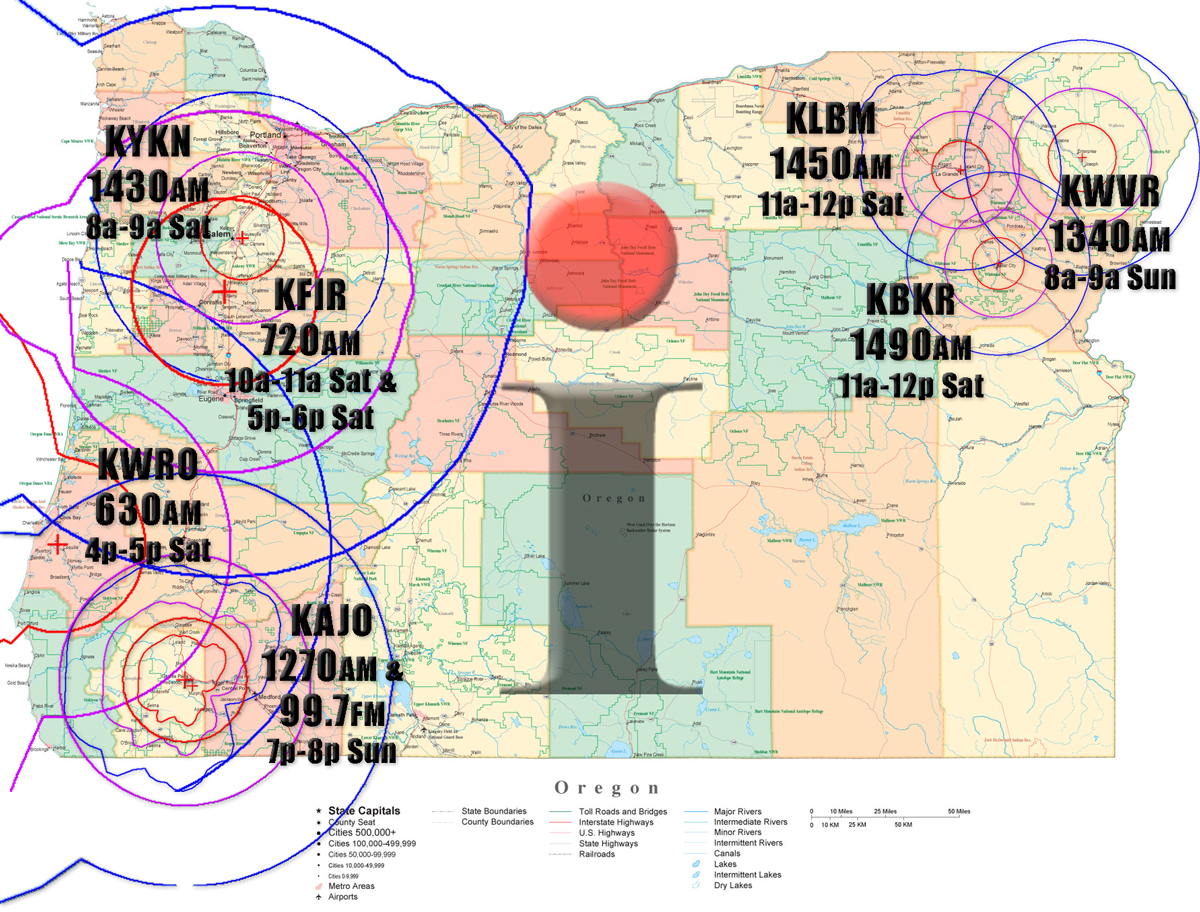

Map of I Spy Radio broadcast areas and air times

The I Spy Radio Show airs weekends — seven times across seven real radio stations, not internet-only streams. Listen anywhere through the stations’ live streams. See when, where, and how to listen for the full schedule.

Missed it? The podcast posts Mondays, after the broadcast stations air the show — here on this page or on your favorite platform.

I Spy Radio  —  Keeping an Eye on Big Government


15-23 Democrats Assisting Oregon’s Suicide – With Republican Help

15-23 Democrats Assisting Oregon’s Suicide – With Republican Help

Show 15-23 Summary: The Democrats’ latest scheme to steal money from Oregonians to solve imaginary problems will kill businesses and jobs. It’s like watching democrats unplug Oregon’s life support. But why are three Republicans helping to push through a carbon cap and trade scheme? It will, allegedly (maybe), replace the governor’s existing climate protection program currently being phased in. Tune in to hear how and why this will chase even more businesses from Oregon and definitely prevent new ones from moving in.

Map showing the radio stations broadcast areas and air time for the I Spy Radio Show.
Current I Spy Radio broadcast areas. Click for full-size map.

The I Spy Radio Show airs weekends, seven times over the weekend, on seven different stations. Listen anywhere through the stations’ live streams! Check out when, where, and how to listen to the I Spy Radio Show. Podcast available Mondays after the show airs on our network of stations.

Air Dates: June 7th & 8th, 2025 | Guest: Jennifer Hamaker 

This Week – Democrats Assisting Oregon’s Suicide — With Republican Help?

The Democrats are raising taxes on practically everything. And they are especially hitting hard its businesses and the factors that generate income and economic activity. In other words, they are harming what would normally help a business grow. And let businesses hire new employees. They are demanding businesses and Oregonians pay more when the State refuses to cut back any spending. While that’s no surprise, it is a surprise that three Republicans have decided to help.

It’s like elected democrats are Dr. Kevorkian. And republicans are his aides. Because what they are hatching will kill Oregon businesses.

Get involved! Don’t be silent! It’s easier than ever to let your voice be heard on bad legislation. Head to this page on Oregon Live for contact info for your legislators. Includes a search function if you’re not 100% sure.
Here’s info for the three republicans mentioned supporting carbon cap and trade: Senator Bruce Starr and representatives Kevin Mannix and Jeff Helfrich.

Why the Democrats’ Plan will Kill Businesses

The Ivanpah solar plant was a massive $2.2 billion green energy boondoggle. But wait, it's even worse than it sounds.
WATCH: The Ivanpah solar plant was a massive $2.2 billion green energy boondoggle. But wait, it gets worse.

In our last show, we interviewed Jonathan Williams, the president and chief economist of the American Legislative Exchange Council. We talked about the coming economic boom for America, thanks to trillion dollar deals Trump brought back from the Middle East. Which could generate up to $10 trillion in economic activity. America is being reshaped into a manufacturing-based economy.

But Oregon is likely to see none of that.

In fact, a recent business survey showed one quarter of Oregon’s business had been approached by other states to relocate. And of those two-thirds said they had already relocated or were expanding their presence outside of Oregon.

But when new businesses are created from those trillions, how many will think of Oregon? Few. If any. Why? Because Oregon is increasing fees and taxes and adding punitive regulations. Not just on businesses but on the potential employees of those new businesses. Worse, Oregon democrats want to punish you if you use (in their mind) the wrong kind of energy.

How many businesses don’t use energy? How many farms don’t use fuels for their equipment? Or how many trucks make deliveries without using fuel?

Move to Oregon where you’ll get punished? Or build in another state where they will welcome you with open arms?

Poison Pills: Carbon Cap and Trade vs. Climate Protection Plan

The democrats’ poison has already been administered. Now it’s just a matter of how quickly the patient will die.

We welcome back Jennifer Hamaker, the president of Oregon Natural; Resource Industries, or ONRI, Because it’s not just the democrats. It’s republicans who are helping to unleash this on Oregonians.

In 2019, Oregon made national news when republican senators walked out the capitol to deny quorum. And refused to come back until the democrats’ carbon tax bill was taken off the table. They had to go across state lines because democrat governor, Kate Brown, threatened to send the state troopers after them to arrest them and drag them back to the capitol.

But they held out. And time ran out. So instead, in 2020, Kate unleashed the Climate Protection Program, the same plan but through an executive order. But Oregon’s appeals court threw it out in 2023. Not to be told no when it comes to punishing people and businesses into submission, Oregon’s DEQ relaunched the same plan with a few changes in 2024. We’re in the “gentle phase” of three phases.

The next phase kicks in. And it’s punitive. But not until 2028. Conveniently after the 2026 election. How bad? The fees to use natural gas will be more than the gas itself. And how bad will that be? According to Jen, if you pay $100 a month for your gas bill, it will skyrocket to $300 per month. Just from the fees. For using the “wrong” fuel for energy. You can imagine what they’ll do to gasoline and diesel.

Stupid Republicans Assisting Assisted Suicide

Tune in to hear why Senator Bruce Starr and representatives Kevin Mannix and Jeff Helfrich are considering helping the democrats pass the slightly less poisonous of the two poison pills. Where the Climate Protection Plan will kill businesses quickly, Republicans are willing to swallow the less poisonous (for now) pill of the carbon cap and trade.

It’s a trap.

Don’t take either pill. Oregonians need to feel the full weight of democrat oppression. Let the democrats take the blame. And Republicans should spend the next year talking about what’s coming in 2028. Unless Oregon finally votes for Republicans.

Don’t miss this show. Because if think paying democrats to pretend to solve imaginary problems is bad enough, you haven’t heard where the money will go.

The I Spy Radio Show Podcast Version

Trapped under a heavy object? Missed the show? Don’t worry—catch the podcast version. Mondays, after our network of radio stations have aired the show, I Spy Radio is now available on your favorite podcasting platform, or you can grab it right here. See the full list of podcast options.

Show Notes: Research, Links Mentioned & Additional Info

  • Jennifer’s organization is Oregon Natural Resource Industries. Their website is ONRI.us
  • Don’t be silent! Let the three republicans (and your own legislators!) know what you think about the Climate Protection Plan and the carbon cap and trade legislation. Here’s info for the three republicans mentioned: Senator Bruce Starr and representatives Kevin Mannix and Jeff Helfrich.
  • Watch that video on Ivanpah. California’s extreme green solar plant that failed. After wasting 2.2 billion. And share that! It’s a prime example of a green energy boondoggle coming soon to Oregon. Here’s the link to copy and share: https://way.lop.temporary.site/wp-content/uploads/2025/06/Ivanpah-Stupid-Idea-and-Waste.mp4
  • Solar Plant Wants to Pay Off Massive Government Loan with Massive Government Grant (Reason, Nov 11, 2014)

Not mentioned but related

Also also related

  • Fury as Republicans go ‘nuclear’ in fight over California car emissions (Guardian,. May 22, 2025)
    • “Senate votes to reverse EPA waiver and prevent state setting own rules”*Environmental Protection Agency (EPA) sets and updates its own federal standards for all states on smog and emissions from cars and trucks … But for decades, California has been granted the ability to make those rules even stricter”
  • Senate nullifies California’s electric vehicle mandate, using fast-track authority to bypass filibuster (CNN, May 22, 2025)
    • “Republicans were livid when at the end of former President Joe Biden’s term, the Environmental Protection Agency greenlit California’s plan to phase out the sale of gas-powered cars by 2035, shifting the state towards electric vehicles.”
  • Kash Patel Announces Charges Against Chinese Nationals In Agroterrorism Case (Trending Politics, June 3, 2025)
  • “A Better Way Than Cap and Trade” (Bjorn Lomborgh, Dec 16, 2008).
  • The End of the EU’s Cap-and-Trade Affair (Bjorn Lomborg, Apr 24, 2013)
  • From the true believers: Carbon Markets 101
14-50 Bailout: Oregon Department of Forestry Chooses to Be Insolvent

14-50 Bailout: Oregon Department of Forestry Chooses to Be Insolvent

Show 14-50 Summary: Too big to fail? Too green to fail? For an agency designed to fund itself and some 200 other public agencies and services, like rural schools, counties, roads, police, and fire, the new “thinking” at the Oregon Department of Forestry just ran out of sustainability. It is now insolvent. And required a special session of the legislature to bail them out because they couldn’t pay the bills they owed for firefighting. But it’s going to get worse with the environmentalists’ new scheme. We talk with Jennifer Hamaker of Oregon Natural Resources and State Rep. Ed Diehl, to find out what happened, why it happened, and how this is all going to get a lot worse.

I Spy Radio Coverage Map as of November 2024
Current I Spy Radio broadcast areas. Click for full-size map.

The I Spy Radio Show airs weekends, seven times over the weekend, on seven different stations. Listen anywhere through the stations’ live streams! Check out when, where, and how to listen to the I Spy Radio Show. Podcast available Mondays after the show airs on our network of stations.

Original Air Dates: December 14th & 15th, 2024 | Guest: Jen Hamaker & Ed Diehl

This Week – Oregon Department of Forestry Insolvent

The legislature held a special session this week to bailout a state agency. One that, since its inception, has been self funding. The Oregon Department of Forestry. Which this year could not pay its own bills for firefighting and had to be rescued by the taxpayer. While it’s not surprising a government agency spent too much and needed more money, this is way worse than the usual government failure.

The Oregon Department of Forestry was designed to fund itself. And not only that, it also funds some 200 other public entities and services. But not any more. Because now ODF has redesigned itself to fail. And to soak up taxpayer dollars. Instead of generating income for the state, it is now a liability. Leadership at Oregon Department of Forestry has determined it no longer wants to do its fundamental job. Which is to oversee—and make money from—the sale of timber on state lands.

But no more. By implementing a massive Habitat Conservation Plan (or HCP), the ODF has ensured its own perpetual bankruptcy. For the next 70 years.

Let’s recap. The Oregon Department of Forestry is supposed to harvest timber on state lands. It doesn’t want to do that. ODF is supposed to manage the forests. It doesn’t want to do that. Managing the forests means preventing fires. It doesn’t want to do that. ODF is supposed to ensure an ongoing, profitable, perpetual, and sustainable timber harvest for the future. It doesn’t want to do that.

What does it want to do? Apparently, sell carbon credits. But there is a real problem with that. (Aside from the fact it’s a massive scam.)

So Why is Oregon Department of Forestry Bankrupt?

We talk with Jen Hamaker, the president of ONRI (Oregon Natural Resource Industries) to find out the Oregon Department of Forestry got into this mess. It was a massive, self-inflicted wound. Like someone who gets injured and then gets surgery to stay disabled so they don’t have to work. Jen walks us through what the ODF was designed to do, what it is doing now, and why the need for a special session to bail them out. And if democrat lawmakers think this is going to get better, think again. This is now baked in. The Oregon Department of Forestry has changed from a billion dollar asset to a billion dollar liability.

Then we talk with State Representative, Ed Diehl (R-HD17), about what happened at the special session. Why did they call the meeting to session and then immediately go behind closed-door committee meetings? Were deals being cut? Rep. Diehl also confirms that ODF is now insolvent. Bankrupt.

ODF’s New Plan: Carbon Credits. Get Paid for Doing Nothing

And it’s only going to get worse. Why? Because the Oregon Department of Forestry wants to move away from forestry and into the carbon credit scheme.

A scheme based on false premises (CO2 is not the enemy, and it is not a pollutant). And a scheme that is likely to fall apart as all across the nation, states lose federal funding for their net zero initiatives.

And we ask, how would this be different if Republicans were in charge? Because this whole Oregon Department of Forestry fiasco is about to get a lot worse — a lot worse — with democrat super majorities in Oregon’s house and senate.

We can all agree ODF needed to pay the bills owed to firefighters. Some whom had to take out huge loans to make ends meet while waiting to be paid. But this bailout doesn’t fix the problem that ODF just created for itself. And its solution to lock up Oregon’s forest lands — let ’em burn! — Oregon Department of Forestry has just made things a lot worse.

The I Spy Radio Show Podcast Version

Trapped under a heavy object? Missed the show? Don’t worry—catch the podcast version. Mondays, after our network of radio stations have aired the show, I Spy Radio is now available on your favorite podcasting platform, or you can grab it right here. See the full list of podcast options.

Show Notes: Research, Links Mentioned & Additional Info

  • Jen Hamaker’s organization is Oregon Natural Resource Industries. Visit them at ONRI.us
  • Rep. Ed Diehl’s website is www.eddiehl.com
  • Oregon isn’t paying its wildfire bills on time. Now legislators must act (OPB, December 11, 2024)
  • Taxpayers “gave” billions to create interest-bearing endowments for Far-Left environmental groups that assault natural resources: “Environmental nonprofit fundraising draws criticism across political spectrum (Capital Press, Nov 14, 2024)
    • An analysis showed “20 nonprofit environmental organizations active in the West … have total net assets of nearly $2 billion dollars”
    • “a significant amount of the money is set aside as an endowment to generate income”
  • This isn’t going to work. Oregon’s Department of Forestry’s plan to stop harvesting timber and start selling carbon credits will fail when the federal government stops cuts the trillions (yes, trillions) of dollars for “Climate Change.”
  • Oregon’s carbon credits scheme to get to net zero, like all states, depends heavily on federal funding.
  • How much federal funding for states’ net zero funding? About $40 billion. (via Perplexity, retrieved Dec 13, 2024).
    • Do democrat state lawmakers honestly think the Trump will continue that scam? (If so, we have a unicorn to sell them.
  • Sen. James Lankford Offers Sneak Peak Into How Exactly DOGE Will Clean Up Government Waste and Abuse (The Daily Signal, Dec 11, 2024)
14-49 The Climate Change Scam: Is this the Beginning of the End?

14-49 The Climate Change Scam: Is this the Beginning of the End?

Show 14-49 Summary: This week we talk to Craig Rucker about what we hope is the beginning of the end of the most extensive and expensive scam in American history — the Climate Change scam. (Or Global Warming scam if you’re old school.) With Trump’s election, there was weeping and gnashing at the annual UN confab for global warming, COP29, which Craig recently attended. We look at the impact the incoming administration will have on policies and personnel. And how changes at the top may filter down to Oregon. Including ruining one of its most recent environmental schemes, to make money from doing nothing.

I Spy Radio Coverage Map as of November 2024
Current I Spy Radio broadcast areas. Click for full-size map.

The I Spy Radio Show airs weekends, seven times over the weekend, on seven different stations. Listen anywhere through the stations’ live streams! Check out when, where, and how to listen to the I Spy Radio Show. Podcast available Mondays after the show airs on our network of stations.

Original Air Dates: December 7, 2024 | Guest: Craig Rucker

This Week – The End of the Climate Change Scam

This week we are talking with Craig Rucker about what we hope is the beginning of the end of the most extensive and expensive scam in American history — the Climate Change scam. (Or Global Warming scam if you’re old school.) Under Biden a minimum of $1.5 trillion was transferred from the US taxpayer to Far Left organizations and causes. We start with the weeping and gnashing at the annual UN confab for global warming, COP29, which Craig recently attended. Many at the conference had been literally banking on a Kamala win to continue the funding that’s been flowing their way. Where will their trillions come from now?

MAGA ladies at COP29

Then we take a look at the impact the incoming administration will have on policies and personnel. And how changes at the top may filter down to Oregon. Including ruining one of its most recent environmental schemes, to make money from doing nothing.

And with Trump’s win, we’re able to move away from theoretical, “If Trump wins, what can we expect?” discussions. Now we can talk about what will happen and what needs to happen. We find out more about those tapped for Secretary of Interior, Energy, and for the EPA and what those appointments will mean for downsizing their agencies. And what policies especially need to be stopped that could unravel the multi-trillion-dollar Climate Change scam.

Is this the beginning of the end of the Climate Change scam?

Let the deprogramming begin.

The I Spy Radio Show Podcast Version

Trapped under a heavy object? Missed the show? Don’t worry—catch the podcast version. Mondays, after our network of radio stations have aired the show, I Spy Radio is now available on your favorite podcasting platform, or you can grab it right here. See the full list of podcast options.

Show Notes: Research, Links Mentioned & Additional Info

Related Information on the Climate Change Scam

  • Net Zero Land Area (Steve Goreham, YT Channel, May 29, 2022)
    • The problem with Net Zero. A Princeton study found that to go from current 10% to 50% renewable by 2050, requires 228,000 square miles of land. That is more than Illinois, Indiana, Iowa, Kentucky, West Virginia, and Wisconsin — combined.
  • PBS Climate Change scam propaganda programming. If you don’t believe their scam, something is wrong with your brain. “How your brain stops you from taking climate change seriously” (PBS, January 7, 2019)
  • Exxon’s chief has a warning for Republicans (Politico, Nov 12, 2024)*The oil giant takes a stance before the Trump administration sets its sights on gutting Biden’s climate agenda.*warns republicans not to gut Biden’s climate agenda
  • DOGE Co-Lead Vivek Ramaswamy at CNBC’s CFO Council Summit (CNBC, YT Channel, Dec 4, 2024)
  • Crescent Dunes: Biden DOJ Moved on Election Night to Cover Up Alleged Solar Energy Scandal that Cost Taxpayers Hundreds of Millions (Breitbart, Nov 25, 2024). 
  • Environmental nonprofit fundraising draws criticism across political spectrum (Capital Press, Nov 14, 2024)
    • IRS filings by 20 nonprofit environmental organizations in the West have total net assets of nearly $2 billion dollars. Often significant amounts are set aside as an endowment to generate additional income beyond donations.
    • Nice. Taxpayers gave Far Left organizations seed money for perpetual income.


Oregon vs Oregon: Urban vs Rural, Politicians vs the People

Oregon vs Oregon: Urban vs Rural, Politicians vs the People

Download the podcast of this week's I Spy Radio Show
To download the show, right-click the mic, and then “Save Link As…” or use our handy player

Show Summary: Oregon’s economy is growing, but politicians want more taxes, including a carbon cap and trade. Why are Oregon politicians determined to ruin a good thing? There is great news out of Trump’s administration with their budget proposal. This should be a time to invest in Oregon, not punish Oregonians with a carbon cap and trade. Plus: Did Gov. Kate Brown and timber companies betray Timber Unity?

Original Air Dates: February 15 & 16, 2020 | Jonathan Williams & Dr. Bob Zybach

This Week: There is some good news that you’ve probably never heard before.

But before we get there, breaking this week were details of what we warned you about a few weeks ago. Details of Governor Brown’s secret meetings with timber companies have come to light, including the start of a deal between timber companies and environmental groups that is taking the wind out of Senate Republicans’ sails. A deal that, despite the 10,000 people who showed up Timber Unity had any say in.

And don’t think she didn’t know exactly why she was doing to sabotage Timber Unity. It is with the deepest sense of betrayal we see these kinds of tricks — instead of straightforward, honest discussions where all sides have a say.

The Good News: Trump Administration’s Exciting Budget Proposal

But, as we said, there is some good news and something you’ve probably never heard before: the words “exciting” and budget proposal” used in the same sentence.

This week we start our conversation with Jonathan Williams, of American Legislative Exchange Council. We’ll discuss with him Trump’s exciting budget proposal that does what so many fiscal conservatives have dreamt of: a return to a balanced budget, honest-to-goodness cuts in federal spending. Be sure to tune in and hear about the 6 million dead people who are finally going to get their checks cut off. Jonathan will also give us the honest-to-goodness look at Oregon’s economic outlook.  An article was recently published touting Oregon’s beating the national economic trends — but we dig into the reality.

The Bad News: Did Timber Betray Timber Unity?

Then we have Dr. Bob Zybach back due to the secret meeting Gov Kate has been having with 13 timber companies and environmental groups.  For someone who has defended the timber industries for decades, you can imagine this secret backroom deal felt like a real betrayal. We discuss the timing and look into the memorandum of understanding itself. We can only guess they’re trying to accomplish—because none of it makes sense.

But get used to this type of behavior if the cap and trade bill goes in.  Salem’s Democrats have purposefully put in measures to keep hidden from public records requests how the government will spend their new revenue. And to whom they will give it.

But we can guess.

Get the inside look at the backroom deals, this week on I Spy Radio. Don’t miss it!

Podcast Version

Never Miss an I Spy Radio Show

Coverage Map of I Spy Radio Show broadcast areas, as of November, 2018
Current I Spy Radio broadcast areas. Click for full-size map.

Five Different Times, on Seven Different Stations. Listen anywhere! All stations stream live!

Saturdays
10a – 11a: KFIR 720AM (entire Willamette Valley) | Direct Link to KFIR Live Stream
11a – noon: KLBM 1450AM (Union County) | Direct Link to KLBM Live Stream
11a – noon: KBKR 1490AM (Baker County) | Direct Link to SuperTalk Live Stream
7p – 8p: KWRO 630AM (Oregon Coast & Southeastern Oregon) | Direct Link to KWRO Live Stream

Sundays
8a – 9a: KWVR 1340AM (Wallowa County) | Direct Link: KWVR Live Stream
7p – 8p: KAJO 1270AM or 99.7FM (Grants Pass/Medford) | Direct Link: KAJO Live Stream


Links Mentioned

Related Links

  • [CHART] See Oregon’s GDP vs nation. Oregon GDP dollars ranks 25th (via US Bureau of Labor and Statistics
  • Democrats advance Oregon’s controversial climate change policy (OregonLive, Feb 13, 2020)
  • Oregon Department of Forestry requests emergency cash infusion as firefighting receivables outstanding (Statesman Journal, Feb 12, 2020)
  • Why The Green New Deal Would Destroy The Environment: The Green New Deal is anything but ‘clean’ or ‘green.’ Even the relatively modest numbers of solar and wind installations in the United States today are causing serious environmental damage. (The Federalist, Feb 12, 2020)
Oregon’s Disastrous Virtue Signalling: Carbon Tax

Oregon’s Disastrous Virtue Signalling: Carbon Tax

Download the podcast of this week's I Spy Radio Show
To download the show, right-click the mic, and then “Save Link As…” or use our handy player

Show Summary: Last year, Republican senators walked out. This year, Oregon’s Democrats are determined to push through a carbon tax. Timber Unity stands for what’s right It’s pretty simple—cap & trade? NO. Timber Unity? YES

Original Air Dates: Jan. 11 & 12, 2020 | Angelita Sanchez of Timber Unity & Dr. Bob Zybach

This Week: Here at I Spy, we are completely against any form of a carbon tax or a carbon cap & trade scheme.

A Carbon Tax: Wrong Thinking

Why is a carbon tax a bad idea? In the first segment of this weekend’s show, host Mark Anderson, thoroughly walks you through the problems of how and why a carbon cap & trade scheme damages an economy and how it violates normal free-market forces.

A carbon tax not only doesn’t work for what they claim it’s supposed to do, but it places an increasing financial burden on citizens. California is a prime example of what happens as its citizens and businesses flee the state. One report has shown tens of thousands of businesses fled California, directly because of California’s carbon tax, in a process known in political circles as “leakage.” Basically, leakage is “How many businesses will leave the state if we pass this bill?”

Also, don’t miss “all you need to know” about “global warming.” It’ll give you some ammunition to use in the coming fight against Oregon’s carbon tax, cap & trade bill.

Timber Unity

Government bureaucrats and far-left politicians who support cap & trade seem to believe they know better than the people they’re supposed to represent. Last year the people came together to put their foot down.

The Timber Unity rally on the capitol steps drew together people in rural areas who were tired of latte-sipping liberals looking down their noses at hicks from the country not knowing liberals are just saving the planet. (I wonder how they think the coffee they’d sipping got to their little coffee house?)

Timber Unity Rally Round 2: Timber Unity’s rally to again fight back against Oregon Democrats’ disastrous carbon tax will be on Thursday, February 6th, 2020. Tentative start time is 10:00. See below for more details, contact, info, and more.


Oregon’s Carbon Tax: New and Improved? Hardly.

Even though Salem’s Democrat legislators are trying to sell the “new and improved” carbon bill as something that would only impact people in the city (for now) it’s simply not true. Because more than 80% of all Oregonian communities have their only means of goods shipped, in or out, are only by truck.

Be sure to tune in to hear the mindset of how these politicians feel about rural areas and who they pretend to protect. What Senator President, Peter Courtney told Timber Unity rally participants right from the start will make your jaw drop.

Oh, and remember how Knute Buehler promised a carbon tax when he was running for governor of Oregon? Here he is suddenly for it now that he’s running for much more conservative CD 2

Good News for Oregon’s Forests?

Then we bring back our timber expert, Dr. Bob Zybach, who continues the conversation on the downfalls of a carbon tax and cap & trade schemes. We hear about how the law negatively impacts our forest management processes, a vital economic impact to Oregon. You’ll get a laugh over OSU’s latest scheme to save the planet. (Insert massive eye roll.)

And he discusses California’s dilemmas with its carbon cap and trade scheme (hint: it’s not working) along with the wildfire issue in Australia and the nonsense of some blaming global warming.

This week it’s all about stopping the nonsense of politicians attempting to fill their tax coffers while claiming it’s “for the environment.”

Podcast Version

Never Miss an I Spy Radio Show!

Coverage Map of I Spy Radio Show broadcast areas, as of November, 2018
Current I Spy Radio broadcast areas. Click for full-size map.

Five Different Times, on Seven Different Stations. Listen anywhere! All stations stream live!

Saturdays
10a – 11a: KFIR 720AM (entire Willamette Valley) | Direct Link to KFIR Live Stream
11a – noon: KLBM 1450AM (Union County) | Direct Link to KLBM Live Stream
11a – noon: KBKR 1490AM (Baker County) | Direct Link to SuperTalk Live Stream
7p – 8p: KWRO 630AM (Oregon Coast & Southeastern Oregon) | Direct Link to KWRO Live Stream

Sundays
8a – 9a: KWVR 1340AM (Wallowa County) | Direct Link: KWVR Live Stream
7p – 8p: KAJO 1270AM or 99.7FM (Grants Pass/Medford) | Direct Link: KAJO Live Stream

Related I Spy Radio Shows

Links Mentioned

Timber Unity Contact Info

  • Timber Unity’s:
    • Facebook page
    • Twitter (@TimberUnity)
    • Questions? Press inquiries? Need info? Contact Angelita Sanchez – her email is arnrc.inc@gmail.com
  • Tweet from @PhRMA: “Did you know that CAR-T therapy was designed to defeat leukemia, but now it’s on the verge of defeating multiple myeloma? That’s the thing about breakthroughs: one can lead to many more.” (via Twitter, Jan. 3, 2020)
  • OSU “study”: We can stop climate change by not logging? “Preserving Forests Makes Perfect Sense, a Letter to the Editor” (via The Oregonian, Jan 5, 2020)
  • Opinion: Why California’s climate solution isn’t cutting it (L.A. Times, Jan. 2, 2020)
    • “The system is supposed to force a gradual decline in carbon dioxide emissions by issuing polluting companies an annually decreasing number of permits to pollute, but it has granted so many exceptions that the program is nearly toothless. … since the beginning of cap and trade in 2013, emissions from oil and gas sources — generated by production, refining and vehicle fuel consumption — have increased by 3.5%”
  • Letters to The Editor:  Is California’s Cap-and-Trade Program Making Climate Change Worse? (L.A. Times, Jan 4., 2020)

Additional Links & Related Info

We Warned You this was Coming

We Warned You this was Coming

PlayPlay

Show Summary: We warned you Oregon was going to try to pass a carbon tax. Find out why this is a horrible idea.

Coverage Map of I Spy Radio Show broadcast areas, as of November, 2018
I Spy Radio Show broadcast areas, as of Nov 2018. Click for full-size map.

Five Different Times, Six Different Stations. Listen anywhere! All stations stream live!

Saturdays
10a – 11a: KFIR 720AM (entire Willamette Valley) | Direct Link to KFIR Live Stream
11a – noon: KLBM 1450AM (Union County) | Direct Link to KLBM Live Stream
11a – noon: KBKR 1490AM (Baker County) | Direct Link to SuperTalk Live Stream
7p – 8p: KWRO 630AM (Oregon Coast & Southeastern Oregon) | Direct Link to KWRO Live Stream

Sundays
8a – 9a: KWVR 1340AM (Wallowa County) | Direct Link: KWVR Live Stream
7p – 8p: KAJO 1270AM (Grants Pass/Medford) | Direct Link: KAJO Live Stream

Air Dates: Dec. 1 & 2, 2018 | Dr. Tim Ball

This Week:  Like you, we always find it interesting when a politician waits until after winning their election to roll out their plans if they get elected.  Such as their budget plans. Well, we warned you this was coming.

I Spy was concerned that if Knute won the governor’s seat, he wanted a carbon tax—and likely would get one. Why? Because Republicans in the legislature would feel obligated to pass it.  And we also knew that even though Kate Brown hadn’t let voters see her big plans to “save” Oregon from financial disaster, we warned you that if Kate won, we’d see a carbon tax, as well as a cap & trade scheme from her too.  She didn’t disappoint.

Stay with us. There is some good news in all this. But first the bad news.

Kate Brown’s Carbon Tax

With the election over, Kate Brown can finally be honest about how much she wants to spend. And about her plans for a carbon tax.

And, sure enough, just this week, The Oregonian ran an article about Kate’s sweeping budget proposal that names all kinds of new spending—about a 10% increase in state spending that will have to be raised through new taxes.

Alexandria Ocasio-Cortez on global warming and science and carbon tax
If Alexandria Ocasio-Cortez believes in Global Warming, it must be true. Just like unicorns.

The shortlist of Oregon’s new spending: $2.2 billion increases for schools, a $375 million PERS bailout for schools, climate change, $50 million on homeless, and oh yes, a special fund to fight President Trump in court. She’ll have to find new creative ways to squeeze even more out of Oregon taxpayers and businesses.

That $2.2 billion doesn’t include other taxes already going up. Remember that Highway Tax Oregon passed in 2017? It’s set to double in 2019. A whopping $434 million. All told, it’s over $3 billion in new taxes. Oh, and that sales tax on healthcare plans that “wasn’t” a sales tax? That’s going up too.

And all that spending doesn’t even include dollar figures for the carbon tax she wants.

The Good News on Oregon’s Carbon Tax Plans

While the rest of the country has the enjoyment of less tax and less government in their lives, Oregon’s Kate Brown plans to heap more taxes and more government on Oregonians.  Has she mentioned any cuts?  No.

So what’s the good news in all of this? It’s all in the D’s lap.  They not only own it but will reap the consequences.  Blue states have been turned red for a lot less. Even deep green Washington rejected a carbon tax.

And that’s the other good news about the prospects of Oregon’s carbon tax. She’s likely not going to pull Republicans over to support a carbon tax. So all it will take is one or two Democrats who think a carbon tax (on top of everything else) is a step too far.

That’s why this week’s show is about giving you the information to help defeat a potential carbon tax.

To get a better handle on what a carbon tax is, how it works, and the propaganda to support it, we call in our climatologist expert, Dr. Tim Ball.

Do you find value in what we’re doing? Consider a gift to help keep us on the air. [wpedon id=”2365″ align=”center”]

Carbon Tax: What the Rest of the World Thinks

Living in Canada, Dr. Tim Ball has witnessed how Canada’s leadership is attempting the same thing—only not everybody is on board. Yes, that’s right. Even Canada is rejecting carbon taxes. Several provinces, including Canada’s most populous, Ontario, are rejecting Trudeau’s carbon tax.

How bad is it? The previous Ontario government was kicked out of office, and by huge margins, when the opponent ran on a promise of getting out of the carbon tax scheme.

Are you listening Oregon Democrats?

And look what happened last week in Paris.  There were literal riots in the street when people found out just how much gasoline taxes were skyrocketing thanks to Macron’s carbon tax. Somehow, you didn’t see reports of police using tear gas on their own citizens who were protesting Macron’s carbon tax. CNN must have been too busy reporting on tear gas being used on our border against invading illegal immigrants carrying flags from other countries.

It’s safe to say that worldwide, support for carbon tax is slipping.

A Carbon Tax Revolt in Oregon?

Could this happen in Oregon? Could we see the voters finally grasp what the Democrats’ plans are? And actually start to fight back? And, dare we hope, rise up against those Democrats force them back away from the brink—when the rest of the nation, and the world, are finally seeing the light.

Find out what you need to know on this week’s I Spy Radio. And then get your phones warmed up as the new legislative sessions starts this winter.

Podcast Version

Trapped under a heavy object? Missed the show? Don’t worry—the podcast version will be right here after the show airs.

Links Mentioned

  • It’s coming: Oregon Governor wants a carbon tax. And cap and trade. “Kate Brown pitches $23.6 billion budget plan” (The Oregonian, Nov. 29, 2018)
  • Carbon tax definition (via Investopedia): “A carbon dioxide tax is paid by businesses and industries that produce carbon dioxide through their operations. The tax is designed to reduce the output of greenhouse gases and carbon dioxide, a colorless and odorless incombustible gas, into the atmosphere. The tax is imposed with the goal of environmental protection.”
  • Carbon taxes for dummies: ‘A carbon tax makes all of us pay’(The Province, Sept. 26, 2018)
  • Another simplified explanation of carbon tax (via Howstuffworks.com)
  • A carbon tax could be a time bomb for the left (Washington Post, Aug 3, 2018)
  • Keep carbon taxes in the ground: ‘Permanently bury these job-killing proposals, after pounding wooden stakes through their hearts’ (CFact, Sept 16, 2018)
  • Paris protest: ‘People are in the red. They can’t afford to eat’(The Guardian, Nov 24, 2018)
  • Don’t Tell Anyone, But We Just Had Two Years Of Record-Breaking Global Cooling (Investors Business Daily, May 16, 2018)
  • Climate Alarmists Suffer Huge Blow On Carbon Tax In Deep Blue Washington State (Climate Depot, Nov 8, 2018)
  • Scientists rip new federal climate report as ‘tripe’ – ’embarrassing’ – ‘systematically flawed’ – Key claim based on study funded by Steyer & Bloomberg (Climate Depot, Nov. 2018)
    • Pretty much all you need to know. “The claim of economic damage from climate change is based on a 15 degree F temp increase that is double the “most extreme value reported elsewhere in the report.” The “sole editor” of this claim in the report was an alumni of the Center for American Progress, which is also funded by Tom Styer”
  • Press Release: Heartland Institute Experts React to Latest Alarmist Government Climate Report (Heartland.org, Nov. 24, 2018)
  • Buck Sexton: “More convinced than ever that it is impossible to get progressives to stop freaking out about climate change- No matter what happens, no matter what evidence is presented- it would just be too psychologically painful for them to accept having been so duped for so long” (Buck Sexton on Twitter, Nov 26, 2018)
  • Paris burns as France faces protests over Carbon Tax on fuel (“French Police fire tear gas at fuel price protesters” Reuters, 24 Nov., 2018)
  • CA Gov. Brown blames climate ‘deniers’ for worsening wildfires – Scientific evidence refutes him: ‘Less fire today than centuries ago’ – Wildfires are NOT due to ‘climate change’(Climate Depot, Nov. 12, 2018)
  • Washington voters overwhelmingly reject proposed carbon tax (“Climate Change Alarmists Suffer Huge Blow In Deep Blue Washington State” Investors Business Daily, Nov 7, 2018)
  • Cal Thomas: “‘A Political Report Masquerading as Science’: The Truth About the New Climate Report” (Daily Signal, Nov. 29, 2018)
  • Coming up in a future show, we’ll be talking about cap and trade schemes defined. Here’s a brief definition of cap and trade, otherwise known as “carbon trading”
Knever Knute?

Knever Knute?

PlayPlay
Download the podcast of this week's I Spy Radio Show
To download the show, right-click the mic, and then “Save Link As…” or use our handy player 

Show Summary: In a followup from last week’s show, we talk with Portland Radio Superstar, Jayne Carroll, about the difficulty facing Oregon Republicans this year. Can Republicans trust Knute Buehler? Should they? Should they vote for him? Plus, more on government corruption and leftist billionaires and their secret operatives implanted in Oregon’s Attorney General office. The Kavanaugh hearings. And O’Keefe’s latest uncovering the Deep State’s sabotage of the Trump administration.

Original Air Dates: September 22 & 23, 2018 | Guest: Jayne Carroll

Last week, we asked whether Oregon Republicans can trust their own candidate, Knute Buehler. Why? Because during the primary, while running against two conservatives, Knute said he opposed a carbon tax. He even called such a scheme Kate Brown’s “honey pot.”

Can Republicans trust Knute Buehler? Plus, Leftist billionaires' secret army planted in states' attorneys general offices
Can Oregon Republicans trust Knute Buehler? Should they?

And then, within weeks of winning the Republican primary, Knute flipped. And now he says he wants a carbon tax.

So which version of Knute do you trust? Primary Knute? Or general election Knute? (Funny how he hasn’t changed his stance on abortion though.)

Our guest last week, Chuck Wiese, a meteorologist and fierce global warming debunker, knows that global warming—now “climate change” (because people are stupid, apparently)— is a scam. Chuck looks at the devastation a carbon tax did to both California and its once proud Republican Party. California’s carbon tax, passed by Arnold Schwarzenegger, a “republican” governor, with the aid of California Republicans, destroyed both the state and the Republicans. As a result, some 10,000 businesses have been forced out of California by the carbon tax.

And now Knute Buehler says he wants a carbon tax. Is Knute trying to destroy Oregon? Or the Oregon Republican Party? Or both?

The Don’t Vote Knute Buehler Strategy

Chuck believes that if Kate Brown gets elected, she won’t be able to pass a carbon tax. Why? Because Republicans in the house and senate will oppose her simply because she’s a Democrat trying to pass (in Knute’s words) a honey pot for Democrats and their Democrat allies.

But if “republican” Knute Buehler gets elected, it’s a different story. Knute will get a carbon tax passed, where Kate Brown will fail if she gets elected. Why? Because in the Knute scenario, Republicans will actually want (or feel obligated to) to support their newly elected “republican” governor.

Imagine that. Republicans passing an anti-business carbon tax. A tax that could punish businesses to the tune of some $17 billion. A tax that will raise prices on every thing. And worse, a tax that will send tens if not hundreds of millions of dollars to… wait for it…Democrats.

If Oregon Republicans pass a carbon tax, it will be like writing checks to the political opponents.

Perhaps this kindergarten-level of “strategic thinking” is why the Oregon Republican Party are in the hole to the tune of –$13,000. Meanwhile, the Oregon Democrat Party is  sitting on a cool half-million in cash in the bank.

So you can see why Chuck Wiese believes it would be better for Oregon Republicans not to elect their own candidate. And it does make a lot of sense—as horrible as it sounds. Sometimes, strategy is very messy. So what are Republicans to do?

That’s why we call in talk show host and long-time political strategist, Jayne Carroll.

This Week’s Show: Jayne Carroll

In the Portland area, Jayne Carroll is a radio superstar. The First Lady of Radio. Last week’s show (The Impossible Choice Facing Oregon Republican Voters This Year) featured Chris Horner, who revealed that Leftist billionaires are secretly embedding global-warming operatives right into states’ attorney general offices. We also talked with Chuck Wiese about his strategy and reasons not to vote for Knute Buehler. Knever Knute. Because Jayne has over 30 years experience in Oregon politics, we want to get her take on things.

While you’ll have to listen, here’s a hint. She’s not thrilled with Knute Buehler. But should Republicans sit this one out? What about the other issues? Will Knute do to the Oregon Republican Party what Schwarzenegger did to California Republicans?

Or what about this: is Knute a Deep State or at least a Democrat plant?

You’ll have to tune in to find out.

We also get her take on the Kavanaugh hearings, the accusations of Christine Ford and the games Democrats play. the latest from Project Veritas exposing the Deep State, and lots more.

Don’t miss this terrific show with one of the best talk show hosts in Portland.

Podcast Version

Map of I Spy Radio Show broadcast areas, starting May 5, 2018
I Spy Radio Show broadcast areas, as of July 2018. Click for full-size map.

Never miss a show! Five Different Times, Six Different Stations. Listen anywhere! All stations stream live!

Saturdays
10a – 11a: KFIR 720AM (entire Willamette Valley) | Direct Link to KFIR Live Stream
11a – noon: KLBM 1450AM (Union County) | Direct Link to KLBM Live Stream
11a – noon: KBKR 1490AM (Baker County) | Direct Link to SuperTalk Live Stream
7p – 8p: KWRO 630AM (Oregon Coast & Southeastern Oregon) | Direct Link to KWRO Live Stream

 Sundays
8a – 9a: KWVR 1340AM (Wallowa County) | Direct Link: KWVR Live Stream
7p – 8p: KAJO 1270AM (Grants Pass/Medford) | Direct Link: KAJO Live Stream

The Impossible Choice Facing Oregon Republican Voters This Year

The Impossible Choice Facing Oregon Republican Voters This Year

PlayPlay

Download the podcast of this week's I Spy Radio Show
To download the show, right-click the mic, and then “Save Link As…” or use the handy player below

Show Summary: Most Republicans believe voting for any Republican is better than any Democrat. Find out why Knute Buehler, running for Oregon’s governor, could be the exception to the rule. Plus: Leftist billionaire’s secret, off-book army in states attorneys general offices. Including right here in Oregon.

Jump to: Free podcast | Links & Info

Original Air Dates: September 15 & 16, 2018 | Guests: Chris Horner & Chuck Wiese

The One Exception to “Always Vote Republican”…?

Like most conservative Republicans, we have always believed you’ll get more of what you want by voting for any Republican iver any Democrat. But on this week’s show, tune in to hear why voting for Knute Buehler, running for Oregon’s governor, could be the exception to the rule.

Map of I Spy Radio Show broadcast areas, starting May 5, 2018
I Spy Radio Show broadcast areas, as of July 2018. Click for full-size map.

This will be a challenging show for listeners because conservative Republicans face an impossible question this election. Is it still better to vote for a Republican candidate if that candidate could do real long-term damage to the Republican party and to Oregon?

In other words, does the maxim, “Always vote for the Republican” still hold if the Republican candidate is actually worse than the Democrat?

Exposed: Billionaires’ Secret Operatives in States AG Offices

As if an potentially untrustworthy Republican candidate for Oregon governor wasn’t bad enough… Add to that worry, the startling revelation that Leftist billionaires are secretly placing operatives in attorneys general offices all across America. Including right here in Oregon.

It’s one bad choice on top of another.

Knute Buehler – Never Knute?

We’re sure the “Never Trumpers” will try to claim this is exactly the same situation they were in a few years back. (Knever Knute?) But it’s not, of course.

The “Never Trump” movement (which Knute was a proud member of, we might add) was a case of so-called “conservatives” opposing Trump for irrational reasons. The Never Trumpers opposed Trump despite Trump running on Conservative values. And conservative tax policies. And a strong Second Amendment defense. Oh, and pro life. Not to mention he opposed global warming. Was for border control and legal immigration. Plus, he pushed for conservative judges.  He was — or should have been—a conservatives dream.

But they just opposed him because he was Trump.

The election in Oregon, however, is a case of a “Republican” candidate pushing Democrat ideals: a carbon tax. (Not to mention being very pro-abortion. And a host of other progressive social issues.) Trump never pushed Democrat policies. That’s why this is different.

The Problem: Knute Buehler’s Carbon Tax

A carbon tax opens the door in Oregon to a potential tax to raise up to $17 billion dollars.  Knute has said he’s for a carbon tax. After claiming (conveniently) during the primary that he was against it. (See Knute Buehler’s op-ed in The Oregonian, Oct. 22, 2017.)

The Danger: Knute Buehler’s Convenient Flip on a Carbon Tax

Just weeks after he won the Republican primary for Oregon’s governor, Knute Buehler suddenly announced that he thinks a carbon tax would be a good idea. What?

A carbon tax will be a killer to businesses, do nothing to affect “climate change,” and spend billions of dollars that will end up in the hands of the Democrats. How does any “Republican” not know this?

To see what will happen to the state and to the Republican party, look no further than what happened in California after “Republican” Governor Schwarzenegger passed their carbon tax. Tens of thousands of businesses left the state. California is now nearly $100 billion in debt. And the once proud Californian Republican party is in shambles and can’t stop anything the Democrats.

Chuck Wiese: Why Republicans Can’t Trust Knute Buehler

Our first guest is Chuck Wiese, a meteorologist and global warming debunker.  Chuck discusses why, despite being a life-long Republican, he is considering actively opposing Knute.

But there’s a real strategy at play here that will challenge your thinking.

Chuck exposes that, when you really start pushing “scientists” who claim to believe in global warming and challenge their facts, they have to admit that even if we do everything they say we have to do, it won’t really affect anything.

So why is Knute supporting a carbon tax? Why has he flipped on this? Is it just a ploy? But if so, how do you know which Knute to believe? Do you take a risk and hope for the best?

Tune in to hear the reasons why not voting Republican may actually be the better long-term choice—if Knute can’t be forced to come around.

Leftist Billionaires Secretly Placing Staff in State AG Offices

To start our conversation, we welcome first time guest, Chris Horner, a Senior Fellow at the Competitive Enterprise Institute (CEI) that was sued by a State’s Attorney General a few years ago simply because CEI didn’t support the idea of global warming.

Since then, Chris has completed two extensive research reports that has uncovered “special assistant attorneys” being secretly placed in states’ Attorneys General and Governor’s offices without any oversight from legislators or voters.  All of this “off book” and hidden from the public and designed to enforce the will of Leftist billionaires.

Like Michael Bloomberg. Who is pushing global warming by creating this shadow government in states across the nation — and it’s happening right here in Oregon.

CEI’s Chris Horner Exposes Billionaires Operatives in States’ AGs

Listen to our guest Chris Horner and the evidence they have gathered through court filings and discovery, including e-mails that reveal how these billionaires are actively trying to undermine the voters and how the AGs are trying to hide all of this from the public.

Podcast Version

Never miss an Episode of I Spy Radio!

I Spy Radio airs at five different times, on six different stations. Listen anywhere! All stations stream live!

Saturdays
10a – 11a: KFIR 720AM (entire Willamette Valley) | Direct Link to KFIR Live Stream
11a – noon: KLBM 1450AM (Union County) | Direct Link to KLBM Live Stream
11a – noon: KBKR 1490AM (Baker County) | Direct Link to SuperTalk Live Stream
7p – 8p: KWRO 630AM (Oregon Coast & Southeastern Oregon) | Direct Link to KWRO Live Stream

Sundays
8a – 9a: KWVR 1340AM (Wallowa County) | Direct Link: KWVR Live Stream
7p – 8p: KAJO 1270AM (Grants Pass/Medford) | Direct Link: KAJO Live Stream

Links Mentioned

Chris Horner (Segments 1 – 3)

CEI Report – Leftist Billionaires’ Privately Fund State Attorney General Offices to Advance Climate Change Legal Positions (Competitive Enterprise Institute, Aug. 29, 2018)

CEI Report Details Leftist Billionaires’ Scheme to Privately Fund Governors’ Offices to Push Partisan Climate Change Agenda(Competitive Enterprise Institute, Sept. 11, 2018)

Chuck Wiese (Segments 4 – 6)

Knute Buehler’s convenient carbon tax lie:

  • During the Republican primary, Knute said he was against the carbon tax. (Knute’s op-ed inThe Oregonian, Oct, 22, 2017)
    • Note: Knute’s campaign staff is now trying to claim he didn’t mean he was against a carbon tax, he was just against Kate Brown being the one to do it
  • The flip: after he won the primary, Knute suddenly reversed his stance on a carbon tax: ““While skeptical of major new spending, Buehler says he is open to increased taxes on electronic and regular cigarettes to pay for budget items like health care, and also to a carbon tax, although not to the Democrats’ cap and trade proposal.” What? Why didn’t he mention he wanted a carbon tax during the primary? (“State Rep. Knute Buehler to challenge Gov. Kate Brown,” Register-Guard, May 16th, 2018)

But wait, there’s more:Buehler on Clean Energy Jobs: Which is it? (Democrat Party of Oregon)

Related Links & Info

  • Knute thinks parties need more control over who can run on their ticket. (Except Knute was lamenting the inability of the Independent Party of Oregon to let him on their ticket, not anything to do with Republicans having more control.) But we agree! Republicans definitely need to have more control over who can and can’t wear the Republican label
  • Dems for Knute? (Oregonian, August 2018)
  • Political scientist: Follow the money for governor (Newberg Graphic, July 19, 2018)
  • Knute’s Background and his position on a carbon tax — from own his website
    • “Buehler, whom Robbins called “a thoughtful, bipartisan pragmatist,” would also support a revenue-neutral carbon tax to stimulate demand for green energy but not a cap-and-invest bill that reeks of “crony capitalism.” He wants to see the LNG natural-gas export terminal come online in Coos Bay and to help rural communities create value-added timber products. For him, the biggest problem in Oregon government is the inefficient muck created by one party in power for so long.”
      • NOTE: “Revenue neutral” means merely shifting who’s paying it (lower taxes on one person while raising taxes on another)
  • Rep. Knute Buehler Says He’s Pro-Choice. Pro-Choice Groups Say He’s Not. (Willamette Week, May 23, 2018)
  • Knute Buehler’s record, basic info, etc. (via Ballotpedia)