Tag: Tina Kotek

16-35 Oregon’s Climate Protection Program: What the Rules Actually Say

16-35 Oregon’s Climate Protection Program: What the Rules Actually Say

I Spy Radio  ·  Keeping an Eye on Big Government
Show 16-35

It’s Worse Than We Thought — What Oregon’s Own Rules Say About the Climate Protection Program

Aired  August 2026
Runtime  46:25
Host  Mark Anderson
Guest  Jen Hamaker

Listen to this episode


Awaiting compiled MP3 from Blubrry — replace [INSERT_MP3_URL] once posted.
Chapter timestamps below are also pending final file concatenation.

About this episode

We’ve covered Oregon’s Climate Protection Program before. This week we went back and actually read the Oregon Administrative Rules behind it — and it’s worse than we thought.

Jen Hamaker, president of Oregon Natural Resource Industries, spent weeks in OAR Chapter 340, Division 273 — the rules DEQ adopted after courts threw out the original program — and joins Mark to walk through what’s actually in there. The fuel-supplier threshold that drops from 100,000 tons today to just 25,000 by 2030, pulling in mom-and-pop distributors alongside the majors. The rule that keeps a company inside the program for six years even after it cuts emissions below the line that got it covered in the first place. The $12,000-per-ton civil penalty — not per day — that applies to every uncovered ton, on top of the $136-per-ton Community Climate Investment payment to an out-of-state nonprofit. And the industrial sectors, from sawmills to concrete, already named in the rule and scheduled to face compliance starting 2028–29.

The show also turns the state’s own logic back on itself: with 2.5 million acres burned this season — a new Oregon record — Mark and Jen run the state’s own cap-and-penalty math against the wildfire carbon that went uncounted, and dig into what a declining forest carbon sink means for a program built entirely around burning less fossil fuel.


In this episode

00:00
01

The Noose Widens — Who Actually Counts as a “Fuel Supplier”

Mark’s opener on how the CPP was born as an executive order after two failed legislative votes, then Jen Hamaker on the fuel-supplier threshold dropping from 100,000 to 25,000 tons by 2030 — and the “aggregation trap” that pulls in unrelated businesses under one owner.

00:00
02

The Market You Can’t Get Out Of

Community Climate Investments, the out-of-state nonprofit CalStart, the $136-per-ton credit price, and the six-year rule that keeps a company covered long after it cuts emissions below the line that got it in.

00:00
03

The Real Fine — $12,000 a Ton, Not $136

The civil penalty most people have never heard of, where that money actually goes, DEQ’s 4.5% cut of the CCI program, and the 15% tribal set-aside with no equivalent floor for rural, remote, or coastal communities.

00:00
04

The Industrial List — Sawmills, Concrete, and Housing Costs

The Emissions-Intensive, Trade-Exposed sectors already named in the rule — sawmills, plywood, pulp and paper, concrete and cement — and why that collides with the governor’s own housing-affordability goals starting in 2028–29.

00:00
05

Oregon’s Own Math, Turned on Itself

2.5 million acres burned this season — a new state record — and what the CPP’s own $12,000-per-ton penalty would mean if Oregon applied its rules to its own wildfire emissions.

00:00
06

The Full Picture Nobody’s Added Up

The spotted owl, a declining forest carbon sink, and why Clean Fuels, HB 2021, and the CPP are never evaluated together — even though Oregonians pay for all of them at once.

Links & resources mentioned

Tribal Population Context

About the guests

Jen Hamaker
President, Oregon Natural Resource Industries (ONRI)

Jen Hamaker is president of Oregon Natural Resource Industries and a sixth-generation Oregonian whose family has worked in the state’s natural-resource sector for generations. A recurring I Spy Radio guest on Oregon energy and climate policy, she returns this week after spending weeks reading the actual Oregon Administrative Rules behind the Climate Protection Program — rather than DEQ’s public-facing summaries of them.

onri.us

Full transcript

MARK: I think one of the themes for this election is that Democrats, who are allegedly all about democracy, simply don’t want to listen to people. That is their track record.

Remember that ODOT gas tax that every Democrat — plus one Republican who is now a Democrat — voted for? That 83% of Oregonians said no to and voted down when they finally did have a voice? That was a paltry 6 cents per gallon tax. What’s happening now — that is currently in effect — makes that pale in comparison to what’s coming if it’s allowed to continue. The Climate Protection Program. And unlike that gas tax, it was never allowed to even be sent to the voters.

In 2019, Democrats in the House passed HB 2020. To stop it, 11 Senate Republicans walked out. Some even left the state. Then-Governor Kate Brown sent the state police after them, but after public pressure, she relented, and the bill died.

But she and the Democrats tried to force it again. In February 2020, SB 1530 — the rewrite. And Republicans walked out again. During that fight, Republicans and industry demanded the question go to the voters. But Democrats voted down a proposal to refer the climate plan to voters. OPB reported that Democrats didn’t want that because they were worried it would fail. And there it is. They don’t listen. Democrats don’t like democracy when democracy tells Democrats no.

So two weeks after that walkout, Governor Kate Brown signed Executive Order 20-04, directing state agencies — unelected state agencies — to design and build the program that the Democrat-controlled legislature had just failed twice to pass. But then the Court of Appeals threw it out on procedural grounds in December 2023, without ever ruling on the merits of the rules themselves. Kotek, newly elected in 2022, declined to appeal and had DEQ redo it — and those new rules took effect January 2025.

But what is the Climate Protection Program? For those of you who didn’t listen to our previous shows, or those of you who did and would like a refresher — the Climate Protection Program is a hard, shrinking cap on carbon emissions. This is not a law. It is an executive order, written by DEQ staff and enforced by an unelected commission.

Here’s how that shrinking cap works. The DEQ, the Department of Environmental Quality, sets a cap on carbon emissions statewide. The DEQ hands out permission slips — one per ton. Like a tightening noose on industry, the allowable amount of CO2 shrinks every year. Last year they allowed 24.2 million tons. This year it’s 23.2 million.

Within that, which businesses are regulated by the CPP is determined by “thresholds.” The allowable per-company threshold is currently 100,000 tons. So that’s hitting the so-called “big polluters.”

But let me pause right there. Carbon dioxide is not a pollutant — it’s a nutrient. Plants need carbon dioxide. They need it to make oxygen, which is sort of important to people.

Those thresholds are what a company is allowed to emit. But go beyond that and you start paying penalties — $136 per ton. So if you’re over that 100,000-ton threshold by just 10% — 10,000 tons — that’s a $1.36 million fine per year.

Back to that threshold, because the CPP doesn’t just tighten — it widens, pulling in more businesses. That threshold of 100,000 is lowered in 2028 by half, to 50,000. You’re allowed to emit 100,000 now, but two years from now, only half of that. And by 2030 — just four years away — it shrinks again by another half, down to 25,000. A whopping 75% reduction in just four years.

So they’re tightening the noose, and what I mean by “it widens” is that they’ll put that noose around more necks. That lowering of the threshold means businesses not currently deemed “large enough emitters” will be deemed that in just a couple of years. And once you’re in, you can’t get out.

We’ve been talking about this for a few years now, and finally other people are starting to pay attention too. But — and this is the reason for this week’s show — it’s worse than we thought. Some related research led us down a rabbit trail back to the CPP, and it turns out that when you dig into the OARs, the Oregon Administrative Rules — the nitty-gritty that nobody likes to look into, but fortunately our guest did — that’s where this cautionary tale turns into a horror story.

To talk about all that, I’d like to welcome Jen Hamaker back to the show. She’s the one who first put us onto this. Jen, welcome back — am I correct in thinking this is worse than we thought? What were your overall impressions as you dug into those rules?

JEN: Yes, it is as bad, if not worse, than what we thought. And DEQ’s own rules are the teeth of the enforcement side of this. It’s bad.

MARK: Personally, I think they’re astronomically worse — especially the lowering of the thresholds, which is going to capture more and more businesses. Looking at this from a business standpoint, I think we’re going to have businesses flooding out of the state as this starts to fully kick in. And the really dangerous thing is that people just don’t know about this right now.

We started talking about this several years ago, and here’s what we thought we knew back then. Back on Show 14-34, Chuck Wiese, our guest on that show, spent an entire hour trying to get straight answers out of DEQ’s Nicole Singh about who’s actually getting hit by this program and how the allotments are apportioned. He called every big supplier by name — Northwest Natural, ExxonMobil, Chevron — because that’s who we assumed this was built for. He never got a straight answer. DEQ just wouldn’t respond.

So here’s what we know now. You went through and read the rules yourself, and it turns out the big suppliers were never the point. That threshold falls from 100,000 tons today to just 25,000 by 2030, which I mentioned in the opener. And by then, DEQ itself expects to cover 99% of Oregon’s liquid fuel and propane supply.

JEN: Correct. Which means the mom-and-pop — anybody that distributes gas or natural gas — it broadens the entire spectrum of who’s going to be under compliance. And it’s punitive.

MARK: On the natural gas front — that was one of the other things that put me onto revisiting this show. I was doing some research, and it turns out the figure that kept coming up was that the CPP was only going to cost $4.9 billion over eleven years. Except that’s not quite correct. That $4.9 billion comes from the natural gas industry’s own lawsuit filings, saying it’s going to cost Oregon ratepayers $4.9 billion over those eleven years — but that’s just the natural gas side. When you expand it into all of the industries, the projections are actually well north of $20 billion over eleven years.

It’s shocking, and I can’t believe nobody’s talking about this — I think simply because they didn’t do what you did, which is actually go and look at how this is going to impact people.

JEN: I didn’t realize it was going to be that much — $20 billion over eleven years. This is the largest climate plan in the world, and it’s punitive, and it’s happening in Oregon when we’re already green.

MARK: Allegedly. As far as the fuel-supplier threshold is concerned, just to give people a sense of scale — when you drop down to 25,000 tons in 2030, a typical U.S. gas station moves 1.2 to 1.8 million gallons a year. So by 2030, a distributor supplying roughly two busy gas stations’ worth of fuel is a regulated, covered entity. Just two stations. This is going to hit all of these mom-and-pop distributors that are out there trying to get the fuel we need to keep the economy going. It’s not just the big regional names — those are the ones getting hit now.

But there’s another issue you uncovered, called an “aggregation trap.” A business owner will often own multiple related — or not even completely related — industries. If one of those business entities falls under this threshold, all of the businesses he owns are also hit.

JEN: Yes. And in a short time, that compliance threshold broadens — it ends up including a lot of different companies. That aggregation trap is horrible, because it regulates people who aren’t even polluting, or bringing in gas, or producing emissions themselves.

MARK: It’s shocking, and we’re definitely going to need a second show on this — I can guarantee we’re only scratching the surface. All right, everyone, stay with us. Lots more to come on the Climate Protection Program with Jen Hamaker.

— Segment 2 —

MARK: And welcome back. This is the I Spy Radio Show, talking today to Jen Hamaker, president of ONRI — Oregon Natural Resource Industries. A sixth-generation Oregonian, her family has been involved in natural resources for literally generations.

Jen, in the last segment we introduced the CPP, the Climate Protection Program — and I want to start digging into some of this. Here’s again what we thought we knew. When we talked to you on a previous show, back on Show 15-23, I said on air — and I quote myself — “they’ve created a market that you can’t even get out of.” That was a gut read at the time. I didn’t have a rule number to point to. It was just an educated guess, knowing how Salem operates and how Democrats work.

So here’s what we know now. It turns out I was right — there’s an actual rule that makes this true. And you found it. Talk to us about the market and how this plays out.

JEN: The CCI is Community Climate Investments. DEQ has picked a nonprofit, CalStart, located down in California. You can pay CalStart for allowances — so if you go over the cap as a company, you can pay into the CCI program, which goes to the nonprofit CalStart, and buy allowable credits from them to offset your emissions. You’re giving money to a nonprofit. And you can also bank your allowances, transfer them, or surrender them. It creates an artificial market where those allowances become very expensive if you need them to continue to operate. This is cap and trade, in black and white. There’s no doubt about it.

MARK: It’s the same effect as the cap-and-trade program the legislature tried to pass. In that same earlier show, we talked about how some Republicans were willing to sign “a deal with the devil” — going along with a legislative cap-and-trade program because it would be slightly better than the Climate Protection Program mistake.

JEN: Yes.

MARK: Unfortunately they didn’t, because when it comes to choosing between two poison pills, you don’t swallow the least poisonous one — you let your opponents do that. Fortunately, they didn’t. So people understand — the reason you’d need those allowances is because you can’t quite get under the threshold set for your business or industry. That’s the 100,000, dropping to 50,000 in 2028, and down to 25,000 by 2030. That allows you to keep polluting beyond the cap if you just can’t quite hit the target. Do we have any sense of what those credits currently sell for?

JEN: You can buy up to 20% of your emissions and give that money to the CCI, the nonprofit, to offset your emissions — and they cost $136 per ton through the government. But once you have those allowances, you can bank them, transfer them, sell them, whatever — and that’s where this artificial market gets created. How much is one of those credits worth when a company needs it to stay in business? The sky’s the limit. It’s a private negotiation between companies.

MARK: And you mentioned it’s a $136-per-ton charge from the government right now.

JEN: Right.

MARK: But we’ll come back to that, because that’s not quite the whole story. The other thing I mentioned is that you can’t get out of this — once you fall in, those rules apply to you for the next six years, at least.

So just to reiterate: if your target is 25,000 tons and you get under to 24,000, that doesn’t mean you’re excluded. You still have to follow those same regulatory requirements for the next six years, just to maybe get out at the end of it — and of course, the rules can change between now and then.

JEN: And it also covers any other companies you might own, even if those are in compliance on their own.

MARK: Exactly right. That’s what’s so frightening about the reach of this — it’s going to start impacting other companies even if they don’t directly fall under it. And you’ve got $20 billion over eleven years being removed from Oregon’s economy on this.

So getting back to CalStart, the nonprofit handling this — this is so typical for the left. They love to operate this way. We’ve seen it with climate change since our first year covering this. What we’ve found is they hide this money behind the shield of a nonprofit, because if it were a government agency, you could file a public records request and say, “Show us how you’re spending this money. Who’s getting it? How much are you taking in, how much are you spending, and with whom?” You can’t do that with a nonprofit — it’s behind that veil of secrecy. They have to show you the top five recipients or so, but beyond that, they could be funding literally hundreds of far-left organizations. That’s where a lot of this will go — to organizations that support climate causes under the banner of “environmental justice.”

How many conservative organizations are involved in environmental justice funding? None that I’m aware of. If this were a funding mechanism the right was using — bleeding off taxpayer dollars for pro-life initiatives, the National Rifle Association, or funding a religion, which is essentially what climate change has become — there would be hell to pay. But for some reason, Republicans tolerate this.

JEN: I agree.

MARK: Okay, everyone, stay with us. We’ll continue this with Jen Hamaker, talking about the Climate Protection Program. There’s still a lot more to unpack here — none of it good.

— Segment 3 —

MARK: And welcome back. We’re talking today to Jen Hamaker, president of ONRI, Oregon Natural Resource Industries — find out more about their work at onri.us. We’re talking about the Climate Protection Program, something you need to know about, because it isn’t getting enough attention. Republicans especially ought to be talking about this, because it’s exponentially larger than the gas tax that was defeated by 83% of voters statewide — including in deep-blue Multnomah County, where it was defeated by 73%. That includes a lot of Democrats.

Jen, one of the things we talked about last segment was this target-emissions line you get fined for on every ton over your allotted amount. Right now that’s 100,000, dropping to 50,000 in two years, down to 25,000 in four years, in 2030. But that’s not the full story, because according to the OARs — and you can find these on today’s show page, 16-35 — one rule states that each metric ton of CO2 of a compliance obligation for which a covered entity does not demonstrate compliance is a separate violation. What that means: a Class I major violation is $12,000 per ton — not per day, per ton. If you exceed that, that’s your fine, and I had no idea it was anywhere near that high.

JEN: So if you exceed that by, say, a thousand tons…

MARK: That’s $12 million. Boom.

JEN: Where does that money go?

MARK: That’s a good question — I don’t have that in front of me right now. We’ll find that out and get it up on the show page. I’d assume some of that has to be offset somehow, but I don’t know off the top of my head.

JEN: Does the CCI get it?

MARK: Possibly — wouldn’t surprise me. We’ll have to figure that one out. But again — $12,000 per ton. If you’re already at 25,000 tons and you go 1,000 tons over that, that’s $12 million. How many businesses do you think can absorb a $12 million fine?

JEN: The DEQ is going to get rich.

MARK: It’s absolutely stunning how punitive this fine is. And even the $136 figure can add up quickly — if you’re over by just a thousand tons, for a small company, that’s a $136,000 fine. That’s two paychecks worth of employees you could have been paying, and instead you’re paying the state.

So one of the things out there is what this “environmental justice” nonprofit funding actually goes toward. Do we even know what qualifies as an environmental-justice expenditure?

JEN: From my experience, pretty much anybody who can justify themselves as environmental justice gets included. And as far as DEQ’s oversight of the CCI, the nonprofit CalStart — DEQ charges 4.5% off the top to oversee them. But within the DEQ statutes, there are no regulations on who the nonprofit can give their money to, as long as it has something to do with environmental justice. To me, it’s a racket.

MARK: It does sound like a racket. One thing I found interesting — a minimum of 15% of those CCI project funds has to go to tribes, specifically federally recognized tribes within Oregon. Fifteen percent — is that fifteen percent of Oregon’s population? I don’t think so. Do we have any idea why they’re getting that guaranteed share?

JEN: I think it’s a feel-good thing. Honestly, the more I understand these regulations and statutes within DEQ, the sicker I get. I don’t have a good answer for you on that one.

MARK: While we were talking, I quickly looked up where that $12,000 goes — that’s a civil penalty, so the state gets that. The CCI credits, though, those still go to CalStart. But the $12,000 is a civil penalty. And it’s even worse than that, because according to my research, the director can escalate that to $25,000 per violation per day.

JEN: All of this is so arbitrary — it’s just a way for government to collect more money, more money, more money. Bigger government, more regulations, more restrictions. Who would ever think you could punish your way out of climate change?

MARK: Punish your way out of it — exactly. It’s kind of like the COVID lockdowns, how onerous those got, where they’d punish you regardless. How many businesses went under because they couldn’t — or wouldn’t — follow the rules, and people weren’t coming through their doors like before? This is going to destroy Oregon’s businesses. We are already bleeding businesses.

JEN: That’s right. And it’s going to take us out of competition too, because anybody inside Oregon’s borders has to comply with this program.

MARK: Imagine trying to attract businesses: “Come to Oregon — and if you pollute more, we’ll let you pollute, for $12,000 a ton.” It’s pretty shocking. All right, everyone, stay with us — we’re going to continue this with Jen Hamaker, talking about the Climate Protection Program and what you need to know.

— Segment 4 —

MARK: And welcome back, talking about the Climate Protection Program. This is coming at you fast — in fact, it’s already in effect, and it’s going to get progressively worse very quickly, within the next two years — conveniently, after the governor’s election. And it’s the governor who could undo this, because it’s not a law, it’s an executive order. Switch who’s governor, and you can undo this. Christine Drazan has said repealing it is a priority for her.

Jen, let’s talk about what we thought we knew about which industries would be hit by this. We had a sense of some of them, but after you dug into the OARs, it turns out to be much broader. Which parts of Oregon’s natural-resource industries are going to be hit by this?

JEN: Every single one of them. There’s something in the CPP rules that specifically identifies what they call EITEs — Emissions-Intensive, Trade-Exposed industries. Those include sawmills, semiconductor manufacturing, plywood mills, veneer mills, and pulp and paper. Our natural-resource industries will be hit by this, and they’re subject to the full emissions regulations under DEQ through the CPP.

MARK: The other ones on that list include concrete and cement companies, iron and steel, glass, chemicals, fertilizer and agricultural chemicals, plastics, mining and quarrying, aerospace, and semiconductor manufacturing, which you mentioned. When you look at all of that — one of the governor’s stated goals is lower-cost, more affordable housing. She’s been saying that since she ran in 2022. Well, guess what she’s targeting: lumber. That’s going to go up. And concrete — you need that to pour foundations. Iron and steel are used in buildings. Glass, for windows. So the very things she says she wants to lower costs on, the CPP and all of these rules are not going to lower anything.

JEN: Correct. And it’s layered on with everything else she’s done — shutting down our forests, regulating all of that too. The crazy thing about the EITEs having to be subject to the full emission-reduction requirements is that DEQ is still developing the specific emissions-intensity benchmarks and reduction schedules, so we don’t even know what the fallout is going to be yet. But what we’ve researched so far tells us it’s going to be extreme. This is the brainchild that started with Kate Brown and moved to Tina Kotek, and she’s ratcheting it up.

MARK: Something else important — the threshold for these EITEs is lower than for fuel suppliers. Their threshold is only 15,000 tons of emissions. That’s hitting a mid-size mill or food processor — not some giant mega-corporation. Smaller, though not quite mom-and-pop, and certainly much smaller than the fuel suppliers at 25,000 tons. Do we have any idea why they’ve lowered it for those industries specifically?

JEN: No — well, it’s the transportation sector that produces the most emissions overall, so the CPP really targets that. And the cap decreases over time while the cost increases over time. With the 15,000-ton threshold for the EITEs, that’s how they’re going to make their bread and butter — semiconductor manufacturing, sawmills, all of it. This is just so punitive, and again, this is the largest, most expensive, most punitive climate plan in the world.

MARK: Even just the $136 per ton is three times what Washington and California charge.

JEN: Yeah, and that’s the base rate.

MARK: Getting back to the CCI payments — the reserve, which was in your notes as item five: DEQ has the ability to retire those compliance instruments. So it’s not just lowering the threshold from 100,000 tons down to 25,000 and even lower by 2050 — it can also lower the amount of credits you’re allowed to buy. Talk to us about how that works.

JEN: A compliance instrument, in layman’s terms, is one ton of CO2, or emissions. The obligation is the volume of emissions each supplier is responsible for. When DEQ retires an allowance — one metric ton — it ratchets the cap down further, and it moves down fast. Under specified circumstances, DEQ can retire those compliance instruments, and that matters because scarcity isn’t an accidental side effect of this program. The declining number of available instruments is central to making the emissions cap work — and to the money it generates for government.

MARK: Right. Just to go through some of the numbers: the reserve currently allows 800,000 instruments from 2025 through 2028–2029. That shrinks to 500,000, and from 2035 onward, to 250,000. So they’re lowering the threshold at which this kicks in, and also lowering what I think of as those “donation” payments — kind of like the old medieval practice of indulgences, effectively letting you keep sinning. They’re shrinking the supply of those indulgences, so the price is going to explode.

JEN: Exactly — that’s exactly my fear. That’s exactly what a program like this supports.

MARK: Horrendous. Okay, coming up, we’re going to talk about the largest polluter in Oregon. Stay with us.

— Segment 5 —

MARK: And welcome back. This week’s show is one of those where the more you look, the worse it gets — and that tends to happen with government programs. We’re talking about the Climate Protection Program, an executive order originally put in place by Kate Brown after Republicans walked out to stop it in the legislature. It was thrown out by the Court of Appeals on disclosure grounds, then reinstated under Governor Kotek, and it’s currently in effect.

Jen, our guest today, is president of ONRI, Oregon Natural Resource Industries — their website is onri.us. Jen, the reason I got onto this angle was thinking about the stated goal of reducing carbon emissions. That’s weird, I thought, because right now we are burning up — this is the largest forest-fire season we’ve ever had. So I started digging: roughly how many acres have already burned? Jen, can you give us a sense of the scale?

JEN: Right now in Oregon we’ve burned 2.5 million acres this year. It’s the biggest fire season in Oregon history.

MARK: And just two years ago we had that really big one, and we thought that was astronomical. This one’s even bigger. It’s like we’ve learned nothing. So again, looking at this through the lens of “we want to reduce carbon emissions” — how much carbon did those 2.5 million acres put into the air, which we’ve said we don’t want to do? Doing the research, that’s roughly 30 million tons of CO2. Our cap this year, per DEQ, is 23,280,253 tons. So that’s roughly 6.72 million tons over the state’s own limit.

If you wanted to fine that — and I’d call this willful negligence, because we know forests burn when you don’t manage them — to me, that’s a willful violation of what we say we want to do. At the $12,000-per-ton civil penalty, that’s $80 billion the state would owe itself. And if you use the full 30 million tons over the cap, remember, this is on top of what industry pays — that’s $360 billion.

But the state isn’t liable for any of that, because apparently that’s not “man-caused” emissions — they call it natural. I’m sorry, but if you have the opportunity to not let these fires burn and don’t take it, to me that’s man-caused.

JEN: That’s correct. And just to put this in perspective — remember the Labor Day fires? The initial blaze emitted enough to equal every single car in Portland running 365 days a year, 24 hours a day. Just to give you an idea of scale.

MARK: How many tons of carbon dioxide do trees take out of the atmosphere once they’ve already burned and are no longer there? You need those plants to take carbon dioxide out of the air. You just let 2.5 million acres go up in flames, putting all of that carbon into the air. You’d think maybe we ought to do something about that.

JEN: It’s a double whammy — we’re destroying the lungs of Oregon.

MARK: Jen, there’s something else from your notes I want to get to. The CPP isn’t Oregon’s only carbon-compliance system, and I think that’s the really dangerous part, because we don’t have a true sense of exactly how much this is all going to cost Oregonians. Separate from the CPP, Oregon’s Clean Fuels Program already operates its own credit-and-deficit system affecting transportation fuels. Walk us through some of these other carbon-compliance systems.

JEN: This is layered carbon compliance on top of carbon compliance. Right now, the fuel tax in Oregon is 40 cents. The Clean Fuels compliance cost is about ten, almost eleven cents. The CPP compliance cost is going to be about 39 cents starting in 2028, and it’ll ratchet up from there. And DEQ’s own calculated average compliance cost rose about 25% in one year. Add all of that up — what’s the aggregate cost to consumers buying fuel? To me, this is one of the scariest parts of the whole thing, because fuel cost touches everything — not just transportation, not just industry, but the mom taking her kid to school in the morning. All of this is going to start costing us, and then heating your home on top of that, with natural gas ratcheting up too. We genuinely don’t know what the end result is going to be for the consumer.

MARK: Just to run through the other pieces you’ve mentioned — on top of the CPP, you’ve got HB 2021’s electricity requirements, Advanced Clean Cars II, Advanced Clean Trucks, the CCI system — that’s the $136-per-ton additional cost if you exceed the cap — plus the 4.5% DEQ fee, and future EITE industrial compliance on top of that. You nailed it when you asked: where is the cumulative economic analysis when you lump all of this together? It’s astronomical.

I don’t understand how they can even consider this, going back to your notes — a logger doesn’t buy Clean Fuels diesel on Monday and CPP diesel on Tuesday. Oregon evaluates these regulations one at a time, but businesses don’t pay them one at a time. Eventually all of this ends up in the hands of the customer, because the upstream fines and regulations impacting the cost of doing business don’t just get absorbed — businesses have to pass that on.

JEN: That’s right. That’s why I think this is a racket — the consumer pays more, and the government gets more. And to add to it: right now DEQ has 21 companies, covered fuel suppliers, receiving compliance instruments under the CPP, and DEQ gets to decide how much each one of those companies gets against the cap — about 24 million tons in 2026. To me, that’s exactly why people don’t trust government — these backroom deals. DEQ says they have an equation, but that equation is only known to DEQ, deciding which company gets how many of these allowances. It’s “you scratch my back, I scratch yours.” Is there something more happening there? I don’t know.

MARK: It’s selective punishment, for sure. All right, everyone, stay with us for our final segment, where we’re going to talk about Oregon doing the opposite of what it says it wants.

— Segment 6 —

MARK: And welcome back for our final segment, talking to Jen Hamaker, president of ONRI, Oregon Natural Resource Industries — onri.us. Jen, we’ve been talking about the CPP, and as we discussed last segment, the stated goal is reducing carbon emissions — and yet the state is by far the biggest polluter of anyone out there.

This ties right in, because with all of these forest fires destroying habitat — did you happen to see that Oregon State researchers recently found the northern spotted owl is functionally extinct in significant parts of its range? We started this effort back in the seventies and eighties to save the spotted owl, and now it’s effectively lost. How many acres have we allowed to burn while claiming we want to protect the spotted owl? How many spotted owls are living in areas that used to be forest and no longer are? I’m guessing zero. Does this affect the habitat conservation plan?

JEN: Actually, yes, it absolutely does — they’ve set aside hundreds of acres per pair of spotted owls, and if the owls are gone, there will be real questions about those set-asides. But I want to bring up something I think your listeners need to understand: none of these rules, regulations, allowances, and compliances have really been looked at in the aggregate — as a whole.

MARK: Yes.

JEN: It’s the same with our forests, which keep burning while government shuts down the Elliott, shuts down millions of acres under the Private Forest Accord, shuts down millions more under the HCP on state lands. They look at each of those individually — they don’t add it all up, so they never see the full picture. That’s exactly what’s happening with the CPP and all of these other rules and regulations, like Clean Fuels, all contributing to what consumers are going to have to pay. Nobody has looked at the full picture. That’s what government keeps doing — they focus on one thing at a time, and pretty soon all of it gets passed on to us.

MARK: Well, and again, they say the goal is a decline in carbon emissions. Okay — we’ve got some carbon vacuum cleaners out there, they’re called trees. Oregon’s own 2025 Land-Based Net Carbon Inventory shows that since 1990, the forest’s ability to remove carbon has declined 44% because of these fires — from 104.5 million tons down to 58.62 million in 2024. Again, if the goal is to reduce carbon, instead we’re letting those trees burn up, which means they can’t be out there pulling carbon out of the air.

JEN: Not only are they no longer able to sequester CO2 once they’ve burned — they’re also contributing to the CO2 total, because roughly half of dried wood, by weight, is carbon. You burn it, and it’s released. It’s a double whammy, again.

MARK: It absolutely is. Jen, unfortunately we’re up against the clock. This has been very informative — as I said at the top of the show, we’re definitely going to have you back, because a lot of what we’ve done here is really just first-blush research, and it’s astronomical just trying to get your head wrapped around it.

JEN: There’s so much to this.

MARK: It absolutely is astonishing. Thank you so much for your time today.

JEN: Thank you so much.

MARK: It probably won’t surprise you that there is a tremendous amount of information we still haven’t covered, including the fact that this isn’t just an Oregon story — there’s an international organization behind all of it. I want to encourage you to go to our website, ispyradio.com/16-35, to find out more — there’s a tremendous amount of information up there already. And I’d especially encourage you to contact your candidates and make this an issue in this campaign, because this is an executive order — the fastest way to undo it is to change who holds that office, the governor. But if you keep — or let expand — those Democrat supermajorities, this becomes law. That’s why you can’t just focus on the governor’s race. You’ve got to support those down-ballot races too, the representatives and the senators. Because as we say every week — the best information does you no good if you don’t use it.
Catch the show live


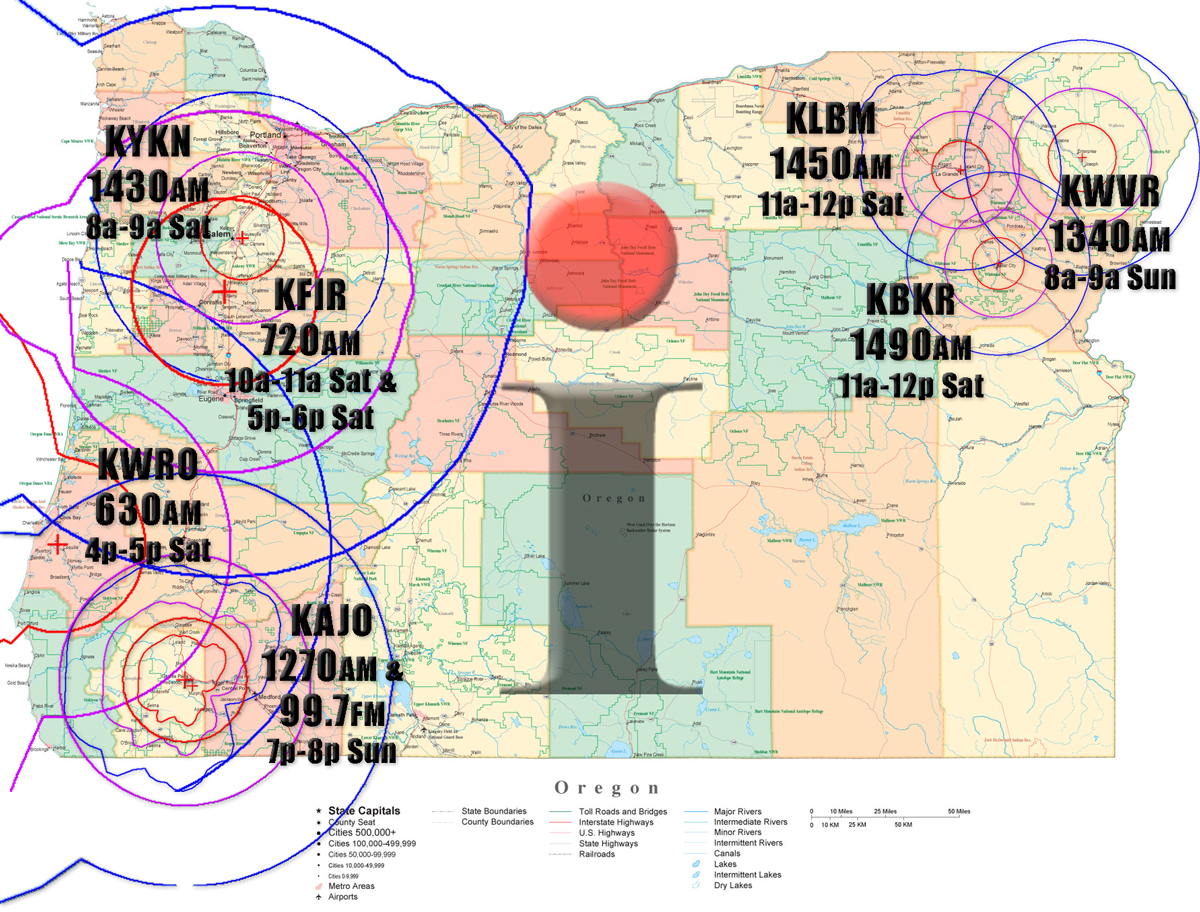
Map of I Spy Radio broadcast areas and air times

The I Spy Radio Show airs weekends — seven times across seven real radio stations, not internet-only streams. Listen anywhere through the stations’ live streams. See when, where, and how to listen for the full schedule.

Missed it? The podcast posts Mondays, after the broadcast stations air the show — here on this page or on your favorite platform.

I Spy Radio  —  Keeping an Eye on Big Government


Oregon’s Universal Health Plan: The $85 Billion Tax Bill | Show 16-31

Oregon’s Universal Health Plan: The $85 Billion Tax Bill | Show 16-31

I Spy Radio Show | Keeping an Eye on Big Government
Show 16-31

Sixteen Years in the Making — Oregon’s March to Socialized Medicine

Aired  August 2026

Runtime  48:00
Host  Mark Anderson
Guest  Lisa Lettenmaier
Listen  See our network of stations, areas, times and livestream options

Listen to this episode (Available Mondays after airing on our network of stations)


Player block is self-contained and swappable. When the site goes static,
replace this <audio> element with the Podlove Web Player to get chapter
navigation and transcript sync — the chapter data below already feeds it.

About this episode

For sixteen years this show has been telling you what was coming. We are now standing on the threshold of it. In seven weeks, a board appointed entirely by Governor Kotek delivers Oregon a blueprint for state-run health care — and the numbers are on the state’s own website.

$85B
Total annual cost
9.6%
New employer payroll tax
10.1%
New personal income tax
Sept 15
Plan due to Legislature

Independent health insurance broker Lisa Lettenmaier of Health Source NW returns for the full hour — and this one may be the most important conversation we have had with her. Mark opens by tracing the ten-step path Oregon has walked since 2011: the bills that created the Coordinated Care Organizations and then exempted them from state and federal antitrust law, the “global budgets” that pour money from every source into a single pot where no one can follow it, and the nonprofit structures that shield those books from public view.

Then the payoff. Because voters passed Measure 111 in 2022, health care is now a right written into the Oregon Constitution — and proponents argue the Legislature is therefore obligated to deliver it. The next year, Senate Bill 1089 created a nine-member Universal Health Plan Governance Board, appointed by the Governor and confirmed by the Senate, and gave it a statutory deadline: September 15, 2026. By law, every member of that board must agree with the objective before they can be appointed to it. There is no seat for a skeptic.

Lisa walks through what the plan would actually cost a household. A 10.1% health care personal income tax stacked on top of Oregon’s existing 4.75%–9.9% rates, kicking in above 200% of the federal poverty line — a threshold a full-time minimum wage earner in Portland has already crossed. A 9.6% employer payroll tax on any business with more than $500,000 in firm-wide payroll, which is a landscaping company with a couple of crews, a small restaurant, a dental office. Plus three points on the corporate income tax and a bump to the corporate activity tax, which is levied on gross receipts, not profit. Total new Oregon revenue: $16.9 billion a year. The other $68 billion has to come from Washington.

And that is before the history. Vermont passed the nation’s first single-payer law and then killed it when the real tax numbers came back at 11.5% on employers and up to 9.5% on individuals — a Democratic governor walked away from his own signature achievement. Oregon is proposing a comparable payroll tax and a higher income tax. And Oregonians have already voted on this once: in 2002, Measure 23 proposed single-payer funded by income and payroll taxes and lost 78.5% to 21.5%.

The hour closes where it has to. In Canada, assisted dying has moved from a mandatory 48-hour waiting period to same-day — and a study has projected savings in the hundreds of billions, with the largest figures under non-voluntary scenarios. Oregon’s own board has adopted five governing principles, and one of them reads: during public health emergencies, protecting community health may temporarily take priority over individual preference. When the government is the only payer, the government decides what your care is worth.

The report lands September 15. It goes to the Legislature seated by the November 3 election — and under the Oregon Constitution, a tax package needs three-fifths of both chambers. Democrats hold 37 of 60 House seats and 18 of 30 in the Senate. Two House seats, or one Senate seat, is the whole margin.


In this episode

00:00
01

Ten Steps to Socialized Medicine

Mark lays out the sixteen-year path — from duping Republicans in 2011 to the final step Oregon is standing on now. Then Lisa on where the 2027 rates landed, the carriers walking away, and Oregon taking over the insurance marketplace from HealthCare.gov.

00:00
02

The Money You Can’t Follow

Why Oregon switched off the antitrust laws for health care, what a “global budget” really does to accountability, and the meeting where Lisa first heard the state pitch buying air conditioners with health care dollars. Plus the cost-shift almost nobody understands.

00:00
03

$85 Billion a Year — and Where It Comes From

CareOregon’s billion-dollar reserve, the California merger Oregon’s own DOJ found unlawful, and then the tax table itself: 10.1% on income, 9.6% on payroll, and what 200% of the poverty line actually means for a family of two.

00:00
04

Vermont Tried This — and Oregon Already Voted No

The projections that killed Green Mountain Care, the 2027 session versus a 2028 ballot measure, and Measure 23’s 57-point defeat in 2002. Plus Medicaid recertification, and the hospital tax Lisa calls a shell game.

00:00
05

The Lies They’re Telling — and the $68 Billion Wish

The state’s own calculator says most households pay less. Lisa explains what it leaves out — what happens to private plans, to provider pay, to wait times, to snowbirds and travelers — and why the whole thing rests on $68 billion a year from a federal government that has not agreed to any of it.

00:00
06

Customer or Liability — and What a “Right” Actually Is

Designed for fraud, or merely indifferent to it? Then Canada’s trajectory, the Oregon board’s own principle that community health may override individual preference, and Mark’s closing argument on why no one has a right to another person’s labor.

Links & resources mentioned

Lisa Lettenmaier & Health Source NW

  • Health Source NW (independent health insurance & Medicare brokerage — Oregon & SW Washington, no cost to clients)

Oregon’s Universal Health Plan — Read Their Own Paperwork

Who Is Pushing It — In Their Own Words

The CCOs — Antitrust, Global Budgets & CareOregon

The 2027 Rates, the Carrier Exodus & the State Marketplace

It Has Been Tried Before

Medicaid, the Provider Tax & What Comes Next

About the guest

Lisa Lettenmaier
Owner, Health Source NW

Lisa Lettenmaier is an independent health insurance broker serving Oregon and Southwest Washington, and the owner of Health Source NW — an agency that helps individuals, families, and seniors navigate individual health insurance and Medicare plans at no additional cost to the client. She has been in the market since before the Affordable Care Act took effect, sat through the rollout meetings, and watched Oregon’s individual market shrink from roughly fifteen carriers to three.

She is a recurring I Spy Radio guest and the show’s go-to voice for common-sense answers on Oregon’s health care system.

healthsourcenw.com

Full transcript

Transcript is being prepared and will be posted shortly. Auto-generated from the episode audio, then cleaned for names, agencies, figures, and natural paragraph breaks.

Catch the show live


Map of I Spy Radio broadcast areas and air times

The I Spy Radio Show airs weekends — seven times across seven real radio stations, not internet-only streams. Listen anywhere through the stations’ live streams. See when, where, and how to listen for the full schedule.

Missed it? The podcast posts Mondays, after the broadcast stations air the show — here on this page or on your favorite platform.

I Spy Radio  —  Keeping an Eye on Big Government


Show 16-04 Podcast – Why Republicans Winning Oregon Elections Just Got More Likely

Show 16-04 Podcast – Why Republicans Winning Oregon Elections Just Got More Likely

Why Republicans Winning Oregon Elections Just Got More Likely

Release Date: January 24, 2026

Duration: 47:55

Host: Mark Anderson

Guests: Rep. Ed Diehl, candidate for Oregon governor, and Eric Lee, senior attorney on Judicial Watch’s election integrity team


About This Episode

Election integrity laws are about to change — for the good. The timing could not be better. Right when a Republican candidate with a proven ability to draw independents and Democrats decided to run for Oregon’s governor. And at a time Oregon Democrats are doing their best to sabotage their own chances by punishing Oregonian to cling to power. Even more, the federal lawsuits to restore trust in our elections haven’t even really gotten started.

Show Notes

  • 00:00 – Representative Ed Diehl announces his run for Oregon governor — what happened to change him from a no to a yes?
  • 09:18 – The highly successful No Gas Tax referendum drew support from all political parties. So how to convert support for that issue into support for him as a governor candidate for Oregon?
  • 16:31 – Oregon Democrats are committing political suicide more on how they are punishing Oregon businesses and the Oregonians who work at them.
  • 24:39 – Eric Lee, senior attorney on Judicial Watch’s election integrity team discusses last week’s SCOTUS ruling and how Bost v. Illinois was so huge for election integrity. Why the rules have now changed.
  • 31:45 – The avalanche of election integrity lawsuits about to come. Judicial Watch sued Oregon to clean up the voter rolls; Oregon surprised court watchers by suddenly announcing they would remove 800,000 inactive voters—about 20–25% of registered voters.
  • 39:09 – Did Oregon’s Secretary of State just blab a little too much and admit Oregon is at fault? That 800,00? That’s just the start. Discovery is underway right now. And did the Secretary of State also open the door to another Judicial Watch lawsuit by violating another federal law?

Transcript

(Opener) There’s a buzz phrase in government that you probably heard. Evidence based. And they use that buzz phrase because what they really want is for you not to question their policies.

Evidence based refers, allegedly, making government policy and spending decisions based on evidence — like data and research (which govt pays someone to do), and so-called “proven results” rather than on ideology, intuition, or anecdote.

Now just to easily disprove the notion of evidence based — when’s the last time democrats push through government policy that supported (or, more to the point, funded) any ideology on the right.

There is overwhelming evidence for conservative, pro-growth economic policies — like lowering taxes and cutting government spending is good for economies and good for people. Instead, Democrats want to raise taxes and increase government spending — the exact opposite of what the evidence shows.

Instead, it’s about things like climate change, which they plan to fix through carbon credits, which fund Democrats. Or Green energy (which isn’t green — and funds Democrats). Or funding the homeless-industrial complex of non-profits, which happen to be Democrats.

Well, the real evidence is in. And it’s fraud and its government incompetence. And we’d planned to talk an awful lot about fraud on today’s show and then, well… the best-laid plans of mice and men, or politicians and radio hosts, sometimes go awry.

Because the last time we talked to representative Ed Diehl back in December, we wanted to get him on our calendar to continue our discussion about fraud, and to get some insights into legislative days at the capital, and what devious schemes those Democrats are up to now. So we threw around some dates and settled on today—we’re talking Wednesday afternoon, January 21st—and we were all set to continue that discussion but then a little something came up.

And I don’t know how we don’t start off with this huge news, even though this show won’t air until the weekend after the big reveal. So, Ed welcome back, and for those who don’t already know by now go ahead and tell ‘em.

Download the Show

Don’t use podcast platforms? No problem! Download Show 16-04. That link will open in a new tab where you can listen right in your browser or download it if you prefer.

Additional Show Notes

For research, links mentioned during the show, additional commentary, etc., head to this page.

Subscribe:
Apple PodcastsSpotify | iHeart | Amazon | TuneIn | RSS | And every major podcast platform — just search for “I Spy Radio Show”

If you enjoy our content, help others discover the show! Give us a like and subscribe or leave us a review. That really helps us get a bump up in the ol’ algorithms when platforms suggest shows to others.

15-51 Podcast: If the Fraud Happened There, It is Happening Here

15-51 Podcast: If the Fraud Happened There, It is Happening Here

Show 15-51 Summary: USAID? The Social Security gateway fraud? All that fraud, waste, and abuse DOGE uncovered? That was bad. But more extensive fraud will be uncovered at the state levels. This week we bring back Rep. Ed Diehl to discuss this success of the No Gas Tax referendum movement. And what that success means for ODOT, an agency that oozes overspending and waste. And what it means for the Democrats who pushed this bill on Oregonians. ODOT is a prime example of a government agency abusing the taxpayer. We are seeing fraud, waste, and abuse exposed at every level of government. We drill down into the Somali fraud in Minnesota because there are patterns now emerging in other states where additional fraud is being uncovered. And those are very similar patterns to fraud that Ed is exposing at Oregon’s Health Authority.


15-51 If the Fraud Happened There, It is Happening Here

15-51 If the Fraud Happened There, It is Happening Here

Show 15-51 Summary:  This week we bring back Rep. Ed Diehl to discuss the success of the No Gas Tax referendum movement. And what that success means for ODOT, an agency that oozes overspending and waste. And for the Democrats who pushed this bill on Oregonians. ODOT is a prime example of a government agency abusing the taxpayer. We are seeing fraud, waste, and abuse exposed at every level of government. But it turns out there’s a lot more fraud out there happening the more we look. We drill down into the Somali fraud in Minnesota because there are patterns now emerging in other states where additional fraud is being uncovered. And those are very similar patterns to fraud that Ed is looking into from Oregon’s Health Authority.

Map showing the radio stations broadcast areas and air time for the I Spy Radio Show.
I Spy Radio broadcast areas. Click for full-size.

The I Spy Radio Show airs weekends, seven times over the weekend, on seven different stations. Listen anywhere through the stations’ live streams! Check out when, where, and how to listen to the I Spy Radio Show. Podcast available Mondays after the show airs on our network of stations.

Air Dates: December 20th & 21st, 2025 | Guest: Rep. Ed Diehl

This Week – Fraud, Waste, and Abuse

Did it occur to anyone the reason why Oregon democrats shoved through the Gas Tax Bill is because throwing more money at ODOT makes it easier to cover up fraud, waste, and abuse? With big spending has come expansive, and expensive fraud. And we’ve only just started to see this exposed.

We welcome back Rep Ed Diehl to talk about the phenomenal success of the No Gas Tax signature gathering to put the referendum on the November election. They needed over 78,000 qualified signatures but have already turned in 193,000. Talk about room for margin of error.

Why not congratulate Oregon Freedom Coalition for their outstanding work? Head to OregonFreedom.com to drop them a Christmas gift to help them build on that success in 2026. Plus, as a registered 501(c)4 and PAC, Oregon residents get a $50 tax credit ($100 per couple) for political donations.

Somali Fraud Framework Here in Oregon?

We’ve said Oregon is the Wuhan Lab of Leftist policies. And that’s true.  They try out policies here, do some gain of function (trial and error, improve processes, persuasion points, marketing, funding, etc.,), and then export it to other states. Fraud happens that same way.

Someone schemes up something, they figure a way to make it work, then others in other states replicate it. And that’s what has happened with the Somali fraud. Which is being uncovered in other states.

It requires an expansive and overly generous social benefit program. Like welfare, Medicaid, food stamps, rental assistance, etc. And, in places like Oregon, they throw a whole bunch more of it under the umbrella of “health care.”

By having such massive amounts of money fly out the door, fraud becomes harder to find, despite there being more of it. It’s one thing to to find a single needle in a haystack. But a haystack the size of a barn can hide a lot more needles. Even worse: use illegal immigrants so anyone who looks can be labelled a “racist” to stop potential investigations in their tracks.

Don’t think that works? It did. In Minnesota, merely suggesting racism was enough to stall investigations. And now at least $1 billion was stolen from Minnesota. And some are saying it’s as high at $9 billion .

We talk with Ed about a fraud scandal through Oregon’s Health Authority. Which is so eager to create a football-field sized haystack they include things like Climate Change as “healthcare.” Literally anything can now be called healthcare.

But what to do about? Those are our questions too.

The I Spy Radio Show Podcast Version

Due to changes in Apple podcast, we now need to post the podcast separately. Listen to 15-51’s podcast here.

Show Notes: Research, Links Mentioned & Additional Info

  • Ed Diehl’s organization is Oregon Freedom Coalition. Head to OregonFreedom.com to learn more. And please donate to reward them for their success—and to grow it in 2026!

Somali Fraud

  • Not familiar with the Somali Fraud? Here’s a Minnesota Somali Fraud Summary via Perplexity AI (Perplexity, Retrieved December 17, 2025)
  • Could Minnesota officials have stopped Feeding our Future fraud sooner? (Star Tribune, October 28, 2022)
  • Many millions lost. Is the Walz administration taking fraud and waste seriously enough? (Star Tribune, July 12, 2024)
  • The Somali Fraud Story Busts Liberal Myths (City Journal, December 2, 2025)
  • Federal investigators warn Minnesota welfare fraud may have helped fund Al-Shabaab (Fox Baltimore, November 21, 2025)
  • How Fraud Swamped Minnesota’s Social Services System on Tim Walz’s Watch (NY Times, Nov. 29, 2025)
  • Government watchdog says evidence in Minnesota fraud cases ‘overwhelming’ (Fox Baltimore, December 4, 2025)
  • ‘It makes me want to knee someone in the groin,’ Senator says of $1B Somali fraud scheme (KOMO News, December 6, 2025)
  • Fear of being called ‘racist’ was key factor in Minnesota’s fraud scandal, expert reveals (Fox News, December 9, 2025)
  • Luxury cars and private villas: See how Minnesota fraudsters spent millions intended for hungry kids (CBS News, December 11, 2025)
  • Expert reveals key factor that led to massive Minnesota fraud scheme (Fox News, Dec 9, 2025)
  • ‘Schemes stacked upon schemes’: $1B public benefits fraud fuels scrutiny of Minnesota’s Somali community (Fox News, Dec 7, 2025)
    • In 2021, when the Minnesota Department of Education grew suspicious and tried to stop the flow of funds, Feeding Our Future sued, alleging racial discrimination. A judge ordered the state to restart reimbursements — a ruling prosecutors said enabled the scheme to escalate.
    • That case has now grown to 78 defendants

Oregon Fraud

  • Health Authority withheld plea for “scrutiny” of Uplifting Journey (Jeff Eager, Substack, Dec 14, 2025)
    • An Oregon Health Authority contracts manager emailed senior leaders in May about a “circuitous” bunch of businesses tied to $60M Arizona Medicaid fraud case
    • OHA paid Uplifting Journey $2.3 million in drug and alcohol treatment Medicaid reimbursements
    • State Rep. Ed Diehl triggered the investigation when he asked OHA whether Uplifting Journeys had ever received state or federal funding.
    • Diehl wanted to know after The Post Millennial reported police responded to 17 calls at the Lake Oswego house operated by Uplifting Journey and alleged gang ties

Related

  • Fraud at the highest levels — inside the White House: “Trump Administration Moves To Expose Autopen Presidency Records Biden Tried To Hide” (Trending Politics, Dec 17, 2025)


15-44 How to Win (and NOT to Win) Oregon

15-44 How to Win (and NOT to Win) Oregon

Show 15-44 Summary: .When it comes to Republicans’ chances in Oregon for statewide races, they don’t need Democrats to defeat them. Because Republicans can, and all too often are, their own worst enemies. After Christine Drazan’s announcement this week that she is officially running once again for governor, there is already a slew of social media posts by Republicans saying they will never vote for her. Which is a great way not to win. So how do Republicans win? We talk with a long-time Republican consultant and a a recent “outsider” Oregon political activist to get their thoughts.

Map showing the radio stations broadcast areas and air time for the I Spy Radio Show.
Current I Spy Radio broadcast areas. Click for full-size map.

The I Spy Radio Show airs weekends, seven times over the weekend, on seven different stations. Listen anywhere through the stations’ live streams! Check out when, where, and how to listen to the I Spy Radio Show. Podcast available Mondays after the show airs on our network of stations.

Air Dates: November 1st & 2nd, 2025 | Guests: Greg Leo & Chuck Wiese

This Week – Can Oregon Republicans Not Kill Their Chances?

Republicans can save Oregon but they have to save each other first. And that means stop savaging each other in the primaries.

Primaries are different than general elections. In general elections, you are voting for who wins. In primaries, you are voting for who competes. You are selecting your team while the other parties select their team.

But all too often, Republicans—more so than the sheep-like Democrats who will vote for anyone (or anything) with a “D” in front of their name—savage and tear down the other Republican candidates in favor of their choice. They announce they will never vote for “the other guy” that their Republican teammates chose.  And proceed to savage the other candidates, tearing them down. And inadvertently planting seeds why no one should vote for them in the general.

Is it more important to win the election? Or that your candidate wins?

Don’t discourage. Encourage.

Republican “Insider” and “Outsider” Views

Christine Drazan officially entered the race for Oregon’s governor this week. (Which as no surprise. No serious person thought she wouldn’t.) Up until then, Danielle Bethell, a Marion County Commissioner, was the only legitimate candidate. But what immediately obvious was the hateful comments — not by Democrats. But by Republicans.

Danielle  Bethell’s campaign website – daniellebethellforgovernor.com
Christine Drazan’s campaign website – christinefororegon.com

We talk first to Greg Leo, a long-time political communications expert who got his start in the Reagan White House. He also spent a lot of time working within and for in the Oregon Republican Party as their communications director. Now, he’s a political consultant. We get his take on Christine Drazan entering the race, how to stop Republicans from spoiling their fellow Republicans’ chances, and what Republicans can do to actual win. That means wooing Democrats and non-affiliated voters. Could an actual conservative Republican do that?

Then we talk with Chuck Wiese, a conservative Republican. But someone who is not involved in Republican party politics. But Chuck is becoming more and more of a political activists, having supported and been part of multiple lawsuits against Oregon, focusing especially on election integrity.

We know Chuck is no fan of Drazan, base don how she ran last time. To get his vote, what does she have to do different this time? How can she prove herself to him—one of her biggest doubters? And can Republicans put aside their differences and preferences to focus on winning the general election?

Because Oregon really and literally cannot afford another Democrat governor.

The I Spy Radio Show Podcast Version

Trapped under a heavy object? Missed the show? Don’t worry—catch the podcast version. Mondays, after our network of radio stations have aired the show, I Spy Radio is now available on your favorite podcasting platform, or you can grab it right here. See the full list of podcast options.

Show Notes: Research, Links Mentioned & Additional Info

  • Greg will be speaking at the Capital City Republican Women’s luncheon on Nov. 13th. Meeting runs from 11:30 am – 1:00 pm. Lunch is optional but is $14.00 if you’d like to eat. To attend, please RSVP by sending an email to ccrwsalem@reagon.com.
  • Learn more about America’s 250th! Head to America250.org for events, state pages, and how you can get involved!
  • Danielle  Bethell’s campaign website – daniellebethellforgovernor.com
  • Christine Drazan’s campaign website – christinefororegon.com


14-34 Oregon’s New Redistribution Scheme: The Climate Protection Plan

14-34 Oregon’s New Redistribution Scheme: The Climate Protection Plan

Show 14-34 Summary: Oregon’s latest wealth redistribution scheme, Governor Kotek’s Climate Protection Plan, is a plan to solve to solve nothing. It is a carbon cap and trade scheme forcing to pretend to cut carbon dioxide emissions. It will have no impact on climate. Zero. None. But it will cost Oregonians millions more every year. In higher food prices. Higher utility bills. And any goods that are shipped and delivered will also cost more. It’s also a plan that Oregonians have directly and indirectly rejected three times before. So why are they doing it?

Be sure to scroll down to the show notes section for the links to submit your comments and tell them no.

I Spy Radio Coverage Map as of April 2024
Current I Spy Radio broadcast areas. Click for full-size map.

The I Spy Radio Show airs weekends, seven times over the weekend, on seven different stations. Listen anywhere through the stations’ live streams! Check out when, where, and how to listen to the I Spy Radio Show. Podcast available Mondays after the show airs on our network of stations.

Original Air Dates: August 24th & 25th, 2024 | Guest: Chuck Wiese

This Week – Oregon’s Climate Protection Plan

This week’s show is a big one — discussing Oregon’s latest scheme to redistribute wealth: the Climate Protection Plan.

The CPP will force a carbon cap and trade program on Oregon’s businesses, which will impact many things you buy and need. Apparently, Governor Kotek and the democrats think that you’re STILL not paying enough on food and utilities, let alone all the other aspects of your life that will be impacted.

This Climate Protection Plan is a scheme that Oregonians rejected directly by turning down a ballot initiative. They rejected it indirectly through their legislature, which wouldn’t pass the bill. And a third time after Governor Brown’s executive order establishing it was tossed by Oregon’s Court of Appeal. Why? Because in her authoritarian zeal to force her belief system on Oregonians, they failed to meet public meeting laws. In fact, the court said the governor and DEQ didn’t appear to even try to meet the public meeting laws.

But the nation’s worst governor, Tina Kotek, (she came in 50th out of 50 in a recent survey) is trying to resurrect it. The DEQ is taking public comment on it right now. And you need to weigh in.

Take action! Head to the Climate Protection Plan page at the DEQ, then scroll down to the public involvement section. If you already know you’re a “no” then submit your comments on Oregon’s CPP by emailing Nicole Singh: cpp.2024@deq.oregon.gov

We interview meteorologist Chuck Wiese to discuss how this CPP will cost Oregonians millions — to solve a non-existent problem.

Climate Protection Plan: the Pretend Solution to an Imaginary Problem

Bad data leads to bad information. Bad information leads to bad decisions. And that’s the foundation of Oregon’s Climate Protection Plan. Chuck Wiese walks us through why the climate change (aka “global warming”) scaremongering is simply wrong.

The whole foundation of Climate Change is that CO2 is warming the Earth and that mankind’s carbon dioxide contribution is causing the warming. Except it’s a wrong idea based on bad information that is based on bad data. And now Oregon’s politicians are forcing a solution to a non-existent problem.

The non-existent problem is that Oregon’ puny CO2 emissions, even if entirely eliminated, is so small (we’re talking hundredths of a percent) that it would make no difference. At all. Especially since China is busily increasing its emissions more than Oregon could possibly cut.

Their solution? A carbon cap and trade scheme. It’s a scam. See the show notes section for lots of information on carbon credits and cap and trade schemes and how they do nothing to fix the “problem” of carbon emissions. As one article says, “Ultimately, carbon credits incentivize the buying and selling of carbon credits, rather than reducing the amount of pollution companies produce. Shell is a classic example of this; the company now has a very lucrative business line of creating and selling carbon credits.”

Yes. It’s all about money. Bilking industries out millions of dollars and redistributing it. Especially to far left environmental “non profits.”

Carbon Dioxide as the Fake Enemy

It’s simple. If Democrats and environmentalists and the far left we’re truly serious about carbon and carbon dioxide they would do a far, far better job of force management. Trees need and suck in carbon dioxide out of the atmosphere. Instead, the Democrats and environmentalists and the far left refuse to do proper forest management. They refuse to cut timber. and what happened? Millions of acres have burned putting all that carbon and CO2 back into the atmosphere not to mention all that soot and particles that they claim to worry about.

Tina Kotek’s Department of Forestry literally just took some 57% of Oregon’s forests offline because of their Habitat Conservation Plan. They are not at all serious about carbon dioxide. So don’t listen to them when they lie to you and claim that they care about carbon dioxide.

The I Spy Radio Show Podcast Version

Trapped under a heavy object? Missed the show? Don’t worry—catch the podcast version. Mondays, after our network of radio stations have aired the show, I Spy Radio is now available on your favorite podcasting platform, or you can grab it right here. See the full list of podcast options.

Show Notes: Research, Links Mentioned & Additional Info

Take action! Head to the Climate Protection Plan page at the DEQ, then scroll down to the public involvement section. If you already know you’re a “no” then submit your comments on Oregon’s CPP by emailing Nicole Singh: cpp.2024@deq.oregon.gov.

Oregon State has valid reasons for opposing Elliott forest carbon-crediting scheme (Oregon Capital Chronicle, Aug 20, 2024)

Actually, it’s the DEQ misleading people: “Oregon DEQ says NW Natural is misleading people on state climate program” (OregonLive, Aug 20, 2022)

Learn about carbon credits and cap and trade schemes

  • Great video—good info and simple to understand: Carbon credits are a complete scam (Auto Expert John Cadogan, YouTube Channel, Jan 9, 2024)
  • Exposing the Carbon Credit and Offset SCAM (Belinda Carr, Apr 20, 2022)
  • Carbon Credits Are the Biggest Scam Since Indulgences—How You Can Avoid Being Fleeced (The Burning Platform, June 11, 2024)
  • The Carbon Credit Scam: Financial Cost, Virtue Signaling, Little or No Environmental Benefit (Gateway Pundit, May 24, 2024)
  • Carbon credit scam exposed: carbon markets fail as CO₂ declines (CFACT, Apr 02, 2020)
    • “…the existence of these markets sets up a perverse incentive. To the average climate campaigner, the goal of such a “market” is to eventually bring CO₂ emissions to as close to zero as possible. But for those companies making big bucks off of carbon credits, when the so-called “pollution” falls, so do their profits. They don’t plan on giving that cash flow up any time soon.”
  • Boondoggle: Carbon capture projects are worse than a public nuisance (CFACT, June 8, 2024)
    • This HAS to be one of the dumbest ideas ever: “…a giant carbon sequestration project on and underneath federal land [in Montana’s Snowy River region]. It would be supported by a vast “carbon capture” network consisting of tens and thousands of miles of new pipelines and dozens of remote storage sites.
    • Carbon offsets are an artificial commodity – completely unrelated to the climate or any other tangible asset. They are an open invitation to fraud because it is impossible to say what effect buying or selling them will have on the climate.
  • World’s largest seller of carbon credits EXPOSED as scam operation (Natural News, March 29, 2023)
  • Unveiling the Potential Scam and Fraud of Carbon Credit Schemes (Irfan Nasrullah via Medium, Sept 27, 2023)
  • Even Greenpeace agrees that carbon credits are a scam, calling them “greenwashing” and “window dressing.
    • “Carbon offsetting is truly a scammer’s dream scheme.” And that’s from Greenpeace, true climate change believers
13-13 Fixing What Ails Oregon | Education, School Choice & Election Integrity

13-13 Fixing What Ails Oregon | Education, School Choice & Election Integrity

Show 13-13 Summary: It’s about education, school choice, and voter integrity and how all of that is being undermined — but what we can do to fix it. Our guest is Marc Thielman, who has his hands in all of those pots and doing the stirring. So much of what ails Oregon right now can be fixed by better schools that teach real civics and history. To get there, the path is Real School Choice. And to get there, we need election integrity. What it really boils down to is we need education freedom in Oregon.

Coverage Map of I Spy Radio Show broadcast areas, as of June 2021
Current I Spy Radio broadcast areas. Click for full-size map.

The I Spy Radio Show airs weekends, six different times, on seven different stations. Listen anywhere through the stations’ live streams! Check out when, where, and how to listen to the I Spy Radio Show. Podcast available Mondays after the show airs on out network of stations.

Original Air Dates: April 1st & 2nd, 2023 | Guest: Marc Thielman

This Week – The Wrong Kind of Power

Oregon does not have an independent, superintendent of state schools. Thanks to John Kitzhaber and easily duped Oregon voters, that elected position was removed and absorbed under the dictator’s office. Oops. The governor’s office.

But that’s what really happened, isn’t it? More and more power consolidated under wannabe kings and queens. What is it with the Left and democrats — who claim they want democracy — grab all the power under a single person’s rule.

But can you believe that even with all that power in one person’s hands, now they want even more power. And it truly is just about control.

What’s Needed: Education Freedom in Oregon

So much of what ails Oregon right now can be fixed by better schools that teach real civics and history. (Two of the things socialists hate most.) To get there, the path is Real School Choice, which would allow parents to use the money already assigned to their child and send them to a school that works best for their child. And to get there, we need election integrity.

Join the fight for education freedom in Oregon! Get Real School Choice on the 2024 ballot. Head to Education Freedom for Oregon to download petition signatures and donate — even just $10, $25, or $50 is a big help!

This week we talk to Marc Thielman who is actively involved with all three of those issues. If you remember, Marc is the former superintendent of the Alsea School District. Which, we might add, was the one and only school district standing up to the governor’s and state’s overreach during covid. Marc defied the state and gave teachers and students options. (How dare he!) He did not enforce mask mandates (what?!). And kept kids in school (the outrage!). Oh. And they had a 500% enrollment increase. And not one covid case traced back to the school.

Marc Thielman on Education, School Choice, and Election Integrity

Perhaps its because Marc Thielman and the Alsea school board defied the state — successfully — that Tina Kotek think she needs even more power over schools. This, a recommendation from Melissa Goff. Who, if you didn’t know, was the superintendent of the Greater Albany Schools District. “Former” because she was such a little tyrant and bully that she was run out of her position. But now she is Kotek’s “education adviser.”

That’s like Stalin advising Chairman Mao.

Tune in to hear Marc talk about this power grab, the school shooting at The Covenant School, the damage transgenderism is doing to people, and, of course, election integrity. We saw blatant cheating in Arizona in 2022. Just in your face cheating. But the Arizona supreme court upheld one of Kari Lake’s complaints and sent back to lower court for review.

How much cheating has to happen before the courts take notice and uphold the law? Could this finally be the foot in the door?

The I Spy Radio Show Podcast Version

Trapped under a heavy object? Missed the show? Don’t worry—catch the podcast version. I Spy Radio is now available on your favorite platform, or you can grab it right here. See the full list of podcast options.

Research, Links Mentioned & Additional Info

Lies, Damned Lies, and Democrats – Marc Thielman on Dems’ Betrayal

Lies, Damned Lies, and Democrats – Marc Thielman on Dems’ Betrayal

Show Summary: Tina Kotek reneged on her deal with Republicans to share equal status on congressional redistricting. Except it no longer pleases her. Probably because the public overwhelmingly opposed her plan to give Portland control over four of Oregon’s six congressional districts. Marc Thielman discusses dealing with lies when it’s the government telling them.

Coverage Map of I Spy Radio Show broadcast areas, as of June 2021
Current I Spy Radio broadcast areas. Click for full-size map.

Six Different Times, on Eight Different Stations. Listen anywhere! Most stations stream live!

Saturdays
8a – 9a: KYKN 1439AM (Salem/Keizer) | Direct Link to KYKN Live Stream
10a – 11a: KFIR 720AM (entire Willamette Valley) Direct Link to KFIR Live Stream
11a – noon: KLBM 1450AM (Union County)
11a – noon: KBKR 1490AM (Baker County) 
7p – 8p: KWRO 630AM (Oregon Coast & Southeastern Oregon) | Direct Link to KWRO Live Stream

Sundays
8a – 9a: KWVR 1340AM (Wallowa County) | Direct Link: KWVR Live Stream
7p – 8p: KAJO 1270AM or 99.7FM (Grants Pass/Medford) | Direct Link: KAJO Live Stream

Mondays
After the show airs on our network of radio stations, you can listen to our podcast either here on our site or your favorite podcast platform. We are now on Apple podcasts, Spotify, Stitcher, TuneIn, and more. See the full podcast list.

Original Air Dates: Sept 25th & 26th, 2021 | Marc Thielman

This Week: The Democrats’ Lies

It’s all about lies and betrayal this week. No, it’s not a soap opera. It’s politics.

As we asked last week, why is it wrong for you to lie to the government, but somehow perfectly okay when the government lies to you? You heard the web of lies the governments (federal and state) spun to take away your freedoms and push a fake “FDA approved” vaccine on people. Which is why Senator Dennis Linthicum announced he and Sen. Kim Thatcher have called for a grand jury investigation.

ICYMI, listen to last week’s show: Senator Dennis Linthicum discusses covid grand jury

Judas, Benedict Arnold, Tina Kotek

Okay, that’s a little hyperbole. After all, Judas and Benedict Arnold were, up until their betrayals, were trustworthy. Because it’s the nature of betrayal that only people you trust can betray you. Tina Kotek, however, is a known liar and anything she said, including a power-sharing deal, should have been viewed with suspicion.

And, surprise surprise, she reneged on the deal she struck with Republicans after getting what she wanted.

Democrat Betrayal: The Setup

In case you missed it, Republicans in Oregon’s House had successfully slowed down the democrats plan to pass thousands of bills. (Without reading them, of course.) So the Republicans, using a legislative tool open to any legislator, demanded each bill be read in its entirety on the House floor, before taking a vote. Since some of these bills are 100s of pages long, things slowed to snail’s pace.

Did you know? If you have Amazon Prime, you can now say, “Alexa, play the I Spy Radio Show on Amazon Music.”

So, Tina Kotek approached the Republicans and said she would give them a co-chair position on the Congressional Redistricting Committee. Which has the power to redraw the congressional districts. So, against advice from pretty much everyone, Republican “leadership” jumped on it. And gave up their power to slow bills. Or walk out on the gun bill. So Tina got what she wanted. And, as good betrayals go, for awhile it looked like she would keep her word.

Except, when things didn’t go her way (the democrats’ plan involved giving Portland control over at least 4 of Oregon’s 6 congressional districts), she yanked the deal. Let’s be clear. She yanked the deal AFTER getting her side of it, what she wanted.

Marc Thielman on Government (and Democrat) Lies

We welcome back Republican candidate for governor, Marc Thielman. We had Marc on a few weeks ago, ironically, to discuss lies from the government because Thielman is also the superintendent of Alsea School District and Gov. Kate Brown and the democrats relentlessly attacked him.

Why? Because Alsea School District was one of the few schools that stayed open during covid. And guess what—they didn’t have a single case of covid traced back to the school.

That meant his actions destroyed their narrative. Their web of lies. That you must cower in fear under your desks (due to fear of covid or the government?). Except they didn’t in Alsea and things were just fine. Brown’s and the democrats’ latest attacks were to call him out for his daring to suggest parents could ask for exemptions for their children on being forced to wear masks.

And there’s nothing big-government democrats hate more than being exposed for frauds. So we wanted to have him back.

Tune in this week to hear Marc Thielman’s responses to Tina Kotek’s betraying the Republicans, how the Republicans should have handled it, dealing with government lies—and what democrats fear most.

This show will infuriate you with the democrats’ lies. But you’ll also hear great things, and we think you’ll come away with new hope for Oregon’s future.

The I Spy Radio Show Podcast Version

Trapped under a heavy object? Missed the show? Don’t worry—catch the podcast version. I Spy Radio is now available on your favorite platform, or you can grab it right here. See the full list of podcast options.

Links & Info