Category: Executive Orders

16-39 It’s Like They Designed the Systems to be Defrauded

16-39 It’s Like They Designed the Systems to be Defrauded

Are we just supposed to trust the experts? Florida attorney Peter Ticktin, a friend of President Trump since their military-school days and counsel to Tina Peters, responds to The Atlantic‘s article on election skeptics. He covers voting-machine vulnerabilities, foreign interference, and the 2018 national emergency on election interference, which was extended again on August 31.

Then Oregon Roundup founder Jeff Eager updates his investigation of Uplifting Journey, the Lake Oswego group home that billed Oregon Medicaid $2.3 million in under a year. He also covers a related company whose residents say they were directed to apply for Washington Medicaid using a Vancouver shelter address, and the 5,600 pages of governor’s office emails he just obtained about First Lady Aimee Kotek Wilson’s role.

Show notes, sources, and the full transcript: https://www.ispyradio.com/election-fraud-oregon-medicaid-fraud

16-37 This Is Fine — Oregon’s Record Wildfires and the Race for a Veto-Proof Supermajority

16-37 This Is Fine — Oregon’s Record Wildfires and the Race for a Veto-Proof Supermajority

Aired  September 12, 2026
Runtime  ~47:55
Host  Mark Anderson
Guests  Angela Plowhead · Derrick Holdstock

This Election Matters

Angela Plowhead is running to flip one of the most competitive seats in the state — and Democrats are pouring national money into keeping it. If what you hear today concerns you, get involved: donate, volunteer, or just spread the word.

Support Angela Plowhead at Angela4Oregon.com →

And she’s not the only race that matters this November — find other Oregon candidates worth your support and get behind them too.

About this episode

Oregon just burned an area bigger than its entire wilderness system — and in Salem, Democrats are two seats away from a legislative majority so large that no walkout and no governor’s veto could stop them. This week, two conversations about a state running out of checks.

First, Dr. Angela Plowhead — Air Force veteran, clinical psychologist, and Republican candidate for Oregon Senate District 10 — returns to the show to take on incumbent Senator Deb Patterson. Angela and Mark dig into the gas tax Oregonians rejected 83–17 percent at the ballot box, the Climate Protection Program’s spiraling cost to Oregon families and businesses, and the government-run universal health care plan Patterson’s own committee is shepherding toward the Legislature. Then the conversation turns to something bigger: why national Democrats have singled out Patterson’s seat as their only incumbent target race in Oregon — and why the two additional seats they’re chasing would hand Democrats a two-thirds supermajority in the Senate, enough to end Republican walkouts for good and override any governor’s veto, Republican or not.

Then, Derrick Holdstock, owner of Western Fire Resources and a 25-year veteran of wildland firefighting, joins Mark to talk about Oregon’s all-time record 2026 fire season — over 2.5 million acres burned, nearly a third of the entire nation’s total. Derrick takes listeners inside an active fire line, then breaks down what actually went wrong: a dispatch system that keeps closer private fire engines waiting behind public agencies, a profit motive that pulls public fire departments away from their own jurisdictions, the pending federal rollback of the roadless rule, and decades of fuels mitigation that simply never got done. He closes with a concrete, low-cost fix — and a hard question about whether Oregon can ever get back to the fire-quiet decades a previous guest says were no accident.


In this episode

00:44
01

“This Is Fine” — Angela Plowhead Returns

Mark’s opener on Oregon Democrats and complacent Republicans, then Dr. Angela Plowhead on why she’s challenging Deb Patterson, Oregon’s crushing tax burden on small business, and the DSA candidates now running in Oregon — plus the reveal that Patterson is the only incumbent Senate Democrat national Democrats have targeted.

09:36
02

The Gas Tax, and a Climate Program Nobody Voted For

Why 95% public opposition didn’t stop the gas tax — and why Democrats moved Measure 120 off the November ballot. Then the real cost of the Climate Protection Program: $4.9 billion for natural gas alone, a floor of $20 billion across the full fuel sector, and Oregon’s forest fires alone blowing past the entire statewide emissions cap.

17:15
03

Universal Health Care — and the Veto-Proof Endgame

An $85–94 billion-a-year health plan that could more than double Oregon’s budget, and Sen. Patterson’s role steering it. Then the segment’s biggest reveal: why two more Senate seats mean Republicans lose their only remaining check — the walkout — and why a Republican governor’s veto stops mattering at a two-thirds supermajority.

25:41
04

2.5 Million Acres — Meet Derrick Holdstock

Oregon’s wildfire season shattered 2024’s record by 400,000 acres — nearly a third of the entire nation’s 2026 burn. Wildfire contractor Derrick Holdstock joins to talk about Western Fire Resources, what it’s actually like inside an active fire line, and why Oregon dispatches engines from as far away as Texas.

33:10
05

The Dispatch System’s Dirty Secret

Why a wet winter with no snowpack made 2026 worse, not better. Then Derrick lays out the fuels-mitigation gap, how Oregon’s mutual-aid system locks out the closest private engines, and the profit motive that pulls public fire departments away from their own home jurisdictions.

41:00
06

Roads, Climate, and the Fix

The roadless rule’s real effect on fighting fire, the spotted owl’s collapse despite decades of hands-off management, and the CO2 math nobody wants to discuss. Derrick closes with a concrete, low-cost fuels-mitigation plan — and the question of whether Oregon can ever get back to the 35 fire-quiet years a previous guest documented.

Links & resources mentioned

Angela Plowhead for Oregon Senate District 10

The Push for a Veto-Proof Supermajority

Oregon’s Gas Tax & Measure 120

The Climate Protection Program’s Real Cost

Oregon’s Universal Health Care Push

Oregon’s Record 2026 Wildfire Season

Forest Management, the Roadless Rule & Fire History

Derrick Holdstock & Western Fire Resources

About the guests

Dr. Angela Plowhead
Republican Candidate, Oregon Senate District 10

Angela Plowhead is an Air Force veteran and former signals intelligence analyst who went on to become a clinical psychologist specializing in geropsychology, with years of service at VA medical centers before opening her own private practice. A former Vice Chair of the Oregon Republican Party, she also runs a nonprofit focused on veteran suicide prevention and serves on her county’s water board and soil & water conservation district. She is challenging longtime incumbent Sen. Deb Patterson for Oregon’s Senate District 10, covering South and West Salem, Monmouth, and Independence.

Angela4Oregon.com

Derrick Holdstock
Owner, Western Fire Resources

Derrick Holdstock has more than 25 years of wildland fire experience. He owns Western Fire Resources, based in Canadian, Texas, which operates four Type 6 wildland fire engines dispatched nationally — including repeated seasons in the Pacific Northwest — alongside fuels mitigation, prescribed fire, wildfire risk analysis, and fire management planning work. Before starting his company, he served as Regional Fire Management Coordinator for Region 1 of the Texas Parks and Wildlife Department’s Wildlife Division, and earlier worked as a wildlife biologist for Texas Parks and Wildlife in the Texas Panhandle and for the BLM in Elko, Nevada.

WesternFire.us

Full transcript ▸

Segment 1 (00:44)

MARK: If you’ve spent practically any time on social media, you’ve no doubt seen that meme with the dog sitting there at the table with a vacant grin on his face as his house burns down around him. And then in the next frame, it zooms in on him and he says, “This is fine.”

But it’s not fine. Not here in Oregon. But that ought to be the theme meme for Oregon’s Democrats. They know things are bad. They know Oregon is burning down, quite literally, and they just sit there. They are the ones in charge. They are the ones that could have fixed things instead. This is fine. Or that it’s Trump’s fault, even though he’s not the one that’s been in power for the last forty years here in Oregon.

The Democrats are great at pointing fingers. They are great at creating the illusion that everything is always somebody else’s fault. That’s the basis of socialism. It’s someone else’s fault that your life is not as good as it could be. Somebody richer than you has things that you don’t. It’s capitalism’s fault. And somehow, you’re entitled to somebody else’s work and money — especially somebody else’s money.

But to some extent that “This Is Fine” meme ought to also be the meme theme for Republicans — and Republican voters who don’t seem to be taking things seriously when there is so much at stake.

And I think you’ll hear just how much things are at stake if everyday Republican voters don’t step up. Oregon may be unrecognizable if the Democrats’ plans this election play out.

I’d like to welcome back Dr. Angela Plowhead. She’s an Air Force veteran, a former signals intelligence analyst, and a clinical psychologist who has built her career serving veterans through the VA. And this year, she is taking that same fight to Salem, challenging State Senator Deb Patterson in Oregon’s Senate District 10. Angela, it’s great to talk to you again — it’s been a while.

ANGELA: Thank you for having me on. It’s great to be here.

MARK: I’ve always thought it kind of interesting that you’re a signals intelligence analyst and now you’re running for Oregon State Senate. I don’t think there’s a lot of intelligence to analyze in that capitol building right now — certainly not with the current crop of Democrats.

ANGELA: Yeah, there certainly hasn’t been a lot of analysis about what bills will do in the future, and the consequences of them for the Oregonian people. It has been an ongoing challenge for them to see the forest for the trees.

MARK: Why did you decide to step up and run for state Senate? What are some of the key issues that really said, “I’ve got to take on this race”?

ANGELA: The reason I initially got involved in politics several years ago was because, as an intelligence analyst, my target nations were either totalitarian, socialistic, or communistic in nature. And I saw what happened to the people of those nations — they were often starving, didn’t have freedom, weren’t able to have the opportunities that I had because of our Constitution to break free from poverty. They were just stuck with whatever their government decided they should have. I started to see that same mentality take root in America, and that frightened me. I said, “I can’t allow this to happen on my watch — if not me, then who, and if not now, then when?” So I stepped up, got involved, and started working as hard as I could to make a difference. I’m on the water board here in my county, I’ve served on lots of different boards and commissions, I’ve been part of CTEC in our area — the technical portion of education for our high schools — where I helped develop a mental health track, and I still continue to serve on one of their advisory boards. There are so many aspects to what’s happening here in Oregon that could be prevented. We see so many other states that are thriving, and we are languishing here in Oregon. And the only answer ever seems to be, “give us more money, and we’ll solve the problem that we helped create.”

MARK: And looking at that strictly from a business standpoint, how is Oregon supposed to attract new businesses when their solution is just, “give us more taxes” — and it’s not just punishing the business, it’s punishing the employees for daring to live here. And on top of that, we’ve got crappy schools. I don’t see the attraction for Oregon to bring these other businesses in.

ANGELA: There isn’t. I’m a small business owner myself — after I left the VA I opened a private practice, and I employ other clinicians. It’s very difficult to make it here as a small business owner, but small business owners employ nine hundred thousand people in Oregon — that’s like a third of our population. So when you take this large number of employees who are then being forced out of work because their employer has to close shop, or they end up moving to a different state because it’s less tax-heavy — Oregon has the second-highest tax burden in the entire United States. Part of what factors into that is the corporate activities tax, where people are taxed on what they sell, not what they make.

MARK: Yes — a horrid tax.

ANGELA: And it’s set at such a low level that even a small business can hit that threshold — heaven forbid you and your spouse happen to have more than one company that combine to hit it. So this is something that is causing people to have to leave the state because they just can’t afford to live here. And I’m not just talking about business owners — I’m talking about the people employed by those companies, because when the work leaves, where are you going to work? We have some small communities where that’s all you have — a small business owner employing people in the entire town. There are cascading effects to every bill that’s passed, and we seem to have legislators who don’t understand the downstream impacts of the decisions they’re making. I spent my entire career as an analyst, in one form or another, having to analyze the results of a decision.

MARK: Well, one of those cascading effects is going to be the Climate Protection Plan — we’ve talked about that previously, and we’ll get into it in the next segment. But you mentioned signals intelligence — a lot of the countries you were looking into were oppressive regimes. I imagine that’s got to have you especially concerned that you’ve got Democratic Socialists of America candidates running in Oregon’s elections?

ANGELA: Absolutely. When you look at their platform, they’re talking about things that will absolutely decimate our nation — completely doing away with our Constitution. And that’s not hyperbole; they will say that they want to do away with our Constitution. They want to eliminate the presidency, they want to eliminate the Senate, they want to have only the House of Representatives so there are no more checks and balances. They want to do away with the Supreme Court — the way they phrase it is “the judiciary.” They want to get rid of prisons, they want to get rid of any sort of immigration enforcement. And no matter where you stand on immigration, I think most people agree you can’t have violent criminals coming into our nation and harming Americans.

MARK: Right — why is it so hard to just follow the law? We have laws for legal immigration. Just follow the laws; your first act coming here shouldn’t be to break our laws and then claim you want to be an American citizen. One of the reasons we wanted to have you on is that, in our analysis of races — House and Senate — yours is one of the top priorities. That means it’s a competitive race, one to go on offense on. Democrats do have a registration edge in your race — it’s genuine, but it’s something Republicans can overcome; it’s not out of reach. The gas tax backlash is very real, even within your district, which includes the more urban areas of Marion and Polk counties. But one of the reasons we wanted to have you on is that national Democrat money is already engaged in your race — national-level Democrats have named Deb Patterson’s re-election a priority. Were you aware of that?

ANGELA: Yes. And I’ll say she is the only incumbent that has been identified as a target race, because they know this is a vulnerable seat.

MARK: And were you aware that national money’s coming into the race — that they had identified that?

ANGELA: Yes.

MARK: Well, we’ll get into more of the reasons why I think they’ve targeted that race. Everyone stay with us — we’ll continue this discussion with Angela after this.

Segment 2 (09:36)

MARK: And welcome back. We’re talking today to Dr. Angela Plowhead — clinical psychologist and Air Force veteran, now challenging Senator Deb Patterson for Senate District 10 here in Oregon. I want to talk about some of the taxes Democrats are looking at pushing, because taxes are generally a political hot potato — most candidates don’t want to run on “I’m going to raise your taxes, buckle up, buttercup.” It just doesn’t play well. But it really surprised me going into this election just how hungry the Democrats have been for taxpayer dollars — you’d think they’d be a little cautious given they’re trying to run on affordability. But look at the gas tax: there was overwhelming, like 95 percent, public opposition to it in the written testimony leading up to the vote, and they passed it anyway. Then, once it passed, they changed the date for Measure 120 — moved it off the November ballot, where it was supposed to occur, because they didn’t want it on the ballot at the same time they’re trying to get reelected. So they pushed it to May. What are people in your district saying about the gas tax?

ANGELA: As I’m door-knocking and talking with people, meeting them at events, people are very discouraged that we have legislators who want to continually tax them on everything under the sun — they recognize how that impacts their ability to pay their bills and support their families. My opponent was one of the people who stood on the Senate floor and argued for why we needed that gas tax passed — she was apparently okay bringing in members from the hospital to come onto the floor to help make sure it passed. That’s why it’s so critical that we win this race. Winning it will get us out of the super-minority, and will likely get us to fourteen Republican senators and sixteen Democrat senators, which means they’ll have to work across the aisle with us to get things passed. If they’re even missing one person, they can’t pass their agenda. There’s another seat potentially in play that could get us to fifteen-fifteen, and that would be the change of Oregon politics as we know it — we’d actually have balance back in Oregon again.

MARK: That would be nice to get to. I think both the House and Senate are in play if Republicans take these races seriously and don’t focus only on the top-tier races — yours is definitely up there, but there are a lot of other districts in play this year, especially with all the taxes Oregon is trying to push. She tried to characterize her vote on the gas tax as, “we sort of had to do it, we didn’t want to do it, it’s a revenue bill” — but as you said, if one of them had defected, they wouldn’t have gotten it through. Why is it always the taxpayers who have to make the hard choices about what they can afford, instead of the government ever looking at cutting some of its own expenses? It’s never “let’s cut a cost” — it’s always “let’s raise more money.”

ANGELA: And that’s the reason our budget has doubled in the last ten years here in Oregon. We have to start looking at what we need versus what we want. There’s been a lot of mission creep across the board in various departments — we have unelected people making laws, making regulations, making taxes for Oregonians, and that’s not how it should be. That should lie firmly with our legislators, and yet they’ve delegated a lot of their responsibility to administrators and departments, which is how we’ve gotten this creep. They’ve also mandated at the legislative level that departments take on responsibilities that really have nothing to do with their mission — that’s another reason we have such out-of-control taxes right now, and people feel it in their pocketbook. You can look across the border into Idaho and see your gas go down by a dollar just by crossing the border, or your food expenses are so much cheaper, and depending on where you are, your housing can be cheaper too. There are things people can see, and they can’t deny their eyes.

MARK: It’s pretty amazing that the Democrats are convinced people just have more and more money. The gas tax was only going to raise — well, I shouldn’t say “only” — six cents per gallon, which to me is pretty paltry when you look at the much larger program coming down the pike if Democrats stay in charge, especially the governor’s office: the Climate Protection Plan. The number that normally gets put out is four point nine billion dollars over eleven years — but that’s just one small segment of the larger fuel sector; that’s just the natural gas tax that hits you if you have natural gas as your heating element at home or business. That goes up four point nine billion over the first eleven years, and the larger fuel sector is twenty billion over that same period. And that’s the floor, not the ceiling, because it doesn’t even include the industrial compliance that starts in 2028. So you’re talking anywhere from twenty to thirty, maybe forty billion dollars over eleven years — and the Democrats are okay with this. What are your thoughts on the Climate Protection Plan?

ANGELA: We’re already paying double what Washington does, and about six times more than what California does. We’re at a hundred and thirty-six dollars per ton of carbon. Washington is at sixty-five to seventy-one dollars, California is at twenty-eight dollars, and the East Coast is at twenty-five. So why does that even exist? Why is this little state of Oregon — with a population so small compared to these other states — paying so much more, when the reality is we’re not going to have that huge of an impact? We would do better to actually control our forests and do better forest management, so we’re not releasing tons of carbon into the atmosphere through forest fires.

MARK: Exactly — and in fact, Oregon’s forest fires this year far exceeded the entire CO2 emissions cap for the whole state. The cap was twenty-three million metric tons, and the fires emitted well over thirty million tons. But it’s time for a break. The other big-ticket item on the Democrats’ tax-and-spend agenda is universal health care — the single biggest tax Oregon has ever done, or likely ever will do, effectively doubling taxes across the board, all to give away “free” health care. We’ll talk about that next with Angela Plowhead, after this.

Segment 3 (17:15)

MARK: Dr. Angela Plowhead is a former Air Force signals intelligence analyst and now a clinical psychologist running for the state Senate here in Oregon, taking on longtime incumbent Deb Patterson in District 10. We were talking about some of the bigger tax bills the Democrats are floating — starting with the small gas tax, moving to the Climate Protection Program, a minimum of about twenty billion dollars over the next eleven years coming out of Oregon’s economy, all to pretend we’re going to make a difference by taking carbon dioxide out of the air. According to one analyst, Chuck Wiese, you couldn’t even measure the difference Oregon getting rid of all its carbon emissions would make on a worldwide scale. The one thing we haven’t talked about is universal health care — and I think this is part of why the Democrat national organizations have targeted your race, because Senator Patterson chairs the Health Care Committee and was a co-sponsor of the bill that put the governance board in place. This is steering Oregon toward a government-run, single-payer health system. Talk to us about that bill and where Senator Patterson stands on it.

ANGELA: That bill, if they’re able to implement it — and they’ve actually put off their committee’s report that would tell taxpayers how much they’re going to have to pay — is estimated at somewhere around eighty-five to ninety-four billion dollars a year. To put that in perspective, Oregon’s entire budget is about seventy billion annually, so you’re talking about more than doubling Oregon’s annual budget with this one bill. As someone who spent twelve years as a provider in the VA system — the nation’s largest health care system — and as someone who’s been a patient of that system, I can tell you: you’re waiting sometimes months to see your primary care doctor. There’s no “I’m feeling sick, so I’m going to go see my doctor.” There’s no urgent care — you go to the emergency room, and you get a provider who’s been appointed to you. You don’t get to select your own doctor. That’s what they’re talking about taking away — your ability to choose your own health care, to choose your specialist, when you need to see them, and to shop around for a doctor who actually suits your needs. We already have a hard time in this state — we had one of the highest error rates for the Medicaid program run by our state, and we have insurance companies dropping like flies. We’ve lost Moda, we’ve lost Providence, we’ve lost Blue Cross in many areas, including mine — that’s my provider. Even our CEOs can’t stand to stay in business; we’ve lost PacificSource down in the Eugene area. So we have a real issue with how we’re managing the current health care system for people already on some sort of government-supported plan. How in the world do they think they can stand up an entire system to support our whole population? We can’t even do it at the national level, with people who’ve been doing this for decades. It’s not feasible.

MARK: Oregon is the petri dish — the Wuhan lab, nowadays, when it comes to left-wing ideology. They experiment here, do the gain-of-function work, and then push it out to other states. With universal health care, I think that’s some of why they’re so desperate to keep Patterson in place — this experiment has been going on since 2011, and when you look at the problems since they first started down that road, it’s by design: put in policies that guarantee things get more expensive, then say, “well, health care is just so expensive, the only way we can afford this is if government pays for everything and makes it free” — leaving out the part about doubling everybody’s taxes. I think this is why the National Democratic Committee has identified Oregon to pick up additional seats — not just to keep Patterson, your opponent, but to pick up other races here in the House and Senate. When I first started researching this general election a few months back, I was surprised to see national-level Democrats getting involved in Oregon, where they already have a majority, with the goal of expanding it further. Initially I chalked it up to greed, or maybe protecting some vulnerable seats. But digging deeper for today’s show, it turns out Democrats want to pick up two seats in the Senate — and why? Because two seats gets them from the current three-fifths majority to a two-thirds supermajority. At three-fifths, Democrats can pass tax increases all they want, and Republicans can’t stop it — we saw that. But at two-thirds, Republicans can’t stop anything, period, because the one tool they have right now — walking out to deny quorum — no longer works; you don’t need a single Republican in the building. That danger is even more alarming in the House, where they only need to pick up three seats to hit that same two-thirds majority. No Republicans needed in either chamber. And if you get a Democrat supermajority in the House and the Senate, even if we manage to elect a Republican governor, she can veto everything they put in front of her — but it won’t matter, because at two-thirds, they can override those vetoes. That’s the key point here, and it ought to concern every Oregonian. We’ve only covered three of the massive spending programs they’ve already said they want. Add a supermajority, and add in even further-left Democratic Socialists to the mix, and Oregon will be unrecognizable in two years.

ANGELA: Absolutely — but this is also an opening and an opportunity for us to capture those seats, and we’ve been working extremely hard in my race to make that happen. The polling shows it: Christine Drazan wins my district, and I win my district. We continue messaging the way we’ve been messaging, which is pointing out Deb Patterson’s record — she’s been one of the chief sponsors of bills that have made Oregon less safe, made education worse, harmed our health care outcomes and access. She’s even harmed our environment by closing down the only incinerator we had in Oregon — which means our medical waste is now being trucked to Arizona, and our law enforcement has no place to confiscate drugs and guns. We’re putting Marion County — one of the largest counties in my area — into Coffin Butte, which only has about six years of capacity left, with no plan for what happens next. That’s the kind of thing I’m talking about when I say this race is critical, not just for Polk and Marion counties, but for our state — and that’s been recognized on both the Democrat and Republican side, and nationally, like you just talked about. This is the only Senate race with an incumbent that’s been targeted by the DNC.

MARK: I find it — well, I shouldn’t find it surprising — that she doesn’t seem to be listening to her constituents, since her own district voted against the 2022 measure to make health care a constitutional right here in Oregon. It’s time for those voters to rise up and say no to Deb Patterson. Thank you so much for your time — could you give us your website?

ANGELA: Yes, it’s Angela4Oregon.com. As you just heard, we’re facing stiff competition, and we need people to help support this race and get us over the line. Please go make a donation, volunteer to help — we’d love all the support we can get at Angela4Oregon.com.

MARK: All right, thank you — we’ll put that up on our website as well. Angela, thank you again.

ANGELA: Thank you for having me.

Segment 4 (25:41)

MARK: In 2024, Oregon set a record for acres burned — two point zero eight million acres. But we learned nothing from that, and did nothing. This year, we not only broke that record, we shattered it — torching another four hundred thousand acres beyond the old record. Officially, as of September 4th, over two point five million acres burned. Gone. To give you an idea of what a colossal failure Oregon’s allegedly environmental Democrat leaders are: nationally, in 2026, a total of roughly eight point three million acres had burned as of last week. Oregon’s two point five million acres accounts for nearly a third of that entire national total. Oregon’s burn is three times the next-closest incompetent state — Washington, at eight hundred fifty thousand acres — and nearly ten times California’s mere two hundred seventy-three thousand acres. Oregon has forty-nine federally designated wilderness areas totaling almost exactly two point five million acres. Two point five million acres is about four percent of Oregon’s entire landmass — in two fire seasons, we’ve allowed almost eight percent of Oregon to go up in smoke. Two point five million acres is not one but two entire states of Delaware. That is some astounding, willful incompetence. To talk about this, I’d like to welcome Derrick Holdstock to the show. He has more than twenty-five years of fire experience and is the owner of Western Fire Resources, based in the city of Canadian, Texas. Derrick, it’s great to talk to you — welcome to the show.

DERRICK: Well, I sure appreciate you having me on.

MARK: Absolutely. So tell us about your company and what you do in fire response and mitigation.

DERRICK: As you said, we’re based out of Canadian, Texas — you can reach us at WesternFire.us. Canadian, Texas is along the Canadian River in the northeast Texas Panhandle, and we operate four Type 6 wildland fire engines with personnel that can be dispatched nationally, including to the Pacific Northwest. This fire season, we worked the Second Flat Fire near Burns, Oregon; two years ago, we sent a couple of engines up to the Battle Mountain Complex near Ukiah, Oregon, while another went to Washington. Beyond fire suppression, we also do fuels-mitigation projects — broadcast and prescribed fire, pile burning, wildfire risk analyses, fire management planning, and even expert witness services. So we’re involved in both active wildfire response and the longer-term work of reducing fuel so the next fire is more manageable.

MARK: I think what most people would love to hear right now is what it’s like to be out there on the front lines — what it’s actually like inside an active fire, the decision-making under that kind of pressure, and the closest call you’ve had.

DERRICK: Oh, wow. It changes day by day. Some days are very low-pressure on the fire line — a lot of long work, mop-up and things like that. Other days, fires are rolling, and it’s more reactive than deliberate — though there’s still a lot of thinking, a lot of command and control. Most of wildland firefighting is based on military concepts, which helps things flow better: you know who your incident commander is, and you know your chain of command. A lot of times you’re just focused on the job you’re doing. The closest call — we were burned over in an engine before, back when I was working for the state of Texas, for Texas Parks and Wildlife, before I owned a contract company. We had an engine burned over when there was a sudden wind shift, and that coincided with a breakdown in communication — one of my crew members had bumped the radio to a different channel, so by the time we realized the wind shift had occurred, we didn’t have a chance to back into our own black, and we just got burned over.

MARK: Jeepers. Wow — I can’t imagine what that must be like, to be in the thick of things like that. You mentioned working for Texas Parks and Wildlife as a fire manager, so you’ve got experience from both the private and public sector sides. It’s nearly twelve hundred miles in a straight line from Canadian, Texas to central Oregon, east of the Cascades — some fifteen hundred if you drive it. I know government doesn’t always respect taxpayer dollars, but why does Oregon rely on companies like yours that far away?

DERRICK: There are seven hundred and thirty-three private engines under contract in the United States right now, and they’re all over the place — Oregon has a bunch, I’ll be honest with you; there are a bunch of engines in Oregon and Washington. But when it comes down to Preparedness Level 5 — the highest level of national preparedness — it’s all hands on deck, and we’re not going to be ordered first, obviously, because that’s a long mobilization. But we’ll definitely be ordered when they’re out of resources. Typically we’re dispatched out of the Southwest and spend most of our time in New Mexico and, to some extent, Arizona — but we can go national when the need is there.

MARK: Well, it’s not just you — Oregon this year brought in fire crews and equipment from nearby California and Nevada, but some from much further away: Minnesota, Louisiana, Alabama, Tennessee, Georgia, even Florida. Does Texas hire fire crews from Oregon?

DERRICK: Actually — we were talking before this started about the Smokehouse Creek Fire that burned through my hometown of Canadian. Yes: Texas doesn’t use contractors, but when they politely asked us to leave, after we’d mobilized through our county judge, Oregon engines actually replaced us. They ordered Oregon engines to replace us.

MARK: I guess you think about that and it just seems kind of crazy that crews have to travel that far. Can you make some sense of it?

DERRICK: I would love to. In the past, we’ve always looked at something called the “closest forces concept” — for initial attack, that makes the most sense: you get your local jurisdiction resources, then any mutual aid resources in the local area, and then you start ordering what you need. In the past it’s always been closest resources; they’re slowly getting away from that, to where it’s “closest government resources,” and in some cases they don’t even worry about distance. That’s been unfortunate, because it delays fire response. But when you’re talking about extended attack, or non-emergency things like ordering for pre-positioning or fuels work, it actually makes more sense to get resources from further away — because if you’re ordering resources in due to fire danger, the local resources probably have fire danger in their own jurisdiction too. So a lot of times you try to get resources from places that currently don’t have fire danger to come in and do those non-emergency things.

MARK: Well, “lack of current fire danger” doesn’t seem to describe Oregon — certainly not this year; it was just kind of everywhere. All right, everyone, stay with us — we’ll continue this discussion with Derrick Holdstock, who has more than twenty-five years of experience fighting wildfires. You’d think maybe Oregon’s policymakers might want to listen to what he has to say.

Segment 5 (33:10)

MARK: And welcome back — this is the I Spy Radio Show, talking today with Derrick Holdstock, who has more than twenty-five years of experience and is the owner of Western Fire Resources, based out of Canadian, Texas. Derrick, as I mentioned last segment, Oregon set an all-time record for fires this year — two point five million acres, well past the previous record set in 2024. Talk to us about Oregon’s 2026 wildfire season and how it differed from previous seasons, other than being record-setting.

DERRICK: Going into the 2026 season, most predictions focused on the lack of snowpack across the West and how that would accelerate the start of fire season — which did come true; fire season started earlier. But what was largely missed is that overall moisture wasn’t lacking — precipitation that would normally have fallen as snow came as rain this past winter, and that grew a tremendous amount of fine fuels, which drove the lower-elevation fires in the sagebrush and pinyon-juniper communities. From a weather standpoint, July and August were pretty typical — the usual summer pattern of a heat dome setting up for a week or more, followed by lightning and critical dry fuels, hot, dry, windy days. We’re currently in a cool, wet spell, but the thing a lot of people missed is that even without snowpack, the moisture was still there, and it grew fine fuels.

MARK: Literal fuel to the fire. So could Oregon have done anything different from a forest management standpoint — this year, or in years past?

DERRICK: Fuels management is a big deal, and I think part of it is a fuels-management issue and part of it is a dispatching issue. Fuels management takes many forms — commercial logging gets all the press, but things like tree thinning, prepping roads as potential fire lines, and building fuel breaks near communities and other values at risk are a big part of the picture, because all of that contributes to how easy or difficult it is to stop a fire. From a dispatching standpoint, Oregon extensively uses the Emergency Conflagration Act and EMAC — the Emergency Management Assistance Compact — both designed to bring in mutual-aid resources from other government agencies. Conflagration mobilizes fire departments from within Oregon; EMAC brings in out-of-state government resources. But in both cases, local private resources can’t be ordered. As good as these mechanisms sound on the surface, they often delay response, because the closer private resources are completely excluded. On July 16th, when everything blew up in Oregon for the next few weeks, all I kept hearing from Oregon company owners was how they could see the fire from where they were, but these fires were ordering department resources from across the state, or in some cases from out of state. There is a way for private engines to get mobilized through the interagency dispatch system — but if you look at the Northwest Mobilization Guide, which I can give you a link to, there’s a carve-out for initial attack. Normally it’s going to be your federal agencies, your state agencies, then fire departments, and contractors last — but for initial attack, it’s supposed to be closest resource. So the two questions I have are: first, if the mobilization guide carves out an exception for initial attack, why weren’t more close, private resources ordered immediately — what was the holdup? And second, what’s even the purpose of requesting state and fire department resources for non-initial-attack work, when those resources have responsibilities in their home jurisdictions — wildfire or all-hazard response, fuels mitigation, preparedness, prevention, whatever it may be? Private resources don’t carry those obligations, because they don’t have a home jurisdiction to protect — so they’re much better suited for non-emergency or slower-paced things, like extended attack or pre-positioned fuels work.

MARK: As far as fuels management — that’s something previous guests have said is sorely lacking nowadays. We certainly saw that down in Los Angeles with their fires, where they hadn’t been cleaning up fuel in those forests, and pretty soon large parts of the city were on fire. So why is there resistance to doing that, if it can prevent these massive, multi-million-acre fires?

DERRICK: There’s going to be all kinds of reasons — you hear there might be environmental reasons, or backlash. A lot of it is a capacity thing. I’ll be honest with you — I was on a fire this summer, and the person I was talking to wasn’t from Oregon, but was with an agency, and they mentioned they were getting paid twenty-four-hour shifts just to man their station. I said, “well, that’s probably really good from a management standpoint, because you could get out there and do some fuels management” — and they just kind of chuckled and said, “not if we’re getting paid twenty-four hours to sit at the station.” So even when there is money available, a lot of that work just doesn’t get done by the agencies. And obviously that’s not everybody — that’s probably just an isolated case, but it does happen.

MARK: Doesn’t sound like they’re doing much other than sitting there playing solitaire, on the off chance a spark starts somewhere. I don’t know — that sounds a lot like things we’ve heard happening here in Oregon. We were talking a little before the show — are our state and federal fire department resources incentivized to leave their jurisdictions to fight fire or pre-position elsewhere?

DERRICK: There is, and it’s kind of a dirty little secret. State and fire department resources have created a profit motive to leave their home jurisdictions. State agencies are a little more careful about covering their own ground first, but for many fire departments, this cash cow has begun to take precedence over local protection responsibilities. As government agencies, it’s reasonable to expect that the ordering jurisdiction reimburses the actual expenses and maybe some reasonable depreciation — most agreements cover this — but there’s also something called an “hourly rate,” which is extra money above and beyond that. If you think about a contractor: they’re paying payroll, payroll taxes, benefits, fuel, travel, maintenance, supplies — all of that is directly related to the incident and gets reimbursed to public agencies too. But a private contractor also has to purchase their own equipment, pay interest on those loans and lines of credit, carry all kinds of insurance, cover repairs and registrations and taxes — things that are usually covered by a department’s local tax base, or that they’re simply exempt from. So these hourly rates turn out to be almost pure profit. I put together a bit of an analysis last year and found that these public fire departments are making about two to four times the profit that a private company can make on these fires, after expenses.

MARK: Well — okay, we’re coming up on a break, so let’s go ahead and do that. We’ll continue our discussion with Derrick Holdstock, owner of Western Fire Resources. Oregon set a record this year for acres burned — Democratic environmental policies at work for you.

Segment 6 (41:00)

MARK: And welcome back. In our final segment, we’re talking today to Derrick Holdstock — he has more than twenty-five years of experience and is the owner of Western Fire Resources; his website, if you’d like to visit, is WesternFire.us. A previous guest, Dr. Bob Zybach, has said that between 1952 and 1987 — thirty-five years — Oregon had only one catastrophic wildfire, and he attributes that largely to forest management. So one of the things that’s never made sense to me is this idea of the roadless rule — how important is it, going out there fighting these fires, to have good road access? And yet we’ve decided not to have roads in a lot of these wilderness areas.

DERRICK: It’s huge — and it’s not just roads, but brushed-out roads, because roads create a mineral firebreak simply because there are no surface fuels on the ground. But beyond that, if you needed to use a road — say, to do a defensive firing operation — you need to take the side of the road you’re going to burn off of and remove the ladder fuels, because ladder fuels are what take a surface fire up into the canopy. You need to remove limbs, small trees, brush. The problem with roads in roadless areas is the roads are still there, and they’re still largely open on the surface, but all the brush has encroached — so they’re pretty useless as fire lines as they currently stand.

MARK: One of the things that seems to pervade so much of environmental thinking, certainly in places like Oregon, is this notion that we need to leave nature alone, and it’s okay that fires happen. There was a famous case back in — I think the eighties, maybe the nineties — up in Yellowstone, where they just let all those acres go up in flames, and defended it as a good thing: forests need fires. But in Oregon, we’ve decided not to touch our acres, supposedly in defense of the spotted owl. When you let millions of acres go up in flames, it tends to impact their habitat — and recently, Oregon State researchers have said the spotted owl is effectively extinct. So I don’t see how this idea of just letting the fires be, without access, is a good idea for fighting these forest fires, or even remotely a good idea environmentally.

DERRICK: Yeah — you hear the same thing in the climate change debate. One thing that’s absolutely irrefutable is that fuel cannot burn if it’s not there. So even if we give the climate-change claims the benefit of the doubt, properly managed fuels are still the only practical way to keep fires small. I don’t care how hot it is, how dry it is, how much wind there is, how much lightning there is — if the fuels lack the continuity and arrangement to sustain extreme fire behavior, extreme fire behavior can’t happen. And the way to get at that is either fuels mitigation, or allowing certain fires to burn at manageable levels — which, when there are houses in the way, is really hard to do in a lot of cases. In the past, there was so much low-intensity fire that there really weren’t a lot of extreme fires, because that undergrowth was kept managed. But as we’ve suppressed fires and taken management out of the system, the fuel has just grown up, and it’s hard not to have big fires now.

MARK: We only have a couple of minutes left, and you’ve laid out a lot of things that are broken — the fuels mitigation nobody’s doing, the dispatch system issues. So what are some of the solutions, from your perspective?

DERRICK: First, I think payments to government agencies should be limited to the true cost of response plus reasonable depreciation, because government agencies aren’t businesses, and removing the profit motive would stop them from acting like one. We should always order the closest resources first — and then, once you get into extended attack, some of those closer resources need to be returned to their home stations so they can cover new starts, while resources that responded later can handle the extended attack. Private resources don’t have a jurisdiction to cover, so that works for them. As far as fuels management — one of the highest-impact things we could do, year-round or at least during the snow-free season, is prep roads as fire lines. If you could order, say, private engines — there are seven hundred and thirty-three of them — for pre-position on initial attack, and have them spend their days prepping roads and doing priority fuels work in communities, you could get roughly a hundred feet on either side of primary and secondary roads on Forest Service and public lands done in a ten-to-fifteen-year timeframe, for only two to three percent of our current wildfire budget. That would result in a network of pre-prepped fire lines immediately available for direct attack or defensive firing, and it would lower suppression costs through smaller fires — it would pay for itself over time.

MARK: Derrick, unfortunately we’re up against the clock — this has really been fascinating, and thank you for what you do. You’re literally putting your life on the line to mitigate against stupid environmental policies.

DERRICK: Absolutely — I appreciate you having me on.

There’s an inherent problem with government and government spending. Government spends money to fix problems. But the problem with that thinking is that you need problems — if there aren’t problems, you don’t need to spend other people’s money. So if you solve the problems… you can probably figure that one out for yourself.

Getting back to this election: as I’ve watched politics from behind the curtain, I can tell you there are few things more frustrating than knowing there are people out there who could help — but don’t. So I hope you’ll take this election seriously. Find some candidates to get behind — if you need help finding those, we’ve got some identified for you. Remember, you don’t have to be in their district to help.

Take this election seriously, before it’s too late — because, as we say every week, the best information does you no good if you don’t use it. Reagan, what do you think?

Catch the show live


Map of I Spy Radio broadcast areas and air times

The I Spy Radio Show airs weekends — seven times across seven real radio stations, not internet-only streams. Listen anywhere through the stations’ live streams. See when, where, and how to listen for the full schedule.

Missed it? The podcast posts Mondays, after the broadcast stations air the show — here on this page or on your favorite platform.

I Spy Radio  —  Keeping an Eye on Big Government
16-35 Oregon’s Climate Protection Program: What the Rules Actually Say

16-35 Oregon’s Climate Protection Program: What the Rules Actually Say

I Spy Radio  ·  Keeping an Eye on Big Government
Show 16-35

It’s Worse Than We Thought — What Oregon’s Own Rules Say About the Climate Protection Program

Aired  August 2026
Runtime  46:25
Host  Mark Anderson
Guest  Jen Hamaker

Listen to this episode


Awaiting compiled MP3 from Blubrry — replace [INSERT_MP3_URL] once posted.
Chapter timestamps below are also pending final file concatenation.

About this episode

We’ve covered Oregon’s Climate Protection Program before. This week we went back and actually read the Oregon Administrative Rules behind it — and it’s worse than we thought.

Jen Hamaker, president of Oregon Natural Resource Industries, spent weeks in OAR Chapter 340, Division 273 — the rules DEQ adopted after courts threw out the original program — and joins Mark to walk through what’s actually in there. The fuel-supplier threshold that drops from 100,000 tons today to just 25,000 by 2030, pulling in mom-and-pop distributors alongside the majors. The rule that keeps a company inside the program for six years even after it cuts emissions below the line that got it covered in the first place. The $12,000-per-ton civil penalty — not per day — that applies to every uncovered ton, on top of the $136-per-ton Community Climate Investment payment to an out-of-state nonprofit. And the industrial sectors, from sawmills to concrete, already named in the rule and scheduled to face compliance starting 2028–29.

The show also turns the state’s own logic back on itself: with 2.5 million acres burned this season — a new Oregon record — Mark and Jen run the state’s own cap-and-penalty math against the wildfire carbon that went uncounted, and dig into what a declining forest carbon sink means for a program built entirely around burning less fossil fuel.


In this episode

00:00
01

The Noose Widens — Who Actually Counts as a “Fuel Supplier”

Mark’s opener on how the CPP was born as an executive order after two failed legislative votes, then Jen Hamaker on the fuel-supplier threshold dropping from 100,000 to 25,000 tons by 2030 — and the “aggregation trap” that pulls in unrelated businesses under one owner.

00:00
02

The Market You Can’t Get Out Of

Community Climate Investments, the out-of-state nonprofit CalStart, the $136-per-ton credit price, and the six-year rule that keeps a company covered long after it cuts emissions below the line that got it in.

00:00
03

The Real Fine — $12,000 a Ton, Not $136

The civil penalty most people have never heard of, where that money actually goes, DEQ’s 4.5% cut of the CCI program, and the 15% tribal set-aside with no equivalent floor for rural, remote, or coastal communities.

00:00
04

The Industrial List — Sawmills, Concrete, and Housing Costs

The Emissions-Intensive, Trade-Exposed sectors already named in the rule — sawmills, plywood, pulp and paper, concrete and cement — and why that collides with the governor’s own housing-affordability goals starting in 2028–29.

00:00
05

Oregon’s Own Math, Turned on Itself

2.5 million acres burned this season — a new state record — and what the CPP’s own $12,000-per-ton penalty would mean if Oregon applied its rules to its own wildfire emissions.

00:00
06

The Full Picture Nobody’s Added Up

The spotted owl, a declining forest carbon sink, and why Clean Fuels, HB 2021, and the CPP are never evaluated together — even though Oregonians pay for all of them at once.

Links & resources mentioned

Tribal Population Context

About the guests

Jen Hamaker
President, Oregon Natural Resource Industries (ONRI)

Jen Hamaker is president of Oregon Natural Resource Industries and a sixth-generation Oregonian whose family has worked in the state’s natural-resource sector for generations. A recurring I Spy Radio guest on Oregon energy and climate policy, she returns this week after spending weeks reading the actual Oregon Administrative Rules behind the Climate Protection Program — rather than DEQ’s public-facing summaries of them.

onri.us

Full transcript ▸

MARK: I think one of the themes for this election is that Democrats, who are allegedly all about democracy, simply don’t want to listen to people. That is their track record.

Remember that ODOT gas tax that every Democrat — plus one Republican who is now a Democrat — voted for? That 83% of Oregonians said no to and voted down when they finally did have a voice? That was a paltry 6 cents per gallon tax. What’s happening now — that is currently in effect — makes that pale in comparison to what’s coming if it’s allowed to continue. The Climate Protection Program. And unlike that gas tax, it was never allowed to even be sent to the voters.

In 2019, Democrats in the House passed HB 2020. To stop it, 11 Senate Republicans walked out. Some even left the state. Then-Governor Kate Brown sent the state police after them, but after public pressure, she relented, and the bill died.

But she and the Democrats tried to force it again. In February 2020, SB 1530 — the rewrite. And Republicans walked out again. During that fight, Republicans and industry demanded the question go to the voters. But Democrats voted down a proposal to refer the climate plan to voters. OPB reported that Democrats didn’t want that because they were worried it would fail. And there it is. They don’t listen. Democrats don’t like democracy when democracy tells Democrats no.

So two weeks after that walkout, Governor Kate Brown signed Executive Order 20-04, directing state agencies — unelected state agencies — to design and build the program that the Democrat-controlled legislature had just failed twice to pass. But then the Court of Appeals threw it out on procedural grounds in December 2023, without ever ruling on the merits of the rules themselves. Kotek, newly elected in 2022, declined to appeal and had DEQ redo it — and those new rules took effect January 2025.

But what is the Climate Protection Program? For those of you who didn’t listen to our previous shows, or those of you who did and would like a refresher — the Climate Protection Program is a hard, shrinking cap on carbon emissions. This is not a law. It is an executive order, written by DEQ staff and enforced by an unelected commission.

Here’s how that shrinking cap works. The DEQ, the Department of Environmental Quality, sets a cap on carbon emissions statewide. The DEQ hands out permission slips — one per ton. Like a tightening noose on industry, the allowable amount of CO2 shrinks every year. Last year they allowed 24.2 million tons. This year it’s 23.2 million.

Within that, which businesses are regulated by the CPP is determined by “thresholds.” The allowable per-company threshold is currently 100,000 tons. So that’s hitting the so-called “big polluters.”

But let me pause right there. Carbon dioxide is not a pollutant — it’s a nutrient. Plants need carbon dioxide. They need it to make oxygen, which is sort of important to people.

Those thresholds are what a company is allowed to emit. But go beyond that and you start paying penalties — $136 per ton. So if you’re over that 100,000-ton threshold by just 10% — 10,000 tons — that’s a $1.36 million fine per year.

Back to that threshold, because the CPP doesn’t just tighten — it widens, pulling in more businesses. That threshold of 100,000 is lowered in 2028 by half, to 50,000. You’re allowed to emit 100,000 now, but two years from now, only half of that. And by 2030 — just four years away — it shrinks again by another half, down to 25,000. A whopping 75% reduction in just four years.

So they’re tightening the noose, and what I mean by “it widens” is that they’ll put that noose around more necks. That lowering of the threshold means businesses not currently deemed “large enough emitters” will be deemed that in just a couple of years. And once you’re in, you can’t get out.

We’ve been talking about this for a few years now, and finally other people are starting to pay attention too. But — and this is the reason for this week’s show — it’s worse than we thought. Some related research led us down a rabbit trail back to the CPP, and it turns out that when you dig into the OARs, the Oregon Administrative Rules — the nitty-gritty that nobody likes to look into, but fortunately our guest did — that’s where this cautionary tale turns into a horror story.

To talk about all that, I’d like to welcome Jen Hamaker back to the show. She’s the one who first put us onto this. Jen, welcome back — am I correct in thinking this is worse than we thought? What were your overall impressions as you dug into those rules?

JEN: Yes, it is as bad, if not worse, than what we thought. And DEQ’s own rules are the teeth of the enforcement side of this. It’s bad.

MARK: Personally, I think they’re astronomically worse — especially the lowering of the thresholds, which is going to capture more and more businesses. Looking at this from a business standpoint, I think we’re going to have businesses flooding out of the state as this starts to fully kick in. And the really dangerous thing is that people just don’t know about this right now.

We started talking about this several years ago, and here’s what we thought we knew back then. Back on Show 14-34, Chuck Wiese, our guest on that show, spent an entire hour trying to get straight answers out of DEQ’s Nicole Singh about who’s actually getting hit by this program and how the allotments are apportioned. He called every big supplier by name — Northwest Natural, ExxonMobil, Chevron — because that’s who we assumed this was built for. He never got a straight answer. DEQ just wouldn’t respond.

So here’s what we know now. You went through and read the rules yourself, and it turns out the big suppliers were never the point. That threshold falls from 100,000 tons today to just 25,000 by 2030, which I mentioned in the opener. And by then, DEQ itself expects to cover 99% of Oregon’s liquid fuel and propane supply.

JEN: Correct. Which means the mom-and-pop — anybody that distributes gas or natural gas — it broadens the entire spectrum of who’s going to be under compliance. And it’s punitive.

MARK: On the natural gas front — that was one of the other things that put me onto revisiting this show. I was doing some research, and it turns out the figure that kept coming up was that the CPP was only going to cost $4.9 billion over eleven years. Except that’s not quite correct. That $4.9 billion comes from the natural gas industry’s own lawsuit filings, saying it’s going to cost Oregon ratepayers $4.9 billion over those eleven years — but that’s just the natural gas side. When you expand it into all of the industries, the projections are actually well north of $20 billion over eleven years.

It’s shocking, and I can’t believe nobody’s talking about this — I think simply because they didn’t do what you did, which is actually go and look at how this is going to impact people.

JEN: I didn’t realize it was going to be that much — $20 billion over eleven years. This is the largest climate plan in the world, and it’s punitive, and it’s happening in Oregon when we’re already green.

MARK: Allegedly. As far as the fuel-supplier threshold is concerned, just to give people a sense of scale — when you drop down to 25,000 tons in 2030, a typical U.S. gas station moves 1.2 to 1.8 million gallons a year. So by 2030, a distributor supplying roughly two busy gas stations’ worth of fuel is a regulated, covered entity. Just two stations. This is going to hit all of these mom-and-pop distributors that are out there trying to get the fuel we need to keep the economy going. It’s not just the big regional names — those are the ones getting hit now.

But there’s another issue you uncovered, called an “aggregation trap.” A business owner will often own multiple related — or not even completely related — industries. If one of those business entities falls under this threshold, all of the businesses he owns are also hit.

JEN: Yes. And in a short time, that compliance threshold broadens — it ends up including a lot of different companies. That aggregation trap is horrible, because it regulates people who aren’t even polluting, or bringing in gas, or producing emissions themselves.

MARK: It’s shocking, and we’re definitely going to need a second show on this — I can guarantee we’re only scratching the surface. All right, everyone, stay with us. Lots more to come on the Climate Protection Program with Jen Hamaker.

— Segment 2 —

MARK: And welcome back. This is the I Spy Radio Show, talking today to Jen Hamaker, president of ONRI — Oregon Natural Resource Industries. A sixth-generation Oregonian, her family has been involved in natural resources for literally generations.

Jen, in the last segment we introduced the CPP, the Climate Protection Program — and I want to start digging into some of this. Here’s again what we thought we knew. When we talked to you on a previous show, back on Show 15-23, I said on air — and I quote myself — “they’ve created a market that you can’t even get out of.” That was a gut read at the time. I didn’t have a rule number to point to. It was just an educated guess, knowing how Salem operates and how Democrats work.

So here’s what we know now. It turns out I was right — there’s an actual rule that makes this true. And you found it. Talk to us about the market and how this plays out.

JEN: The CCI is Community Climate Investments. DEQ has picked a nonprofit, CalStart, located down in California. You can pay CalStart for allowances — so if you go over the cap as a company, you can pay into the CCI program, which goes to the nonprofit CalStart, and buy allowable credits from them to offset your emissions. You’re giving money to a nonprofit. And you can also bank your allowances, transfer them, or surrender them. It creates an artificial market where those allowances become very expensive if you need them to continue to operate. This is cap and trade, in black and white. There’s no doubt about it.

MARK: It’s the same effect as the cap-and-trade program the legislature tried to pass. In that same earlier show, we talked about how some Republicans were willing to sign “a deal with the devil” — going along with a legislative cap-and-trade program because it would be slightly better than the Climate Protection Program mistake.

JEN: Yes.

MARK: Unfortunately they didn’t, because when it comes to choosing between two poison pills, you don’t swallow the least poisonous one — you let your opponents do that. Fortunately, they didn’t. So people understand — the reason you’d need those allowances is because you can’t quite get under the threshold set for your business or industry. That’s the 100,000, dropping to 50,000 in 2028, and down to 25,000 by 2030. That allows you to keep polluting beyond the cap if you just can’t quite hit the target. Do we have any sense of what those credits currently sell for?

JEN: You can buy up to 20% of your emissions and give that money to the CCI, the nonprofit, to offset your emissions — and they cost $136 per ton through the government. But once you have those allowances, you can bank them, transfer them, sell them, whatever — and that’s where this artificial market gets created. How much is one of those credits worth when a company needs it to stay in business? The sky’s the limit. It’s a private negotiation between companies.

MARK: And you mentioned it’s a $136-per-ton charge from the government right now.

JEN: Right.

MARK: But we’ll come back to that, because that’s not quite the whole story. The other thing I mentioned is that you can’t get out of this — once you fall in, those rules apply to you for the next six years, at least.

So just to reiterate: if your target is 25,000 tons and you get under to 24,000, that doesn’t mean you’re excluded. You still have to follow those same regulatory requirements for the next six years, just to maybe get out at the end of it — and of course, the rules can change between now and then.

JEN: And it also covers any other companies you might own, even if those are in compliance on their own.

MARK: Exactly right. That’s what’s so frightening about the reach of this — it’s going to start impacting other companies even if they don’t directly fall under it. And you’ve got $20 billion over eleven years being removed from Oregon’s economy on this.

So getting back to CalStart, the nonprofit handling this — this is so typical for the left. They love to operate this way. We’ve seen it with climate change since our first year covering this. What we’ve found is they hide this money behind the shield of a nonprofit, because if it were a government agency, you could file a public records request and say, “Show us how you’re spending this money. Who’s getting it? How much are you taking in, how much are you spending, and with whom?” You can’t do that with a nonprofit — it’s behind that veil of secrecy. They have to show you the top five recipients or so, but beyond that, they could be funding literally hundreds of far-left organizations. That’s where a lot of this will go — to organizations that support climate causes under the banner of “environmental justice.”

How many conservative organizations are involved in environmental justice funding? None that I’m aware of. If this were a funding mechanism the right was using — bleeding off taxpayer dollars for pro-life initiatives, the National Rifle Association, or funding a religion, which is essentially what climate change has become — there would be hell to pay. But for some reason, Republicans tolerate this.

JEN: I agree.

MARK: Okay, everyone, stay with us. We’ll continue this with Jen Hamaker, talking about the Climate Protection Program. There’s still a lot more to unpack here — none of it good.

— Segment 3 —

MARK: And welcome back. We’re talking today to Jen Hamaker, president of ONRI, Oregon Natural Resource Industries — find out more about their work at onri.us. We’re talking about the Climate Protection Program, something you need to know about, because it isn’t getting enough attention. Republicans especially ought to be talking about this, because it’s exponentially larger than the gas tax that was defeated by 83% of voters statewide — including in deep-blue Multnomah County, where it was defeated by 73%. That includes a lot of Democrats.

Jen, one of the things we talked about last segment was this target-emissions line you get fined for on every ton over your allotted amount. Right now that’s 100,000, dropping to 50,000 in two years, down to 25,000 in four years, in 2030. But that’s not the full story, because according to the OARs — and you can find these on today’s show page, 16-35 — one rule states that each metric ton of CO2 of a compliance obligation for which a covered entity does not demonstrate compliance is a separate violation. What that means: a Class I major violation is $12,000 per ton — not per day, per ton. If you exceed that, that’s your fine, and I had no idea it was anywhere near that high.

JEN: So if you exceed that by, say, a thousand tons…

MARK: That’s $12 million. Boom.

JEN: Where does that money go?

MARK: That’s a good question — I don’t have that in front of me right now. We’ll find that out and get it up on the show page. I’d assume some of that has to be offset somehow, but I don’t know off the top of my head.

JEN: Does the CCI get it?

MARK: Possibly — wouldn’t surprise me. We’ll have to figure that one out. But again — $12,000 per ton. If you’re already at 25,000 tons and you go 1,000 tons over that, that’s $12 million. How many businesses do you think can absorb a $12 million fine?

JEN: The DEQ is going to get rich.

MARK: It’s absolutely stunning how punitive this fine is. And even the $136 figure can add up quickly — if you’re over by just a thousand tons, for a small company, that’s a $136,000 fine. That’s two paychecks worth of employees you could have been paying, and instead you’re paying the state.

So one of the things out there is what this “environmental justice” nonprofit funding actually goes toward. Do we even know what qualifies as an environmental-justice expenditure?

JEN: From my experience, pretty much anybody who can justify themselves as environmental justice gets included. And as far as DEQ’s oversight of the CCI, the nonprofit CalStart — DEQ charges 4.5% off the top to oversee them. But within the DEQ statutes, there are no regulations on who the nonprofit can give their money to, as long as it has something to do with environmental justice. To me, it’s a racket.

MARK: It does sound like a racket. One thing I found interesting — a minimum of 15% of those CCI project funds has to go to tribes, specifically federally recognized tribes within Oregon. Fifteen percent — is that fifteen percent of Oregon’s population? I don’t think so. Do we have any idea why they’re getting that guaranteed share?

JEN: I think it’s a feel-good thing. Honestly, the more I understand these regulations and statutes within DEQ, the sicker I get. I don’t have a good answer for you on that one.

MARK: While we were talking, I quickly looked up where that $12,000 goes — that’s a civil penalty, so the state gets that. The CCI credits, though, those still go to CalStart. But the $12,000 is a civil penalty. And it’s even worse than that, because according to my research, the director can escalate that to $25,000 per violation per day.

JEN: All of this is so arbitrary — it’s just a way for government to collect more money, more money, more money. Bigger government, more regulations, more restrictions. Who would ever think you could punish your way out of climate change?

MARK: Punish your way out of it — exactly. It’s kind of like the COVID lockdowns, how onerous those got, where they’d punish you regardless. How many businesses went under because they couldn’t — or wouldn’t — follow the rules, and people weren’t coming through their doors like before? This is going to destroy Oregon’s businesses. We are already bleeding businesses.

JEN: That’s right. And it’s going to take us out of competition too, because anybody inside Oregon’s borders has to comply with this program.

MARK: Imagine trying to attract businesses: “Come to Oregon — and if you pollute more, we’ll let you pollute, for $12,000 a ton.” It’s pretty shocking. All right, everyone, stay with us — we’re going to continue this with Jen Hamaker, talking about the Climate Protection Program and what you need to know.

— Segment 4 —

MARK: And welcome back, talking about the Climate Protection Program. This is coming at you fast — in fact, it’s already in effect, and it’s going to get progressively worse very quickly, within the next two years — conveniently, after the governor’s election. And it’s the governor who could undo this, because it’s not a law, it’s an executive order. Switch who’s governor, and you can undo this. Christine Drazan has said repealing it is a priority for her.

Jen, let’s talk about what we thought we knew about which industries would be hit by this. We had a sense of some of them, but after you dug into the OARs, it turns out to be much broader. Which parts of Oregon’s natural-resource industries are going to be hit by this?

JEN: Every single one of them. There’s something in the CPP rules that specifically identifies what they call EITEs — Emissions-Intensive, Trade-Exposed industries. Those include sawmills, semiconductor manufacturing, plywood mills, veneer mills, and pulp and paper. Our natural-resource industries will be hit by this, and they’re subject to the full emissions regulations under DEQ through the CPP.

MARK: The other ones on that list include concrete and cement companies, iron and steel, glass, chemicals, fertilizer and agricultural chemicals, plastics, mining and quarrying, aerospace, and semiconductor manufacturing, which you mentioned. When you look at all of that — one of the governor’s stated goals is lower-cost, more affordable housing. She’s been saying that since she ran in 2022. Well, guess what she’s targeting: lumber. That’s going to go up. And concrete — you need that to pour foundations. Iron and steel are used in buildings. Glass, for windows. So the very things she says she wants to lower costs on, the CPP and all of these rules are not going to lower anything.

JEN: Correct. And it’s layered on with everything else she’s done — shutting down our forests, regulating all of that too. The crazy thing about the EITEs having to be subject to the full emission-reduction requirements is that DEQ is still developing the specific emissions-intensity benchmarks and reduction schedules, so we don’t even know what the fallout is going to be yet. But what we’ve researched so far tells us it’s going to be extreme. This is the brainchild that started with Kate Brown and moved to Tina Kotek, and she’s ratcheting it up.

MARK: Something else important — the threshold for these EITEs is lower than for fuel suppliers. Their threshold is only 15,000 tons of emissions. That’s hitting a mid-size mill or food processor — not some giant mega-corporation. Smaller, though not quite mom-and-pop, and certainly much smaller than the fuel suppliers at 25,000 tons. Do we have any idea why they’ve lowered it for those industries specifically?

JEN: No — well, it’s the transportation sector that produces the most emissions overall, so the CPP really targets that. And the cap decreases over time while the cost increases over time. With the 15,000-ton threshold for the EITEs, that’s how they’re going to make their bread and butter — semiconductor manufacturing, sawmills, all of it. This is just so punitive, and again, this is the largest, most expensive, most punitive climate plan in the world.

MARK: Even just the $136 per ton is three times what Washington and California charge.

JEN: Yeah, and that’s the base rate.

MARK: Getting back to the CCI payments — the reserve, which was in your notes as item five: DEQ has the ability to retire those compliance instruments. So it’s not just lowering the threshold from 100,000 tons down to 25,000 and even lower by 2050 — it can also lower the amount of credits you’re allowed to buy. Talk to us about how that works.

JEN: A compliance instrument, in layman’s terms, is one ton of CO2, or emissions. The obligation is the volume of emissions each supplier is responsible for. When DEQ retires an allowance — one metric ton — it ratchets the cap down further, and it moves down fast. Under specified circumstances, DEQ can retire those compliance instruments, and that matters because scarcity isn’t an accidental side effect of this program. The declining number of available instruments is central to making the emissions cap work — and to the money it generates for government.

MARK: Right. Just to go through some of the numbers: the reserve currently allows 800,000 instruments from 2025 through 2028–2029. That shrinks to 500,000, and from 2035 onward, to 250,000. So they’re lowering the threshold at which this kicks in, and also lowering what I think of as those “donation” payments — kind of like the old medieval practice of indulgences, effectively letting you keep sinning. They’re shrinking the supply of those indulgences, so the price is going to explode.

JEN: Exactly — that’s exactly my fear. That’s exactly what a program like this supports.

MARK: Horrendous. Okay, coming up, we’re going to talk about the largest polluter in Oregon. Stay with us.

— Segment 5 —

MARK: And welcome back. This week’s show is one of those where the more you look, the worse it gets — and that tends to happen with government programs. We’re talking about the Climate Protection Program, an executive order originally put in place by Kate Brown after Republicans walked out to stop it in the legislature. It was thrown out by the Court of Appeals on disclosure grounds, then reinstated under Governor Kotek, and it’s currently in effect.

Jen, our guest today, is president of ONRI, Oregon Natural Resource Industries — their website is onri.us. Jen, the reason I got onto this angle was thinking about the stated goal of reducing carbon emissions. That’s weird, I thought, because right now we are burning up — this is the largest forest-fire season we’ve ever had. So I started digging: roughly how many acres have already burned? Jen, can you give us a sense of the scale?

JEN: Right now in Oregon we’ve burned 2.5 million acres this year. It’s the biggest fire season in Oregon history.

MARK: And just two years ago we had that really big one, and we thought that was astronomical. This one’s even bigger. It’s like we’ve learned nothing. So again, looking at this through the lens of “we want to reduce carbon emissions” — how much carbon did those 2.5 million acres put into the air, which we’ve said we don’t want to do? Doing the research, that’s roughly 30 million tons of CO2. Our cap this year, per DEQ, is 23,280,253 tons. So that’s roughly 6.72 million tons over the state’s own limit.

If you wanted to fine that — and I’d call this willful negligence, because we know forests burn when you don’t manage them — to me, that’s a willful violation of what we say we want to do. At the $12,000-per-ton civil penalty, that’s $80 billion the state would owe itself. And if you use the full 30 million tons over the cap, remember, this is on top of what industry pays — that’s $360 billion.

But the state isn’t liable for any of that, because apparently that’s not “man-caused” emissions — they call it natural. I’m sorry, but if you have the opportunity to not let these fires burn and don’t take it, to me that’s man-caused.

JEN: That’s correct. And just to put this in perspective — remember the Labor Day fires? The initial blaze emitted enough to equal every single car in Portland running 365 days a year, 24 hours a day. Just to give you an idea of scale.

MARK: How many tons of carbon dioxide do trees take out of the atmosphere once they’ve already burned and are no longer there? You need those plants to take carbon dioxide out of the air. You just let 2.5 million acres go up in flames, putting all of that carbon into the air. You’d think maybe we ought to do something about that.

JEN: It’s a double whammy — we’re destroying the lungs of Oregon.

MARK: Jen, there’s something else from your notes I want to get to. The CPP isn’t Oregon’s only carbon-compliance system, and I think that’s the really dangerous part, because we don’t have a true sense of exactly how much this is all going to cost Oregonians. Separate from the CPP, Oregon’s Clean Fuels Program already operates its own credit-and-deficit system affecting transportation fuels. Walk us through some of these other carbon-compliance systems.

JEN: This is layered carbon compliance on top of carbon compliance. Right now, the fuel tax in Oregon is 40 cents. The Clean Fuels compliance cost is about ten, almost eleven cents. The CPP compliance cost is going to be about 39 cents starting in 2028, and it’ll ratchet up from there. And DEQ’s own calculated average compliance cost rose about 25% in one year. Add all of that up — what’s the aggregate cost to consumers buying fuel? To me, this is one of the scariest parts of the whole thing, because fuel cost touches everything — not just transportation, not just industry, but the mom taking her kid to school in the morning. All of this is going to start costing us, and then heating your home on top of that, with natural gas ratcheting up too. We genuinely don’t know what the end result is going to be for the consumer.

MARK: Just to run through the other pieces you’ve mentioned — on top of the CPP, you’ve got HB 2021’s electricity requirements, Advanced Clean Cars II, Advanced Clean Trucks, the CCI system — that’s the $136-per-ton additional cost if you exceed the cap — plus the 4.5% DEQ fee, and future EITE industrial compliance on top of that. You nailed it when you asked: where is the cumulative economic analysis when you lump all of this together? It’s astronomical.

I don’t understand how they can even consider this, going back to your notes — a logger doesn’t buy Clean Fuels diesel on Monday and CPP diesel on Tuesday. Oregon evaluates these regulations one at a time, but businesses don’t pay them one at a time. Eventually all of this ends up in the hands of the customer, because the upstream fines and regulations impacting the cost of doing business don’t just get absorbed — businesses have to pass that on.

JEN: That’s right. That’s why I think this is a racket — the consumer pays more, and the government gets more. And to add to it: right now DEQ has 21 companies, covered fuel suppliers, receiving compliance instruments under the CPP, and DEQ gets to decide how much each one of those companies gets against the cap — about 24 million tons in 2026. To me, that’s exactly why people don’t trust government — these backroom deals. DEQ says they have an equation, but that equation is only known to DEQ, deciding which company gets how many of these allowances. It’s “you scratch my back, I scratch yours.” Is there something more happening there? I don’t know.

MARK: It’s selective punishment, for sure. All right, everyone, stay with us for our final segment, where we’re going to talk about Oregon doing the opposite of what it says it wants.

— Segment 6 —

MARK: And welcome back for our final segment, talking to Jen Hamaker, president of ONRI, Oregon Natural Resource Industries — onri.us. Jen, we’ve been talking about the CPP, and as we discussed last segment, the stated goal is reducing carbon emissions — and yet the state is by far the biggest polluter of anyone out there.

This ties right in, because with all of these forest fires destroying habitat — did you happen to see that Oregon State researchers recently found the northern spotted owl is functionally extinct in significant parts of its range? We started this effort back in the seventies and eighties to save the spotted owl, and now it’s effectively lost. How many acres have we allowed to burn while claiming we want to protect the spotted owl? How many spotted owls are living in areas that used to be forest and no longer are? I’m guessing zero. Does this affect the habitat conservation plan?

JEN: Actually, yes, it absolutely does — they’ve set aside hundreds of acres per pair of spotted owls, and if the owls are gone, there will be real questions about those set-asides. But I want to bring up something I think your listeners need to understand: none of these rules, regulations, allowances, and compliances have really been looked at in the aggregate — as a whole.

MARK: Yes.

JEN: It’s the same with our forests, which keep burning while government shuts down the Elliott, shuts down millions of acres under the Private Forest Accord, shuts down millions more under the HCP on state lands. They look at each of those individually — they don’t add it all up, so they never see the full picture. That’s exactly what’s happening with the CPP and all of these other rules and regulations, like Clean Fuels, all contributing to what consumers are going to have to pay. Nobody has looked at the full picture. That’s what government keeps doing — they focus on one thing at a time, and pretty soon all of it gets passed on to us.

MARK: Well, and again, they say the goal is a decline in carbon emissions. Okay — we’ve got some carbon vacuum cleaners out there, they’re called trees. Oregon’s own 2025 Land-Based Net Carbon Inventory shows that since 1990, the forest’s ability to remove carbon has declined 44% because of these fires — from 104.5 million tons down to 58.62 million in 2024. Again, if the goal is to reduce carbon, instead we’re letting those trees burn up, which means they can’t be out there pulling carbon out of the air.

JEN: Not only are they no longer able to sequester CO2 once they’ve burned — they’re also contributing to the CO2 total, because roughly half of dried wood, by weight, is carbon. You burn it, and it’s released. It’s a double whammy, again.

MARK: It absolutely is. Jen, unfortunately we’re up against the clock. This has been very informative — as I said at the top of the show, we’re definitely going to have you back, because a lot of what we’ve done here is really just first-blush research, and it’s astronomical just trying to get your head wrapped around it.

JEN: There’s so much to this.

MARK: It absolutely is astonishing. Thank you so much for your time today.

JEN: Thank you so much.

MARK: It probably won’t surprise you that there is a tremendous amount of information we still haven’t covered, including the fact that this isn’t just an Oregon story — there’s an international organization behind all of it. I want to encourage you to go to our website, ispyradio.com/16-35, to find out more — there’s a tremendous amount of information up there already. And I’d especially encourage you to contact your candidates and make this an issue in this campaign, because this is an executive order — the fastest way to undo it is to change who holds that office, the governor. But if you keep — or let expand — those Democrat supermajorities, this becomes law. That’s why you can’t just focus on the governor’s race. You’ve got to support those down-ballot races too, the representatives and the senators. Because as we say every week — the best information does you no good if you don’t use it.
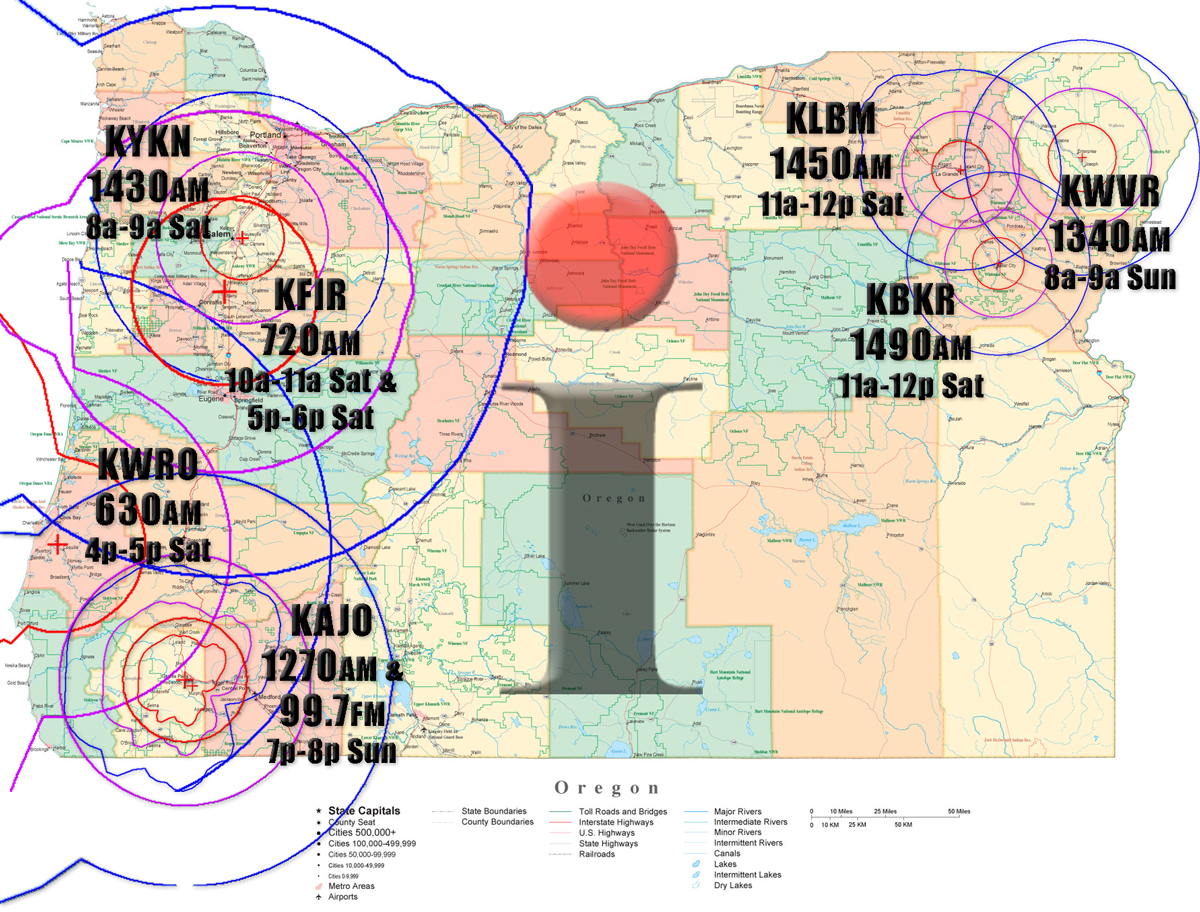
Catch the show live


Map of I Spy Radio broadcast areas and air times

The I Spy Radio Show airs weekends — seven times across seven real radio stations, not internet-only streams. Listen anywhere through the stations’ live streams. See when, where, and how to listen for the full schedule.

Missed it? The podcast posts Mondays, after the broadcast stations air the show — here on this page or on your favorite platform.

I Spy Radio  —  Keeping an Eye on Big Government


16-20 Oregon’s Future: Forest Mismanagement & Election Integrity

16-20 Oregon’s Future: Forest Mismanagement & Election Integrity

Oregon’s Future: Forest Mismanagement and Election Integrity

Release Date: May 16, 2026

Duration: 47:55

Host: Mark Anderson

Guests: Dr. Bob Zybach, forester, National Wildfire Alliance and Eric Lee, senior attorney for Judicial Watch’s Election Integrity Team


About This Episode

On Show 16-20, this week, we dive deep into two major fights for Oregon’s future: the mismanagement of our timber landscape and the critical battle over the integrity of our voter rolls.

First, we sit down with Dr. Bob Zybach, who is running for Lane County Commissioner. For decades, Zybach has documented the federal failures that have turned Oregon’s lush forests into tinderboxes. We discuss the real cost of federal forest mismanagement, the status of the National Wildfire Alliance’s work with the Trump administration, and the startling truth about the billions spent on the spotted owl recovery. If you live in Lane County or care about our O&C lands, you need to hear what Zybach says every voter must understand before the May 19th election.

Then, Eric Lee, Senior Attorney for Judicial Watch, joins us to sound the alarm on election integrity. Following a landmark legal victory and settlement against the state of Oregon over its 800,000 inactive voters, Lee breaks down what it takes to actually clean the rolls. And he tells us what’s actually in the settlement agreement that will hold Oregon accountable. We’ll discuss how President Trump’s recent Executive Order and the SAVE Act impact mail-in voting vulnerabilities.

Tune in to hear how demanding accountability for our forests and security at the ballot box will safeguard a promising future for Oregon.

Transcript

(Opener with Bob Zybach) Oregon was once one of the most productive timber states in the nation — and in many ways it still could be. In fact Oregon was the top or “most” in a lot of thing. Forests, timber, high tech. education, etc. The forests are still there. The growing capacity is still there.

The problem is the policy. Oregon keeps saying it wants jobs — but then does nothing to take advantage of the free-money that grows in our forests at a rate of 9 billion board feet per year.

And few people in Oregon have watched that decline as closely, or fought it as long, as our next guest. Dr. Bob Zybach is a forester whose academic focus is catastrophic wildfire in Oregon, and he’s been working with the National Wildfire Alliance to push back.

(Opener with Eric Lee) Our second guest today is a man who has been working to do something Oregon’s Secretary of State refused to do: clean up Oregon’s voter rolls. Which is always weird when govt which creates the laws — doesn’t follow their own laws.

Eric Lee is a senior attorney with Judicial Watch’s election integrity team. Eric, welcome back to I Spy Radio. … So when we last talked, Judicial Watch had a lawsuit pending against Oregon to force them to remove 800,000 inactive registrations from the voter rolls…


Subscribe:
Apple Podcasts | Spotify | iHeart | Amazon | TuneIn | And every major podcast platform — just search for “I Spy Radio Show”

If you enjoy our content, help others discover the show! Give us a like and subscribe or leave us a review on your favorite podcast platform—or drop a comment below. That really helps us get a bump up in the ol’ algorithms when platforms suggest shows to others.


15-28 The Big Beautiful Bill is the Beginning Not the End

15-28 The Big Beautiful Bill is the Beginning Not the End

Show 15-28 Summary: Not to sound too much like Nancy Pelosi but now that the One Big Beautiful Bill passed, we know what’s in it. It was making a lot of people lose their minds perhaps because they didn’t understand the bill and what could or could not be in it. It’s clear they didn’t read it and listened to the wrong analysts. Which is why it will make people like Elon Musk and his very public temper tantrum look very foolish.

Map showing the radio stations broadcast areas and air time for the I Spy Radio Show.
Current I Spy Radio broadcast areas. Click for full-size map.

The I Spy Radio Show airs weekends, seven times over the weekend, on seven different stations. Listen anywhere through the stations’ live streams! Check out when, where, and how to listen to the I Spy Radio Show. Podcast available Mondays after the show airs on our network of stations.

Air Dates: July 12th & 13th, 2025 | Guest: Jonathan Williams

This Week – The Big Beautiful Bill Passed — Now What?

Nancy Pelosi famously said about Obamacare that “We have to pass it to find out what’s in it.” And now that we have the final version of the Big Beautiful Bill, we do know what’s in it.

But leading up to its final passage, it made a lot of people lose their minds. Legislators should know better but a lot of grassroots did not understand what a reconciliation bill was and how limited they are — just to budget items that affect federal spending or revenue. Which is why it could never be “the one bill” to accomplish everything America First that everyone wanted. So why didn’t the people who ought to have known better say that? Rather than try to sabotage it?

Perhaps they had their own agenda. And, as typical, they wanted something other than what they were saying.

Elon Musk — The Spoiled Kid in the Grocery Store

Spoiled brat Elon Musk throws temper tantrum over the One Big Beautiful Bill
click for full size

By definition, a reconciliation is limited. Not only in terms of what can or can’t be in it but also what budgetary items it can cut. It doesn’t take much to understand that. So someone as smart as Elon had to know that. Which implies then that he wanted something else. And his public shrieking tantrum was calculated. He had to know they couldn’t make the massive cuts he said he wanted. So it’s clear he either didn’t read the bill or listened to the wrong analysts. Or made the calculated move to get attention, blame people, and offer the solution. A third party with the goal to selectively to pick off vulnerable Republicans to be the key swing votes in Congress.

But Elon Musk’s temper tantrum gambit will look pretty foolish when the Big  Beautiful Bill succeeds. He’ll not only look like the spoiler but what he is. Spoiled.

How do we know? Hint: everyone was predicting the end of the economic world after Trump’s reciprocal tariffs. Now they’re admitting they were wrong.

The Big Beautiful Bill Reality

Now that the bill was passed and signed, the fury has died down—mostly—we welcome back Jonathan Williams, the president and chief economist at the American Legislative Exchange Council (ALEC) to get some truth and reality about what was in it. No. It wasn’t perfect. Yes we would have liked more spending cuts.

But while the shrieking and tantruming was happening the detractors missed a key part of the bill. It codified 28 of Trump’s exectutive orders. They’re no longer executive orders, easily undone by the next president with a pen. Now they are law. And, even better, for those demanding more cuts, once the bill was passed and signed, President Trump used his executive power to rescind (cut) spending on key points. Like stopping the green energy credits and Global Warming spending. 

But. And here’s the biggest and most overlooked aspect of the Big Beautiful Bill. It doesn’t end here. It’s the beginning.

Did you feel the political ground under you shift? Because unlike so many other big gigantic bills, this was about cutting spending, cutting taxes, and cutting the size and scope of government. And some actual entitlement reforms. When is the last time that happened? Maybe in the 1990s with Newt Gingrich?

And this isn’t some deep red state doing it. This is Washington DC. And it’s just the beginning. There are already plans in the works for two more bills like it to make further cuts and to push more of the America First agenda.

And that’s why, with the Trump Train rolling, people like Elon Musk standing on the platform shrieking about what is not on the train  will look pretty foolish as the train pulls away without them.

Rich States, Poor States. Poor Oregon.

We  also talk with Jonathan about Oregon’s latest ranking in the 18th edition of Rich States, Poor States. Jonathan is one of its co-authors. For anyone who lives in Oregon, it will come as no surprise that we dropped one point from last year.

But Oregon made some recent economic bungles that have come to light? How bad would it have been for Oregon’s ranking if these had come to light before the latest edition had been released?

Related:
Show 15-23 with Jennifer Hamaker
  – Oregon’s Climate Protection Plan’s planned devastation to Oregon’s economy — conveniently phased in after the 2026 election
Show 15-25 with Ed Diehl  Oregon’s HB2025, the ODOT tax bill, which would have been the biggest tax increase in Oregon’s history

The I Spy Radio Show Podcast Version

Trapped under a heavy object? Missed the show? Don’t worry—catch the podcast version. Mondays, after our network of radio stations have aired the show, I Spy Radio is now available on your favorite podcasting platform, or you can grab it right here. See the full list of podcast options.

Show Notes: Research, Links Mentioned & Additional Info

  • Jonathan is the president and chief economist organization at American Legislative Exchange Council. Find out more at ALEC.org.
    • Encourage your representatives to join ALEC! There are state and city memberships. Help elected officials understand economic problems and the real solutions available to get out of them. Send them this link: https://alec.org/membership/.
    • And you too can join as a private-sector member!
    • Follow Jonathan on Twitter at @TaxEconomist.
  • Head to Rich States, Poor States to see how your state is doing.
  • See the list: Trump’s Big Beautiful Bill codifies 28 executive orders and actions
  • Steve Moore: Trump just scored the biggest conservative victory in three decades (Fox News, July 10, 2025)
    • “What isn’t well known is that this new law doesn’t just change tax policy. It includes dozens of other long-sought policy goals – what I call ‘hidden gems’.”
  • Conservatives say Trump won their megabill votes by promising crackdown on renewable energy credits (Politico, July 3, 2025)
    • “Hard-line House conservatives said President Donald Trump assured them his administration would take action to constrict wind or solar projects that qualify for Inflation Reduction Act tax credits — a pledge that ultimately persuaded them to back the party’s megabill.” → A promise kept with Trump’s rescission package.
  • Johnson says megabill will be ‘jet fuel’ for economy; teases 2 future bills within next year (Fox News, July 6, 2025)
    • Johnson said the BBB is just the first step in a three-tier strategy. Johnson expects a second reconciliation bill by fall and a third by spring before the end of the current Congress. “You’ll see more of us advancing these common-sense principles to deliver that American First agenda”
  • Trump says U.S. struck trade deal with Vietnam that imposes 20% tariff on its imports (CNBC, July 2, 2025)
  • U.S. Supreme Court Greenlights Trump’s Federal Government Purge (GWP, July 8, 2025)
  • Supreme Court allows Trump to implement plans (Scotusblog, June 8, 2025)
    • In an 8 to 1 ruling the U.S. Supreme Court has overturned Clinton-appointed judge’s ruling that temporarily stopped Trump to do mass layoffs. Now his administration can immediately move forward

Sorry Democrats. The BBB Does NOT End Social Security

  • Social Security letter on taxes sends confusing message, some experts say (Washington Post, July 4, 2025)
  • Megabill does not eliminate taxes on Social Security — But it does increase the standard deduction for seniors.
    • Tax exemption for Social Security goes from 64 percent to 88 percent.
  • Does the “big, beautiful bill” eliminate taxes on Social Security? (CBS News, July 8, 2025)

The One Big Beautiful Bill is the Start, Not the End

Green Energy isn’t So Green Anymore

Funny how Global Warming believers suddenly change their beliefs when they aren’t paid to believe them any more.

Oregon’s Economic Outlook Not Looking Good

15-24 Scams and Fraud: Superpowers of the Left

15-24 Scams and Fraud: Superpowers of the Left

Show 15-24 Summary: The Left lives off scams and fraud. You don’t have 1,500 staged Defy Democracy protests “spring up” organically. It costs money. Lots of it. Craig Rucker from CFACT discusses the continuing, multi-billion-dollar scams of climate change and green energy that fund the Far Left. So why do people inside the Trump administration want to keep the green spigot open? What you haven’t heard about windmills. And what Biden tried to keep hidden. And then Eric Lee, a senior attorney with Judicial Watch, discusses their upcoming hearing as the state of Oregon seeks to dismiss. Judicial Watch’s case would pry open Oregon’s voter rolls and force them to clean them up. As required by law. Because fraud is how Democrats get elected.

Map showing the radio stations broadcast areas and air time for the I Spy Radio Show.
Current I Spy Radio broadcast areas. Click for full-size map.

The I Spy Radio Show airs weekends, seven times over the weekend, on seven different stations. Listen anywhere through the stations’ live streams! Check out when, where, and how to listen to the I Spy Radio Show. Podcast available Mondays after the show airs on our network of stations.

Air Dates: June 14th & 15th, 2025 | Guests: Craig Rucker & Eric Lee

This Week – Scams and Fraud

Scams and fraud are how the Left funds itself—and get elected. They are the Left’s true superpowers. Staging 1,000+ protests to Defy Democracy don’t happen in less than a week. With no planning. And no money. Quite the opposite. Do you ever see these massive, widespread protests from the Rigth? No. Because the Right doesn’t get 100s of billions of taxpayer dollars to fund their ideology. But the Left sure does.

It’s time for that to end. And the the Trump administration is working hard to correct these scams and fraud. But is he once again being undermined by people in his own administration?

Craig Rucker: Climate Change and “Green” Energy Scams

First up, we talk with Craig Rucker, President of Committee for a Constructive Tomorrow or CFACT, about some recent revelations that the Biden administration quietly gave waivers to wind farms special waivers, passing along disposal costs to taxpayers. They also removed comments they didn’t like to force an expensive and useless rule change onto natural gas and coal power plants.

And there are more instances of changing data, including outright fraud. Which probably explains why the defendant in a current RICO case in California fled the state. Wait until you hear what else he did besides jimmy the numbers. Craig also discusses the Department of Interior and how Trump’s team may not be in alignment with Trump when it comes to global warming.

Did you catch last week’s show with Jen Hamaker exposing Oregon’s Climate Protection Plan and the latest, it’s carbon cap and trade scheme? It’s Oregon’s democrat-assisted suicide. And with three republicans’ help.

Eric Lee: Dirty Voter Rolls — the Pathway to Election Fraud

Next up is first-time guest, Eric Lee, a senior attorney on Judicial Watch’s election integrity team and a specialist on the National Voting Registration Act. In a much-anticipated lawsuit against Oregon and Oregon’s Secretary of State, oral arguments start Wednesday, June 18th in Eugene’s federal district court as Oregon hopes to get the case dismissed on procedural grounds.

But has Oregon accidentally undermined the credibility of their own case with some public statements? Including admitting just how messy Oregon’s voter database truly is? You’ll hear what Judicial Watch alleges that Oregon’s done and not done, in direct violation of the National Voting Registration Act.  And Judicial Watch’s surprise that Oregon hasn’t entered any filings against the merit of the case.  You’ll hear why they’re here in Oregon fighting the good fight for election integrity — and the reasons why Oregon must clean up its voter rolls.

Sorry Oregon, “trust us” and not letting anyone look isn’t going to fly any longer.

If you want to better understand the Far Left’s operational methods, don’t miss this show!

The I Spy Radio Show Podcast Version

Trapped under a heavy object? Missed the show? Don’t worry—catch the podcast version. Mondays, after our network of radio stations have aired the show, I Spy Radio is now available on your favorite podcasting platform, or you can grab it right here. See the full list of podcast options.

Show Notes: Research, Links Mentioned & Additional Info

Craig Rucker: Climate Change & Green Energy Scams

  • Craig’s organization is the Committee For A Constructive Tomorrow. Visit them at CFACT.org
  • Check out some of these terrific articles from CFACT
  • A simple exercise in the social cost of climate extremism (CFACT May 30, 2025)
  • Department of Interior emails reveal Biden’s offshore wind waivers (Just the News, May 28, 2025)
  • Offshore wind opponents file lawsuit to stop Empire Wind, arguing feds’ greenlighting violated law (Just the News, June 11, 2025)
  • Biden’s EPA hid comments from Dept. of Energy (Just the News, June 8, 2025)
    • “Energy Secretary Chris Wright confirmed in March, that when a study on liquefied natural gas was completed, the Biden administration didn’t like what the study said, so they set out to produce one that would support the climate policies they wanted.”
    • “Politico reports that Trump plans to sign a trio of resolutions Thursday, June 12th to revoke California’s nation-leading vehicle emissions standards and also impacts a dozen other blue states, including Oregon, who’ve adopted the rules.”
  • RICO defendant flees the state. Press release from Suisun News (via Facebook, June 9, 2025)
  • Fury as Republicans go ‘nuclear’ in fight over California car emissions (Guardian,. May 22, 2025)
  • Senate nullifies California’s electric vehicle mandate, using fast-track authority to bypass filibuster (CNN, May 22, 2025)
  • Trump is about to kill California’s EV rules (Politico, June 10, 2025)

Eric Lee: Judicial Watch Lawsuit against Oregon

  • The Beginning of the End for KNOWiNK? Oregon Dumps KNOWiNK TotalVote System Four Years Into Contract (Gateway Pundit, June 3, 2025)
  • Can Any States Using KNOWink Software Applications Be Confident in Safe and Secure Elections?  (Gateway Pundit, Jan 17, 2024)
  • Justice Department Backs Judicial Watch (Gateway Pundit, June 7, 2025)
  • Justice Department Files Statement of Interest in Oregon Elections Case Concerning States’ Obligations Under the National Voter Registration Act (DOJ, June 6, 2025)
  • Wow! In Washington DC? Democrats voted against illegals voting in U.S. elections? “House Passes Bill to Repeal D.C. Law Allowing Non-Citizens to Vote” (Gateway Pundit, June 11, 2025)
    • “Washington DC Local Resident Voting Rights of 2022” allowed non‑U.S. citizens, including potentially illegal immigrants and foreign agents, to cast ballots in local elections.
15-23 Democrats Assisting Oregon’s Suicide – With Republican Help

15-23 Democrats Assisting Oregon’s Suicide – With Republican Help

Show 15-23 Summary: The Democrats’ latest scheme to steal money from Oregonians to solve imaginary problems will kill businesses and jobs. It’s like watching democrats unplug Oregon’s life support. But why are three Republicans helping to push through a carbon cap and trade scheme? It will, allegedly (maybe), replace the governor’s existing climate protection program currently being phased in. Tune in to hear how and why this will chase even more businesses from Oregon and definitely prevent new ones from moving in.

Map showing the radio stations broadcast areas and air time for the I Spy Radio Show.
Current I Spy Radio broadcast areas. Click for full-size map.

The I Spy Radio Show airs weekends, seven times over the weekend, on seven different stations. Listen anywhere through the stations’ live streams! Check out when, where, and how to listen to the I Spy Radio Show. Podcast available Mondays after the show airs on our network of stations.

Air Dates: June 7th & 8th, 2025 | Guest: Jennifer Hamaker 

This Week – Democrats Assisting Oregon’s Suicide — With Republican Help?

The Democrats are raising taxes on practically everything. And they are especially hitting hard its businesses and the factors that generate income and economic activity. In other words, they are harming what would normally help a business grow. And let businesses hire new employees. They are demanding businesses and Oregonians pay more when the State refuses to cut back any spending. While that’s no surprise, it is a surprise that three Republicans have decided to help.

It’s like elected democrats are Dr. Kevorkian. And republicans are his aides. Because what they are hatching will kill Oregon businesses.

Get involved! Don’t be silent! It’s easier than ever to let your voice be heard on bad legislation. Head to this page on Oregon Live for contact info for your legislators. Includes a search function if you’re not 100% sure.
Here’s info for the three republicans mentioned supporting carbon cap and trade: Senator Bruce Starr and representatives Kevin Mannix and Jeff Helfrich.

Why the Democrats’ Plan will Kill Businesses

The Ivanpah solar plant was a massive $2.2 billion green energy boondoggle. But wait, it's even worse than it sounds.
WATCH: The Ivanpah solar plant was a massive $2.2 billion green energy boondoggle. But wait, it gets worse.

In our last show, we interviewed Jonathan Williams, the president and chief economist of the American Legislative Exchange Council. We talked about the coming economic boom for America, thanks to trillion dollar deals Trump brought back from the Middle East. Which could generate up to $10 trillion in economic activity. America is being reshaped into a manufacturing-based economy.

But Oregon is likely to see none of that.

In fact, a recent business survey showed one quarter of Oregon’s business had been approached by other states to relocate. And of those two-thirds said they had already relocated or were expanding their presence outside of Oregon.

But when new businesses are created from those trillions, how many will think of Oregon? Few. If any. Why? Because Oregon is increasing fees and taxes and adding punitive regulations. Not just on businesses but on the potential employees of those new businesses. Worse, Oregon democrats want to punish you if you use (in their mind) the wrong kind of energy.

How many businesses don’t use energy? How many farms don’t use fuels for their equipment? Or how many trucks make deliveries without using fuel?

Move to Oregon where you’ll get punished? Or build in another state where they will welcome you with open arms?

Poison Pills: Carbon Cap and Trade vs. Climate Protection Plan

The democrats’ poison has already been administered. Now it’s just a matter of how quickly the patient will die.

We welcome back Jennifer Hamaker, the president of Oregon Natural; Resource Industries, or ONRI, Because it’s not just the democrats. It’s republicans who are helping to unleash this on Oregonians.

In 2019, Oregon made national news when republican senators walked out the capitol to deny quorum. And refused to come back until the democrats’ carbon tax bill was taken off the table. They had to go across state lines because democrat governor, Kate Brown, threatened to send the state troopers after them to arrest them and drag them back to the capitol.

But they held out. And time ran out. So instead, in 2020, Kate unleashed the Climate Protection Program, the same plan but through an executive order. But Oregon’s appeals court threw it out in 2023. Not to be told no when it comes to punishing people and businesses into submission, Oregon’s DEQ relaunched the same plan with a few changes in 2024. We’re in the “gentle phase” of three phases.

The next phase kicks in. And it’s punitive. But not until 2028. Conveniently after the 2026 election. How bad? The fees to use natural gas will be more than the gas itself. And how bad will that be? According to Jen, if you pay $100 a month for your gas bill, it will skyrocket to $300 per month. Just from the fees. For using the “wrong” fuel for energy. You can imagine what they’ll do to gasoline and diesel.

Stupid Republicans Assisting Assisted Suicide

Tune in to hear why Senator Bruce Starr and representatives Kevin Mannix and Jeff Helfrich are considering helping the democrats pass the slightly less poisonous of the two poison pills. Where the Climate Protection Plan will kill businesses quickly, Republicans are willing to swallow the less poisonous (for now) pill of the carbon cap and trade.

It’s a trap.

Don’t take either pill. Oregonians need to feel the full weight of democrat oppression. Let the democrats take the blame. And Republicans should spend the next year talking about what’s coming in 2028. Unless Oregon finally votes for Republicans.

Don’t miss this show. Because if think paying democrats to pretend to solve imaginary problems is bad enough, you haven’t heard where the money will go.

The I Spy Radio Show Podcast Version

Trapped under a heavy object? Missed the show? Don’t worry—catch the podcast version. Mondays, after our network of radio stations have aired the show, I Spy Radio is now available on your favorite podcasting platform, or you can grab it right here. See the full list of podcast options.

Show Notes: Research, Links Mentioned & Additional Info

  • Jennifer’s organization is Oregon Natural Resource Industries. Their website is ONRI.us
  • Don’t be silent! Let the three republicans (and your own legislators!) know what you think about the Climate Protection Plan and the carbon cap and trade legislation. Here’s info for the three republicans mentioned: Senator Bruce Starr and representatives Kevin Mannix and Jeff Helfrich.
  • Watch that video on Ivanpah. California’s extreme green solar plant that failed. After wasting 2.2 billion. And share that! It’s a prime example of a green energy boondoggle coming soon to Oregon. Here’s the link to copy and share: https://way.lop.temporary.site/wp-content/uploads/2025/06/Ivanpah-Stupid-Idea-and-Waste.mp4
  • Solar Plant Wants to Pay Off Massive Government Loan with Massive Government Grant (Reason, Nov 11, 2014)

Not mentioned but related

Also also related

  • Fury as Republicans go ‘nuclear’ in fight over California car emissions (Guardian,. May 22, 2025)
    • “Senate votes to reverse EPA waiver and prevent state setting own rules”*Environmental Protection Agency (EPA) sets and updates its own federal standards for all states on smog and emissions from cars and trucks … But for decades, California has been granted the ability to make those rules even stricter”
  • Senate nullifies California’s electric vehicle mandate, using fast-track authority to bypass filibuster (CNN, May 22, 2025)
    • “Republicans were livid when at the end of former President Joe Biden’s term, the Environmental Protection Agency greenlit California’s plan to phase out the sale of gas-powered cars by 2035, shifting the state towards electric vehicles.”
  • Kash Patel Announces Charges Against Chinese Nationals In Agroterrorism Case (Trending Politics, June 3, 2025)
  • “A Better Way Than Cap and Trade” (Bjorn Lomborgh, Dec 16, 2008).
  • The End of the EU’s Cap-and-Trade Affair (Bjorn Lomborg, Apr 24, 2013)
  • From the true believers: Carbon Markets 101
15-20 Judicial Tyranny | Self-Inflicted Wounds

15-20 Judicial Tyranny | Self-Inflicted Wounds

Show 15-20 Summary: This week we’re talking about activist judges, nationwide injunctions, and what could be done. Plus, a look at what is happening here in Oregon in the legislature. The woke is winning which means Oregon will lose billions. Making Oregon’s business environment toxic will repel any chance of landing some of the trillions Trump is bringing back into the U.S. But hating Trump and going woke are the hill the Democrats will die on.

I Spy Radio Coverage Map as of November 2024
Current I Spy Radio broadcast areas. Click for full-size map.

The I Spy Radio Show airs weekends, seven times over the weekend, on seven different stations. Listen anywhere through the stations’ live streams! Check out when, where, and how to listen to the I Spy Radio Show. Podcast available Mondays after the show airs on our network of stations.

Air Dates: May 17th & 18th, 2025 | Guests: Hans von Spakovsky & Dennis Linthicum

This Week – Injunctions on Trial. Oregon’s Self-Inflicted Wounds

We welcome back Hans von Spakovsky, the manager of the Election Law Reform Initiative and a senior legal fellow at the Heritage Foundation, to discuss judicial tyranny. Judges who are in clear violation of the Constitution by intruding into Executive Branch authority.

Fact: The only court established by the Constitution is the Supreme Court

There is no constitutional authority for district courts to reach outside their district. And yet they have been allowed to do so. Presidents do not have to obey these courts, so why have they? The Supreme Court on Thursday heard oral arguments on a case that could impact lower courts (there are 93 federal district courts) and a radical judge’s ability to issue a national injunction. This is a pivotal moment in U.S. history and whether unelected jurists have the power to anoint themselves as supreme leaders.

Then we welcome back former Senator Dennis Linthicum. He lost his seat when Republican senators walked out to deny quorum to stop the horrendous HB2002. The child mutilation bill. Now he’s swapped roles with his wife, who won his seat, and he’s her legislative aide. Does that new role give him new perspectives?

Oregon has a poisonous business environment thanks to taxes, fees, regulations, and other businesses fleeing the state. And this showed up in Oregon’s May revenue report. Democrats control everything at the state level—governor, super majorities in house and senate, all the state-level elected positions, and all the judges. But democrats are blaming Republicans. Really? And now democrats are raising taxes on everything.

Trump just brought back up to $10 trillions in new deals from his Middle East tour. With Oregon’s hatred of Trump and its own businesses, what’s the likelihood of any of those new trade dollars coming to Oregon. Tune in to hear Dennis’s surprising answer.

The I Spy Radio Show Podcast Version

Trapped under a heavy object? Missed the show? Don’t worry—catch the podcast version. Mondays, after our network of radio stations have aired the show, I Spy Radio is now available on your favorite podcasting platform, or you can grab it right here. See the full list of podcast options.

Show Notes: Research, Links Mentioned & Additional Info

Hans von Spakovsky’s Segments

Dennis Linthicum’s Segments

Not Mentioned but Related to Today’s Show


15-19 The Green Brick Road to the Gold City Hits a Dead End

15-19 The Green Brick Road to the Gold City Hits a Dead End

Show 15-19 Summary: Tap your ruby slippers, Dorothy. It’s time to get back to reality. We are on the threshold of ridding ourselves of one of the biggest, most expensive scams in human history. Climate Change and so-called “green energy” (it’s not) are on the ropes, thanks to their bottomless free taxpayer money drying up. It’s amazing how this scam has fooled so many people. But maybe it shouldn’t be a surprise. They billions of dollars flooded the media to spread global warming hysteria and green energy propaganda. which led to hundreds of billions of dollars wasted on high cost, inefficient green energy. So long, goodbye.

I Spy Radio Coverage Map as of November 2024
Current I Spy Radio broadcast areas. Click for full-size map.

The I Spy Radio Show airs weekends, seven times over the weekend, on seven different stations. Listen anywhere through the stations’ live streams! Check out when, where, and how to listen to the I Spy Radio Show. Podcast available Mondays after the show airs on our network of stations.

Air Dates: May, 2025 | Guest(s): 

This Week – The Wizard of Oz and Other Fantasies 

It was the Green Brick road to the Golden City. And Dorothy and her companions were told they just needed to make it down the path to reach the Gold City and all their greediest dreams would come true. Trillions of dollars waited for them. More wealth than they could ever imagine.

And then Trump got elected.

Now, with the wave of a pen, and dragging a reluctant Congress behind him, Trump is cutting off their funding they need to keep the scam alive. By taking away the billions of free taxpayer money from their marketing and propaganda, green will have to stand on its own. But because it only ever survived through massive subsidies, it won’t. It is more expensive. It is inefficient. And it will never meet the energy needs of tomorrow.

Renewable Green Energy Exposed as the Fraud it is

First up we welcome back Dr. Bonner Cohen, a senior policy analyst at CFACT. so many people have been fooled by Climate Change and Global Warming they believed green energy (it’s not green) would save us from the predictions the world would end.

Scary predictions led places like Spain and Germany and the rest of the EU to spend enormous amounts on inefficient green energy. Just weeks ago, Spain went 100% renewable. For one day. they quickly turned their nuclear plant back on. Which they plan to decommission. but they might want to hold off on that because a funny thing happened. The wind stopped blowing, and the sun stopped shining. And the entire country’s grid went down. A blackout that affected all of Spain, Portugal, and parts of France.

I wonder if anyone sitting in the dark thought that, just maybe, these renewables weren’t such a great idea after all.

We talk about what happened — and the irony of what was happening that same day over in Poland.

Global Warming Programming and Predictions

Next, we talk with Marc Morano, the editor of Climate Depot — fantastic clearing house of real information about the scam of Climate Change. The Doomers have been making catastrophic climate predictions for decades. But none of them come true.

Or, actually, they do come true. Tune in to find out how they do it.

Our prediction: “Green” energy and fake renewables may disappear but in 2170, Climate Change Doomers will still be predicting we only have 10 years to do something. Bank on it.

But now that the public money is drying up for green energy what does that mean for the overall scam of Climate Change? How long will it take to deprogram people who have been fooled but can’t admit they’ve been fooled?

That might become easier now that the propaganda arm of climate change is losing all their billions they got for things like so-called research to prove climate change was real. And that it really will happen — this time. Trust us!

Google, one of the biggest pushers of the climate change scam, is suddenly taking a hard turn away from green energy by going nuclear. And that runs them right up against reality. They can’t keep telling us that green energy is the solution when clearly they themselves are living the opposite.

Tap your ruby slippers, Dorothy. It’s time to get back to reality!

The I Spy Radio Show Podcast Version

Trapped under a heavy object? Missed the show? Don’t worry—catch the podcast version. Mondays, after our network of radio stations have aired the show, I Spy Radio is now available on your favorite podcasting platform, or you can grab it right here. See the full list of podcast options.

Show Notes: Research, Links Mentioned & Additional Info

  • Both of our guests are with CFACT — Committee for a Constructive Tomorrow. 
  • Marc is editor of ClimateDepot.com, a project of CFACT. Want the reality of Climate Change? Get it at Climate Depot.
  • Google agrees to fund the development of three new nuclear sites (CNBC May 7, 2025)
  • An Inconvenient Truth’s 19th Anniversary (Real Climate Science, May 5, 2025)
  • Energy Budget Blueprint Cuts $19.3 Billion (Epoch Times, May 7, 2025)*Cuts $19.3 billion in dedicated funding for Biden-era “green energy” initiatives.*Increases funding for the National Nuclear Security Administration by 25% — without that bump, it would otherwise be a budgetary cut of 18.2 percent
  • Surprise! Two new studies find ice is rebounding at BOTH poles! ‘Surprising pause’ in Arctic sea ice decline & Antarctica sees ‘record-breaking accumulation of ice’ (Climate Depot, Nay 7, 2025)
  • The secretive government unit planning to dim the sun (The Telegraph, via Yahoo News, May 7, 2025)
  • Dr. Patrick Moore – Carbon and Climate Catastrophe (Steamboat Institute, YT Channel, August 28, 2024)
  • BBC: ‘How the political consensus on climate change has shattered’ – ‘The political climate is very different…reaching net zero is fast becoming a political dividing line’ (Climate Depot, May 8, 2025)
  • U. of Cambridge prof Mike Hulme declares his dissent: ‘I disagree with the doom-mongers’ – ‘Climate change is cited as the sole explanation for everything going wrong in the world. Drought, famine, flooding, wars, racism – you name it’ (Climate Depot, May 8, 2025)
  • LA Times: ‘The high cost of California’s green energy policies’ – ‘Cost of electricity in state is now the highest in the continental U.S.’ – ‘High energy prices are a self-inflicted wound’ (Climate Depot, May 8, 2025)
  • The claim that any species, including mammals, can only survive within a narrow ONE DEGREE range is not just misleading… it’s dangerously pseudoscientific’ (Climate Depot, May 8, 2025)
  • THIS NASA’s GISS Gets the Boot: A Seinfeldian Saga – ‘Climate models churned out by GISS might just be as fictional as a Vandelay Industries’(Climate Depot, May 8, 2025)
15-18 Scott McEwen: Judges, Insurrections, Revelations, and Prosecutions

15-18 Scott McEwen: Judges, Insurrections, Revelations, and Prosecutions

Show 15-18 Summary: Scott McEwen, the bestselling co-author of American Sniper joins us to discuss Trump’s first 100 days, activist judges, immigration, and the stunning RFK revelation that Biden’s HHS was the “principle vector” of child sex trafficking, Plus, he shares exclusive news about some of his novels. And you can meet him in person. Scott will be at a book signing event at the Main Street Mercantile in Aurora, Oregon, on May 17th.

I Spy Radio Coverage Map as of November 2024
Current I Spy Radio broadcast areas. Click for full-size map.

The I Spy Radio Show airs weekends, seven times over the weekend, on seven different stations. Listen anywhere through the stations’ live streams! Check out when, where, and how to listen to the I Spy Radio Show. Podcast available Mondays after the show airs on our network of stations.

Air Dates: May 3rd & 4th, 2025 | Guest: Scott McEwen

This Week – Scott McEwen’s Take

No one can say Trump’s first 100 days were slow and uneventful. Executive orders undoing Biden’s damage. DOGE finding no end of democrat-led fraud, abuse, and corruption, pocketing billions of taxpayer dollars. Judicial activism like the country has never seen before. Restoring American energy dominance. Tariffs to force better trade deals. And now the latest revelation from RFK: Biden’s HHS Department was the “principle vector” for child sex trafficking in America.

No matter where you look, the Trump administration is impacting every day Americans. Which is why the democrats are so angry. And why the media has been spinning like crazy, with with over 95% negative news coverage of Trump, JD Vance, and especially Elon Musk.

Judges, Immigration, Revelations, and Prosecutions

Scott contacted us a few weeks ago that he had some exclusive news he wanted to share with our audience. Plus, he wanted to announce an upcoming book signing at a lifelong friend’s store in Aurora. (See details below.)

Scott McEwen is not “just” a bestselling writer. He is also a former trial lawyer and a fierce American patriot with a deep sense of justice and what is right and wrong. As a former attorney, he is deeply troubled what sees as judicial activism and its attack on our Constitution. The foundation of our legal system. But there is justice coming.

A Patriot’s Perspective

President Trump's Truth Social post about the impact of tariffs on income tax. Bad news for the Trump haters.
Don’t worry, Trump haters: You can choose to keep paying your taxes.

We start out with the extreme irony of NY Attorney General Letitia James — who prosecuted Trump for “real estate fraud,” claiming he had overvalued his properties to obtain a loan. Except it turns out Letitia is the one who committed real estate fraud to obtain a loan. (Always accuse the other side of that which you yourself are guilty.) According to reports, o get more favorable loan terms, she claimed on her mortgage application the home — in Virginia — would be her primary residence. Now, the DOJ is opening a case against her. And it could cost her her job. (Oh the delicious, delicious irony!)

Then we wade into judicial activism, immigration, and the stunning revelation at a Cabinet meeting. RFK Jr. revealed that child-sniffing Joe Biden’s HHS Department was, the “principle vector” of child sex trafficking in the U.S., acting as the middle man.

Remember, the Biden administration “lost” over 300,000 children during his four years as they pushed unaccompanied minors out of detention centers into America — and then lost track of them. We also get Scott’s take on the big reveal from last week: Peter Ticktin has recorded evidence of the real insurrection. Democrats in September 2020 plotting the January 6th attack on the U.S. Capitol. Treason?

Epstein, the fake Russia collusion, insurrection, treason, child trafficking. How much more can we take and when will the prosecutions start?

Tune in for a great discussion you won’t want to miss. And make plans to see Scott in person on May 17th!

Scott McEwen Book Signing Event Details

Scott’s book signing will be on May 17th at 5:30pm in Aurora, Oregon, at the Main Street Mercantile, located at 21610 Main St NE, Aurora, OR 97002. Please note that there will be a limited amount of books for sale (it’s not easy lugging a case of books through the airport) so please bring your own copy for Scott to sign.

Order your books now to have them in time for the event! Some of our favorites include: American Sniper, Sniper Elite (four books series), Hell Week and Beyond: The Making of a Navy SEAL, and especially Camp Valor (two-book series).

There will be some light refreshments, great conversation, and some door prizes. And one lucky person will win an autographed first edition of American Sniper.

Plus, he’ll also share some more details and exciting news about his novels.

The I Spy Radio Show Podcast Version

Trapped under a heavy object? Missed the show? Don’t worry—catch the podcast version. Mondays, after our network of radio stations have aired the show, I Spy Radio is now available on your favorite podcasting platform, or you can grab it right here. See the full list of podcast options.

Show Notes: Research, Links Mentioned & Additional Info

  • Scott’s website with all of his books is www.scottmcewen.com
  • Scott McEwen’s book signing event is at 5:30 p.m. on Saturday, May 17th. It will be held at the Main Street Mercantile, in historic Aurora, Oregon. The owner is a former classmate of Scott’s and a lifelong friend. shop is located at 21610 Main St NE, Aurora, OR 97002. This is BYOB event – Bring Your Own Book. There will be a limited amount of books available for sale, so bring your own copy for Scott to sign. Visit Main Street Mercantile’s website or check out their Facebook page.
  • Trump vs. NY AG Letitia James: What’s behind the fraud accusations in an ongoing feud (Gothamist, April 18, 2025)
  • The 100-Day Hoax Hit List (WLT Report, April30, 2025)
  • HHS whistleblower Tara Lee Rodas testified that the U.S. government is working as the ‘middleman’ in a massive child trafficking operation (Collin Rugg, X, Apr 26, 2025)
    • “The United States government has become the middleman in a large scale multi-billion dollar child trafficking operation that is run by Bad actors seeking to profit off of the lives of children…”
  • VIDEO: RFK admits that Biden’s HHS department was a “collaborator in child trafficking, sex, and for slavery.” (Riley Gaines, via X, April 30, 2025)

Related Stories