Category: Politics

16-37 This Is Fine — Oregon’s Record Wildfires and the Race for a Veto-Proof Supermajority

16-37 This Is Fine — Oregon’s Record Wildfires and the Race for a Veto-Proof Supermajority

Aired  September 12, 2026
Runtime  ~47:55
Host  Mark Anderson
Guests  Angela Plowhead · Derrick Holdstock

This Election Matters

Angela Plowhead is running to flip one of the most competitive seats in the state — and Democrats are pouring national money into keeping it. If what you hear today concerns you, get involved: donate, volunteer, or just spread the word.

Support Angela Plowhead at Angela4Oregon.com →

And she’s not the only race that matters this November — find other Oregon candidates worth your support and get behind them too.

About this episode

Oregon just burned an area bigger than its entire wilderness system — and in Salem, Democrats are two seats away from a legislative majority so large that no walkout and no governor’s veto could stop them. This week, two conversations about a state running out of checks.

First, Dr. Angela Plowhead — Air Force veteran, clinical psychologist, and Republican candidate for Oregon Senate District 10 — returns to the show to take on incumbent Senator Deb Patterson. Angela and Mark dig into the gas tax Oregonians rejected 83–17 percent at the ballot box, the Climate Protection Program’s spiraling cost to Oregon families and businesses, and the government-run universal health care plan Patterson’s own committee is shepherding toward the Legislature. Then the conversation turns to something bigger: why national Democrats have singled out Patterson’s seat as their only incumbent target race in Oregon — and why the two additional seats they’re chasing would hand Democrats a two-thirds supermajority in the Senate, enough to end Republican walkouts for good and override any governor’s veto, Republican or not.

Then, Derrick Holdstock, owner of Western Fire Resources and a 25-year veteran of wildland firefighting, joins Mark to talk about Oregon’s all-time record 2026 fire season — over 2.5 million acres burned, nearly a third of the entire nation’s total. Derrick takes listeners inside an active fire line, then breaks down what actually went wrong: a dispatch system that keeps closer private fire engines waiting behind public agencies, a profit motive that pulls public fire departments away from their own jurisdictions, the pending federal rollback of the roadless rule, and decades of fuels mitigation that simply never got done. He closes with a concrete, low-cost fix — and a hard question about whether Oregon can ever get back to the fire-quiet decades a previous guest says were no accident.


In this episode

00:44
01

“This Is Fine” — Angela Plowhead Returns

Mark’s opener on Oregon Democrats and complacent Republicans, then Dr. Angela Plowhead on why she’s challenging Deb Patterson, Oregon’s crushing tax burden on small business, and the DSA candidates now running in Oregon — plus the reveal that Patterson is the only incumbent Senate Democrat national Democrats have targeted.

09:36
02

The Gas Tax, and a Climate Program Nobody Voted For

Why 95% public opposition didn’t stop the gas tax — and why Democrats moved Measure 120 off the November ballot. Then the real cost of the Climate Protection Program: $4.9 billion for natural gas alone, a floor of $20 billion across the full fuel sector, and Oregon’s forest fires alone blowing past the entire statewide emissions cap.

17:15
03

Universal Health Care — and the Veto-Proof Endgame

An $85–94 billion-a-year health plan that could more than double Oregon’s budget, and Sen. Patterson’s role steering it. Then the segment’s biggest reveal: why two more Senate seats mean Republicans lose their only remaining check — the walkout — and why a Republican governor’s veto stops mattering at a two-thirds supermajority.

25:41
04

2.5 Million Acres — Meet Derrick Holdstock

Oregon’s wildfire season shattered 2024’s record by 400,000 acres — nearly a third of the entire nation’s 2026 burn. Wildfire contractor Derrick Holdstock joins to talk about Western Fire Resources, what it’s actually like inside an active fire line, and why Oregon dispatches engines from as far away as Texas.

33:10
05

The Dispatch System’s Dirty Secret

Why a wet winter with no snowpack made 2026 worse, not better. Then Derrick lays out the fuels-mitigation gap, how Oregon’s mutual-aid system locks out the closest private engines, and the profit motive that pulls public fire departments away from their own home jurisdictions.

41:00
06

Roads, Climate, and the Fix

The roadless rule’s real effect on fighting fire, the spotted owl’s collapse despite decades of hands-off management, and the CO2 math nobody wants to discuss. Derrick closes with a concrete, low-cost fuels-mitigation plan — and the question of whether Oregon can ever get back to the 35 fire-quiet years a previous guest documented.

Links & resources mentioned

Angela Plowhead for Oregon Senate District 10

The Push for a Veto-Proof Supermajority

Oregon’s Gas Tax & Measure 120

The Climate Protection Program’s Real Cost

Oregon’s Universal Health Care Push

Oregon’s Record 2026 Wildfire Season

Forest Management, the Roadless Rule & Fire History

Derrick Holdstock & Western Fire Resources

About the guests

Dr. Angela Plowhead
Republican Candidate, Oregon Senate District 10

Angela Plowhead is an Air Force veteran and former signals intelligence analyst who went on to become a clinical psychologist specializing in geropsychology, with years of service at VA medical centers before opening her own private practice. A former Vice Chair of the Oregon Republican Party, she also runs a nonprofit focused on veteran suicide prevention and serves on her county’s water board and soil & water conservation district. She is challenging longtime incumbent Sen. Deb Patterson for Oregon’s Senate District 10, covering South and West Salem, Monmouth, and Independence.

Angela4Oregon.com

Derrick Holdstock
Owner, Western Fire Resources

Derrick Holdstock has more than 25 years of wildland fire experience. He owns Western Fire Resources, based in Canadian, Texas, which operates four Type 6 wildland fire engines dispatched nationally — including repeated seasons in the Pacific Northwest — alongside fuels mitigation, prescribed fire, wildfire risk analysis, and fire management planning work. Before starting his company, he served as Regional Fire Management Coordinator for Region 1 of the Texas Parks and Wildlife Department’s Wildlife Division, and earlier worked as a wildlife biologist for Texas Parks and Wildlife in the Texas Panhandle and for the BLM in Elko, Nevada.

WesternFire.us

Full transcript

Segment 1 (00:44)

MARK: If you’ve spent practically any time on social media, you’ve no doubt seen that meme with the dog sitting there at the table with a vacant grin on his face as his house burns down around him. And then in the next frame, it zooms in on him and he says, “This is fine.”

But it’s not fine. Not here in Oregon. But that ought to be the theme meme for Oregon’s Democrats. They know things are bad. They know Oregon is burning down, quite literally, and they just sit there. They are the ones in charge. They are the ones that could have fixed things instead. This is fine. Or that it’s Trump’s fault, even though he’s not the one that’s been in power for the last forty years here in Oregon.

The Democrats are great at pointing fingers. They are great at creating the illusion that everything is always somebody else’s fault. That’s the basis of socialism. It’s someone else’s fault that your life is not as good as it could be. Somebody richer than you has things that you don’t. It’s capitalism’s fault. And somehow, you’re entitled to somebody else’s work and money — especially somebody else’s money.

But to some extent that “This Is Fine” meme ought to also be the meme theme for Republicans — and Republican voters who don’t seem to be taking things seriously when there is so much at stake.

And I think you’ll hear just how much things are at stake if everyday Republican voters don’t step up. Oregon may be unrecognizable if the Democrats’ plans this election play out.

I’d like to welcome back Dr. Angela Plowhead. She’s an Air Force veteran, a former signals intelligence analyst, and a clinical psychologist who has built her career serving veterans through the VA. And this year, she is taking that same fight to Salem, challenging State Senator Deb Patterson in Oregon’s Senate District 10. Angela, it’s great to talk to you again — it’s been a while.

ANGELA: Thank you for having me on. It’s great to be here.

MARK: I’ve always thought it kind of interesting that you’re a signals intelligence analyst and now you’re running for Oregon State Senate. I don’t think there’s a lot of intelligence to analyze in that capitol building right now — certainly not with the current crop of Democrats.

ANGELA: Yeah, there certainly hasn’t been a lot of analysis about what bills will do in the future, and the consequences of them for the Oregonian people. It has been an ongoing challenge for them to see the forest for the trees.

MARK: Why did you decide to step up and run for state Senate? What are some of the key issues that really said, “I’ve got to take on this race”?

ANGELA: The reason I initially got involved in politics several years ago was because, as an intelligence analyst, my target nations were either totalitarian, socialistic, or communistic in nature. And I saw what happened to the people of those nations — they were often starving, didn’t have freedom, weren’t able to have the opportunities that I had because of our Constitution to break free from poverty. They were just stuck with whatever their government decided they should have. I started to see that same mentality take root in America, and that frightened me. I said, “I can’t allow this to happen on my watch — if not me, then who, and if not now, then when?” So I stepped up, got involved, and started working as hard as I could to make a difference. I’m on the water board here in my county, I’ve served on lots of different boards and commissions, I’ve been part of CTEC in our area — the technical portion of education for our high schools — where I helped develop a mental health track, and I still continue to serve on one of their advisory boards. There are so many aspects to what’s happening here in Oregon that could be prevented. We see so many other states that are thriving, and we are languishing here in Oregon. And the only answer ever seems to be, “give us more money, and we’ll solve the problem that we helped create.”

MARK: And looking at that strictly from a business standpoint, how is Oregon supposed to attract new businesses when their solution is just, “give us more taxes” — and it’s not just punishing the business, it’s punishing the employees for daring to live here. And on top of that, we’ve got crappy schools. I don’t see the attraction for Oregon to bring these other businesses in.

ANGELA: There isn’t. I’m a small business owner myself — after I left the VA I opened a private practice, and I employ other clinicians. It’s very difficult to make it here as a small business owner, but small business owners employ nine hundred thousand people in Oregon — that’s like a third of our population. So when you take this large number of employees who are then being forced out of work because their employer has to close shop, or they end up moving to a different state because it’s less tax-heavy — Oregon has the second-highest tax burden in the entire United States. Part of what factors into that is the corporate activities tax, where people are taxed on what they sell, not what they make.

MARK: Yes — a horrid tax.

ANGELA: And it’s set at such a low level that even a small business can hit that threshold — heaven forbid you and your spouse happen to have more than one company that combine to hit it. So this is something that is causing people to have to leave the state because they just can’t afford to live here. And I’m not just talking about business owners — I’m talking about the people employed by those companies, because when the work leaves, where are you going to work? We have some small communities where that’s all you have — a small business owner employing people in the entire town. There are cascading effects to every bill that’s passed, and we seem to have legislators who don’t understand the downstream impacts of the decisions they’re making. I spent my entire career as an analyst, in one form or another, having to analyze the results of a decision.

MARK: Well, one of those cascading effects is going to be the Climate Protection Plan — we’ve talked about that previously, and we’ll get into it in the next segment. But you mentioned signals intelligence — a lot of the countries you were looking into were oppressive regimes. I imagine that’s got to have you especially concerned that you’ve got Democratic Socialists of America candidates running in Oregon’s elections?

ANGELA: Absolutely. When you look at their platform, they’re talking about things that will absolutely decimate our nation — completely doing away with our Constitution. And that’s not hyperbole; they will say that they want to do away with our Constitution. They want to eliminate the presidency, they want to eliminate the Senate, they want to have only the House of Representatives so there are no more checks and balances. They want to do away with the Supreme Court — the way they phrase it is “the judiciary.” They want to get rid of prisons, they want to get rid of any sort of immigration enforcement. And no matter where you stand on immigration, I think most people agree you can’t have violent criminals coming into our nation and harming Americans.

MARK: Right — why is it so hard to just follow the law? We have laws for legal immigration. Just follow the laws; your first act coming here shouldn’t be to break our laws and then claim you want to be an American citizen. One of the reasons we wanted to have you on is that, in our analysis of races — House and Senate — yours is one of the top priorities. That means it’s a competitive race, one to go on offense on. Democrats do have a registration edge in your race — it’s genuine, but it’s something Republicans can overcome; it’s not out of reach. The gas tax backlash is very real, even within your district, which includes the more urban areas of Marion and Polk counties. But one of the reasons we wanted to have you on is that national Democrat money is already engaged in your race — national-level Democrats have named Deb Patterson’s re-election a priority. Were you aware of that?

ANGELA: Yes. And I’ll say she is the only incumbent that has been identified as a target race, because they know this is a vulnerable seat.

MARK: And were you aware that national money’s coming into the race — that they had identified that?

ANGELA: Yes.

MARK: Well, we’ll get into more of the reasons why I think they’ve targeted that race. Everyone stay with us — we’ll continue this discussion with Angela after this.

Segment 2 (09:36)

MARK: And welcome back. We’re talking today to Dr. Angela Plowhead — clinical psychologist and Air Force veteran, now challenging Senator Deb Patterson for Senate District 10 here in Oregon. I want to talk about some of the taxes Democrats are looking at pushing, because taxes are generally a political hot potato — most candidates don’t want to run on “I’m going to raise your taxes, buckle up, buttercup.” It just doesn’t play well. But it really surprised me going into this election just how hungry the Democrats have been for taxpayer dollars — you’d think they’d be a little cautious given they’re trying to run on affordability. But look at the gas tax: there was overwhelming, like 95 percent, public opposition to it in the written testimony leading up to the vote, and they passed it anyway. Then, once it passed, they changed the date for Measure 120 — moved it off the November ballot, where it was supposed to occur, because they didn’t want it on the ballot at the same time they’re trying to get reelected. So they pushed it to May. What are people in your district saying about the gas tax?

ANGELA: As I’m door-knocking and talking with people, meeting them at events, people are very discouraged that we have legislators who want to continually tax them on everything under the sun — they recognize how that impacts their ability to pay their bills and support their families. My opponent was one of the people who stood on the Senate floor and argued for why we needed that gas tax passed — she was apparently okay bringing in members from the hospital to come onto the floor to help make sure it passed. That’s why it’s so critical that we win this race. Winning it will get us out of the super-minority, and will likely get us to fourteen Republican senators and sixteen Democrat senators, which means they’ll have to work across the aisle with us to get things passed. If they’re even missing one person, they can’t pass their agenda. There’s another seat potentially in play that could get us to fifteen-fifteen, and that would be the change of Oregon politics as we know it — we’d actually have balance back in Oregon again.

MARK: That would be nice to get to. I think both the House and Senate are in play if Republicans take these races seriously and don’t focus only on the top-tier races — yours is definitely up there, but there are a lot of other districts in play this year, especially with all the taxes Oregon is trying to push. She tried to characterize her vote on the gas tax as, “we sort of had to do it, we didn’t want to do it, it’s a revenue bill” — but as you said, if one of them had defected, they wouldn’t have gotten it through. Why is it always the taxpayers who have to make the hard choices about what they can afford, instead of the government ever looking at cutting some of its own expenses? It’s never “let’s cut a cost” — it’s always “let’s raise more money.”

ANGELA: And that’s the reason our budget has doubled in the last ten years here in Oregon. We have to start looking at what we need versus what we want. There’s been a lot of mission creep across the board in various departments — we have unelected people making laws, making regulations, making taxes for Oregonians, and that’s not how it should be. That should lie firmly with our legislators, and yet they’ve delegated a lot of their responsibility to administrators and departments, which is how we’ve gotten this creep. They’ve also mandated at the legislative level that departments take on responsibilities that really have nothing to do with their mission — that’s another reason we have such out-of-control taxes right now, and people feel it in their pocketbook. You can look across the border into Idaho and see your gas go down by a dollar just by crossing the border, or your food expenses are so much cheaper, and depending on where you are, your housing can be cheaper too. There are things people can see, and they can’t deny their eyes.

MARK: It’s pretty amazing that the Democrats are convinced people just have more and more money. The gas tax was only going to raise — well, I shouldn’t say “only” — six cents per gallon, which to me is pretty paltry when you look at the much larger program coming down the pike if Democrats stay in charge, especially the governor’s office: the Climate Protection Plan. The number that normally gets put out is four point nine billion dollars over eleven years — but that’s just one small segment of the larger fuel sector; that’s just the natural gas tax that hits you if you have natural gas as your heating element at home or business. That goes up four point nine billion over the first eleven years, and the larger fuel sector is twenty billion over that same period. And that’s the floor, not the ceiling, because it doesn’t even include the industrial compliance that starts in 2028. So you’re talking anywhere from twenty to thirty, maybe forty billion dollars over eleven years — and the Democrats are okay with this. What are your thoughts on the Climate Protection Plan?

ANGELA: We’re already paying double what Washington does, and about six times more than what California does. We’re at a hundred and thirty-six dollars per ton of carbon. Washington is at sixty-five to seventy-one dollars, California is at twenty-eight dollars, and the East Coast is at twenty-five. So why does that even exist? Why is this little state of Oregon — with a population so small compared to these other states — paying so much more, when the reality is we’re not going to have that huge of an impact? We would do better to actually control our forests and do better forest management, so we’re not releasing tons of carbon into the atmosphere through forest fires.

MARK: Exactly — and in fact, Oregon’s forest fires this year far exceeded the entire CO2 emissions cap for the whole state. The cap was twenty-three million metric tons, and the fires emitted well over thirty million tons. But it’s time for a break. The other big-ticket item on the Democrats’ tax-and-spend agenda is universal health care — the single biggest tax Oregon has ever done, or likely ever will do, effectively doubling taxes across the board, all to give away “free” health care. We’ll talk about that next with Angela Plowhead, after this.

Segment 3 (17:15)

MARK: Dr. Angela Plowhead is a former Air Force signals intelligence analyst and now a clinical psychologist running for the state Senate here in Oregon, taking on longtime incumbent Deb Patterson in District 10. We were talking about some of the bigger tax bills the Democrats are floating — starting with the small gas tax, moving to the Climate Protection Program, a minimum of about twenty billion dollars over the next eleven years coming out of Oregon’s economy, all to pretend we’re going to make a difference by taking carbon dioxide out of the air. According to one analyst, Chuck Wiese, you couldn’t even measure the difference Oregon getting rid of all its carbon emissions would make on a worldwide scale. The one thing we haven’t talked about is universal health care — and I think this is part of why the Democrat national organizations have targeted your race, because Senator Patterson chairs the Health Care Committee and was a co-sponsor of the bill that put the governance board in place. This is steering Oregon toward a government-run, single-payer health system. Talk to us about that bill and where Senator Patterson stands on it.

ANGELA: That bill, if they’re able to implement it — and they’ve actually put off their committee’s report that would tell taxpayers how much they’re going to have to pay — is estimated at somewhere around eighty-five to ninety-four billion dollars a year. To put that in perspective, Oregon’s entire budget is about seventy billion annually, so you’re talking about more than doubling Oregon’s annual budget with this one bill. As someone who spent twelve years as a provider in the VA system — the nation’s largest health care system — and as someone who’s been a patient of that system, I can tell you: you’re waiting sometimes months to see your primary care doctor. There’s no “I’m feeling sick, so I’m going to go see my doctor.” There’s no urgent care — you go to the emergency room, and you get a provider who’s been appointed to you. You don’t get to select your own doctor. That’s what they’re talking about taking away — your ability to choose your own health care, to choose your specialist, when you need to see them, and to shop around for a doctor who actually suits your needs. We already have a hard time in this state — we had one of the highest error rates for the Medicaid program run by our state, and we have insurance companies dropping like flies. We’ve lost Moda, we’ve lost Providence, we’ve lost Blue Cross in many areas, including mine — that’s my provider. Even our CEOs can’t stand to stay in business; we’ve lost PacificSource down in the Eugene area. So we have a real issue with how we’re managing the current health care system for people already on some sort of government-supported plan. How in the world do they think they can stand up an entire system to support our whole population? We can’t even do it at the national level, with people who’ve been doing this for decades. It’s not feasible.

MARK: Oregon is the petri dish — the Wuhan lab, nowadays, when it comes to left-wing ideology. They experiment here, do the gain-of-function work, and then push it out to other states. With universal health care, I think that’s some of why they’re so desperate to keep Patterson in place — this experiment has been going on since 2011, and when you look at the problems since they first started down that road, it’s by design: put in policies that guarantee things get more expensive, then say, “well, health care is just so expensive, the only way we can afford this is if government pays for everything and makes it free” — leaving out the part about doubling everybody’s taxes. I think this is why the National Democratic Committee has identified Oregon to pick up additional seats — not just to keep Patterson, your opponent, but to pick up other races here in the House and Senate. When I first started researching this general election a few months back, I was surprised to see national-level Democrats getting involved in Oregon, where they already have a majority, with the goal of expanding it further. Initially I chalked it up to greed, or maybe protecting some vulnerable seats. But digging deeper for today’s show, it turns out Democrats want to pick up two seats in the Senate — and why? Because two seats gets them from the current three-fifths majority to a two-thirds supermajority. At three-fifths, Democrats can pass tax increases all they want, and Republicans can’t stop it — we saw that. But at two-thirds, Republicans can’t stop anything, period, because the one tool they have right now — walking out to deny quorum — no longer works; you don’t need a single Republican in the building. That danger is even more alarming in the House, where they only need to pick up three seats to hit that same two-thirds majority. No Republicans needed in either chamber. And if you get a Democrat supermajority in the House and the Senate, even if we manage to elect a Republican governor, she can veto everything they put in front of her — but it won’t matter, because at two-thirds, they can override those vetoes. That’s the key point here, and it ought to concern every Oregonian. We’ve only covered three of the massive spending programs they’ve already said they want. Add a supermajority, and add in even further-left Democratic Socialists to the mix, and Oregon will be unrecognizable in two years.

ANGELA: Absolutely — but this is also an opening and an opportunity for us to capture those seats, and we’ve been working extremely hard in my race to make that happen. The polling shows it: Christine Drazan wins my district, and I win my district. We continue messaging the way we’ve been messaging, which is pointing out Deb Patterson’s record — she’s been one of the chief sponsors of bills that have made Oregon less safe, made education worse, harmed our health care outcomes and access. She’s even harmed our environment by closing down the only incinerator we had in Oregon — which means our medical waste is now being trucked to Arizona, and our law enforcement has no place to confiscate drugs and guns. We’re putting Marion County — one of the largest counties in my area — into Coffin Butte, which only has about six years of capacity left, with no plan for what happens next. That’s the kind of thing I’m talking about when I say this race is critical, not just for Polk and Marion counties, but for our state — and that’s been recognized on both the Democrat and Republican side, and nationally, like you just talked about. This is the only Senate race with an incumbent that’s been targeted by the DNC.

MARK: I find it — well, I shouldn’t find it surprising — that she doesn’t seem to be listening to her constituents, since her own district voted against the 2022 measure to make health care a constitutional right here in Oregon. It’s time for those voters to rise up and say no to Deb Patterson. Thank you so much for your time — could you give us your website?

ANGELA: Yes, it’s Angela4Oregon.com. As you just heard, we’re facing stiff competition, and we need people to help support this race and get us over the line. Please go make a donation, volunteer to help — we’d love all the support we can get at Angela4Oregon.com.

MARK: All right, thank you — we’ll put that up on our website as well. Angela, thank you again.

ANGELA: Thank you for having me.

Segment 4 (25:41)

MARK: In 2024, Oregon set a record for acres burned — two point zero eight million acres. But we learned nothing from that, and did nothing. This year, we not only broke that record, we shattered it — torching another four hundred thousand acres beyond the old record. Officially, as of September 4th, over two point five million acres burned. Gone. To give you an idea of what a colossal failure Oregon’s allegedly environmental Democrat leaders are: nationally, in 2026, a total of roughly eight point three million acres had burned as of last week. Oregon’s two point five million acres accounts for nearly a third of that entire national total. Oregon’s burn is three times the next-closest incompetent state — Washington, at eight hundred fifty thousand acres — and nearly ten times California’s mere two hundred seventy-three thousand acres. Oregon has forty-nine federally designated wilderness areas totaling almost exactly two point five million acres. Two point five million acres is about four percent of Oregon’s entire landmass — in two fire seasons, we’ve allowed almost eight percent of Oregon to go up in smoke. Two point five million acres is not one but two entire states of Delaware. That is some astounding, willful incompetence. To talk about this, I’d like to welcome Derrick Holdstock to the show. He has more than twenty-five years of fire experience and is the owner of Western Fire Resources, based in the city of Canadian, Texas. Derrick, it’s great to talk to you — welcome to the show.

DERRICK: Well, I sure appreciate you having me on.

MARK: Absolutely. So tell us about your company and what you do in fire response and mitigation.

DERRICK: As you said, we’re based out of Canadian, Texas — you can reach us at WesternFire.us. Canadian, Texas is along the Canadian River in the northeast Texas Panhandle, and we operate four Type 6 wildland fire engines with personnel that can be dispatched nationally, including to the Pacific Northwest. This fire season, we worked the Second Flat Fire near Burns, Oregon; two years ago, we sent a couple of engines up to the Battle Mountain Complex near Ukiah, Oregon, while another went to Washington. Beyond fire suppression, we also do fuels-mitigation projects — broadcast and prescribed fire, pile burning, wildfire risk analyses, fire management planning, and even expert witness services. So we’re involved in both active wildfire response and the longer-term work of reducing fuel so the next fire is more manageable.

MARK: I think what most people would love to hear right now is what it’s like to be out there on the front lines — what it’s actually like inside an active fire, the decision-making under that kind of pressure, and the closest call you’ve had.

DERRICK: Oh, wow. It changes day by day. Some days are very low-pressure on the fire line — a lot of long work, mop-up and things like that. Other days, fires are rolling, and it’s more reactive than deliberate — though there’s still a lot of thinking, a lot of command and control. Most of wildland firefighting is based on military concepts, which helps things flow better: you know who your incident commander is, and you know your chain of command. A lot of times you’re just focused on the job you’re doing. The closest call — we were burned over in an engine before, back when I was working for the state of Texas, for Texas Parks and Wildlife, before I owned a contract company. We had an engine burned over when there was a sudden wind shift, and that coincided with a breakdown in communication — one of my crew members had bumped the radio to a different channel, so by the time we realized the wind shift had occurred, we didn’t have a chance to back into our own black, and we just got burned over.

MARK: Jeepers. Wow — I can’t imagine what that must be like, to be in the thick of things like that. You mentioned working for Texas Parks and Wildlife as a fire manager, so you’ve got experience from both the private and public sector sides. It’s nearly twelve hundred miles in a straight line from Canadian, Texas to central Oregon, east of the Cascades — some fifteen hundred if you drive it. I know government doesn’t always respect taxpayer dollars, but why does Oregon rely on companies like yours that far away?

DERRICK: There are seven hundred and thirty-three private engines under contract in the United States right now, and they’re all over the place — Oregon has a bunch, I’ll be honest with you; there are a bunch of engines in Oregon and Washington. But when it comes down to Preparedness Level 5 — the highest level of national preparedness — it’s all hands on deck, and we’re not going to be ordered first, obviously, because that’s a long mobilization. But we’ll definitely be ordered when they’re out of resources. Typically we’re dispatched out of the Southwest and spend most of our time in New Mexico and, to some extent, Arizona — but we can go national when the need is there.

MARK: Well, it’s not just you — Oregon this year brought in fire crews and equipment from nearby California and Nevada, but some from much further away: Minnesota, Louisiana, Alabama, Tennessee, Georgia, even Florida. Does Texas hire fire crews from Oregon?

DERRICK: Actually — we were talking before this started about the Smokehouse Creek Fire that burned through my hometown of Canadian. Yes: Texas doesn’t use contractors, but when they politely asked us to leave, after we’d mobilized through our county judge, Oregon engines actually replaced us. They ordered Oregon engines to replace us.

MARK: I guess you think about that and it just seems kind of crazy that crews have to travel that far. Can you make some sense of it?

DERRICK: I would love to. In the past, we’ve always looked at something called the “closest forces concept” — for initial attack, that makes the most sense: you get your local jurisdiction resources, then any mutual aid resources in the local area, and then you start ordering what you need. In the past it’s always been closest resources; they’re slowly getting away from that, to where it’s “closest government resources,” and in some cases they don’t even worry about distance. That’s been unfortunate, because it delays fire response. But when you’re talking about extended attack, or non-emergency things like ordering for pre-positioning or fuels work, it actually makes more sense to get resources from further away — because if you’re ordering resources in due to fire danger, the local resources probably have fire danger in their own jurisdiction too. So a lot of times you try to get resources from places that currently don’t have fire danger to come in and do those non-emergency things.

MARK: Well, “lack of current fire danger” doesn’t seem to describe Oregon — certainly not this year; it was just kind of everywhere. All right, everyone, stay with us — we’ll continue this discussion with Derrick Holdstock, who has more than twenty-five years of experience fighting wildfires. You’d think maybe Oregon’s policymakers might want to listen to what he has to say.

Segment 5 (33:10)

MARK: And welcome back — this is the I Spy Radio Show, talking today with Derrick Holdstock, who has more than twenty-five years of experience and is the owner of Western Fire Resources, based out of Canadian, Texas. Derrick, as I mentioned last segment, Oregon set an all-time record for fires this year — two point five million acres, well past the previous record set in 2024. Talk to us about Oregon’s 2026 wildfire season and how it differed from previous seasons, other than being record-setting.

DERRICK: Going into the 2026 season, most predictions focused on the lack of snowpack across the West and how that would accelerate the start of fire season — which did come true; fire season started earlier. But what was largely missed is that overall moisture wasn’t lacking — precipitation that would normally have fallen as snow came as rain this past winter, and that grew a tremendous amount of fine fuels, which drove the lower-elevation fires in the sagebrush and pinyon-juniper communities. From a weather standpoint, July and August were pretty typical — the usual summer pattern of a heat dome setting up for a week or more, followed by lightning and critical dry fuels, hot, dry, windy days. We’re currently in a cool, wet spell, but the thing a lot of people missed is that even without snowpack, the moisture was still there, and it grew fine fuels.

MARK: Literal fuel to the fire. So could Oregon have done anything different from a forest management standpoint — this year, or in years past?

DERRICK: Fuels management is a big deal, and I think part of it is a fuels-management issue and part of it is a dispatching issue. Fuels management takes many forms — commercial logging gets all the press, but things like tree thinning, prepping roads as potential fire lines, and building fuel breaks near communities and other values at risk are a big part of the picture, because all of that contributes to how easy or difficult it is to stop a fire. From a dispatching standpoint, Oregon extensively uses the Emergency Conflagration Act and EMAC — the Emergency Management Assistance Compact — both designed to bring in mutual-aid resources from other government agencies. Conflagration mobilizes fire departments from within Oregon; EMAC brings in out-of-state government resources. But in both cases, local private resources can’t be ordered. As good as these mechanisms sound on the surface, they often delay response, because the closer private resources are completely excluded. On July 16th, when everything blew up in Oregon for the next few weeks, all I kept hearing from Oregon company owners was how they could see the fire from where they were, but these fires were ordering department resources from across the state, or in some cases from out of state. There is a way for private engines to get mobilized through the interagency dispatch system — but if you look at the Northwest Mobilization Guide, which I can give you a link to, there’s a carve-out for initial attack. Normally it’s going to be your federal agencies, your state agencies, then fire departments, and contractors last — but for initial attack, it’s supposed to be closest resource. So the two questions I have are: first, if the mobilization guide carves out an exception for initial attack, why weren’t more close, private resources ordered immediately — what was the holdup? And second, what’s even the purpose of requesting state and fire department resources for non-initial-attack work, when those resources have responsibilities in their home jurisdictions — wildfire or all-hazard response, fuels mitigation, preparedness, prevention, whatever it may be? Private resources don’t carry those obligations, because they don’t have a home jurisdiction to protect — so they’re much better suited for non-emergency or slower-paced things, like extended attack or pre-positioned fuels work.

MARK: As far as fuels management — that’s something previous guests have said is sorely lacking nowadays. We certainly saw that down in Los Angeles with their fires, where they hadn’t been cleaning up fuel in those forests, and pretty soon large parts of the city were on fire. So why is there resistance to doing that, if it can prevent these massive, multi-million-acre fires?

DERRICK: There’s going to be all kinds of reasons — you hear there might be environmental reasons, or backlash. A lot of it is a capacity thing. I’ll be honest with you — I was on a fire this summer, and the person I was talking to wasn’t from Oregon, but was with an agency, and they mentioned they were getting paid twenty-four-hour shifts just to man their station. I said, “well, that’s probably really good from a management standpoint, because you could get out there and do some fuels management” — and they just kind of chuckled and said, “not if we’re getting paid twenty-four hours to sit at the station.” So even when there is money available, a lot of that work just doesn’t get done by the agencies. And obviously that’s not everybody — that’s probably just an isolated case, but it does happen.

MARK: Doesn’t sound like they’re doing much other than sitting there playing solitaire, on the off chance a spark starts somewhere. I don’t know — that sounds a lot like things we’ve heard happening here in Oregon. We were talking a little before the show — are our state and federal fire department resources incentivized to leave their jurisdictions to fight fire or pre-position elsewhere?

DERRICK: There is, and it’s kind of a dirty little secret. State and fire department resources have created a profit motive to leave their home jurisdictions. State agencies are a little more careful about covering their own ground first, but for many fire departments, this cash cow has begun to take precedence over local protection responsibilities. As government agencies, it’s reasonable to expect that the ordering jurisdiction reimburses the actual expenses and maybe some reasonable depreciation — most agreements cover this — but there’s also something called an “hourly rate,” which is extra money above and beyond that. If you think about a contractor: they’re paying payroll, payroll taxes, benefits, fuel, travel, maintenance, supplies — all of that is directly related to the incident and gets reimbursed to public agencies too. But a private contractor also has to purchase their own equipment, pay interest on those loans and lines of credit, carry all kinds of insurance, cover repairs and registrations and taxes — things that are usually covered by a department’s local tax base, or that they’re simply exempt from. So these hourly rates turn out to be almost pure profit. I put together a bit of an analysis last year and found that these public fire departments are making about two to four times the profit that a private company can make on these fires, after expenses.

MARK: Well — okay, we’re coming up on a break, so let’s go ahead and do that. We’ll continue our discussion with Derrick Holdstock, owner of Western Fire Resources. Oregon set a record this year for acres burned — Democratic environmental policies at work for you.

Segment 6 (41:00)

MARK: And welcome back. In our final segment, we’re talking today to Derrick Holdstock — he has more than twenty-five years of experience and is the owner of Western Fire Resources; his website, if you’d like to visit, is WesternFire.us. A previous guest, Dr. Bob Zybach, has said that between 1952 and 1987 — thirty-five years — Oregon had only one catastrophic wildfire, and he attributes that largely to forest management. So one of the things that’s never made sense to me is this idea of the roadless rule — how important is it, going out there fighting these fires, to have good road access? And yet we’ve decided not to have roads in a lot of these wilderness areas.

DERRICK: It’s huge — and it’s not just roads, but brushed-out roads, because roads create a mineral firebreak simply because there are no surface fuels on the ground. But beyond that, if you needed to use a road — say, to do a defensive firing operation — you need to take the side of the road you’re going to burn off of and remove the ladder fuels, because ladder fuels are what take a surface fire up into the canopy. You need to remove limbs, small trees, brush. The problem with roads in roadless areas is the roads are still there, and they’re still largely open on the surface, but all the brush has encroached — so they’re pretty useless as fire lines as they currently stand.

MARK: One of the things that seems to pervade so much of environmental thinking, certainly in places like Oregon, is this notion that we need to leave nature alone, and it’s okay that fires happen. There was a famous case back in — I think the eighties, maybe the nineties — up in Yellowstone, where they just let all those acres go up in flames, and defended it as a good thing: forests need fires. But in Oregon, we’ve decided not to touch our acres, supposedly in defense of the spotted owl. When you let millions of acres go up in flames, it tends to impact their habitat — and recently, Oregon State researchers have said the spotted owl is effectively extinct. So I don’t see how this idea of just letting the fires be, without access, is a good idea for fighting these forest fires, or even remotely a good idea environmentally.

DERRICK: Yeah — you hear the same thing in the climate change debate. One thing that’s absolutely irrefutable is that fuel cannot burn if it’s not there. So even if we give the climate-change claims the benefit of the doubt, properly managed fuels are still the only practical way to keep fires small. I don’t care how hot it is, how dry it is, how much wind there is, how much lightning there is — if the fuels lack the continuity and arrangement to sustain extreme fire behavior, extreme fire behavior can’t happen. And the way to get at that is either fuels mitigation, or allowing certain fires to burn at manageable levels — which, when there are houses in the way, is really hard to do in a lot of cases. In the past, there was so much low-intensity fire that there really weren’t a lot of extreme fires, because that undergrowth was kept managed. But as we’ve suppressed fires and taken management out of the system, the fuel has just grown up, and it’s hard not to have big fires now.

MARK: We only have a couple of minutes left, and you’ve laid out a lot of things that are broken — the fuels mitigation nobody’s doing, the dispatch system issues. So what are some of the solutions, from your perspective?

DERRICK: First, I think payments to government agencies should be limited to the true cost of response plus reasonable depreciation, because government agencies aren’t businesses, and removing the profit motive would stop them from acting like one. We should always order the closest resources first — and then, once you get into extended attack, some of those closer resources need to be returned to their home stations so they can cover new starts, while resources that responded later can handle the extended attack. Private resources don’t have a jurisdiction to cover, so that works for them. As far as fuels management — one of the highest-impact things we could do, year-round or at least during the snow-free season, is prep roads as fire lines. If you could order, say, private engines — there are seven hundred and thirty-three of them — for pre-position on initial attack, and have them spend their days prepping roads and doing priority fuels work in communities, you could get roughly a hundred feet on either side of primary and secondary roads on Forest Service and public lands done in a ten-to-fifteen-year timeframe, for only two to three percent of our current wildfire budget. That would result in a network of pre-prepped fire lines immediately available for direct attack or defensive firing, and it would lower suppression costs through smaller fires — it would pay for itself over time.

MARK: Derrick, unfortunately we’re up against the clock — this has really been fascinating, and thank you for what you do. You’re literally putting your life on the line to mitigate against stupid environmental policies.

DERRICK: Absolutely — I appreciate you having me on.

There’s an inherent problem with government and government spending. Government spends money to fix problems. But the problem with that thinking is that you need problems — if there aren’t problems, you don’t need to spend other people’s money. So if you solve the problems… you can probably figure that one out for yourself.

Getting back to this election: as I’ve watched politics from behind the curtain, I can tell you there are few things more frustrating than knowing there are people out there who could help — but don’t. So I hope you’ll take this election seriously. Find some candidates to get behind — if you need help finding those, we’ve got some identified for you. Remember, you don’t have to be in their district to help.

Take this election seriously, before it’s too late — because, as we say every week, the best information does you no good if you don’t use it. Reagan, what do you think?
Catch the show live


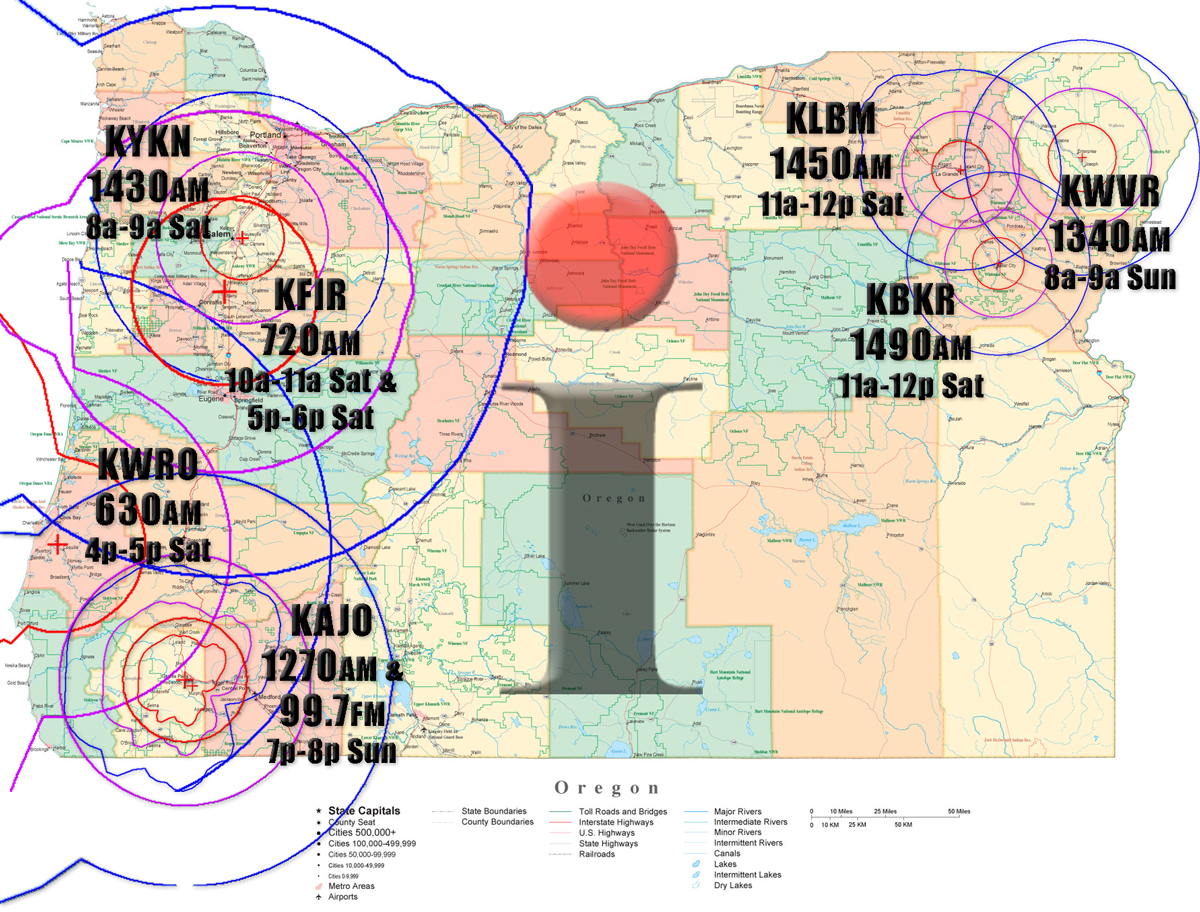
Map of I Spy Radio broadcast areas and air times

The I Spy Radio Show airs weekends — seven times across seven real radio stations, not internet-only streams. Listen anywhere through the stations’ live streams. See when, where, and how to listen for the full schedule.

Missed it? The podcast posts Mondays, after the broadcast stations air the show — here on this page or on your favorite platform.

I Spy Radio  —  Keeping an Eye on Big Government
16-35 Oregon’s Climate Protection Program: What the Rules Actually Say

16-35 Oregon’s Climate Protection Program: What the Rules Actually Say

I Spy Radio  ·  Keeping an Eye on Big Government
Show 16-35

It’s Worse Than We Thought — What Oregon’s Own Rules Say About the Climate Protection Program

Aired  August 2026
Runtime  46:25
Host  Mark Anderson
Guest  Jen Hamaker

Listen to this episode


Awaiting compiled MP3 from Blubrry — replace [INSERT_MP3_URL] once posted.
Chapter timestamps below are also pending final file concatenation.

About this episode

We’ve covered Oregon’s Climate Protection Program before. This week we went back and actually read the Oregon Administrative Rules behind it — and it’s worse than we thought.

Jen Hamaker, president of Oregon Natural Resource Industries, spent weeks in OAR Chapter 340, Division 273 — the rules DEQ adopted after courts threw out the original program — and joins Mark to walk through what’s actually in there. The fuel-supplier threshold that drops from 100,000 tons today to just 25,000 by 2030, pulling in mom-and-pop distributors alongside the majors. The rule that keeps a company inside the program for six years even after it cuts emissions below the line that got it covered in the first place. The $12,000-per-ton civil penalty — not per day — that applies to every uncovered ton, on top of the $136-per-ton Community Climate Investment payment to an out-of-state nonprofit. And the industrial sectors, from sawmills to concrete, already named in the rule and scheduled to face compliance starting 2028–29.

The show also turns the state’s own logic back on itself: with 2.5 million acres burned this season — a new Oregon record — Mark and Jen run the state’s own cap-and-penalty math against the wildfire carbon that went uncounted, and dig into what a declining forest carbon sink means for a program built entirely around burning less fossil fuel.


In this episode

00:00
01

The Noose Widens — Who Actually Counts as a “Fuel Supplier”

Mark’s opener on how the CPP was born as an executive order after two failed legislative votes, then Jen Hamaker on the fuel-supplier threshold dropping from 100,000 to 25,000 tons by 2030 — and the “aggregation trap” that pulls in unrelated businesses under one owner.

00:00
02

The Market You Can’t Get Out Of

Community Climate Investments, the out-of-state nonprofit CalStart, the $136-per-ton credit price, and the six-year rule that keeps a company covered long after it cuts emissions below the line that got it in.

00:00
03

The Real Fine — $12,000 a Ton, Not $136

The civil penalty most people have never heard of, where that money actually goes, DEQ’s 4.5% cut of the CCI program, and the 15% tribal set-aside with no equivalent floor for rural, remote, or coastal communities.

00:00
04

The Industrial List — Sawmills, Concrete, and Housing Costs

The Emissions-Intensive, Trade-Exposed sectors already named in the rule — sawmills, plywood, pulp and paper, concrete and cement — and why that collides with the governor’s own housing-affordability goals starting in 2028–29.

00:00
05

Oregon’s Own Math, Turned on Itself

2.5 million acres burned this season — a new state record — and what the CPP’s own $12,000-per-ton penalty would mean if Oregon applied its rules to its own wildfire emissions.

00:00
06

The Full Picture Nobody’s Added Up

The spotted owl, a declining forest carbon sink, and why Clean Fuels, HB 2021, and the CPP are never evaluated together — even though Oregonians pay for all of them at once.

Links & resources mentioned

Tribal Population Context

About the guests

Jen Hamaker
President, Oregon Natural Resource Industries (ONRI)

Jen Hamaker is president of Oregon Natural Resource Industries and a sixth-generation Oregonian whose family has worked in the state’s natural-resource sector for generations. A recurring I Spy Radio guest on Oregon energy and climate policy, she returns this week after spending weeks reading the actual Oregon Administrative Rules behind the Climate Protection Program — rather than DEQ’s public-facing summaries of them.

onri.us

Full transcript

MARK: I think one of the themes for this election is that Democrats, who are allegedly all about democracy, simply don’t want to listen to people. That is their track record.

Remember that ODOT gas tax that every Democrat — plus one Republican who is now a Democrat — voted for? That 83% of Oregonians said no to and voted down when they finally did have a voice? That was a paltry 6 cents per gallon tax. What’s happening now — that is currently in effect — makes that pale in comparison to what’s coming if it’s allowed to continue. The Climate Protection Program. And unlike that gas tax, it was never allowed to even be sent to the voters.

In 2019, Democrats in the House passed HB 2020. To stop it, 11 Senate Republicans walked out. Some even left the state. Then-Governor Kate Brown sent the state police after them, but after public pressure, she relented, and the bill died.

But she and the Democrats tried to force it again. In February 2020, SB 1530 — the rewrite. And Republicans walked out again. During that fight, Republicans and industry demanded the question go to the voters. But Democrats voted down a proposal to refer the climate plan to voters. OPB reported that Democrats didn’t want that because they were worried it would fail. And there it is. They don’t listen. Democrats don’t like democracy when democracy tells Democrats no.

So two weeks after that walkout, Governor Kate Brown signed Executive Order 20-04, directing state agencies — unelected state agencies — to design and build the program that the Democrat-controlled legislature had just failed twice to pass. But then the Court of Appeals threw it out on procedural grounds in December 2023, without ever ruling on the merits of the rules themselves. Kotek, newly elected in 2022, declined to appeal and had DEQ redo it — and those new rules took effect January 2025.

But what is the Climate Protection Program? For those of you who didn’t listen to our previous shows, or those of you who did and would like a refresher — the Climate Protection Program is a hard, shrinking cap on carbon emissions. This is not a law. It is an executive order, written by DEQ staff and enforced by an unelected commission.

Here’s how that shrinking cap works. The DEQ, the Department of Environmental Quality, sets a cap on carbon emissions statewide. The DEQ hands out permission slips — one per ton. Like a tightening noose on industry, the allowable amount of CO2 shrinks every year. Last year they allowed 24.2 million tons. This year it’s 23.2 million.

Within that, which businesses are regulated by the CPP is determined by “thresholds.” The allowable per-company threshold is currently 100,000 tons. So that’s hitting the so-called “big polluters.”

But let me pause right there. Carbon dioxide is not a pollutant — it’s a nutrient. Plants need carbon dioxide. They need it to make oxygen, which is sort of important to people.

Those thresholds are what a company is allowed to emit. But go beyond that and you start paying penalties — $136 per ton. So if you’re over that 100,000-ton threshold by just 10% — 10,000 tons — that’s a $1.36 million fine per year.

Back to that threshold, because the CPP doesn’t just tighten — it widens, pulling in more businesses. That threshold of 100,000 is lowered in 2028 by half, to 50,000. You’re allowed to emit 100,000 now, but two years from now, only half of that. And by 2030 — just four years away — it shrinks again by another half, down to 25,000. A whopping 75% reduction in just four years.

So they’re tightening the noose, and what I mean by “it widens” is that they’ll put that noose around more necks. That lowering of the threshold means businesses not currently deemed “large enough emitters” will be deemed that in just a couple of years. And once you’re in, you can’t get out.

We’ve been talking about this for a few years now, and finally other people are starting to pay attention too. But — and this is the reason for this week’s show — it’s worse than we thought. Some related research led us down a rabbit trail back to the CPP, and it turns out that when you dig into the OARs, the Oregon Administrative Rules — the nitty-gritty that nobody likes to look into, but fortunately our guest did — that’s where this cautionary tale turns into a horror story.

To talk about all that, I’d like to welcome Jen Hamaker back to the show. She’s the one who first put us onto this. Jen, welcome back — am I correct in thinking this is worse than we thought? What were your overall impressions as you dug into those rules?

JEN: Yes, it is as bad, if not worse, than what we thought. And DEQ’s own rules are the teeth of the enforcement side of this. It’s bad.

MARK: Personally, I think they’re astronomically worse — especially the lowering of the thresholds, which is going to capture more and more businesses. Looking at this from a business standpoint, I think we’re going to have businesses flooding out of the state as this starts to fully kick in. And the really dangerous thing is that people just don’t know about this right now.

We started talking about this several years ago, and here’s what we thought we knew back then. Back on Show 14-34, Chuck Wiese, our guest on that show, spent an entire hour trying to get straight answers out of DEQ’s Nicole Singh about who’s actually getting hit by this program and how the allotments are apportioned. He called every big supplier by name — Northwest Natural, ExxonMobil, Chevron — because that’s who we assumed this was built for. He never got a straight answer. DEQ just wouldn’t respond.

So here’s what we know now. You went through and read the rules yourself, and it turns out the big suppliers were never the point. That threshold falls from 100,000 tons today to just 25,000 by 2030, which I mentioned in the opener. And by then, DEQ itself expects to cover 99% of Oregon’s liquid fuel and propane supply.

JEN: Correct. Which means the mom-and-pop — anybody that distributes gas or natural gas — it broadens the entire spectrum of who’s going to be under compliance. And it’s punitive.

MARK: On the natural gas front — that was one of the other things that put me onto revisiting this show. I was doing some research, and it turns out the figure that kept coming up was that the CPP was only going to cost $4.9 billion over eleven years. Except that’s not quite correct. That $4.9 billion comes from the natural gas industry’s own lawsuit filings, saying it’s going to cost Oregon ratepayers $4.9 billion over those eleven years — but that’s just the natural gas side. When you expand it into all of the industries, the projections are actually well north of $20 billion over eleven years.

It’s shocking, and I can’t believe nobody’s talking about this — I think simply because they didn’t do what you did, which is actually go and look at how this is going to impact people.

JEN: I didn’t realize it was going to be that much — $20 billion over eleven years. This is the largest climate plan in the world, and it’s punitive, and it’s happening in Oregon when we’re already green.

MARK: Allegedly. As far as the fuel-supplier threshold is concerned, just to give people a sense of scale — when you drop down to 25,000 tons in 2030, a typical U.S. gas station moves 1.2 to 1.8 million gallons a year. So by 2030, a distributor supplying roughly two busy gas stations’ worth of fuel is a regulated, covered entity. Just two stations. This is going to hit all of these mom-and-pop distributors that are out there trying to get the fuel we need to keep the economy going. It’s not just the big regional names — those are the ones getting hit now.

But there’s another issue you uncovered, called an “aggregation trap.” A business owner will often own multiple related — or not even completely related — industries. If one of those business entities falls under this threshold, all of the businesses he owns are also hit.

JEN: Yes. And in a short time, that compliance threshold broadens — it ends up including a lot of different companies. That aggregation trap is horrible, because it regulates people who aren’t even polluting, or bringing in gas, or producing emissions themselves.

MARK: It’s shocking, and we’re definitely going to need a second show on this — I can guarantee we’re only scratching the surface. All right, everyone, stay with us. Lots more to come on the Climate Protection Program with Jen Hamaker.

— Segment 2 —

MARK: And welcome back. This is the I Spy Radio Show, talking today to Jen Hamaker, president of ONRI — Oregon Natural Resource Industries. A sixth-generation Oregonian, her family has been involved in natural resources for literally generations.

Jen, in the last segment we introduced the CPP, the Climate Protection Program — and I want to start digging into some of this. Here’s again what we thought we knew. When we talked to you on a previous show, back on Show 15-23, I said on air — and I quote myself — “they’ve created a market that you can’t even get out of.” That was a gut read at the time. I didn’t have a rule number to point to. It was just an educated guess, knowing how Salem operates and how Democrats work.

So here’s what we know now. It turns out I was right — there’s an actual rule that makes this true. And you found it. Talk to us about the market and how this plays out.

JEN: The CCI is Community Climate Investments. DEQ has picked a nonprofit, CalStart, located down in California. You can pay CalStart for allowances — so if you go over the cap as a company, you can pay into the CCI program, which goes to the nonprofit CalStart, and buy allowable credits from them to offset your emissions. You’re giving money to a nonprofit. And you can also bank your allowances, transfer them, or surrender them. It creates an artificial market where those allowances become very expensive if you need them to continue to operate. This is cap and trade, in black and white. There’s no doubt about it.

MARK: It’s the same effect as the cap-and-trade program the legislature tried to pass. In that same earlier show, we talked about how some Republicans were willing to sign “a deal with the devil” — going along with a legislative cap-and-trade program because it would be slightly better than the Climate Protection Program mistake.

JEN: Yes.

MARK: Unfortunately they didn’t, because when it comes to choosing between two poison pills, you don’t swallow the least poisonous one — you let your opponents do that. Fortunately, they didn’t. So people understand — the reason you’d need those allowances is because you can’t quite get under the threshold set for your business or industry. That’s the 100,000, dropping to 50,000 in 2028, and down to 25,000 by 2030. That allows you to keep polluting beyond the cap if you just can’t quite hit the target. Do we have any sense of what those credits currently sell for?

JEN: You can buy up to 20% of your emissions and give that money to the CCI, the nonprofit, to offset your emissions — and they cost $136 per ton through the government. But once you have those allowances, you can bank them, transfer them, sell them, whatever — and that’s where this artificial market gets created. How much is one of those credits worth when a company needs it to stay in business? The sky’s the limit. It’s a private negotiation between companies.

MARK: And you mentioned it’s a $136-per-ton charge from the government right now.

JEN: Right.

MARK: But we’ll come back to that, because that’s not quite the whole story. The other thing I mentioned is that you can’t get out of this — once you fall in, those rules apply to you for the next six years, at least.

So just to reiterate: if your target is 25,000 tons and you get under to 24,000, that doesn’t mean you’re excluded. You still have to follow those same regulatory requirements for the next six years, just to maybe get out at the end of it — and of course, the rules can change between now and then.

JEN: And it also covers any other companies you might own, even if those are in compliance on their own.

MARK: Exactly right. That’s what’s so frightening about the reach of this — it’s going to start impacting other companies even if they don’t directly fall under it. And you’ve got $20 billion over eleven years being removed from Oregon’s economy on this.

So getting back to CalStart, the nonprofit handling this — this is so typical for the left. They love to operate this way. We’ve seen it with climate change since our first year covering this. What we’ve found is they hide this money behind the shield of a nonprofit, because if it were a government agency, you could file a public records request and say, “Show us how you’re spending this money. Who’s getting it? How much are you taking in, how much are you spending, and with whom?” You can’t do that with a nonprofit — it’s behind that veil of secrecy. They have to show you the top five recipients or so, but beyond that, they could be funding literally hundreds of far-left organizations. That’s where a lot of this will go — to organizations that support climate causes under the banner of “environmental justice.”

How many conservative organizations are involved in environmental justice funding? None that I’m aware of. If this were a funding mechanism the right was using — bleeding off taxpayer dollars for pro-life initiatives, the National Rifle Association, or funding a religion, which is essentially what climate change has become — there would be hell to pay. But for some reason, Republicans tolerate this.

JEN: I agree.

MARK: Okay, everyone, stay with us. We’ll continue this with Jen Hamaker, talking about the Climate Protection Program. There’s still a lot more to unpack here — none of it good.

— Segment 3 —

MARK: And welcome back. We’re talking today to Jen Hamaker, president of ONRI, Oregon Natural Resource Industries — find out more about their work at onri.us. We’re talking about the Climate Protection Program, something you need to know about, because it isn’t getting enough attention. Republicans especially ought to be talking about this, because it’s exponentially larger than the gas tax that was defeated by 83% of voters statewide — including in deep-blue Multnomah County, where it was defeated by 73%. That includes a lot of Democrats.

Jen, one of the things we talked about last segment was this target-emissions line you get fined for on every ton over your allotted amount. Right now that’s 100,000, dropping to 50,000 in two years, down to 25,000 in four years, in 2030. But that’s not the full story, because according to the OARs — and you can find these on today’s show page, 16-35 — one rule states that each metric ton of CO2 of a compliance obligation for which a covered entity does not demonstrate compliance is a separate violation. What that means: a Class I major violation is $12,000 per ton — not per day, per ton. If you exceed that, that’s your fine, and I had no idea it was anywhere near that high.

JEN: So if you exceed that by, say, a thousand tons…

MARK: That’s $12 million. Boom.

JEN: Where does that money go?

MARK: That’s a good question — I don’t have that in front of me right now. We’ll find that out and get it up on the show page. I’d assume some of that has to be offset somehow, but I don’t know off the top of my head.

JEN: Does the CCI get it?

MARK: Possibly — wouldn’t surprise me. We’ll have to figure that one out. But again — $12,000 per ton. If you’re already at 25,000 tons and you go 1,000 tons over that, that’s $12 million. How many businesses do you think can absorb a $12 million fine?

JEN: The DEQ is going to get rich.

MARK: It’s absolutely stunning how punitive this fine is. And even the $136 figure can add up quickly — if you’re over by just a thousand tons, for a small company, that’s a $136,000 fine. That’s two paychecks worth of employees you could have been paying, and instead you’re paying the state.

So one of the things out there is what this “environmental justice” nonprofit funding actually goes toward. Do we even know what qualifies as an environmental-justice expenditure?

JEN: From my experience, pretty much anybody who can justify themselves as environmental justice gets included. And as far as DEQ’s oversight of the CCI, the nonprofit CalStart — DEQ charges 4.5% off the top to oversee them. But within the DEQ statutes, there are no regulations on who the nonprofit can give their money to, as long as it has something to do with environmental justice. To me, it’s a racket.

MARK: It does sound like a racket. One thing I found interesting — a minimum of 15% of those CCI project funds has to go to tribes, specifically federally recognized tribes within Oregon. Fifteen percent — is that fifteen percent of Oregon’s population? I don’t think so. Do we have any idea why they’re getting that guaranteed share?

JEN: I think it’s a feel-good thing. Honestly, the more I understand these regulations and statutes within DEQ, the sicker I get. I don’t have a good answer for you on that one.

MARK: While we were talking, I quickly looked up where that $12,000 goes — that’s a civil penalty, so the state gets that. The CCI credits, though, those still go to CalStart. But the $12,000 is a civil penalty. And it’s even worse than that, because according to my research, the director can escalate that to $25,000 per violation per day.

JEN: All of this is so arbitrary — it’s just a way for government to collect more money, more money, more money. Bigger government, more regulations, more restrictions. Who would ever think you could punish your way out of climate change?

MARK: Punish your way out of it — exactly. It’s kind of like the COVID lockdowns, how onerous those got, where they’d punish you regardless. How many businesses went under because they couldn’t — or wouldn’t — follow the rules, and people weren’t coming through their doors like before? This is going to destroy Oregon’s businesses. We are already bleeding businesses.

JEN: That’s right. And it’s going to take us out of competition too, because anybody inside Oregon’s borders has to comply with this program.

MARK: Imagine trying to attract businesses: “Come to Oregon — and if you pollute more, we’ll let you pollute, for $12,000 a ton.” It’s pretty shocking. All right, everyone, stay with us — we’re going to continue this with Jen Hamaker, talking about the Climate Protection Program and what you need to know.

— Segment 4 —

MARK: And welcome back, talking about the Climate Protection Program. This is coming at you fast — in fact, it’s already in effect, and it’s going to get progressively worse very quickly, within the next two years — conveniently, after the governor’s election. And it’s the governor who could undo this, because it’s not a law, it’s an executive order. Switch who’s governor, and you can undo this. Christine Drazan has said repealing it is a priority for her.

Jen, let’s talk about what we thought we knew about which industries would be hit by this. We had a sense of some of them, but after you dug into the OARs, it turns out to be much broader. Which parts of Oregon’s natural-resource industries are going to be hit by this?

JEN: Every single one of them. There’s something in the CPP rules that specifically identifies what they call EITEs — Emissions-Intensive, Trade-Exposed industries. Those include sawmills, semiconductor manufacturing, plywood mills, veneer mills, and pulp and paper. Our natural-resource industries will be hit by this, and they’re subject to the full emissions regulations under DEQ through the CPP.

MARK: The other ones on that list include concrete and cement companies, iron and steel, glass, chemicals, fertilizer and agricultural chemicals, plastics, mining and quarrying, aerospace, and semiconductor manufacturing, which you mentioned. When you look at all of that — one of the governor’s stated goals is lower-cost, more affordable housing. She’s been saying that since she ran in 2022. Well, guess what she’s targeting: lumber. That’s going to go up. And concrete — you need that to pour foundations. Iron and steel are used in buildings. Glass, for windows. So the very things she says she wants to lower costs on, the CPP and all of these rules are not going to lower anything.

JEN: Correct. And it’s layered on with everything else she’s done — shutting down our forests, regulating all of that too. The crazy thing about the EITEs having to be subject to the full emission-reduction requirements is that DEQ is still developing the specific emissions-intensity benchmarks and reduction schedules, so we don’t even know what the fallout is going to be yet. But what we’ve researched so far tells us it’s going to be extreme. This is the brainchild that started with Kate Brown and moved to Tina Kotek, and she’s ratcheting it up.

MARK: Something else important — the threshold for these EITEs is lower than for fuel suppliers. Their threshold is only 15,000 tons of emissions. That’s hitting a mid-size mill or food processor — not some giant mega-corporation. Smaller, though not quite mom-and-pop, and certainly much smaller than the fuel suppliers at 25,000 tons. Do we have any idea why they’ve lowered it for those industries specifically?

JEN: No — well, it’s the transportation sector that produces the most emissions overall, so the CPP really targets that. And the cap decreases over time while the cost increases over time. With the 15,000-ton threshold for the EITEs, that’s how they’re going to make their bread and butter — semiconductor manufacturing, sawmills, all of it. This is just so punitive, and again, this is the largest, most expensive, most punitive climate plan in the world.

MARK: Even just the $136 per ton is three times what Washington and California charge.

JEN: Yeah, and that’s the base rate.

MARK: Getting back to the CCI payments — the reserve, which was in your notes as item five: DEQ has the ability to retire those compliance instruments. So it’s not just lowering the threshold from 100,000 tons down to 25,000 and even lower by 2050 — it can also lower the amount of credits you’re allowed to buy. Talk to us about how that works.

JEN: A compliance instrument, in layman’s terms, is one ton of CO2, or emissions. The obligation is the volume of emissions each supplier is responsible for. When DEQ retires an allowance — one metric ton — it ratchets the cap down further, and it moves down fast. Under specified circumstances, DEQ can retire those compliance instruments, and that matters because scarcity isn’t an accidental side effect of this program. The declining number of available instruments is central to making the emissions cap work — and to the money it generates for government.

MARK: Right. Just to go through some of the numbers: the reserve currently allows 800,000 instruments from 2025 through 2028–2029. That shrinks to 500,000, and from 2035 onward, to 250,000. So they’re lowering the threshold at which this kicks in, and also lowering what I think of as those “donation” payments — kind of like the old medieval practice of indulgences, effectively letting you keep sinning. They’re shrinking the supply of those indulgences, so the price is going to explode.

JEN: Exactly — that’s exactly my fear. That’s exactly what a program like this supports.

MARK: Horrendous. Okay, coming up, we’re going to talk about the largest polluter in Oregon. Stay with us.

— Segment 5 —

MARK: And welcome back. This week’s show is one of those where the more you look, the worse it gets — and that tends to happen with government programs. We’re talking about the Climate Protection Program, an executive order originally put in place by Kate Brown after Republicans walked out to stop it in the legislature. It was thrown out by the Court of Appeals on disclosure grounds, then reinstated under Governor Kotek, and it’s currently in effect.

Jen, our guest today, is president of ONRI, Oregon Natural Resource Industries — their website is onri.us. Jen, the reason I got onto this angle was thinking about the stated goal of reducing carbon emissions. That’s weird, I thought, because right now we are burning up — this is the largest forest-fire season we’ve ever had. So I started digging: roughly how many acres have already burned? Jen, can you give us a sense of the scale?

JEN: Right now in Oregon we’ve burned 2.5 million acres this year. It’s the biggest fire season in Oregon history.

MARK: And just two years ago we had that really big one, and we thought that was astronomical. This one’s even bigger. It’s like we’ve learned nothing. So again, looking at this through the lens of “we want to reduce carbon emissions” — how much carbon did those 2.5 million acres put into the air, which we’ve said we don’t want to do? Doing the research, that’s roughly 30 million tons of CO2. Our cap this year, per DEQ, is 23,280,253 tons. So that’s roughly 6.72 million tons over the state’s own limit.

If you wanted to fine that — and I’d call this willful negligence, because we know forests burn when you don’t manage them — to me, that’s a willful violation of what we say we want to do. At the $12,000-per-ton civil penalty, that’s $80 billion the state would owe itself. And if you use the full 30 million tons over the cap, remember, this is on top of what industry pays — that’s $360 billion.

But the state isn’t liable for any of that, because apparently that’s not “man-caused” emissions — they call it natural. I’m sorry, but if you have the opportunity to not let these fires burn and don’t take it, to me that’s man-caused.

JEN: That’s correct. And just to put this in perspective — remember the Labor Day fires? The initial blaze emitted enough to equal every single car in Portland running 365 days a year, 24 hours a day. Just to give you an idea of scale.

MARK: How many tons of carbon dioxide do trees take out of the atmosphere once they’ve already burned and are no longer there? You need those plants to take carbon dioxide out of the air. You just let 2.5 million acres go up in flames, putting all of that carbon into the air. You’d think maybe we ought to do something about that.

JEN: It’s a double whammy — we’re destroying the lungs of Oregon.

MARK: Jen, there’s something else from your notes I want to get to. The CPP isn’t Oregon’s only carbon-compliance system, and I think that’s the really dangerous part, because we don’t have a true sense of exactly how much this is all going to cost Oregonians. Separate from the CPP, Oregon’s Clean Fuels Program already operates its own credit-and-deficit system affecting transportation fuels. Walk us through some of these other carbon-compliance systems.

JEN: This is layered carbon compliance on top of carbon compliance. Right now, the fuel tax in Oregon is 40 cents. The Clean Fuels compliance cost is about ten, almost eleven cents. The CPP compliance cost is going to be about 39 cents starting in 2028, and it’ll ratchet up from there. And DEQ’s own calculated average compliance cost rose about 25% in one year. Add all of that up — what’s the aggregate cost to consumers buying fuel? To me, this is one of the scariest parts of the whole thing, because fuel cost touches everything — not just transportation, not just industry, but the mom taking her kid to school in the morning. All of this is going to start costing us, and then heating your home on top of that, with natural gas ratcheting up too. We genuinely don’t know what the end result is going to be for the consumer.

MARK: Just to run through the other pieces you’ve mentioned — on top of the CPP, you’ve got HB 2021’s electricity requirements, Advanced Clean Cars II, Advanced Clean Trucks, the CCI system — that’s the $136-per-ton additional cost if you exceed the cap — plus the 4.5% DEQ fee, and future EITE industrial compliance on top of that. You nailed it when you asked: where is the cumulative economic analysis when you lump all of this together? It’s astronomical.

I don’t understand how they can even consider this, going back to your notes — a logger doesn’t buy Clean Fuels diesel on Monday and CPP diesel on Tuesday. Oregon evaluates these regulations one at a time, but businesses don’t pay them one at a time. Eventually all of this ends up in the hands of the customer, because the upstream fines and regulations impacting the cost of doing business don’t just get absorbed — businesses have to pass that on.

JEN: That’s right. That’s why I think this is a racket — the consumer pays more, and the government gets more. And to add to it: right now DEQ has 21 companies, covered fuel suppliers, receiving compliance instruments under the CPP, and DEQ gets to decide how much each one of those companies gets against the cap — about 24 million tons in 2026. To me, that’s exactly why people don’t trust government — these backroom deals. DEQ says they have an equation, but that equation is only known to DEQ, deciding which company gets how many of these allowances. It’s “you scratch my back, I scratch yours.” Is there something more happening there? I don’t know.

MARK: It’s selective punishment, for sure. All right, everyone, stay with us for our final segment, where we’re going to talk about Oregon doing the opposite of what it says it wants.

— Segment 6 —

MARK: And welcome back for our final segment, talking to Jen Hamaker, president of ONRI, Oregon Natural Resource Industries — onri.us. Jen, we’ve been talking about the CPP, and as we discussed last segment, the stated goal is reducing carbon emissions — and yet the state is by far the biggest polluter of anyone out there.

This ties right in, because with all of these forest fires destroying habitat — did you happen to see that Oregon State researchers recently found the northern spotted owl is functionally extinct in significant parts of its range? We started this effort back in the seventies and eighties to save the spotted owl, and now it’s effectively lost. How many acres have we allowed to burn while claiming we want to protect the spotted owl? How many spotted owls are living in areas that used to be forest and no longer are? I’m guessing zero. Does this affect the habitat conservation plan?

JEN: Actually, yes, it absolutely does — they’ve set aside hundreds of acres per pair of spotted owls, and if the owls are gone, there will be real questions about those set-asides. But I want to bring up something I think your listeners need to understand: none of these rules, regulations, allowances, and compliances have really been looked at in the aggregate — as a whole.

MARK: Yes.

JEN: It’s the same with our forests, which keep burning while government shuts down the Elliott, shuts down millions of acres under the Private Forest Accord, shuts down millions more under the HCP on state lands. They look at each of those individually — they don’t add it all up, so they never see the full picture. That’s exactly what’s happening with the CPP and all of these other rules and regulations, like Clean Fuels, all contributing to what consumers are going to have to pay. Nobody has looked at the full picture. That’s what government keeps doing — they focus on one thing at a time, and pretty soon all of it gets passed on to us.

MARK: Well, and again, they say the goal is a decline in carbon emissions. Okay — we’ve got some carbon vacuum cleaners out there, they’re called trees. Oregon’s own 2025 Land-Based Net Carbon Inventory shows that since 1990, the forest’s ability to remove carbon has declined 44% because of these fires — from 104.5 million tons down to 58.62 million in 2024. Again, if the goal is to reduce carbon, instead we’re letting those trees burn up, which means they can’t be out there pulling carbon out of the air.

JEN: Not only are they no longer able to sequester CO2 once they’ve burned — they’re also contributing to the CO2 total, because roughly half of dried wood, by weight, is carbon. You burn it, and it’s released. It’s a double whammy, again.

MARK: It absolutely is. Jen, unfortunately we’re up against the clock. This has been very informative — as I said at the top of the show, we’re definitely going to have you back, because a lot of what we’ve done here is really just first-blush research, and it’s astronomical just trying to get your head wrapped around it.

JEN: There’s so much to this.

MARK: It absolutely is astonishing. Thank you so much for your time today.

JEN: Thank you so much.

MARK: It probably won’t surprise you that there is a tremendous amount of information we still haven’t covered, including the fact that this isn’t just an Oregon story — there’s an international organization behind all of it. I want to encourage you to go to our website, ispyradio.com/16-35, to find out more — there’s a tremendous amount of information up there already. And I’d especially encourage you to contact your candidates and make this an issue in this campaign, because this is an executive order — the fastest way to undo it is to change who holds that office, the governor. But if you keep — or let expand — those Democrat supermajorities, this becomes law. That’s why you can’t just focus on the governor’s race. You’ve got to support those down-ballot races too, the representatives and the senators. Because as we say every week — the best information does you no good if you don’t use it.

Catch the show live


Map of I Spy Radio broadcast areas and air times

The I Spy Radio Show airs weekends — seven times across seven real radio stations, not internet-only streams. Listen anywhere through the stations’ live streams. See when, where, and how to listen for the full schedule.

Missed it? The podcast posts Mondays, after the broadcast stations air the show — here on this page or on your favorite platform.

I Spy Radio  —  Keeping an Eye on Big Government


Oregon’s Universal Health Plan: The $85 Billion Tax Bill | Show 16-31

Oregon’s Universal Health Plan: The $85 Billion Tax Bill | Show 16-31

I Spy Radio Show | Keeping an Eye on Big Government
Show 16-31

Sixteen Years in the Making — Oregon’s March to Socialized Medicine

Aired  August 2026

Runtime  48:00
Host  Mark Anderson
Guest  Lisa Lettenmaier
Listen  See our network of stations, areas, times and livestream options

Listen to this episode (Available Mondays after airing on our network of stations)


Player block is self-contained and swappable. When the site goes static,
replace this <audio> element with the Podlove Web Player to get chapter
navigation and transcript sync — the chapter data below already feeds it.

About this episode

For sixteen years this show has been telling you what was coming. We are now standing on the threshold of it. In seven weeks, a board appointed entirely by Governor Kotek delivers Oregon a blueprint for state-run health care — and the numbers are on the state’s own website.

$85B
Total annual cost
9.6%
New employer payroll tax
10.1%
New personal income tax
Sept 15
Plan due to Legislature

Independent health insurance broker Lisa Lettenmaier of Health Source NW returns for the full hour — and this one may be the most important conversation we have had with her. Mark opens by tracing the ten-step path Oregon has walked since 2011: the bills that created the Coordinated Care Organizations and then exempted them from state and federal antitrust law, the “global budgets” that pour money from every source into a single pot where no one can follow it, and the nonprofit structures that shield those books from public view.

Then the payoff. Because voters passed Measure 111 in 2022, health care is now a right written into the Oregon Constitution — and proponents argue the Legislature is therefore obligated to deliver it. The next year, Senate Bill 1089 created a nine-member Universal Health Plan Governance Board, appointed by the Governor and confirmed by the Senate, and gave it a statutory deadline: September 15, 2026. By law, every member of that board must agree with the objective before they can be appointed to it. There is no seat for a skeptic.

Lisa walks through what the plan would actually cost a household. A 10.1% health care personal income tax stacked on top of Oregon’s existing 4.75%–9.9% rates, kicking in above 200% of the federal poverty line — a threshold a full-time minimum wage earner in Portland has already crossed. A 9.6% employer payroll tax on any business with more than $500,000 in firm-wide payroll, which is a landscaping company with a couple of crews, a small restaurant, a dental office. Plus three points on the corporate income tax and a bump to the corporate activity tax, which is levied on gross receipts, not profit. Total new Oregon revenue: $16.9 billion a year. The other $68 billion has to come from Washington.

And that is before the history. Vermont passed the nation’s first single-payer law and then killed it when the real tax numbers came back at 11.5% on employers and up to 9.5% on individuals — a Democratic governor walked away from his own signature achievement. Oregon is proposing a comparable payroll tax and a higher income tax. And Oregonians have already voted on this once: in 2002, Measure 23 proposed single-payer funded by income and payroll taxes and lost 78.5% to 21.5%.

The hour closes where it has to. In Canada, assisted dying has moved from a mandatory 48-hour waiting period to same-day — and a study has projected savings in the hundreds of billions, with the largest figures under non-voluntary scenarios. Oregon’s own board has adopted five governing principles, and one of them reads: during public health emergencies, protecting community health may temporarily take priority over individual preference. When the government is the only payer, the government decides what your care is worth.

The report lands September 15. It goes to the Legislature seated by the November 3 election — and under the Oregon Constitution, a tax package needs three-fifths of both chambers. Democrats hold 37 of 60 House seats and 18 of 30 in the Senate. Two House seats, or one Senate seat, is the whole margin.


In this episode

00:00
01

Ten Steps to Socialized Medicine

Mark lays out the sixteen-year path — from duping Republicans in 2011 to the final step Oregon is standing on now. Then Lisa on where the 2027 rates landed, the carriers walking away, and Oregon taking over the insurance marketplace from HealthCare.gov.

00:00
02

The Money You Can’t Follow

Why Oregon switched off the antitrust laws for health care, what a “global budget” really does to accountability, and the meeting where Lisa first heard the state pitch buying air conditioners with health care dollars. Plus the cost-shift almost nobody understands.

00:00
03

$85 Billion a Year — and Where It Comes From

CareOregon’s billion-dollar reserve, the California merger Oregon’s own DOJ found unlawful, and then the tax table itself: 10.1% on income, 9.6% on payroll, and what 200% of the poverty line actually means for a family of two.

00:00
04

Vermont Tried This — and Oregon Already Voted No

The projections that killed Green Mountain Care, the 2027 session versus a 2028 ballot measure, and Measure 23’s 57-point defeat in 2002. Plus Medicaid recertification, and the hospital tax Lisa calls a shell game.

00:00
05

The Lies They’re Telling — and the $68 Billion Wish

The state’s own calculator says most households pay less. Lisa explains what it leaves out — what happens to private plans, to provider pay, to wait times, to snowbirds and travelers — and why the whole thing rests on $68 billion a year from a federal government that has not agreed to any of it.

00:00
06

Customer or Liability — and What a “Right” Actually Is

Designed for fraud, or merely indifferent to it? Then Canada’s trajectory, the Oregon board’s own principle that community health may override individual preference, and Mark’s closing argument on why no one has a right to another person’s labor.

Links & resources mentioned

Lisa Lettenmaier & Health Source NW

  • Health Source NW (independent health insurance & Medicare brokerage — Oregon & SW Washington, no cost to clients)

Oregon’s Universal Health Plan — Read Their Own Paperwork

Who Is Pushing It — In Their Own Words

The CCOs — Antitrust, Global Budgets & CareOregon

The 2027 Rates, the Carrier Exodus & the State Marketplace

It Has Been Tried Before

Medicaid, the Provider Tax & What Comes Next

About the guest

Lisa Lettenmaier
Owner, Health Source NW

Lisa Lettenmaier is an independent health insurance broker serving Oregon and Southwest Washington, and the owner of Health Source NW — an agency that helps individuals, families, and seniors navigate individual health insurance and Medicare plans at no additional cost to the client. She has been in the market since before the Affordable Care Act took effect, sat through the rollout meetings, and watched Oregon’s individual market shrink from roughly fifteen carriers to three.

She is a recurring I Spy Radio guest and the show’s go-to voice for common-sense answers on Oregon’s health care system.

healthsourcenw.com

Full transcript

Transcript is being prepared and will be posted shortly. Auto-generated from the episode audio, then cleaned for names, agencies, figures, and natural paragraph breaks.

Catch the show live


Map of I Spy Radio broadcast areas and air times

The I Spy Radio Show airs weekends — seven times across seven real radio stations, not internet-only streams. Listen anywhere through the stations’ live streams. See when, where, and how to listen for the full schedule.

Missed it? The podcast posts Mondays, after the broadcast stations air the show — here on this page or on your favorite platform.

I Spy Radio  —  Keeping an Eye on Big Government


16-29 Breaking the Spell — Mike Gonzalez on the Rise of Socialism in America

16-29 Breaking the Spell — Mike Gonzalez on the Rise of Socialism in America

Breaking the Spell — Mike Gonzalez on the Rise of Socialism in America

Aired  July 18–19, 2026
Runtime  ~48 min
Host  Mark Anderson
Guest  Mike Gonzalez, The Heritage Foundation
Listen  See our network of stations, areas, times and livestream options

About this episode

Mike Gonzalez fled Communist Cuba with his family when he was twelve years old. Now a senior fellow at The Heritage Foundation, he joins Mark to explain why socialism is winning young voters who’ve never lived under it — and why that’s no accident.

Mark and Mike Gonzalez, the Angeles T. Arredondo E Pluribus Unum Senior Fellow at The Heritage Foundation and co-author of NextGen Marxism, trace how a cultural takeover of institutions like the Smithsonian is reshaping how young Americans see their own country, and how billions in taxpayer dollars — from USAID to the Corporation for Public Broadcasting to a $2.8 billion “climate justice” grant program — have quietly subsidized the activist ecosystem behind it. They dig into whether socialist candidates actually win head-to-head races against Republicans or whether vote-splitting and ranked-choice voting are doing the real work, and bring it home to Oregon: the primary upset of a sitting Democratic state senator, an open Portland House seat, and a sitting DSA incumbent since 2022 — plus Portland DSA’s open push for single-payer health care here in Oregon.

The back half of the show is built around what Mark calls “breaking the spell” — a set of direct, personal questions aimed at disarming committed socialists, including two on-air hypothetical tests: would they personally give away 90–95% of their own income today, and would they accept a nine-month wait for surgery under the kind of socialized medicine they’re proposing for everyone else? The show closes with Gonzalez’s practical, on-the-ground advice for pushing back — at school board meetings, at the ballot box, and in conversations with friends and family who’ve bought into the utopia.

In this episode

00:44
01

Fleeing Cuba — From Journalist to Fighting Socialism Full-Time

Gonzalez on leaving Cuba at twelve, his path from the Wall Street Journal to Heritage, and how the Smithsonian became his current fight. Plus: the deep-blue primary playbook behind Darializa Chevalier’s win over a three-term incumbent in New York.

10:29
02

Why Socialism Is Winning Now — and the Smithsonian’s $1.1 Billion Question

The Cold War generation gap, the manufactured “Hispanic” census category, and the White House’s 160-page report on the National Museum of American History — plus whether institutions that keep indoctrinating should lose public funding.

18:08
03

Follow the Money — USAID, CPB, and the $303 Billion Question

How defunding USAID correlated with seven straight conservative wins in Latin America, the OMB’s push to do the same thing domestically, and the $303 billion a year flowing to more than 100,000 NGOs — compared to what conservative causes receive.

25:51
04

Do They Win Head-to-Head? Vote-Splitting, the Democratic Civil War, and Oregon

Why every headline socialist win is a safe-seat primary, the academic case for ranked-choice voting as a deliberate DSA strategy, and whether establishment Democrats like Shapiro and Fetterman can actually stop the party’s leftward drift.

33:20
05

Breaking the Spell, Part 1 — The Hypocrisy Tests

What actually disarms a committed socialist, Gonzalez’s own family history with envy and expropriation in Cuba, and Mark’s two on-air tests: giving away your own wealth, and waiting nine months for surgery — plus Oregon’s own push for single-payer health care.

40:46
06

Breaking the Spell, Part 2 — What Actually Works

Practical, local-level advice for pushing back — school boards, syllabi, parent-teacher nights — plus whether “communist” is the right line of attack given capitalism’s own sliding favorability numbers, and Gonzalez’s closing message to young Americans.

Links & resources mentioned

Mike Gonzalez & The Heritage Foundation

  • Mike Gonzalez (heritage.org staff bio)
  • The Heritage Foundation
  • NextGen Marxism: What It Is and How to Combat It (with Katharine Gorka, Encounter Books, April 2024)
  • The Plot to Change America: How Identity Politics is Dividing the Land of the Free (Encounter Books, 2020)

The Smithsonian & “Saving America’s Story”

Follow the Money

Elections, Vote-Splitting & Oregon

Oregon’s Universal Health Care Push

  • Right to Health Care constitutional amendment (Measure 111, 2022) — Universal Health Plan Governance Board created by HB 1089 (2023); single-payer plan due to the Legislature by September 2026

About the guest

Mike Gonzalez
Angeles T. Arredondo E Pluribus Unum Senior Fellow  ·  The Heritage Foundation

Mike Gonzalez fled Communist Cuba with his family as a child. A former journalist who wrote for the Wall Street Journal, he is now the Angeles T. Arredondo E Pluribus Unum Senior Fellow at The Heritage Foundation, where his current work centers on the Smithsonian Institution and the census’s racial and ethnic categories. He is co-author, with Katharine Gorka, of NextGen Marxism: What It Is and How to Combat It (Encounter Books, 2024), and author of The Plot to Change America: How Identity Politics is Dividing the Land of the Free (Encounter Books, 2020).

heritage.org/staff/mike-gonzalez

Full transcript

Segment 01 · Fleeing Cuba — From Journalist to Fighting Socialism Full-Time · 00:44

Mark:

Let’s say that you wanted to destroy America, but you didn’t want America to know that you wanted to destroy America. How would you do it?

Well, one of the first things you would need to do is figure out how to get money. A lot of money. And nothing bothersome like going out and earning it, or developing a billion-dollar company — that’s a lot of hard work. Besides, you’re going to need much more than that, because destroying America is going to require reprogramming people, distorting their view of reality, and getting them to believe a lie.

We’ve talked about that before — we interviewed one of the co-authors of the book Disinformation. This was a Soviet program back when the Soviet Union was still around, and that kind of disinformation is a key part of socialism or communism, if you prefer — they’re the same thing. But to do that, you need a tremendous amount of resources and money, because doing it on a country-wide scale is not easy or inexpensive. And you’ll need allies — the media, universities, clever marketing slogans. So you need a lot of money.

Now, what’s the largest business in America with practically a bottomless checkbook? No, it’s not SpaceX or Google or one of the new AI companies. It’s the American government. They spend trillions of dollars every year — so much they can barely keep track of it. You don’t need a trillion dollars every year, that would be too obvious. But you do need to bleed off money by the billions — hundreds of billions of dollars every year.

And that’s easy — fraud, or setting up imaginary problems like Climate Change, telling people if we don’t do something the world is going to end. You scare people into believing things that simply aren’t real. And you need enemies — what better enemy than America itself, since that’s what you’re trying to destroy. But you can’t make it too obvious that you’re just voting to give Democrats money. Instead you need a network of shell companies — nonprofits. And you need laws to protect how all of that public money gets sent to them, and how it’s spent, and who they give it to.

On today’s show, we’re taking a deeper look at socialism. The goal today is to give you some idea of what you’re facing, because it’s coming here — especially right here in Oregon — unless people wake up and realize what the stakes are and do something about it.

As we say all too often here on I Spy Radio, the fight for freedom is an everyday fight. So to talk about the rise of socialism in America, I’d like to welcome Mike Gonzalez, the Angeles T. Arredondo E Pluribus Unum Senior Fellow at The Heritage Foundation. That is quite a mouthful, but it’s great to have you. Thanks for joining us.

Mike Gonzalez:

Mark, thanks a lot for having me on. Arredondo — it is a mouthful, but it’s a very nice family name.

Mark:

Oh, yeah, I have no doubt about it. So, we know you’re busy getting ready to testify in front of Congress, so we really appreciate you joining us here. As I understand things, you and your family left Cuba — so how old were you when that happened?

Mike Gonzalez:

Oh my God, it’s so long ago — I was twelve years old when I left. That’s not exactly last week, if you look at me.

Mark:

So do you have any memories of it yourself, or is most of what you know entirely secondhand, from your family and what they’ve told you over the years?

Mike Gonzalez:

No, no, no — I have many, many memories, most of them very bad, because communism is a horrible thing and we shouldn’t be inviting it into this country. But there you are. I still have searing memories of what that was like in the sixties.

Mark:

Well, the owner of one of the stations we air on grew up back in Romania when it was still behind the Iron Curtain, and he left when he turned twenty-one, if I remember right. So in terms of what you experienced, are there details that have really stuck with you as you’ve gotten older and started studying socialism for a living — things that just jump out and say, oh my gosh, people really need to know this?

Mike Gonzalez:

Well, socialism has evolved from the socialism that I experienced — I experienced a revolution, like the communism it used to be. You talk about your friend in Romania — we all have war stories to trade. I was just in the Czech Republic two weeks ago; we say we’re members of a club nobody wants to be a member of. So it’s socialism today, and I’ve written a few books about how this has undergone an evolution — a huge change that’s more cultural. It affects our cultural institutions. The work I’m occupied with right now is the Smithsonian. The Trump administration, quite rightly I think, has focused on the Smithsonian Institution, which is the world’s largest museum complex, and cultural Marxists have taken it over. They’ve tried to use history and these museums that the nation has entrusted to them for societal change — that’s what cultural Marxists do. They try to use the culture, the educational system, to change how people think from within. It’s no longer a revolution like my family experienced — but if you change how people believe, then you have millions of voters voting for someone like Zohran Mamdani, or for Katie Wilson, or for Graham Platner, or for Darializa Chevalier. And they’ve been told by their cultural institutions that this is good, that this is how society needs to change — that American culture needs to change. That’s what I’ve gained through my studies, not through personal experience.

Mark:

Well, I think so much of what today’s socialists think — when it comes to why they want socialism — is because they have no experience with it. It’s really very much this imaginary utopia. So what’s the reaction of today’s socialist wannabes when you tell them, hey, have you ever lived in a socialist country or experienced it? Because my family has.

Mike Gonzalez:

Well, they don’t, really. First they’ll say platitudes like, “that wasn’t really socialism,” or “it’ll be different this time, we know what we’re doing.” Or they’ll say what happened in Cuba was actually pretty good — it was an attempt at equality, and you’re just a malcontent, you should go build socialism in Cuba. They’ll say a number of things that evade reality. To quote scripture, they know not what they do.

Mark:

Yeah, or what they espouse. You’ve got a recent book out with Katharine Gorka, NextGen Marxism, and I got a really interesting review from a Manhattan Institute fellow saying it shows readers the nature of the beast, and how to fight it. I’d like to come back to that in more depth later in the show — but for now, can you give our listeners a preview? What are some of the things that work to stop the socialists?

Mike Gonzalez:

Well, I think what Trump is doing — you have to take the cultural institutions back. You have to clean out the universities, clean out the Smithsonian, and that’s what’s being done right now. The administration looks serious about taking back an institution that belongs to the American people, not to these Marxists. I’m testifying in Congress twice next week on this issue. So all of these things — fighting the universities, the Smithsonian, the K-through-12 school system, bringing down the Department of Education, fighting the teachers unions — all of it matters. That’s the way to do it. But you also have to run candidates against these people. Darializa Chevalier is going to be elected — she’s in a very deeply blue district in New York. She won the primary because nobody turned out to vote except her followers. She beat Adriano Espaillat, a working-class guy who’d held that seat for three terms, was an appropriator, brought a lot of bacon to his district. And yet her very organized, very disciplined followers were able to beat him in the primary. And once you win a Democratic primary in a deep blue district, you win. She’s going to win the election. She’s going to be in Congress.

Mark:

Absolutely. Okay, stay with us — today’s show is all about socialism and defeating it. Coming up: why is socialism gaining so much ground in today’s America?

Segment 02 · Why Socialism Is Winning Now — and the Smithsonian’s $1.1 Billion Question · 10:29

Mark:

Our guest today is Mike Gonzalez, senior fellow with the Heritage Foundation, and we’re talking about the rise of socialism — later on we’ll ask him about stopping it. So, Mike, socialism isn’t new — Bernie Sanders has been selling this since the 1980s. So the question isn’t whether socialism exists in America, it’s why it’s suddenly appealing and gaining ground, especially with people under thirty. I’ve got a theory on this: I don’t think this current push for socialism would have gone anywhere in the years right after the fall of the Soviet Union, when most adults had grown up in the shadow of the Cold War and understood personally what the fight against communism actually was. Young people today just don’t have that reference point. Do you think that’s one reason this is working now — that they just have no clue what they’ve actually fallen in love with — or is there something else driving it?

Mike Gonzalez:

This is a variety of things. Yes, we were fighting the Soviet Union — American people saw that the Soviet Union and the countries behind the Iron Curtain lacked freedom and were economically backward, all the things that happened under communism. But these things were also taught in school. In the 1970s, in high school, I was taught a class — Americanism versus Communism — it was mandatory. People were taught the nature of communism; immigrants were taught to assimilate. All of these things have disappeared. The left has won a number of key, very important victories that have left us without any weapons to fight communism. So all of this has to be reversed. I’m about to get busy trying to get rid of the racial categories in the U.S. census — categories like “Hispanic,” for example, are fake, synthetic categories the left created in the 1970s to balkanize the nation, to drive us apart, to make sure we had no assimilation ethos anymore. We have to be serious about getting rid of all of these things.

Mark:

Well, I know that Hispanics used to be considered Caucasian, and then that got split out, as you say —

Mike Gonzalez:

There were no Hispanics. There are no Hispanics. There’s no Hispanic cuisine, no Hispanic food, no Hispanic culture, no Hispanic history. If you were a person of African descent from the Caribbean or South America, you were considered a person of African descent. If you were of European descent, you were considered a person of European descent. This is what the left did — they were very methodical about it. They created “Hispanic” in 1977 through the Office of Management and Budget, and then they said, we’re going to retroactively change history. For example, we celebrated the 250th anniversary of America, and people were talking about Bernardo de Gálvez, a general who won many victories on the side of the colonists, and people were saying, well, there’s your Hispanic general. No — he was not a Hispanic general, he was from Spain. My own ancestor, who fought alongside him at Baton Rouge and Pensacola, was from Cuba. Hispanics did not exist at that time. But the left is very clever — they talk about Hispanic participation in the Civil War. How could there be Hispanics? The category hadn’t been created yet.

Mark:

Well, just to get back to what you talked about, because I think this culture war is so important — that’s one of the reasons this is taking hold. You had a really interesting article, and I think you were on Fox News talking about this too — the White House put out a report called “Saving America’s Story,” accusing the Smithsonian’s National Museum of American History of — well, we talked about that in the previous segment, but it really strikes me that this is so key to why socialism takes hold: they have to erase the past, or rewrite it, to cast America as the villain instead of the hero. That’s not an accident — it’s standard operating procedure for socialism, communism, Marxism, whatever form it takes, because they need villains. That’s part of good story-crafting — you’ve got to have a villain to rise up against. So they’ve recast America as the villain, and they need people not to know how good things used to be, when socialism inevitably failed. Is that a fair read?

Mike Gonzalez:

I urge everybody listening to my voice right now to go to the White House website and find this report on the Smithsonian and read it, because it’s a really important report — a hundred and sixty pages long, five hundred and fifty-two endnotes. It quotes the leaders of the Smithsonian, and all of them say they want to use the Smithsonian — not just Smithsonian history itself, but history as a tool for change. They want to change America systemically, and they’re going to use this huge museum complex, and history itself, the past, to create societal change in America. And they’re doing this with our money — 1.1 billion dollars of our money that we give them every year.

Mark:

Yep, I was just going to point that out — this is what they’re doing with America’s tax money, to rewrite America’s history. There was a really interesting line from an article by the Victims of Communism Memorial Foundation that called schools and universities, quote, “the epicenters of indoctrination.” And if that’s true — getting back to funding — should schools and universities that keep doing this lose all public financing, including things like research grants?

Mike Gonzalez:

Yeah, absolutely. With the Smithsonian — we defunded the Corporation for Public Broadcasting last year, and it should have been defunded, because they were using taxpayer money for biased reporting, and we don’t need to pay a news outlet to do that. However, we can’t do the same thing with the Smithsonian. The Smithsonian is really important — societies and cultures need national museums. They need museums that preserve, collect, and curate national history and heritage to transmit it to future generations. Museums play a key role in that. When Africa became decolonized, the first thing those countries did was create national museums. When the communists took over mainland China in 1949, the Nationalists saved hundreds of thousands of artifacts from five thousand years of continuous history across all the dynasties and brought them to Taipei — I’ve been to that museum — so that the Chinese in the future would know what Chinese culture and heritage was. So we cannot just defund the Smithsonian. We just need to fire the leadership.

Mark:

Yeah, absolutely. Okay, I do want to come back to the money side of things and how we are funding our own demise. That’s next, with Mike Gonzalez, senior fellow at the Heritage Foundation, talking about the dangerous rise of socialism.

Segment 03 · Follow the Money — USAID, CPB, and the $303 Billion Question · 18:08

Mark:

And welcome back — this is the I Spy Radio Show, talking today to Mike Gonzalez, senior fellow with the Heritage Foundation. His family fled Cuba after socialism, or communism, took over there — doesn’t matter what you call it, there are different degrees of the same immoral system that doesn’t recognize individual rights, the very thing America was founded on. And now socialism is on the rise right here. In the last segment we talked about the money and the public funding of organizations that hate America — the Smithsonian, public schools out there trying to change not just history but how people learn and think about America. I think that’s really endemic to why socialism keeps growing — we’re funding our enemies. And aside from the fact that socialism itself is a parasite, a tick that can only survive by feeding on the back of capitalism — when we talk about the public funding of these organizations that hate us, it’s much more than just these institutions. For decades we’ve been funding things like green energy and climate change, and none of that money ends up on the right — it’s all going to the left, and we’re talking trillions of dollars. Al Gore himself said that about six hundred billion dollars from the Inflation Reduction Act — one bill from the Biden administration — was going to give them six hundred and thirty-some billion dollars, and it’s actually even more than that, because some of those tax credits would have kept going forever had the Trump administration not pulled them. One estimate I saw was over one point two trillion dollars that would have gone to the left. Do you think the Trump administration is finally wising up to the fact that we’ve got to stop giving taxpayer money to people within the country who hate the country?

Mike Gonzalez:

This is something the left has been very, very good at, and the right just doesn’t know how to do — and we shouldn’t do it either. But the left has created a machine for giving taxpayer money to its pet causes and pet organizations. The main example of this is USAID, the U.S. Agency for International Development. When Trump, Marco Rubio, and Elon Musk came in in January 2025, one of the first things they did was dismantle USAID. Since then — and a good paper is waiting to be written on the correlation — we’ve had seven victories in a row by conservative candidates in Latin America. I was just an hour ago with the new foreign minister, who’s about to become the new president of Colombia, taking over from the communist Petro. When Petro ran in 2022, our government sent thirty million dollars through USAID — sent it straight to the left in Colombia. We did this constantly. Now that USAID is no longer there to finance their institutions, they’ve lost seven presidential elections in a row. We need to get wise. And we’re doing this internally too, by the way — OMB, the Office of Management and Budget, has just proposed a rule to do the same thing with domestic funding — to dry up the funding for these institutions domestically, not just internationally.

Mark:

Well, I’m really encouraged to hear that, because feeding taxpayer dollars to the left and these organizations eventually filters down to campaigns. I came across one non-profit research group that found at least thirty-five thousand nonprofits get half or more of their revenue from federal taxpayers, and that taxpayer financing provides roughly three hundred and three billion dollars a year to more than a hundred thousand NGOs. That’s a tremendous amount of money — and I don’t know of any funding at all that goes to the NRA from U.S. taxpayer dollars, or to pro-life groups, or to conservative evangelical churches, getting even one billion dollars. And here you’ve got three hundred and three billion dollars a year going to a hundred thousand NGOs. That’s pretty hard to overcome.

Mike Gonzalez:

Right, and we have to stop doing that. I think this is another great thing President Trump — he’s not perfect, but he’s doing a lot of intelligent things, and the people around him are doing a lot of intelligent things too. One of them is getting rid of this machine that funds the left with money collected from all Americans — the CPB, the Corporation for Public Broadcasting, money from all Americans going to fund radio and TV stations that were inimical to the wishes and interests of the average American citizen. No more of that.

Mark:

Well, that’s so encouraging to hear that Trump is finally waking up to that — and I think he’s surrounded himself with much better, more competent people this time around than he had in his first administration.

Mike Gonzalez:

Absolutely.

Mark:

I think it’s places like Congress, in both the Senate and the House, that seem to be resistant to this. I’d like to think they’re finally going to start pulling the plug on this, because there’s another one I came across too — I mentioned the six hundred and some billion dollars from just one bill, the Inflation Reduction Act. There was a separate two-point-eight-billion-dollar Environmental and Climate Justice program tied to funding groups like the Climate Justice Alliance, and those payments are currently on hold because it’s tied up in the courts. But if this isn’t fixed legislatively — and it’s got to be fixed legislatively, not just administratively —

Mike Gonzalez:

Well, I agree with that — things are going to have to be codified by Congress. For example, that OMB rule I just mentioned will have to be codified by Congress too. In the meantime, the president is going to have to act through executive orders. You see how difficult it is just to pass the SAVE Act, even though Republicans have had majorities in the House and the Senate. This should be a gimme by now. And by the way, it’s not just people on the Hill opposing the president — there are people deeply embedded in the bureaucracy who are still there. For example — and I think we’re going to hear more about this, breaking new ground here — money is still going out from the State Department to fund some of these leftover programs. I’m not the guy doing that research, but I know people who are. If that’s true, that’s career officials deeply embedded at the State Department trying to do what they can to sabotage and subvert the policy of the elected government of the United States.

Mark:

Yeah, that is absolutely shocking, and yet not surprising. Socialism is the opposite of America’s founding, so in order to pull it off here, you’ve got to have people on the inside taking it down from within. All right, it’s time for a break — coming up, we’re going to talk more about how socialism wins at the ballot box. Stay with us.

Segment 04 · Do They Win Head-to-Head? Vote-Splitting, the Democratic Civil War, and Oregon · 25:51

Mark:

Mike Gonzalez, senior fellow with the Heritage Foundation, is our guest today. We’re talking about the rise of socialism here in America, which was founded on the exact opposite values of what socialism’s values are, if you can call them that. Mike, we talked earlier about them winning elections, and you’d mentioned that when a socialist wins in a deep blue district, it’s an automatic shoo-in that they’re going to win the election.

Mike Gonzalez:

If they win the primary — if they win the primary.

Mark:

Right — if they win the primary, then it’s a shoo-in for them to win the general, and boom, they’re in Congress, or whatever office at the state level. So I went looking for a single documented case this cycle of a democratic socialist beating a Republican head-to-head in a genuinely competitive district — not a safe seat, and not a multi-candidate plurality like when Mamdani won against two other opponents. I couldn’t find one. Every headline win is a Democratic primary in an already safe blue seat. Are you aware of any cases where they’ve actually won against a Republican in a general election?

Mike Gonzalez:

Well, they beat the Republican in New York.

Mark:

Well, yeah, but that was a plurality — I’m talking about a head-to-head.

Mike Gonzalez:

No — he got over fifty percent of the vote.

Mark:

Yeah, I wasn’t clear there — I meant a plurality of candidates, not a plurality of the vote totals. There were three candidates in that race, and I was wondering if you knew of a place where there was a real head-to-head in a competitive district — someplace like New York City, which was never going to be competitive for Republicans anyway. I mention that because what we’re seeing here in places like Oregon — there was a real push last year to get ranked-choice voting; Portland is actually using it now — and there’s some genuine academic research behind this. It goes back to things like Duverger’s Law and Arrow’s Impossibility Theorem, which show that once you’ve got three or more names on a ballot, that election can be manipulated, and a candidate with genuine minority support can win outright. Do you think that’s the actual mechanical reason DSA has been pushing so hard for things like ranked-choice voting and multi-candidate strategies — not idealism, but simple math and statistics?

Mike Gonzalez:

What I’ve seen — the people who put that strategy together, for example, there was a guy named Daniel Moraff, one of three people who helped build it. He wrote a long piece for In These Times, a communist magazine, about nine years ago, laying out the strategy. The strategy was to win in the primaries in very blue districts. They figured out the Green Party doesn’t win, the third party never wins. But if you take over the Democratic Party with a socialist candidate, a DSA candidate — and this is a takeover, by the way, a zombie takeover of an existing party — and you win in these blue districts, then you’re assured of winning. We’ve got another example in the Democratic primary in the city where I am right now — the mayor was DSA, the one who won, I forget her name. There’s no doubt in my mind, or in anybody’s mind — I’m not a betting man, but I’m not going to bet against her being elected in November, because ninety-four percent of Washington voted for Kamala Harris. Let that sink in — that’s not ninety-four percent of any one race, that’s all of D.C.’s voters. Ninety-four percent voted for Kamala Harris. You’re telling me they’re not going to elect the socialist mayor? No — they will elect the socialist mayor. So the blueprint this guy Moraff set up, I think, is working really well for them.


Mark:

Well, one of the things I hear on occasion is people like James Carville out there aghast at what’s happening — that the socialists are starting to win. I’m not sure how seriously I take that, because the Democrats have been lurching left just fine for a couple of decades now. Ever since Clinton left office, they’ve been marching steadily to the left, and now all of a sudden they’ve got these socialist candidates and — surprise, surprise — they’re winning. Well, you’ve been telling them for the last two decades that that’s perfectly fine. So do you think there’s an actual struggle within the Democratic Party — that they’re genuinely concerned about these democratic socialists — or are they perfectly fine with this?

Mike Gonzalez:

Well, the governor of Pennsylvania, Josh Shapiro, is fighting this. Rahm Emanuel is fighting this. One of the senators from Pennsylvania, John Fetterman, is fighting this. God knows Chuck Schumer and Hakeem Jeffries are not fighting it, but you have enough Democrats of renown — I just named four of them — who are saying, no, we cannot allow the DSA to take the party over. It’s going to be a lot of fun watching what they do.

Mark:

But at the same time, you’ve got, as you mentioned, D.C. voting ninety-four percent for Kamala Harris. So I question whether the average Democrat is really going to say, “I am so committed to fighting socialism within our own party that I’m willing to vote for a Republican instead of a socialist,” when it comes to the general.

Mike Gonzalez:

Oh, no, no, no — that’s not going to happen. That, in my opinion, will not happen. They will not vote for a Republican. I’m looking out the window at the Capitol right now, in the city where I am — they will not vote for the Republican. Let me take that to the bank, man.

Mark:

Right. But in the broader national sense, do you think enough Democrats will say we need to take this seriously enough that we will, in fact, vote for a Republican over a socialist?

Mike Gonzalez:

No, that’s not going to happen. What some of them will do is fight internally — the people I just mentioned, Shapiro, Rahm Emanuel, John Fetterman, they’ll fight internally. When it comes to final election day, Republican versus a DSA candidate, maybe some will stay home. I don’t think we’re that divided right now — the Democrats have really energized against Trump, the same way we’re energized for Trump. And the reason for that is Trump gets things accomplished. The reason people love him is he gets things accomplished, and the reason people hate him is he gets things accomplished.

Mark:

Our guest today is Mike Gonzalez from the Heritage Foundation. Coming up, we’re going to pick his brain on how to deprogram a socialist — we know some people break away. What works, and what doesn’t.

Segment 05 · Breaking the Spell, Part 1 — The Hypocrisy Tests · 33:20

Mark:

There’s a saying that goes something like, “those who don’t understand socialism are socialists, and those who do understand it are not.” Our guest today is Mike Gonzalez — his family escaped Cuba when he was twelve, and he’s now a senior fellow at the Heritage Foundation. Is there a specific question, or a specific thing you say to a committed socialist, that you’ve found genuinely disarms them — where you can actually see the light switch on behind their eyes about what socialism really is?

Mike Gonzalez:

Look — if you’ve been taught by the schools, the universities, the cultural institutions, the media, that this country is systemically racist, that it’s structurally oppressive, that slavery and Jim Crow delegitimize this country from the beginning, and that’s become your faith, and you believe in a worldly utopia — there’s not a lot that can be said to convince you otherwise. But I have seen people convinced in socialist countries — when they get sent to the gulag, or when their father gets shot by a firing squad, or when their wife or husband goes to the authorities and spies on them. When you come up against the reality of socialism — the gulags, people snitching on you, people taking your farm or your cows away — then you can become convinced. But in terms of rhetoric, we have to take the institutions back — I keep coming back to that. We have to take the cultural institutions back, the universities back, the K-through-12 schools back, the museums back, the art houses and entertainment houses back. Because once people are indoctrinated, nothing will change — unless they end up in a gulag in Siberia.

Mark:

Well, there’s a whole field of study about changing people’s minds once they’ve been made up, and I like how you framed it — it really is its own religion, and trying to get somebody to change their religion once they’ve grown up in it is very difficult. So is the process to just chip away at their beliefs — does that work?

Mike Gonzalez:

I’ll just say what I said — no, you have to actually put them on a train to Siberia.

Mark:

Well, I’d hope that would wake them up, although for some people I’m not entirely sure. But let’s do a little brainstorming — here’s a test. In terms of messaging, if somebody wants to redistribute the wealth of the rich, what about asking them if they’d personally be willing to give away ninety-five percent of their own income starting today, with no complaints? If you confront somebody with a scenario like that — where the rich and wealthy give up ninety percent or more of their wealth, and eventually that wealth runs out and they have to turn to people like the person you’re talking to — are you willing to give up ninety percent of your income? Does that have any effect?

Mike Gonzalez:

I have strong memories from the sixties — I don’t think a lot of people were bothered that my family’s house and everything else was taken away. This envy is behind a lot of this, but we rarely write about envy, and yet it’s a driver of a lot of these policies and politics. I remember a lot of people who quietly went along and thought it was good that they took the farm away, good that the country took it away, good that they took the car away. Sorry to reveal the human condition to you, but there it is.

Mark:

Yeah, it’s socialism at its core — it’s really completely self-centered. They promote it as something great for all of society, but it’s very selfish — it’s “me first, you’ve got things, I want it.” I think Margaret Thatcher was the one who said it’s the politics of envy and greed, and I think that’s exactly right. So when you look at places like the socialized countries — Canada, the UK, so much of the EU — they’ve got nationalized health care, and that’s a big thing happening right now here in Oregon too. In fact, the Portland chapter of the Democratic Socialists of America is now openly pushing for a switch to single-payer, universal health care, free access for everybody, right here in Oregon. It’ll only cost eighty-three billion dollars a year — but that’s beside the point. So again, to try to chip away at their mindset: based on what happens in these socialized countries, ask them — if they needed a serious operation, would they be willing to accept a nine-month to a year-long wait, and let other people go first, the way people generally do under socialized medicine in Canada and elsewhere? Would that shock them into some kind of sense of reality?

Mike Gonzalez:

No — again, no. If you’re in Canada right now and you want to leave, you have to pay an exit tax. So say you have a portfolio — a million dollars made up of American companies, Amazon, General Motors, Toys R Us, whatever — you have to act as though you’re selling that portfolio and pay the Canadian government the tax on it before you’re allowed to move. And Canadians are okay with that.

Mark:

Well, they’re trying that same thing in California — Newsom wanted some kind of exit tax too, because so many millionaires were leaving, and he wanted them to pay an extra tax on the way out. I think that stalled, but last I knew he was at least trying it.

Mike Gonzalez:

Yeah, because that’s what happens — why did the Berlin Wall go up? When governments do these things, people flee. Why did my parents flee? Marx wrote about this in the Manifesto — he said people are going to react badly when their property is taken away, and that’s why he said himself there will be a need for “despotic inroads.” That’s the English translation — there’s going to be a need for despotism, because people don’t react well to having their stuff taken away.

Mark:

Yeah, you know, in some ways it’d be nice if schools actually taught the Communist Manifesto for what it really says, not just what people imagine it says.

Mike Gonzalez:

Right.

Mark:

Okay, let’s take a break. Then we’ll wrap things up with Mike Gonzalez, senior fellow with the Heritage Foundation, talking about breaking the spell of socialism. Coming up: some of the practical things you can do.

Segment 06 · Breaking the Spell, Part 2 — What Actually Works · 40:46

Mark:

And welcome back — our final segment now with Mike Gonzalez, senior fellow with the Heritage Foundation. We’ve been talking really since the start of the show about how to defeat socialism, and your book review, as I said, promised readers would learn how to fight it. In your experience, can you give our audience some practical steps — things they can be doing? What actually works to push back against this at the local level, maybe with friends and neighbors or family members — a lot of families are dealing with this too — and what tends not to work?

Mike Gonzalez:

I think you have to monitor what your children are studying. You have to ask inquisitive questions — “what did you learn today, let me see your homework.” You have to attend the Board of Education meetings. You have to go to parent-teacher night. You have to look at the syllabus your kid has for a class at Cornell or Penn State. You have to not abdicate your role as a parent — you have to follow these things very closely.

Mark:

Well, definitely — knowing what your kids are being taught is absolutely key to stopping this at the next generation. So, in terms of political strategy — because we’ve got three now, well, there was one Democratic Socialists of America candidate already, she’s been that since 2022. And now we’ve got two districts where they flipped the incumbent — one was a sitting incumbent, and the other was the handpicked successor to a retiring incumbent — and those are both now DSA candidates, and they’re going to win because they’re in deep blue districts. Trump, Vance, and NRCC Chairman Richard Hudson have all leaned hard into calling this movement communist ahead of the midterms, but Hudson said the Democrats are making it easy for us. I kind of think that’s a bit naive, because there’ve been polls showing capitalism’s favorability among adults down to fifty-four percent overall, and only forty-two percent among Democrats. Do you agree that this line of attack — leaning into “communist” and assuming this is a shoo-in because Democrats are going so far left — is going to work? Or if not, how should they change their strategy?

Mike Gonzalez:

That’s a good point. Capitalism — nobody defends capitalism anymore, not even the right. The right is beginning to attack capitalism too. If even conservatives don’t defend capitalism, well, the left surely isn’t going to defend it. So capitalism isn’t winning right now, because people don’t understand — first of all, “capitalism” is the left’s word for it. It’s the word the left came up with to describe our free-market system, our system of freedom. I own this phone in my hand right now — I can sell it to you for whatever I want, you can offer whatever you want, we agree on a price, you walk away happy, I walk away happy. There’s no victim there — there are two winners. If you explain things like that to people, they get it. But I do think you make a good point that we need to keep calling them communists — we need to insist on calling them Marxists and communists, we can’t back away from that. But then we also have to talk about everything else that comes with communism — the imprisonment, the gulags, all of the soul-killing that comes with it.

Mark:

Yeah, absolutely. So, final question — I’d like to bring this back to where we started. Knowing everything your family went through in Cuba, what do you most want Americans, especially young Americans, to understand before they cast a vote for any socialist?

Mike Gonzalez:

Marx and Engels did not make a distinction between socialism and communism — to them it was the same thing. I’ve heard people defending the DSA saying, “this isn’t the socialism of gulags.” No — it’s always the socialism of gulags. Always. Because of what Marx said — that when you take people’s property away, people get upset, and you need to introduce despotism. So there will always be repression, there will always be — freedom of speech will have to go, all of our basic freedoms will be suppressed. That’s baked into the system — that’s not a bug, that’s a feature. Communists like Marcuse will tell you this when they have a moment of candor — they’ll tell you.

Mark:

Yeah. Unfortunately, it’s time for us to go. Thank you so much — we really appreciate your time today.

Mike Gonzalez:

Thank you — thank you very much. Bye, guys.

Mark (close):

Socialism often starts in poor and poorly run countries, because people see the few rich and believe it’s those rich — and the political system — holding them down. Which is why it’s a little odd to think that socialism is gaining ground here in America.

Until you understand how the left is undermining America’s success and our future generations. Because kids today have it easy — by and large, they don’t have to work, unlike when we were kids. And because of that, they don’t develop a real sense of how hard it can be to earn a dollar.

People who know how hard it is to earn a living are far less likely to want to take away somebody else’s living. The left knows that — that’s why they push higher and higher minimum wage laws, twenty dollars or more. You don’t start at the bottom — you start out at forty thousand dollars a year with no skills and no training. You start out middle class. There’s no reason to work to get ahead — you’re already ahead.

So their early thinking isn’t informed by an appreciation of hard work — it starts instead with, why aren’t I getting even more? It’s unfair that I’m not.

Our guest today talked about how it seems the only way to truly get through to a wannabe socialist is to send them to a concentration camp, the gulags. Then they’ll understand what an all-powerful government can and will do to citizens who only have the rights government gave them — not rights from God, rights from the government.

And let’s not forget — that’s exactly what the left and the Biden administration wanted to do back during COVID, to send people who wouldn’t take the vaccine off to concentration camps. So to think this could never happen here is a mistake. Remember, it almost did. Which is why you need to take this seriously.

Because as we say every week, the best information does you no good if you don’t use it.

Reagan, what do you think?

Catch the show live


Map of I Spy Radio broadcast areas and air times

The I Spy Radio Show airs weekends — seven times across seven real radio stations, not internet-only streams. Listen anywhere through the stations’ live streams. See when, where, and how to listen for the full schedule.

Missed it? The podcast posts Mondays, after the broadcast stations air the show — here on this page or on your favorite platform.

Music: Codename Dougwood by Shane Ivers — https://www.silvermansound.com


16-21 The Ground Game Unfiltered

16-21 The Ground Game Unfiltered

Primary Results and What Now to Win?

Release Date: May 23, 2026

Duration: 47:55

Host: Mark Anderson

Guests: Dr. Jerome Corsi and Ed Diehl, Oregon governor candidate

About This Episode

On Show 16-21, we start out by breaking down the high-stakes primary results across six states: Pennsylvania, Georgia, Alabama, Kentucky, Idaho, and of course Oregon.First, national political analyst Dr. Jerome Corsi joins us to dissect the Republican landscape heading into the midterms. What does a 37-0 endorsement record say about the party’s current leadership? Plus, we dive into the upcoming Texas Senate runoff, the legal battles surrounding Oregon’s redistricting maps, and recent shocking claims regarding the 2020 election evidence file. And what about the oft-promised evidence of fraud in the 2020 election? Now acting AG Todd Blanche says they have it. Okay. So do they have it or not?

Then, we pivot to local ground zero with Ed Diehl, fresh off his second-place finish in the Oregon gubernatorial primary. Ed pulls back the curtain on his race to discuss what went wrong on election night, the impact of shadow campaigns and funding, whether Oregon should switch to a runoff model, and how the ORP handles candidate qualifications.

Show Notes

  • 00:00 – Primary night recap – elections in six states, including Oregon. Thomas Massie is out —  is he seriously considering a run for president and is anyone taking him seriously. Mitch already retired. His MAGA replacement won yugely. Is there still a lane for the establishment Republicans.
  • 8:48 – Todd Blanche announced on Fox Business they have the evidence of 2020 voter fraud. So release it already.
  • 16:57 – The impact of SCOTUS allowing congressional districts to be redrawn to eliminate race-based districts. What kind of impact that will really have. Can any racist redistricting survive?
  • 24:13 – Oregon’s Republican primary race for governor with Ed Diehl. He was building momentum and might have won if the election had gone on another two weeks. Dissecting what happened.
  • 31:22 – About those shadow campaigns and the fake Dudley poll… Fixing Oregon’s primary system. What can Republicans do – and what about adding a runoff election?
  • 39:56 – The incredible success of the No Gas Tax referendum. New ballot initiatives. What next to win in November?

Transcript

Opener with Jerome Corsi:

It was primary night in six states Tuesday — Pennsylvania, Georgia, Alabama, Kentucky, Idaho, and Oregon — and if you were watching the results come in, you saw something that hasn’t happened much in American political history: a sitting president going a perfect thirty-seven and zero in a single primary night. Not a lame duck. Not a party looking for a new direction. A party that has consolidated around one man and his agenda. If only people elected to congress and the senate would also consolidate around President Trump and his agenda we could actually get things done.

Dr. Jerome Corsi has a Harvard PhD in political science, he’s written about 30-some books, including multiple NYT bestsellers. He is the founder & CEO of CorsiNation.com. And be sure to go to his election integrity website, Gods Five Stones dot com. Dr Corsi it is always great to talk to you.

Opener with Ed Diehl:

Whenever elections come and go I always can’t help but think of that quote from Plato’s famous work, The Republic written some 350 years before Christ. He cites Socrates: “One of the penalties for refusing to participate in politics is that you end up being governed by your inferiors.”

Socrates argues that truly wise and virtuous individuals do not seek power for personal gain. Instead, they only accept leadership roles out of necessity—fearing that if they don’t, they will be ruled by people worse than themselves. The “penalty” is a natural consequence of civic withdrawal: the vacuum of responsible leadership is filled by those driven by ambition, rhetoric, or self-interest rather than wisdom. Or what’s best for the people who elect them.

Subscribe:
Apple PodcastsSpotify | iHeart | Amazon | TuneIn | And every major podcast platform — just search for “I Spy Radio Show”

If you enjoy our content, help others discover the show! Give us a like and subscribe or leave us a review on your favorite podcast platform—or drop a comment below. That really helps us get a bump up in the ol’ algorithms when platforms suggest shows to others.

Additional Show Notes

Dr. Jerome Corsi’s websites are www.CorsiNation.com and www.GodsFiveStones.com.

Georgia where candidates did not receive a majority and headed to a runoff (see Trump’s primary power reigns — with an asterisk (MS Now, May 19, 2026)

President Trump Goes 37-0 in Tuesday GOP Primaries (WLT Report, May 20, 2026)

“Stolen 2020 Election Proof Deja vu, Pt 1” (Substack, Jerome Corsi, May 19, 2026)

“Deep State Admits Voter Fraud is Real – Dr. Jerome Corsi” (USA Watchdog, May 20, 2026)


16-20 Oregon’s Future: Forest Mismanagement & Election Integrity

16-20 Oregon’s Future: Forest Mismanagement & Election Integrity

Oregon’s Future: Forest Mismanagement and Election Integrity

Release Date: May 16, 2026

Duration: 47:55

Host: Mark Anderson

Guests: Dr. Bob Zybach, forester, National Wildfire Alliance and Eric Lee, senior attorney for Judicial Watch’s Election Integrity Team


About This Episode

On Show 16-20, this week, we dive deep into two major fights for Oregon’s future: the mismanagement of our timber landscape and the critical battle over the integrity of our voter rolls.

First, we sit down with Dr. Bob Zybach, who is running for Lane County Commissioner. For decades, Zybach has documented the federal failures that have turned Oregon’s lush forests into tinderboxes. We discuss the real cost of federal forest mismanagement, the status of the National Wildfire Alliance’s work with the Trump administration, and the startling truth about the billions spent on the spotted owl recovery. If you live in Lane County or care about our O&C lands, you need to hear what Zybach says every voter must understand before the May 19th election.

Then, Eric Lee, Senior Attorney for Judicial Watch, joins us to sound the alarm on election integrity. Following a landmark legal victory and settlement against the state of Oregon over its 800,000 inactive voters, Lee breaks down what it takes to actually clean the rolls. And he tells us what’s actually in the settlement agreement that will hold Oregon accountable. We’ll discuss how President Trump’s recent Executive Order and the SAVE Act impact mail-in voting vulnerabilities.

Tune in to hear how demanding accountability for our forests and security at the ballot box will safeguard a promising future for Oregon.

Transcript

(Opener with Bob Zybach) Oregon was once one of the most productive timber states in the nation — and in many ways it still could be. In fact Oregon was the top or “most” in a lot of thing. Forests, timber, high tech. education, etc. The forests are still there. The growing capacity is still there.

The problem is the policy. Oregon keeps saying it wants jobs — but then does nothing to take advantage of the free-money that grows in our forests at a rate of 9 billion board feet per year.

And few people in Oregon have watched that decline as closely, or fought it as long, as our next guest. Dr. Bob Zybach is a forester whose academic focus is catastrophic wildfire in Oregon, and he’s been working with the National Wildfire Alliance to push back.

(Opener with Eric Lee) Our second guest today is a man who has been working to do something Oregon’s Secretary of State refused to do: clean up Oregon’s voter rolls. Which is always weird when govt which creates the laws — doesn’t follow their own laws.

Eric Lee is a senior attorney with Judicial Watch’s election integrity team. Eric, welcome back to I Spy Radio. … So when we last talked, Judicial Watch had a lawsuit pending against Oregon to force them to remove 800,000 inactive registrations from the voter rolls…


Subscribe:
Apple PodcastsSpotify | iHeart | Amazon | TuneIn | And every major podcast platform — just search for “I Spy Radio Show”

If you enjoy our content, help others discover the show! Give us a like and subscribe or leave us a review on your favorite podcast platform—or drop a comment below. That really helps us get a bump up in the ol’ algorithms when platforms suggest shows to others.


16-18: They’re Hoping You Won’t Notice the Numbers

16-18: They’re Hoping You Won’t Notice the Numbers

Show Summary

In this episode, we dive into the economic divide between “rich states” and “poor states” with Jonathan Williams, Chief Economist at ALEC. As Oregon falls to 40th in national economic outlook, we explore the data behind why tax-heavy, high-spending states are falling behind and the looming 300% natural gas price spike facing Oregonians. We also shift gears to election integrity with Dr. Douglas Frank and Judicial Watch to discuss the recent removal of 800,000 names from Oregon’s voter rolls. From the intent of our Founding Fathers to the transparency of our local ballots, this episode uncovers the numbers and policies shaping Oregon’s future.

Air Dates: May 2nd & 3rd, 2026 | Guests: Jonathan Williams & Dr Douglas Frank

About This Episode

On Show 16-18, is your state building wealth — or quietly destroying it? This week we sit down with Jonathan Williams, President and Chief Economist  of ALEC and co-author of the just-released 19th edition of Rich States, Poor States. Nineteen years of data. One consistent lesson: the states that tax less, spend smarter, and keep government accountable consistently outperform the rest — and the gap is widening.

Oregon economic outlook and election integrity Discover why Oregon ranks 40th in economic outlook. We discuss the 19th edition of Rich States, Poor States, potential energy price hikes, and the battle for Oregon’s election integrity.
Click for full image

Oregon ranks 40th in Economic Outlook and shows how bleak our economic future is. Jonathan breaks down what that means, why it matters for your wallet right now, and what’s coming. Especially if Phase 2 of Oregon’s Climate Protection Program hits in 2028 — potentially spiking natural gas costs by 300%.

We also dig into what happens when state agencies become too disorganized to audit, what the labor market is actually signaling, and — on the eve of America’s 250th birthday — what the founders actually intended when they designed the relationship between states and the federal government.

This is the economic conversation Oregon needs to hear.

Dr. Frank is visiting every county in Oregon. Coming up May 4th through 6th: Portland, Salem, and Canby. Head to Secure Our Elections Now to find a Dr. Frank event near you.

Also this week, election integrity expert Dr. Douglas Frank joins us on Oregon’s elections integrity — who’s really controlling Oregon’s elections, and what’s the state of our rolls? Plus, Judicial Watch’s landmark settlement forced Oregon to address 800,000 names that shouldn’t have been on voter rolls. A step forward — but is it enough?

Tune in because what Oregonians don’t know about its own numbers is exactly what some are counting on.

Catch Live the Show or Podcast

Map showing the radio stations broadcast areas and air time for the I Spy Radio Show.
I Spy Radio broadcast areas. Click for full-size.

The I Spy Radio Show airs weekends—seven different times on seven different radio stations. The real ones, not internet-only “radio” stations. Listen anywhere through the stations’ live streams! Check out when, where, and how to listen to see a full list of times and stations.

Trapped under a heavy object? Missed the show? Need to listen again? Wish you could share it? We’ve got you covered. Mondays, after our network of radio stations have aired the show, catch the I Spy Radio podcast version is available on your favorite podcasting platform, or you can grab it right here with the built-in player. See the full list of podcast options.

Show Notes: Research, Links Mentioned & Additional Info

  • Jonathan Williams is the president and chief economist organization at American Legislative Exchange Council. Find out more at ALEC.org.
      • Encourage your representatives to join ALEC! There are state and city memberships. Help elected officials understand economic problems and the real solutions available to get out of them. Send them this link: https://alec.org/membership/.
      • And you too can join as a private-sector member!
      • Follow Jonathan on Twitter at @TaxEconomist.
  • Head to Rich States, Poor States to see how your state is doing — .

Dr. Frank Election Integrity Events

16-17 Iron Curtain Deja Vu Part 2: Echoes of Communism

16-17 Iron Curtain Deja Vu Part 2: Echoes of Communism

Iron Curtain Déjà vu, Part 2: Echoes of Communism

Release Date: April 25, 2026

Duration: 47:55

Host: Mark Anderson

Guests: Michael Astalis – Property developer, owner of KFIR radio station, Iron Curtain escapee


About This Episode

On Show 16-17, we continue our discussion with Michael Astalis, who escaped Romania’s oppressive communism and came to America, where he became a successful businessman and property developer in Southern California. (If you missed Part 1, you really missed a fascinating story. Head to Part 1, Show 16-15.) Communist Romania had no property rights and after losing all of his income properties in the Los Angeles fires, Michael learned firsthand how California now treats property rights in the same abusive way. But it’s far more than just that.

Show Notes

  • 00:45 – Brief refresher of  Michael’s escape from communism, zeroing in on that day he was publicly shamed by his university as a “traitor.”
  • 08:34 – Communism demands loyalty, no independent thinking, but what was the mechanism for conformity?
  • 17:03 – In California, what Michael is seeing more and more elements of that reminds him of what he grew up with under Romania’s communism.
  • 23:35 – The 2025 Los Angeles fire. Michael lost all his income properties — California’s communistic environment policies created the problem. What he personally saw and experienced that led to people being killed in the fires.
  • 30:36 – Did Romania’s communistic government handle natural disasters better? Or do they sound like California?
  • 41:00 – Democrats in California’s move to one-party rule, seizing more power. Voting in Romania vs California. Not much difference. Does he still have hope for America and what does defending that freedom mean for the rest of us? A surprising glimmer.

Transcript

(Opener) And welcome — very glad you’re joining us today here on the I Spy Radio Show, where every week we help you get a little more intelligence on big government. The peak of big government is communism. If you heard our show 2 weeks ago, you got a pretty good glimpse at what it was like for our guest to grow up under communism. It’s one thing to read about it in a book or see old movie reels it’s quite another to have lived it.

I would like to welcome back Michael Astalis, a successful business owner and property developer in Los Angeles CA he grew up in Romania back when it was still a communist country and we’re continuing our discussion from Part 1 of this show. If you missed that show you really ought to go hear that too. You can find that at ispyradio.com/16-15. Today’s show will be 16-17. In Part 1 we covered what his life was like, the loss of his family farm — confiscation actually. And how he and his family were able to get out frombehind the Iron Curtain, and come to America. But Michael is now seeing echoes of the communism he grew up under happening right now in modern-day America. And that will be the main focus of our show today.

Michael welcome back — I’m really looking forward to continuing our discussion.

Subscribe:
Apple PodcastsSpotify | iHeart | Amazon | TuneIn | And every major podcast platform — just search for “I Spy Radio Show”

If you enjoy our content, help others discover the show! Give us a like and subscribe or leave us a review on your favorite podcast platform—or drop a comment below. That really helps us get a bump up in the ol’ algorithms when platforms suggest shows to others.

Additional Show Notes

About the Show: Catch it Live or the Podcast

Map showing the radio stations broadcast areas and air time for the I Spy Radio Show.
I Spy Radio broadcast areas. Click for full-size.

The I Spy Radio Show airs weekends—seven different times on seven different radio stations. The real ones, not internet-only “radio” stations. Listen anywhere through the stations’ live streams! Check out when, where, and how to listen to see a full list of times and stations.

Trapped under a heavy object? Missed the show? Need to listen again? Wish you could share it? We’ve got you covered. Mondays, after our network of radio stations have aired the show, catch the I Spy Radio podcast version is available on your favorite podcasting platform, or you can grab it right here with the built-in player.


16-15 Iron Curtain Deja Vu Part 1

16-15 Iron Curtain Deja Vu Part 1

Iron Curtain Déjà vu, Part 1

Release Date: April 12, 2026

Duration: 47:55

Host: Mark Anderson

Guests: Michael Astalis – Property developer, owner of KFIR radio station, Iron Curtain escapee

About This Episode

On Show 16-15, imagine growing up in a world where the walls had ears and one in fifty people around you were a government informant. And saying the wrong thing, or being suspected of believing the wrong things, could mean serous trouble. Jail, accusations of being an insurrectionist, or much worse. This week, we sit down with a man who survived the brutal dictator Nicolae Ceaușescu, and his regime in Communist Romania—a place where the state didn’t just control your career and your travel, they tried to control your mind. It’s a gripping look at the price of liberty and the ghost of communism. Don’t miss this powerful conversation. Be sure to catch 16-17 Iron Curtain Deja Vu Part 2.

Show Notes

  • 00:00 – Introduction. What daily life was like under Communism. And how long before it went from “political” government change to brutal and authoritarian? Shooting at hungry kids?
  • 08:52 – When Michael turned 16, Nicolae Ceaușescu took power. Brutal secret police watching everything. 1 in 50 Romanians were rumored to be working for them. School life when you’re branded a traitor.
  • 16:04 – Michael’s window to the outside world: radio. How they got one, and what would happen if they got caught listening. In a hard-line communist country like Romania, what realistic future prospects existed, if any? The thought propaganda. Travel restrictions. How Michael finally got out. The eerie similarities between Communist Romania and some modern-day American states.
  • 24:34 – New life in America. Chasing the American Dream, and the hard work to get there. Chasing it in the 1970s vs now. Getting used to free speech.
  • 32:19 – More echoes of communism in his adopted home state of California. Worst aspects of what he sees now — the policies that are used to shift the U.S.
  • 40:10 – Going from hiding an illegal radio to owning his own station. His perspective on American interventions in socialist/communist Venezuela and Iran. Teaser for Part 2.

Transcript

(Opener) Lately, it seems more times than not, you see posts online about how great communism is. New York City voters fell for it. That all these things you need will be free. They fell for the lie.

“Free” is communism’s biggest lie. And here’s the biggest tell of that biggest lie: no communist leader lives under a bridge like the people who live under communism do. No communist leader has given up their wealth, their mansion — and sometimes even just one of their mansions to people who don’t have homes. So much for equality and equal results.

If people are getting paid then nothing is free.

Capitalism is the freest economic system in the world. By definition, it needs to be. If people don’t have the freedom to open businesses, to pursue their dreams, To benefit from their own ideas and hard work — capitalism fails.

And despite having that freedom here in America to go out there and make our dreams, to chase that American dream of success, those freedoms are slipping away — Not through armed rebellion and revolution — its more subtle. Because the very system designed to create those freedoms also allows the freedom to make bad decisions but it has a lot to do with our so-called education system, Where teachers paid by capitalism have the freedom of speech to tell kid s how evil capitalism and America are. Lies and disinformation they would not be able to say about communism if they lived under communism.

And then kids who come up through that system and then go on to lead misguided lives based on misinformation and try to spread “the good news” about communism. Thankfully not everyone is fooled.

There’s a line that gets repeated a lot in political conversation these days. You’ve no doubt heard it — that America is sleepwalking toward socialism. Or that maybe we’ve already arrived. Most people who talk about Communism — for or against it — are speaking from theory — from a textbook or a news segment or something they saw on social media — who might intellectually realize what’s happening and they’re right. But today’s guest is speaking from something else entirely: from memory. From having lived it.

Michael Astalis is a successful business owner and property developer in Southern California — los angeles in particular. We got to know Michael bec he also owns a radio stations, KFIR, one of the stations on which I Spy Radio airs. He’s an American success story in the truest sense. But he wasn’t born here. He was born in Romania — when it was still behind the Iron Curtain — and grew up there, including living his last 5 years there under one of the most brutal communist dictators of the 20th century, Nicolae Chow shesh koo.

Here’s something that changed this conversation: when we first booked Michael, it was our understanding he had come here as a young boy — that communism was just a childhood memory for him. We were wrong. He didn’t leave Romania until age 21, after attending 3 years at a Romanian university. He saw communism, he lived it, as an adult, a young man trying to set out in life. That’s a very different lens than a child’s.

As a result, we’re splitting Michael’s story across two shows. Today — Romania. What that system actually looked like from the inside — the secret police, the ration lines, the forbidden radio broadcasts. And what it wasa like to escape that and come to America. Then, in two weeks, we’ll bring Michael back to talk about California — a state that, in his words and experience, is looking more familiar than it should.

Michael, welcome to I Spy Radio!

Subscribe:
Apple PodcastsSpotify | iHeart | Amazon | TuneIn | And every major podcast platform — just search for “I Spy Radio Show”

If you enjoy our content, help others discover the show! Give us a like and subscribe or leave us a review on your favorite podcast platform—or drop a comment below. That really helps us get a bump up in the ol’ algorithms when platforms suggest shows to others.

More About This Episode

A first time guest to I Spy Radio, Michael Astalis, a property developer and owner of KFIR 720AM, shares his incredible story of growing up in Romania. Like scavenging spare parts to build a secret, homemade radio just to catch a whisper of the truth from Radio Free Europe or the Voice of America. Think of that. A radio. Something considered so dangerous that the mere possession of it would have cost him his freedom. We’ll discuss the reality of Michael’s life behind the Iron Curtain. The government seizing their home and farm at gun point, the constant surveillance, and the escape to freedom that changed everything.

Now a successful American property developer, Michael also reveals a startling perspective on the “land of opportunity.” But things have changed tremendously since 1970 when he escaped communism. And he has been seeing the same echoes of corruption and pay-to-play that he fled decades ago. In California. Where he not fulfilled his American Dream — but also lost it all.

Be sure to join us for Part 2 in two weeks when Michael shares what happened in California and how its punitive policies threaten to resurrect Romania’s Iron Curtain.

Catch Live the Show or Podcast

Map showing the radio stations broadcast areas and air time for the I Spy Radio Show.
I Spy Radio broadcast areas. Click for full-size.

The I Spy Radio Show airs weekends—seven different times on seven different radio stations. The real ones, not internet-only “radio” stations. Listen anywhere through the stations’ live streams! Check out when, where, and how to listen to see a full list of times and stations.

Trapped under a heavy object? Missed the show? Need to listen again? Wish you could share it? We’ve got you covered. Mondays, after our network of radio stations have aired the show, catch the I Spy Radio podcast version is available on your favorite podcasting platform, or you can grab it right here with the built-in player. See the full list of podcast options.


16-10 Democrats Trying to Steal the Faith Voters for 2026 Midterms?

16-10 Democrats Trying to Steal the Faith Voters for 2026 Midterms?

Democrats Trying to Steal the Faith Voters for 2026 Midterms?

Release Date: March 7th, 2026

Duration: 47:55

Host: Mark Anderson

Guests: Pastor Jackson Lahmeyer, Co-Founder of Pastors for Trump


About This Episode

Democrats are suddenly quoting more Bible verses at events and are trying to bleed off the Faith Vote. And in tight races, even a half percent of voters can make the difference. Pastor Jackson Lahmeyer, the co-founder of Pastors for Trump, discusses the faith pandering, Trump’s own faith journey—and how for some Christians, their faith can sometimes be their biggest roadblock.

Show Notes

  • 00:00 – More Democrats quoting Bible verses at their events. Our guest says they are trying to steal the Faith Vote. Wait, what? In a tight race, “converting” votes from Republican to Democrat could make the difference.
  • 7:57 – Christians and politics. Why are evangelical Christians sometimes terrible political allies. Especially in Trump’s third election when so many said they weren’t going to vote. They ended up supporting him. We discuss what changed their minds. Why faith can sometimes be a stumbling block.
  • 17:52 – President Trump established the White House Faith Advisory Board and there is now a Faith Office in the West Wing—and Democrats’ reaction? Democrats fighting for the Christian vote in the 2026 midterms.
  • 24:52 – Democrats pursuing the Faith Vote. Do they honestly think that will work or is there something else afoot? About that Faith Office — what about Muslims? Is the White House aware that Islam is directly opposed to Christianity — which makes them opposed to America’s founding and its rights.
  • 31:00 – Why America never could have happened in an Islamic country. Former cultural jihadist’s conversion to Christianity. Is the White House concerned about the huge influx of Muslims under Biden? Are they even aware of the elements of their religion that make them anti-America? The U.K. as hostage.
  • 36:49 – Pastor Lahmeyer’s books, Chasing the Wind and Divided – overcoming the double life within us. Getting churches involved in politics. Advice for pastors — and for congregations — when there is resistance to the idea of getting active. Closer.

Transcript

(Opener) It has been a terribly busy week and not enough hours — (working behind the scenes, tryin’ to save Oregon) — while also trying to prepare for this week’s show. So I’m going to once again forgo my usual opener and get right to it.

Pastor Jackson Lah meyer is a member of the White House Faith Advisory Board, a published Author and the Lead Pastor of Sheridan Church in tulsa OK. As we head toward the 2026 midterms, his defining issue is the ‘growing fight’ for the Christian vote. Because both Republicans and now Democrats are pursuing Christian voters. And that definitely got our attention. Pastor, thanks for joining us today.

(Closer)

You know when it comes to faith I don’t have a lot of faith in Democrats being serious about faith. You have to show something. There has to be some kind of grounding in reality. And not only do most Democrat policies have no grounding in reality neither do their words. But they are very clever about the words they use.

They can easily trick people because too many people don’t take the time to learn about important issues, about America’s founding, — and our schools as we know, are letting us down on that regard America’s unique founding, miraculous founding really,

To get politics right, to get your political party right, you first need to get your relationship with God right.

But you also need to be involved. Don’t just complain from the sidelines. There is plenty of things to be doing if you don’t like what your party’s doing get involved become part of it.

This year, in Oregon, I think is the Republicans best chance at winning the governor’s race since the last time they won it. There are so many upsides right now. Democrats have destroyed the economy — they are chasing businesses out, the no gas tax bill will either be directly on the ballot or indirectly by pointing out in the voters pamphlets that the Democrat candidate voted for it – and then tried to get around the voters— that pesky democracy thing—by changing the date when people could vote on it.

Plus there are other tax referendums being prepared that will likely be on November ballot. IP 28 the insane far left animal rights bill will likely qualify and people will turn out to shoot that down., With the right candidate, we may even take the US Senate seat from Jeff the potato Merkley

There is a lot for Republicans to get excited about, because there is a lot to get people to go vote. With the right candidates running combined with all of the issues and problems that Oregonians are facing —because of the Democrats — they could draw enough Democrats and NAVs across the aisle to finally break the Democrats stranglehold on Oregon. I just don’t see how Oregon survives another four years of this disaster.

But it will take you to stand up. Because as we say every week, just like faith, the best information does you no good if you don’t use it. Reagan? What do you think.

Subscribe:
Apple PodcastsSpotify | iHeart | Amazon | TuneIn | And every major podcast platform — just search for “I Spy Radio Show”

If you enjoy our content, help others discover the show! Give us a like and subscribe or leave us a review on your favorite podcast platform—or drop a comment below. That really helps us get a bump up in the ol’ algorithms when platforms suggest shows to others.

Show Notes