Are we just supposed to trust the experts? Florida attorney Peter Ticktin, a friend of President Trump since their military-school days and counsel to Tina Peters, responds to The Atlantic‘s article on election skeptics. He covers voting-machine vulnerabilities, foreign interference, and the 2018 national emergency on election interference, which was extended again on August 31.
Then Oregon Roundup founder Jeff Eager updates his investigation of Uplifting Journey, the Lake Oswego group home that billed Oregon Medicaid $2.3 million in under a year. He also covers a related company whose residents say they were directed to apply for Washington Medicaid using a Vancouver shelter address, and the 5,600 pages of governor’s office emails he just obtained about First Lady Aimee Kotek Wilson’s role.
Listen to this episode (Available Mondays after airing on our network of stations)
Player block is self-contained and swappable. When the site goes static,
replace this <audio> element with the Podlove Web Player to get chapter
navigation and transcript sync — the chapter data below already feeds it.
For sixteen years this show has been telling you what was coming. We are now standing on the threshold of it. In seven weeks, a board appointed entirely by Governor Kotek delivers Oregon a blueprint for state-run health care — and the numbers are on the state’s own website.
$85B
Total annual cost
9.6%
New employer payroll tax
10.1%
New personal income tax
Sept 15
Plan due to Legislature
Independent health insurance broker Lisa Lettenmaier of Health Source NW returns for the full hour — and this one may be the most important conversation we have had with her. Mark opens by tracing the ten-step path Oregon has walked since 2011: the bills that created the Coordinated Care Organizations and then exempted them from state and federal antitrust law, the “global budgets” that pour money from every source into a single pot where no one can follow it, and the nonprofit structures that shield those books from public view.
Then the payoff. Because voters passed Measure 111 in 2022, health care is now a right written into the Oregon Constitution — and proponents argue the Legislature is therefore obligated to deliver it. The next year, Senate Bill 1089 created a nine-member Universal Health Plan Governance Board, appointed by the Governor and confirmed by the Senate, and gave it a statutory deadline: September 15, 2026. By law, every member of that board must agree with the objective before they can be appointed to it. There is no seat for a skeptic.
Lisa walks through what the plan would actually cost a household. A 10.1% health care personal income tax stacked on top of Oregon’s existing 4.75%–9.9% rates, kicking in above 200% of the federal poverty line — a threshold a full-time minimum wage earner in Portland has already crossed. A 9.6% employer payroll tax on any business with more than $500,000 in firm-wide payroll, which is a landscaping company with a couple of crews, a small restaurant, a dental office. Plus three points on the corporate income tax and a bump to the corporate activity tax, which is levied on gross receipts, not profit. Total new Oregon revenue: $16.9 billion a year. The other $68 billion has to come from Washington.
And that is before the history. Vermont passed the nation’s first single-payer law and then killed it when the real tax numbers came back at 11.5% on employers and up to 9.5% on individuals — a Democratic governor walked away from his own signature achievement. Oregon is proposing a comparable payroll tax and a higher income tax. And Oregonians have already voted on this once: in 2002, Measure 23 proposed single-payer funded by income and payroll taxes and lost 78.5% to 21.5%.
The hour closes where it has to. In Canada, assisted dying has moved from a mandatory 48-hour waiting period to same-day — and a study has projected savings in the hundreds of billions, with the largest figures under non-voluntary scenarios. Oregon’s own board has adopted five governing principles, and one of them reads: during public health emergencies, protecting community health may temporarily take priority over individual preference. When the government is the only payer, the government decides what your care is worth.
The report lands September 15. It goes to the Legislature seated by the November 3 election — and under the Oregon Constitution, a tax package needs three-fifths of both chambers. Democrats hold 37 of 60 House seats and 18 of 30 in the Senate. Two House seats, or one Senate seat, is the whole margin.
In this episode
00:00
01
Ten Steps to Socialized Medicine
Mark lays out the sixteen-year path — from duping Republicans in 2011 to the final step Oregon is standing on now. Then Lisa on where the 2027 rates landed, the carriers walking away, and Oregon taking over the insurance marketplace from HealthCare.gov.
00:00
02
The Money You Can’t Follow
Why Oregon switched off the antitrust laws for health care, what a “global budget” really does to accountability, and the meeting where Lisa first heard the state pitch buying air conditioners with health care dollars. Plus the cost-shift almost nobody understands.
00:00
03
$85 Billion a Year — and Where It Comes From
CareOregon’s billion-dollar reserve, the California merger Oregon’s own DOJ found unlawful, and then the tax table itself: 10.1% on income, 9.6% on payroll, and what 200% of the poverty line actually means for a family of two.
00:00
04
Vermont Tried This — and Oregon Already Voted No
The projections that killed Green Mountain Care, the 2027 session versus a 2028 ballot measure, and Measure 23’s 57-point defeat in 2002. Plus Medicaid recertification, and the hospital tax Lisa calls a shell game.
00:00
05
The Lies They’re Telling — and the $68 Billion Wish
The state’s own calculator says most households pay less. Lisa explains what it leaves out — what happens to private plans, to provider pay, to wait times, to snowbirds and travelers — and why the whole thing rests on $68 billion a year from a federal government that has not agreed to any of it.
00:00
06
Customer or Liability — and What a “Right” Actually Is
Designed for fraud, or merely indifferent to it? Then Canada’s trajectory, the Oregon board’s own principle that community health may override individual preference, and Mark’s closing argument on why no one has a right to another person’s labor.
Links & resources mentioned
Lisa Lettenmaier & Health Source NW
Health Source NW(independent health insurance & Medicare brokerage — Oregon & SW Washington, no cost to clients)
Oregon’s Universal Health Plan — Read Their Own Paperwork
Public Enterprise Launch Canvas (PDF)(prepared by a board Transition Committee member, June 2, 2026 — the $85 billion figure, the $21 billion reserve, and a list of what still has not been built)
Lisa Lettenmaier is an independent health insurance broker serving Oregon and Southwest Washington, and the owner of Health Source NW — an agency that helps individuals, families, and seniors navigate individual health insurance and Medicare plans at no additional cost to the client. She has been in the market since before the Affordable Care Act took effect, sat through the rollout meetings, and watched Oregon’s individual market shrink from roughly fifteen carriers to three.
She is a recurring I Spy Radio guest and the show’s go-to voice for common-sense answers on Oregon’s health care system.
Transcript is being prepared and will be posted shortly. Auto-generated from the episode audio, then cleaned for names, agencies, figures, and natural paragraph breaks.
Catch the show live
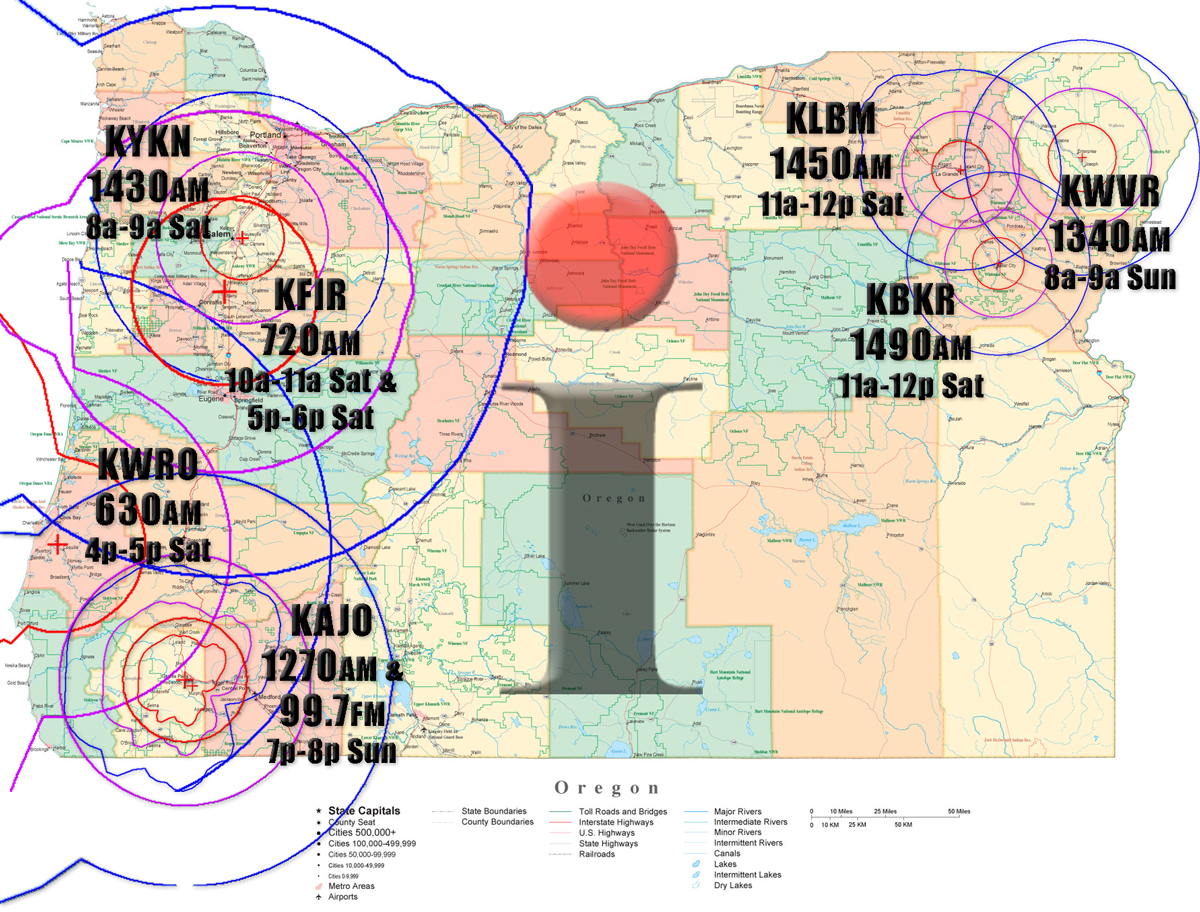
The I Spy Radio Show airs weekends — seven times across seven real radio stations, not internet-only streams. Listen anywhere through the stations’ live streams. See when, where, and how to listen for the full schedule.
Missed it? The podcast posts Mondays, after the broadcast stations air the show — here on this page or on your favorite platform.
I Spy Radio — Keeping an Eye on Big Government
Why Oregon’s Health Care Lost Its Way—and Can It Recover?
Show Summary: It was only six years ago that Oregon had one of the health care systems and markets in the nation. But then Democrats “fixed it” with their zeal for universal health care. A look back—and can it be fixed?
Current I Spy Radio broadcast areas. Click for full-size map.
Five Different Times, on Seven Different Stations. Listen anywhere! All stations stream live!
There’s a scene in Star Trek III when the crew of the Enterprise have stolen the ship and they’re being pursued by the Excelsior, the newest, fastest ship in the Federation fleet. The Enterprise goes to warp and the Excelsior prepares to give chase—only to have the engines grind to a halt and come to a dead stop. Scotty turns to Dr. McCoy, hands him some bolts, and says, “Here, Doctor. From one surgeon to another. The more they overhaul the plumbing, the easier it is to stop up the drain.”
And that’s pretty much what happened to Oregon’s health care.
Oregon’s Health Care: What Happened?
What happened? In a word: Democrats. In their zeal to push Oregon into “universal health care,” also known as “single payer.” Or, more accurately, “socialized medicine.”
A Look Back at Oregon’s Health Care
This week, we’re joined by Lisa Lettenmaier, the owner and operator of Health Source Northwest. Lisa is our go-to expert for health care, especially the “unique aspects” of Oregon’s health care market, given our lurch toward socialized medicine.
It’s open enrollment time. Do you have an insurance plan? The deadline is Dec. 7th for Medicare and Dec. 15th for individuals. See HealthSourceNW.com
Oregon’s Health Care System Transformation
In 2013, then-Oregon-Governor John Kitzhaber, a huge proponent of single-payer/universal health care/socialized medicine introduced a grand plan for Oregon’s health care. It was generally known (in typical socialist lingo) as “Oregon’s health system transformation.”
Kitzhaber convinced Obama to spend billions on this new innovative health care system that was going to transform health care as we know it: improve care and lower costs. You read that correctly. We spent billions to lower costs.
It introduced regional monopolies known as “coordinated care organizations” (CCOs). This, despite studies that repeatedly shown that ACOs (associated care organizations, as they are known in Obamacare) do not save money. And do not improve care.
Oregon’s Coordinated Care Organizations
To set up these monopolies, they introduced legislation to bypass antitrust laws, violating the free market. The Oregon Health Authority (nice name, Nazis!) became the overseer of all things health. And the bureaucracies. Multiple layers of bureaucrats between you and your doctor. All of whom end up on Oregon’s PERS. A global budget that removed the ability to track monies allocated per patient. (Because that wouldn’t ever lead to abuse, grift, and corruption.) And a never-before seen cap on Medicare and Medicaid.
Basically, CCOs violated every free-market principle that would lower costs and improve care.
And, sadly, Oregon Republicans helped pass it. Yes, Republicans. How did this happen?
Useful Idiots: Oregon’s Republicans
Basically, the transformation was sold to gullible Republicans under the guise of “saving money” and “local control.” After the fact, they were “surprised” that this turned out to be a big giant push toward socialized medicine.
In reality, it shouldn’t have surprised any of them. Why? Because on the first page, the first paragraph of the bill it clearly said, “It is the intention of the Legislative Assembly to achieve the goals of universal access.” Yes. Universal health care. Single payer. No private health care. The finest that Venezuela has to offer.
True Stories of Socialized Medicine
Here’s a reminder: no democrat running for president has ever lived under socialism. Not one. That’s right. None of them have ever lived under universal health care. And yet Bernie and Warren and several others are pushing for both socialism and universal health care.
Know what’s funny? Have you noticed that when people in those universal health care systems run into trouble, they go to where there isn’t a universal health care system? Instead, they come here to the U.S. rather than waiting weeks or months for treatment.
Well, not everyone. Just the rich. And the politicians.
When you run into trouble in a universal health care system, you go to where there isn’t a universal health care system
Want some true stories from people who have lived under socialized medicine? See this thread on Twitter from Carlos Osweda.
Podcast Version
Trapped under a heavy object? Missed the show? Don’t worry—the podcast version will be right here after the show airs.
Obscure Model Puts a Price on Good Health—and Drives Down Drug Costs: Concept called QALY places dollar value on the health medicines can restore; ‘starting to influence decision-making’ (Wall Street Journal, Nov 4, 2019)
Don’t want to do abortions, sterilization, or assisted suicide? Tough. Or so says a NY Federal Judge: “Federal judge blocks HHS ‘conscience rule’ for health care workers. Rule was slated to go into effect November 22” (KTVZ, Nov 6, 2019)
To download the show, right-click the mic, and then “Save Link As…” or use the handy player below.
Air Dates: June 20 & 21, 2015 | Grace-Marie Turner
The Supreme Court will decide soon what to do about the Obamacare subsidies, which some say are the backbone to the entire law. What will it mean for the healthcare system if Obamacare is, to use Obama’s words, “fundamentally transformed”? We talk with Grace-Marie Turner of the Galen Institute about what the Court’s potential rulings could mean.
Obamacare advocates like to say we need to keep Obamacare because the Republicans haven’t come up with any plans to replace it. But this is a straw man arguement because a bad “comprehensive” plan is not inherently a better situation than a series of plans. It implies the healthcare system must be run by the federal government without stopping to ask whethere it should be meddling in your health care in the first place.
One aspect of Obamacare that many people haven’t heard of — including Oregonians — are School Based Health Centers. These “health clinics” are not what they seem. Like so much of the tripe pushed by the radical Left, what they claim is different, very different, than what they are. We talk with Nancy Traherne of the Rogue Vally Republican Women, which invited Mark Anderson to speak at their June 24th luncheon. (Note: If your organization would like Mark to come discuss how to fight back against SBHCs, please contact Karla Davenport for booking information.)