In this episode, we dive into the economic divide between “rich states” and “poor states” with Jonathan Williams, Chief Economist at ALEC. As Oregon falls to 40th in national economic outlook, we explore the data behind why tax-heavy, high-spending states are falling behind and the looming 300% natural gas price spike facing Oregonians. We also shift gears to election integrity with Dr. Douglas Frank and Judicial Watch to discuss the recent removal of 800,000 names from Oregon’s voter rolls. From the intent of our Founding Fathers to the transparency of our local ballots, this episode uncovers the numbers and policies shaping Oregon’s future.
Air Dates: May 2nd & 3rd, 2026 | Guests: Jonathan Williams & Dr Douglas Frank
About This Episode
On Show 16-18, is your state building wealth — or quietly destroying it? This week we sit down with Jonathan Williams, President and Chief Economist of ALEC and co-author of the just-released 19th edition of Rich States, Poor States. Nineteen years of data. One consistent lesson: the states that tax less, spend smarter, and keep government accountable consistently outperform the rest — and the gap is widening.
Click for full image
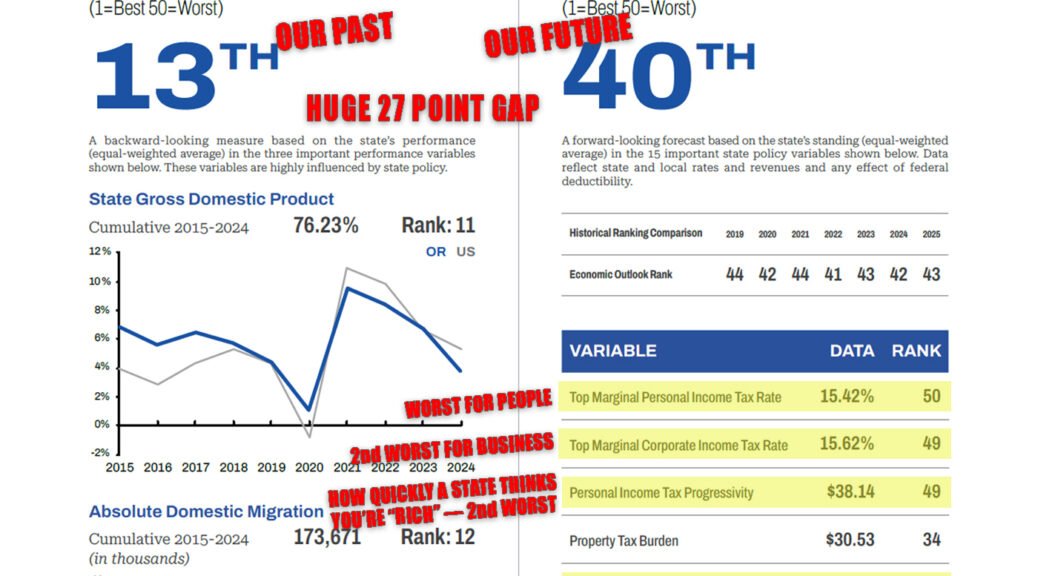
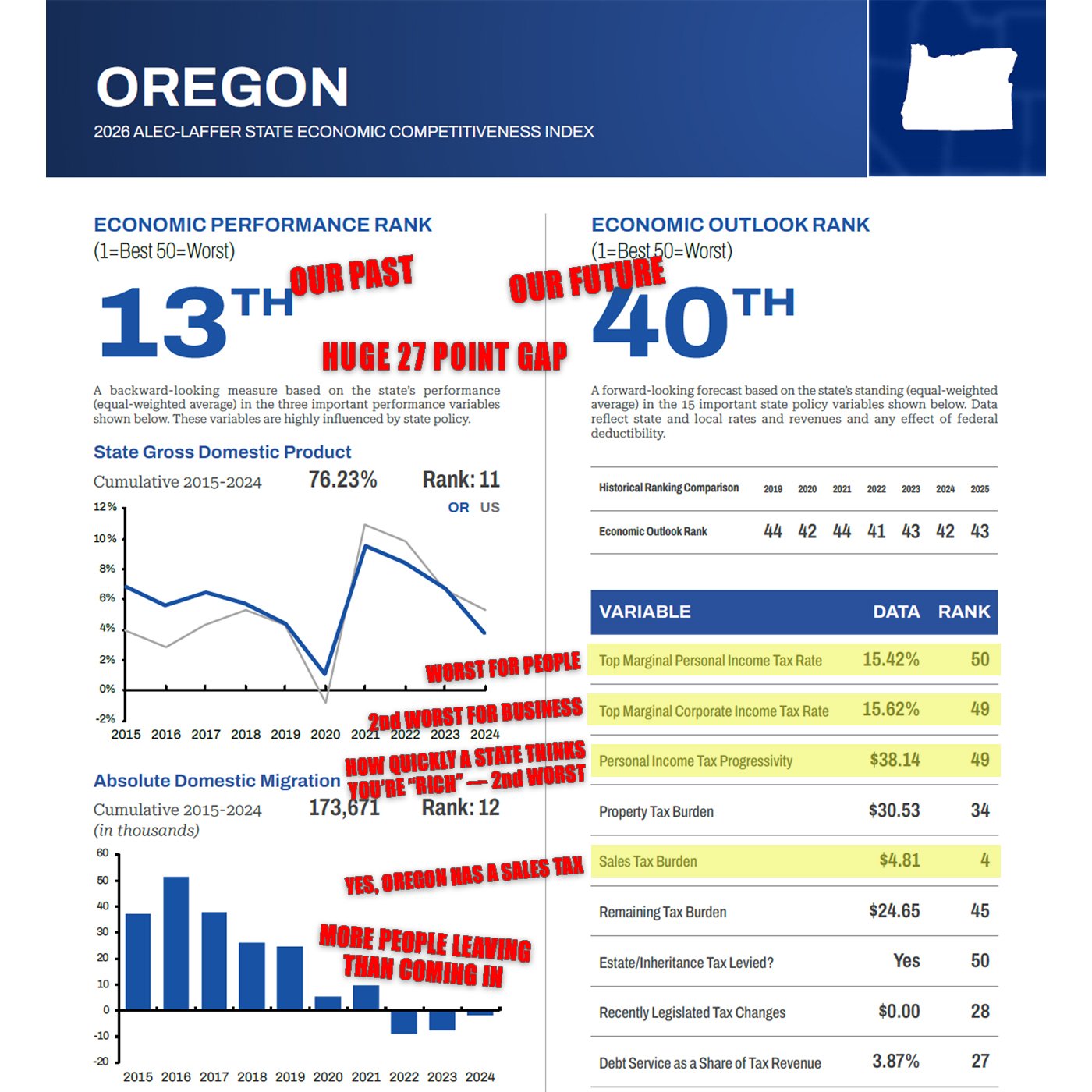
Oregon ranks 40th in Economic Outlook and shows how bleak our economic future is. Jonathan breaks down what that means, why it matters for your wallet right now, and what’s coming. Especially if Phase 2 of Oregon’s Climate Protection Program hits in 2028 — potentially spiking natural gas costs by 300%.
We also dig into what happens when state agencies become too disorganized to audit, what the labor market is actually signaling, and — on the eve of America’s 250th birthday — what the founders actually intended when they designed the relationship between states and the federal government.
This is the economic conversation Oregon needs to hear.
Dr. Frank is visiting every county in Oregon. Coming up May 4th through 6th: Portland, Salem, and Canby. Head to Secure Our Elections Now to find a Dr. Frank event near you.
Also this week, election integrity expert Dr. Douglas Frank joins us on Oregon’s elections integrity — who’s really controlling Oregon’s elections, and what’s the state of our rolls? Plus, Judicial Watch’s landmark settlement forced Oregon to address 800,000 names that shouldn’t have been on voter rolls. A step forward — but is it enough?
Tune in because what Oregonians don’t know about its own numbers is exactly what some are counting on.
Catch Live the Show or Podcast
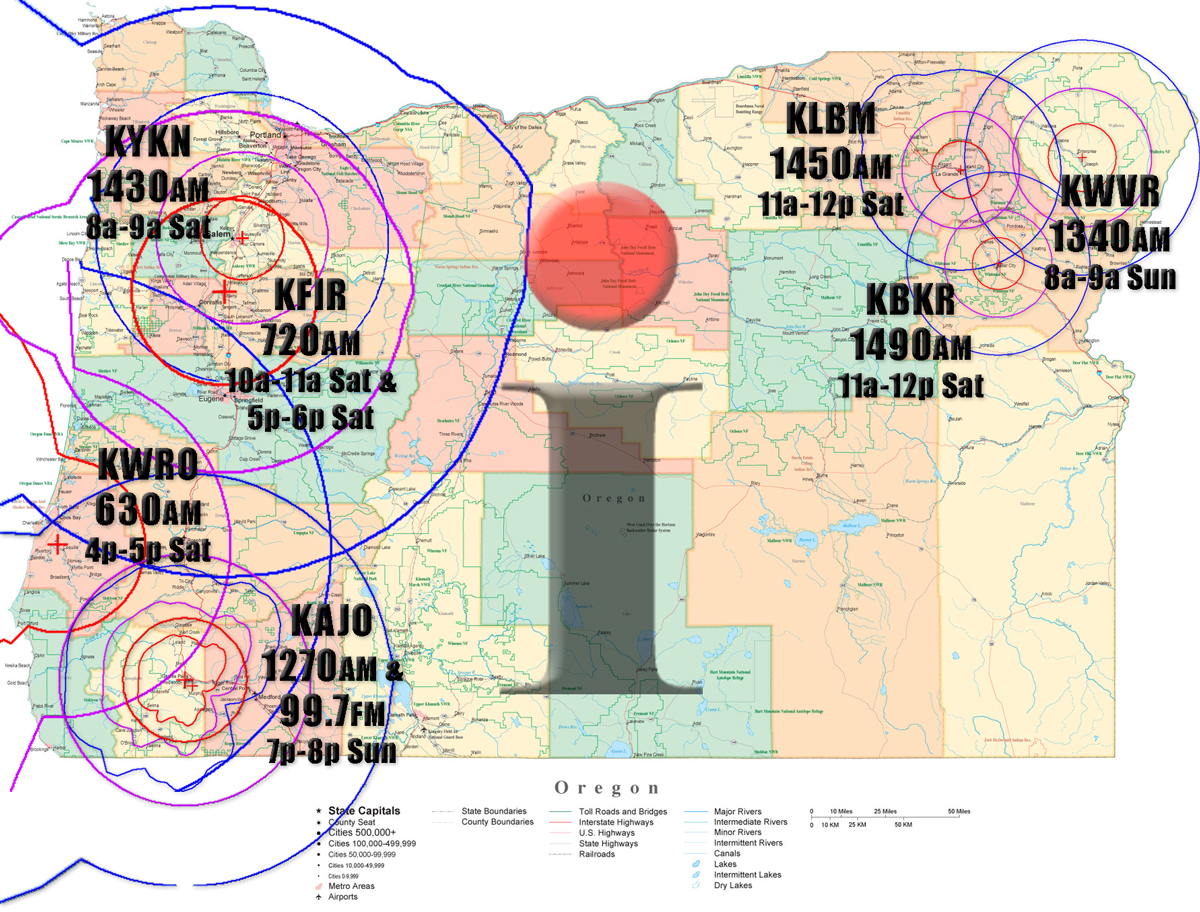
I Spy Radio broadcast areas. Click for full-size.
The I Spy Radio Show airs weekends—seven different times on seven different radio stations. The real ones, not internet-only “radio” stations. Listen anywhere through the stations’ live streams! Check out when, where, and how to listen to see a full list of times and stations.
Trapped under a heavy object? Missed the show? Need to listen again? Wish you could share it? We’ve got you covered. Mondays, after our network of radio stations have aired the show, catch the I Spy Radio podcast version is available on your favorite podcasting platform, or you can grab it right here with the built-in player. See the full list of podcast options.
Show Notes: Research, Links Mentioned & Additional Info
Jonathan Williams is the president and chief economist organization at American Legislative Exchange Council. Find out more at ALEC.org.
Encourage your representatives to join ALEC! There are state and city memberships. Help elected officials understand economic problems and the real solutions available to get out of them. Send them this link: https://alec.org/membership/.
Show 15-28 Summary: Not to sound too much like Nancy Pelosi but now that the One Big Beautiful Bill passed, we know what’s in it. It was making a lot of people lose their minds perhaps because they didn’t understand the bill and what could or could not be in it. It’s clear they didn’t read it and listened to the wrong analysts. Which is why it will make people like Elon Musk and his very public temper tantrum look very foolish.
Current I Spy Radio broadcast areas. Click for full-size map.
The I Spy Radio Show airs weekends, seven times over the weekend, on seven different stations. Listen anywhere through the stations’ live streams! Check out when, where, and how to listen to the I Spy Radio Show. Podcast available Mondays after the show airs on our network of stations.
Air Dates: July 12th & 13th, 2025 | Guest: Jonathan Williams
This Week – The Big Beautiful Bill Passed — Now What?
Nancy Pelosi famously said about Obamacare that “We have to pass it to find out what’s in it.” And now that we have the final version of the Big Beautiful Bill, we do know what’s in it.
But leading up to its final passage, it made a lot of people lose their minds. Legislators should know better but a lot of grassroots did not understand what a reconciliation bill was and how limited they are — just to budget items that affect federal spending or revenue. Which is why it could never be “the one bill” to accomplish everything America First that everyone wanted. So why didn’t the people who ought to have known better say that? Rather than try to sabotage it?
Perhaps they had their own agenda. And, as typical, they wanted something other than what they were saying.
Elon Musk — The Spoiled Kid in the Grocery Store
click for full size
By definition, a reconciliation is limited. Not only in terms of what can or can’t be in it but also what budgetary items it can cut. It doesn’t take much to understand that. So someone as smart as Elon had to know that. Which implies then that he wanted something else. And his public shrieking tantrum was calculated. He had to know they couldn’t make the massive cuts he said he wanted. So it’s clear he either didn’t read the bill or listened to the wrong analysts. Or made the calculated move to get attention, blame people, and offer the solution. A third party with the goal to selectively to pick off vulnerable Republicans to be the key swing votes in Congress.
But Elon Musk’s temper tantrum gambit will look pretty foolish when the Big Beautiful Bill succeeds. He’ll not only look like the spoiler but what he is. Spoiled.
How do we know? Hint: everyone was predicting the end of the economic world after Trump’s reciprocal tariffs. Now they’re admitting they were wrong.
The Big Beautiful Bill Reality
Now that the bill was passed and signed, the fury has died down—mostly—we welcome back Jonathan Williams, the president and chief economist at the American Legislative Exchange Council (ALEC) to get some truth and reality about what was in it. No. It wasn’t perfect. Yes we would have liked more spending cuts.
But while the shrieking and tantruming was happening the detractors missed a key part of the bill. It codified 28 of Trump’s exectutive orders. They’re no longer executive orders, easily undone by the next president with a pen. Now they are law. And, even better, for those demanding more cuts, once the bill was passed and signed, President Trump used his executive power to rescind (cut) spending on key points. Like stopping the green energy credits and Global Warming spending.
But. And here’s the biggest and most overlooked aspect of the Big Beautiful Bill. It doesn’t end here. It’s the beginning.
Did you feel the political ground under you shift? Because unlike so many other big gigantic bills, this was about cutting spending, cutting taxes, and cutting the size and scope of government. And some actual entitlement reforms. When is the last time that happened? Maybe in the 1990s with Newt Gingrich?
And this isn’t some deep red state doing it. This is Washington DC. And it’s just the beginning. There are already plans in the works for two more bills like it to make further cuts and to push more of the America First agenda.
And that’s why, with the Trump Train rolling, people like Elon Musk standing on the platform shrieking about what is not on the train will look pretty foolish as the train pulls away without them.
Rich States, Poor States. Poor Oregon.
We also talk with Jonathan about Oregon’s latest ranking in the 18th edition of Rich States, Poor States. Jonathan is one of its co-authors. For anyone who lives in Oregon, it will come as no surprise that we dropped one point from last year.
But Oregon made some recent economic bungles that have come to light? How bad would it have been for Oregon’s ranking if these had come to light before the latest edition had been released?
Related: Show 15-23 with Jennifer Hamaker – Oregon’s Climate Protection Plan’s planned devastation to Oregon’s economy — conveniently phased in after the 2026 election Show 15-25 with Ed Diehl Oregon’s HB2025, the ODOT tax bill, which would have been the biggest tax increase in Oregon’s history
The I Spy Radio Show Podcast Version
Trapped under a heavy object? Missed the show? Don’t worry—catch the podcast version. Mondays, after our network of radio stations have aired the show, I Spy Radio is now available on your favorite podcasting platform, or you can grab it right here. See the full list of podcast options.
Show Notes: Research, Links Mentioned & Additional Info
Jonathan is the president and chief economist organization at American Legislative Exchange Council. Find out more at ALEC.org.
Encourage your representatives to join ALEC! There are state and city memberships. Help elected officials understand economic problems and the real solutions available to get out of them. Send them this link: https://alec.org/membership/.
See the list: Trump’s Big Beautiful Bill codifies 28 executive orders and actions
Steve Moore: Trump just scored the biggest conservative victory in three decades (Fox News, July 10, 2025)
“What isn’t well known is that this new law doesn’t just change tax policy. It includes dozens of other long-sought policy goals – what I call ‘hidden gems’.”
Conservatives say Trump won their megabill votes by promising crackdown on renewable energy credits (Politico, July 3, 2025)
“Hard-line House conservatives said President Donald Trump assured them his administration would take action to constrict wind or solar projects that qualify for Inflation Reduction Act tax credits — a pledge that ultimately persuaded them to back the party’s megabill.” → A promise kept with Trump’s rescission package.
Johnson says megabill will be ‘jet fuel’ for economy; teases 2 future bills within next year (Fox News, July 6, 2025)
Johnson said the BBB is just the first step in a three-tier strategy. Johnson expects a second reconciliation bill by fall and a third by spring before the end of the current Congress. “You’ll see more of us advancing these common-sense principles to deliver that American First agenda”
Trump says U.S. struck trade deal with Vietnam that imposes 20% tariff on its imports (CNBC, July 2, 2025)
U.S. Supreme Court Greenlights Trump’s Federal Government Purge (GWP, July 8, 2025)
In an 8 to 1 ruling the U.S. Supreme Court has overturned Clinton-appointed judge’s ruling that temporarily stopped Trump to do mass layoffs. Now his administration can immediately move forward
Sorry Democrats. The BBB Does NOT End Social Security
Within Intel’s manufacturing division, known as Intel Foundry, the company plans to eliminate up to 20 percent of technician, engineer, and researcher positions in its Oregon facilities.
Show 14-28 Summary: We’re talking economics and the rather grim picture being painted by the data—if someone actually bothers to look. You know. Like what the media used to do. Hold truth to power. While America’s economy is suffering through economic dementia under Joe Biden, there is not a lot of good news. Not even in supposedly “good” job reports — because they keep revising things down when they think no one is looking. But there are some bright spots ahead. If, and only if, we change who is in charge of our economy. So when will the media stop covering up Joe’s economic dementia?
Current I Spy Radio broadcast areas. Click for full-size map.
The I Spy Radio Show airs weekends, six different times, on seven different stations. Listen anywhere through the stations’ live streams! Check out when, where, and how to listen to the I Spy Radio Show. Podcast available Mondays after the show airs on out network of stations.
Original Air Dates: July 13th & 14th, 2024 | Guest: Jonathan Williams
This Week – Bidenomics: Economic Dementia
Despite the left stream media’s best cheerleading efforts, actual data about the economy is getting out. And it’s not good. Spikes in business bankruptcies. Especially small business bankruptcies. Even personal bankruptcies.
With all the business bankruptcies, and others reporting on the verge of bankruptcy, it’s no wonder that there is also a spike in store closings. If they continue at this rate,
In an America suffering from economic dementia, we need some common sense. Which is why we turn to Jonathan Williams, the Executive Vice President of Policy and the Chief Economist for ALEC. The American Legislative Exchange Council.
Economic Dementia: Did you know?
Under Bidenomics, 27% of Americans say they skip meals due to rising food costs.And 39% skip meals to make house or rent payments
It seems there is no end of bad economic indicators. (Just take a gander at the show notes below.) A spike in bankruptcies. Cruelly keeping interest rates high Thousands and thousands of store closures. Including discount stores. (How bad is Bidenomics when people can’t even afford to shop at discount stores?) And regulations weighing down businesses. And in the middle of all that Joe Biden and the democrats want to raise taxes? That’s not just economic dementia. That’s economic suicide.
The only way out is to change the people in charge. Because if the definition of insanity is doing the same thing and expecting different results, then electing the same politicians is political insanity.
Be on the lookout. Joe Biden’s economy has been terrible ever since he’s been in office. But the media has been providing propaganda cheerleading to convince you otherwise. Bt when the left-stream media stops covering for Joe’s economic dementia? That’s when you’ll know the knives are out.
Because no one wins an election when the economy is in the toilet.
The I Spy Radio Show Podcast Version
Trapped under a heavy object? Missed the show? Don’t worry—catch the podcast version. Mondays, after our network of radio stations have aired the show, I Spy Radio is now available on your favorite podcasting platform, or you can grab it right here. See the full list of podcast options.
Show Notes: Research, Links Mentioned & Additional Info
Jonathan Williams and ALEC Links
Jonathan’s organization is ALEC – the American Legislative Exchange Council. Find out more at ALEC.org.
Encourage your representatives to join ALEC! There are state and city memberships. Help elected officials understand economic problems and the real solutions available to get out of them! Send them this link: https://alec.org/membership/.
And you too can join as a private-sector member!
You can follow Jonathan on Twitter at @TaxEconomist.
Jonathan’s op-ed in The Daily Caller: “Biden’s Pledge To Let Trump’s Tax Cuts Die Has Stirred Up A Hornet’s Nest” (Daily Caller, June 10, 2024)
Those blue states that have seen the light: Hawaii and Connecticut: “‘Blue’ States Make Fiscal Progress: Jonathan Williams on American Radio Journal” (via ALEC, June 27, 2024)
Economic Dementia Links & Info
Department of Interior shuts down millions of acres of Alaska to all oil, gas and mining activity (Just the News, July 8, 2024)
Biden’s Department of Interior blocked 28 million acres of federal land in Alaska from any oil or gas development or mining
Biden’s Interior also blocked a 200-mile gravel road that would have connected mining districts in West Central Alaska to a highway that runs through the middle of the state.
“While we do not forecast a recession in 2024, we do expect consumer spending growth to cool further and for overall GDP growth to slow to under 1% over the Q2 to Q3 2024 period. Thereafter, inflation should gradually normalize to the Fed’s 2-percent target in 2025 as quarterly annualized GDP growth rises toward its potential of near 2%.
So 2% GDP through the end of the year and into 2025. Yikes!
Free Money! (Just tax corporations!) Oregon Rebate – the Oregon basic income scam to give everyone $750. (Hint: it’s not a “rebate” if you didn’t earn it or buy it.)
14-18 Troubling Signs about Bidenomics | Learn to Think Like an Economist
Show 14-18 Summary: Does anyone remember when the media objectively covered economics. After all, so much of it revolves around data. And yet the mainstream media does everything it can to attack good economies, like we had under Trump, while providing cover for lame economies, driven primarily by government and government spending, like what we have under Joe Biden. So how do you know what to trust and whom to trust? On this week’s show we talk to an economist to help you think like an economist.
Current I Spy Radio broadcast areas. Click for full-size map.
The I Spy Radio Show airs weekends, six different times, on seven different stations. Listen anywhere through the stations’ live streams! Check out when, where, and how to listen to the I Spy Radio Show. Podcast available Mondays after the show airs on out network of stations.
Original Air Dates: May 4th & 5th, 2024 | Guest: Jonathan Williams
This Week – Despite the mainstream media doing their best to run cover for Biden and his economic policies, there are some troubling signs about Bidenomics. And some of it really troubling. Which is why you’re not hearing those kinds of stories in the mainstream media.
When it comes to the economy, White House Press Secretary Karine Jean-Pierre is Biden’s DEI hiring-equivalent of “Baghdad Bob.”
GDP for the first quarter was half of normal growth and less than half of the previous quarter. Unemployment for April rose with one of the indicators the worst it’s been since November 2021. And yet all we ever hear out of the White House is how great things are. Including a rather startling comment from KJP. According to her, prices are too low. That woman is Biden’s DEI hiring equivalent of “Baghdad Bob.”
But because economic reporting has become so politicized how can an everyday person tell whether or not the economy is doing well — aside from their own subjective experiences? Because their experiences may not be what everyone else is going through.
Think Like an Economist
So this week we talk to an economist—Jonathan Williams, Executive Vice President of the American Legislative Exchange Council, and their chief economist—to help people learn to think a little more like an economist.
What are some of the trigger points to look for? What are some of the more reliable measurements that indicate a good or a bad economy? And what economic levers can they pull to turn an economy around or to keep a good economy going?
And all of that to help people pick the right people to put them in charge to get the economy on the right track
The I Spy Radio Show Podcast Version
Trapped under a heavy object? Missed the show? Don’t worry—catch the podcast version. Mondays, after our network of radio stations have aired the show, I Spy Radio is now available on your favorite podcasting platform, or you can grab it right here. See the full list of podcast options.
Research, Links Mentioned & Additional Info
Jonathan’s organization is ALEC – the American Legislative Exchange Council. Find out more at ALEC.org.
Encourage your representatives to join ALEC! There are state and city memberships. Help elected officials understand economic problems and the real solutions available to get out of them! Send them this link: https://alec.org/membership/.
And you too can join as a private-sector member!
You can follow Jonathan on Twitter at @TaxEconomist.
The Daily Signal reported that under new federal guidelines — released on Monday by the Equal Employment Opportunity Commission — an employer would be guilty of harassment by requiring someone to use a restroom that corresponds with their biological sex or if someone “misgenders” them.
Show 14-06 Summary: This week, it’s all about cutting through the mainstream media propaganda about the economy. Especially the lies about Bidenomics. Because it’s more Bidumbnomics than anything. Bidumbnomics is a good way to kill the economy, interfere with markets, and promote products and ideas that don’t work and cost more. Bidumbnomics are dumb economics policies that require dumb people in the media to not ask questions and keep people misinformed about how bad things really are. Like not questioning the miracle January 2024 jobs report. Or looking at the failure of 100s of billions wasted on “green energy.” (It’s not green.) Plus, Oregon is not immune. Oregon democrats also love Bidumbnomics. Spend more. Tax more. Ignore reality. Like Oregon democrats’ plan to raise statewide property taxes and do away with the current caps on property tax increases.
Current I Spy Radio broadcast areas. Click for full-size map.
The I Spy Radio Show airs weekends, six different times, on seven different stations. Listen anywhere through the stations’ live streams! Check out when, where, and how to listen to the I Spy Radio Show. Podcast available Mondays after the show airs on out network of stations.
Original Air Dates: February 10th & 11th, 2024 | Guest: Jonathan Williams
This Week – Bidenomics is Bidumbnomics
All you need for dumb economics policies like Bidumbnomics to be perceived as “working” is to have a willing media to spread government propaganda. And the media needs to be dumb enough about economics to not ask any questions about what they’re told. And certainly not do any kind of even simple analysis.
That way, the media keeps people uninformed. Because if people really knew how bad things were, they would be demanding answers. And politicians never want that. They want compliant sheep people who stay out of the way. Miserable peasants.
Public outcry works! (click image for full-size)
Why? Because when people do know what their politicians are actually doing, and the actual outcomes of their schemes, people tend to revolt. And, yes, public outcry really does work.
Take a look at the win in the EU when farmers had had enough. The public joined them. And now the EU gave in to their demands.
Look no further than the boondoggle of Biden’s dream of a wind farm in every pot. Bidumbnomics sank several 10s of billions of your money into expensive wind farms. Especially very expensive offshore wind farms. But these expensive Bidumbnomics boondoggles have done so poorly, despite all that free cash from U.S. taxpayers, that multiple wind farm companies have cancelled contracts. And they were willing to do so because the economics of it was so poor that unless they get free cash it was a better deal to cancel the deal.
Think of that. Companies willing to take a loss of 100s of millions rather than go through with it and lose even more. And in the case of one company, they took a 4 billion loss.
Now that is Bidumbnomicsat work. Waste companies’ money, waste taxpayer money, and all for products that are less effective and more expensive to ratepayers.
Wow.
An Actual Economist Breaks Examines Bidumbnomics
We welcome back Jonathan Williams, the executive vice president of ALEC — the American Legislative Exchange Council. Jonathan is also their chief economist. And we walk through the truth about that blockbuster January jobs report. It turns out, it is more fantasy than fantastic. See this great analysis from ZeroHedge: “Inside The Most Ridiculous Jobs Report In Recent History“.) And we all know this fantasy will be corrected downward in a month or two after they got their useful idiots in the media to repeat their headline to the point where most people will think Bidenomics is working.
But to be fair, not all economic news in the mainstream media is propaganda to prop up Bidumbnomics. Sometimes, it’s more of a confession. Like Jerome Powell appearing on 60 Minutes. Who told America that we just can’t spending like we are.
But other times, it is definitely propaganda. We take a look at the slumping EV (electric vehicle) sales. After spending, yet again, 100s of billions of taxpayer dollars on the EV boondoggle, including mandating sales quotas, Bidumbnomics strikes again. EVs sales are way down.
And even in Oregon, they are nowhere near their lofty goals of 250,000 EVs by 2025.
Oregon Democrats Embrace Bidumbnomics
Speaking of Oregon, the democrat governor and democrat-controlled house and senate want their own version of dumb economics. Like ignoring people’s economic reality to impose their ideology. And mainly, that’s more spending of taxpayer dollars to reward the political allies. There is never enough money to spend all they want on everything they want.
The answer? Raise taxes. And not just a little. They want $3 billion in more taxes. And, as if they haven’t driven enough people away, they want to eliminate and caps on statewide property taxes.
The only reason why even more Oregonians haven’t driven away is their EV must have run out of charge. Maybe that’s why Oregon wants to mandate even more of them.
But wait, it gets worse. Not only do Oregon elected democrats want to spend more, Tobias Read, the democrat in charge of Oregon’s Treasury wants Oregon’s PERS to make less money. By forcing Oregon’s investment into “Net Zero.” Uh, Toby, in case you missed it due to Bidumbnomics government propaganda media, but Net Zero funds are losing money by the day. Intelligent investors are getting out of Net Zero funds, not in. Perhaps Oregon’s PERS being in the hole by a mere $28 billion just isn’t enough?
Tune in to get the info you need. to be better informed on economics and real economic policies. So when your legislator wants to go full Bidumbnomics, you have the info you need to convince them otherwise.
The I Spy Radio Show Podcast Version
Trapped under a heavy object? Missed the show? Don’t worry—catch the podcast version. I Spy Radio is now available on your favorite platform, or you can grab it right here. See the full list of podcast options.
Research, Links Mentioned & Additional Info
Jonathan’s organization is ALEC – the American Legislative Exchange Council. Find out more at ALEC.org.
Encourage your representatives to join ALEC! There are state and city memberships. Help elected officials understand economic problems and the real solutions available to get out of them! Send them this link: https://alec.org/membership/.
And you too can join as a private-sector member!
You can follow Jonathan on Twitter at @TaxEconomist.
“In 2019, Senate Bill 1044 set a target of 250,000 registered Zero Emission Vehicles on Oregon roads by 2025. … [But] the number of Oregon-registered zero emission vehicles on Oregon roads as of September 2023 (with less than a year and a half to go) was just 70,000. … The likelihood that this number will grow to 250,000 over the next 12 months is nil.”
Plan to make Oregon retirement fund carbon neutral relies on industry, Wall Street doing the same (OPB, Feb 7, 2024)
Show Summary: It’s true economics isn’t the most exciting topic in the world — that is, until everything starts blowing up. Then you’ll wish you’d paid attention.
Current I Spy Radio broadcast areas. Click for full-size map.
Five Different Times, on Seven Different Stations. Listen anywhere! All stations stream live!
Mondays
After the show airs on our network of radio stations, you can listen to our podcast either here on our site or your favorite podcast platform. We are now on Apple podcasts, Spotify, Stitcher, TuneIn, and more. See the full podcast list.
This Week: Economics isn’t always exciting — unless things are blowing up. Or it’s a horse race.
We welcome back Jonathan Williams, Chief Economist and Executive Vice President of Policy of the American Legislative Exchange Council. ALEC has just released their 2021 Rich States, Poor States guide for 2021, an annual guide to the 50 states’ economic outlook. Talk about good, bad, and ugly. Look no further than how the states are competing with one another.
The Overall U.S. Economy & Economics
Before we narrow down to the states, we first look at the overall economy. This is a bit of a continuation of the last time Jonathan was on, when we talked about the democrats’ shift to what we call “non-reality economics.” The democrats’ plans are an explosion of taxes and spending sprees (what did we just say about exploding economics…?).
That discussion, was about the radical shift we’re seeing the democrats trying desperately to push on the U.S. Which, sadly, takes a hard left turn away from what has made America successful. It’s a fantasy land where debt has no meaning, money is infinite, and all we need to do is print money and borrow until every there’s a unicorn in every garage and a leprechaun in every pot.
But the problem democrats always run into is simple one. Reality. And there’s proof, thanks to the 50 test tubes of democracy that make up America.
Good Economies: How NOT to do it
Sometimes, to know what to do, it helps to know what not to do. And look no further than New York State, which had the worst response to covid and lost a congressional seat due to people fleeing the Empire State. And now new York will punish the people and businesses that for some reason haven’t left. Yet.
We talk with Jonathan about his terrific article in the National Review, “The Fallout from ‘Progressive’ Budgets in New York.” There has been a massive shift in who pays for things. Now, instead of New York being in debt to cover its debt, everyone else gets to go in debt to cover New York’s debts.
And that’s the direction we as a nation are headed. Where there is a fundamental shift in who pays for things: everyone is paying for everyone else. That’s socialism. Marxist ideology pushed onto America.
Socialism only survives as long as it is able to feed off the success of capitalism
– Mark Anderson
Rich States, Poor States
Why and how economies and economic policies work is sometimes beyond people’s wheelhouse. But everyone understands competition, right? Who’s best. Who’s worst. And who’s on the way up and who’s on the way down.
Courtesy Rich States, Poor States, 2021 Edition. (Click image for full size.)
That’s where Rich States, Poor States comes in. (You can download your own copy right here.) RSPS is a look back at the states’ economic performances over the last 10 years—of available data. This year, its’ a look at 2009–2019.
The backward-looking economic performance ranking examines how well states did. Oregon, from 2009–2019, really didn’t do too bad. This ranking looks at three variables: a state’s gross domestic product, their absolute domestic migration, and non-farm payroll.
Take a look at Oregon’s charts. And look at how well they’re correlated. As the state did better and better, culminating in 2015, people moved in (especially in 2016). Payrolls went up. And then, as Oregon’s GDP declined, there went the people. And payrolls dropped.
See? Economics isn’t too hard.
Oregon’s Economic Outlook
When it comes to Oregon’s economic outlook ranking, every year we’re like “please don’t embarrass us, please don’t embarrass us…” And then there we are. Near the bottom. Again. But it’s even worse this year.
You’ll have to tune in to hear just how bad. (Or, you could cheat and go right to Rich States Poor States to find out.) But here’s a hint. We beat even our idiot neighbor to the south in some categories. In fact, in the worst possible category. And we’re worse than New York State in some categories. You know, the one state we just mentioned. How not to run an economy.
Although at least the beat us to the bottom for the worst outlook. Hey. You gotta look for the positive right?
The I Spy Radio Show Podcast Version
Trapped under a heavy object? Missed the show? Don’t worry—catch the podcast version. I Spy Radio is now available on your favorite platform, or you can grab it right here. See the full list of podcast options.
Links Mentioned
Jonathan’s organization is American Legislative Exchange Council, or ALEC. Be sure to check their new and improved website which now features terrific, insightful articles and videos: www.alec.org
Rich States Poor States. You can download the latest (2021) edition, or explore previous ones.
“New Census Report: Americans Continue to Vote with Their Feet in Favor of Economic Opportunity” (ALEC, Apr 26, 2021)
Inflation is happening, despite what lies the Biden administration is spewing. See the Consumer Price Index charts.
Did You Know…?
The Fed has been pumping (printing) money into the economy. But something new happened in 2020. Now, they are buying corporate bonds. This is a direct investment into select corporations. Here’s a hint. It’s not mom-and-pop shops. It’s gigantic companies that don’t need the money, but the Fed is rewarding them anyway.
The Fed says it is going to start buying individual corporate bonds (CNBC, June 15, 2020)
Why is the Fed buying up mortgages? At $40 billion per month. Is this why the housing market keeps exploding? “Understanding the Federal Reserve Balance Sheet” (Investopedia, Mar 19, 2021)
Related Links
The Fed Should Get Out of the Mortgage Market: Even central bankers are starting to wonder why they’re adding $40 billion of housing debt every month. (Bloomberg Opinion, May 11, 2021)
“Why exactly is the Fed still increasing its holdings of mortgage-backed securities by $40 billion a month when Chair Jerome Powell himself has said that “the housing sector has more than fully recovered from the downturn”?* “The Fed has gobbled up almost $2 trillion of MBS since March 2020, which is more than its total aggregate purchases in any of its previous quantitative easing episodes.”
At an average home mortgage price of $250,000, the fed backs the mortgage on some 8 million homes. Yikes!
What Is An Agency MBS And How Does The Federal Reserve’s Purchase Of MBS Affect Mortgage Rates? (Quicken Loans, Feb 19, 2021)
“A mortgage-backed security (MBS) is a pool of home loans, often packaged by Fannie Mae, Freddie Mac or Ginnie Mae, sold on the open bond market to investors. The investors who buy the securities then receive the payback on a monthly basis when homeowners make their principal and interest payments.”
Difference Between Agency and Non-Agency Mortgage-Backed Securities (The Balance, Jul 15 2020) – “Agency” simply means an dept of the federal govt, or MBS that become backed by the full faith and credit of the U.S.
To download the show, right-click the mic, then “Save Link As…” or use our handy player below
Show Summary:Do you have an unlimited amount of money? Or time? If not, then welcome to the world of economics—where math meets reality. Or, if you’re you’re talking about Oregon Democrats in charge of Oregon’s economic outlook, where math meets imaginary.
Original Air Dates: June 8 & 9, 2019 | Guest(s): Jonathan Williams
When it comes to economic outlook, there’s no better organization to turn to than ALEC — American Legislative Exchange Council, the nation’s premiere economic forecaster for the 50 states. And when it comes to Oregon’s economic outlook, they know what can make Oregon successful.
If only Oregon Democrats did.
Oregon’s Economic Outlook
Those two kids in the front look like they’re running the numbers on how much all this is gonna cost their generation…
We’ve said often that Oregon is the Petri dish for all things Left, except the Petri dish is no longer needed to prove what works or doesn’t work in economics. States across the U.S. are demonstrating how increased taxes are not the way to economic recovery. And even though the proof is in the pudding our Democrat legislators refuse to take heed.
Now ranked a very dismal 44th in ALEC’s survey of economic outlook among the states, Oregon may soon find their economic coffers emptying as businesses leave to move to much more friendly taxed states. It’s already happening. Stimson Lumber announced this last week that they were packing up, closing their operations in Forest Grove, and heading out of state.
Oddly, with all its spending, Oregon may soon be one of the biggest cheerleaders of the Trump economy. Because what do you think will happen if suddenly the economy retreats when Oregon just decided to raise billions in new taxes?
Jonathan Williams from ALEC
To bring clarity to the problems of high taxed states we bring on Jonathan Williams, co-author of Rich States Poor States to give us the good and bad news of how states are dealing with Trump’s booming economy. He discusses Oregon’s problems and why it was ranked so low—and that was before the new multi-billion-dollar business tax was passed.
We also get to look at what states like Idaho, Texas, Tennessee and others are doing not only enjoying Trump’s tax cuts but jumping on and cutting their own state taxes that highly benefits their citizens. (Like and support your people? What a concept!)
Listen to find out how Oregon is starting down the path of socialism by the D’s desire for centralized planning. Hear what one Democrat Senator had to say while standing on the senate floor about businesses that could no longer afford to stay in Oregon. And listen to hear how Democrats are using the tax codes to only allow the “right” kind of business to operate in Oregon. Is this a new trend in national politics?
If nothing else, Oregon Democrats are proving the importance of borders. If the D’s get too destructive you can vote with your feet.
Podcast Version
Never Miss an I Spy Radio Show!
I Spy Radio Show broadcast areas, as of Nov 2018. Click for full-size map.
Five different times, on seven different stations. Listen anywhere! All stations stream live!