16-37 This Is Fine — Oregon’s Record Wildfires and the Race for a Veto-Proof Supermajority
Angela Plowhead is running to flip one of the most competitive seats in the state — and Democrats are pouring national money into keeping it. If what you hear today concerns you, get involved: donate, volunteer, or just spread the word.
Support Angela Plowhead at Angela4Oregon.com →
And she’s not the only race that matters this November — find other Oregon candidates worth your support and get behind them too.
About this episode
Oregon just burned an area bigger than its entire wilderness system — and in Salem, Democrats are two seats away from a legislative majority so large that no walkout and no governor’s veto could stop them. This week, two conversations about a state running out of checks.
First, Dr. Angela Plowhead — Air Force veteran, clinical psychologist, and Republican candidate for Oregon Senate District 10 — returns to the show to take on incumbent Senator Deb Patterson. Angela and Mark dig into the gas tax Oregonians rejected 83–17 percent at the ballot box, the Climate Protection Program’s spiraling cost to Oregon families and businesses, and the government-run universal health care plan Patterson’s own committee is shepherding toward the Legislature. Then the conversation turns to something bigger: why national Democrats have singled out Patterson’s seat as their only incumbent target race in Oregon — and why the two additional seats they’re chasing would hand Democrats a two-thirds supermajority in the Senate, enough to end Republican walkouts for good and override any governor’s veto, Republican or not.
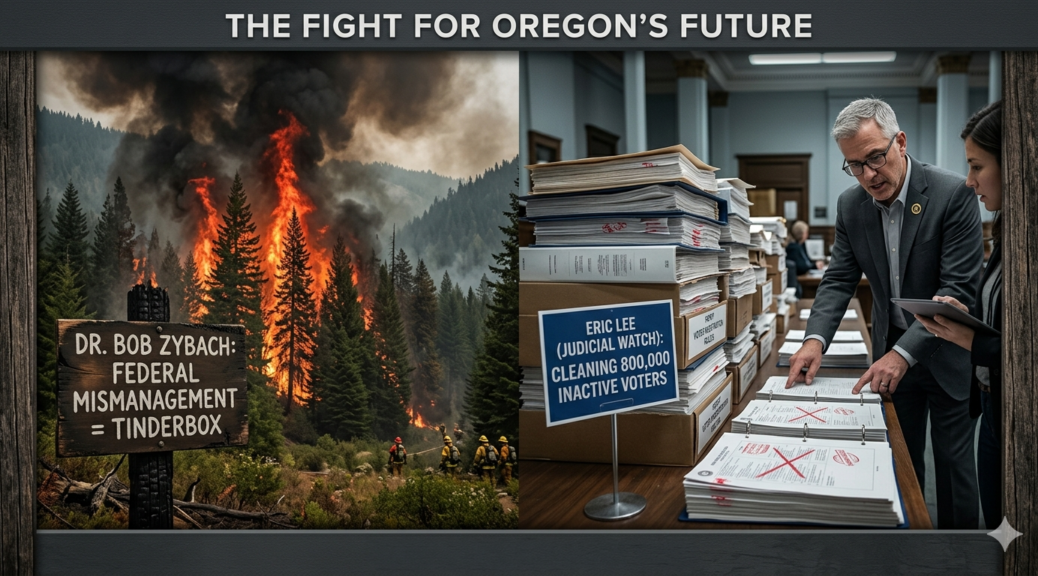
Then, Derrick Holdstock, owner of Western Fire Resources and a 25-year veteran of wildland firefighting, joins Mark to talk about Oregon’s all-time record 2026 fire season — over 2.5 million acres burned, nearly a third of the entire nation’s total. Derrick takes listeners inside an active fire line, then breaks down what actually went wrong: a dispatch system that keeps closer private fire engines waiting behind public agencies, a profit motive that pulls public fire departments away from their own jurisdictions, the pending federal rollback of the roadless rule, and decades of fuels mitigation that simply never got done. He closes with a concrete, low-cost fix — and a hard question about whether Oregon can ever get back to the fire-quiet decades a previous guest says were no accident.
In this episode
“This Is Fine” — Angela Plowhead Returns
Mark’s opener on Oregon Democrats and complacent Republicans, then Dr. Angela Plowhead on why she’s challenging Deb Patterson, Oregon’s crushing tax burden on small business, and the DSA candidates now running in Oregon — plus the reveal that Patterson is the only incumbent Senate Democrat national Democrats have targeted.
The Gas Tax, and a Climate Program Nobody Voted For
Why 95% public opposition didn’t stop the gas tax — and why Democrats moved Measure 120 off the November ballot. Then the real cost of the Climate Protection Program: $4.9 billion for natural gas alone, a floor of $20 billion across the full fuel sector, and Oregon’s forest fires alone blowing past the entire statewide emissions cap.
Universal Health Care — and the Veto-Proof Endgame
An $85–94 billion-a-year health plan that could more than double Oregon’s budget, and Sen. Patterson’s role steering it. Then the segment’s biggest reveal: why two more Senate seats mean Republicans lose their only remaining check — the walkout — and why a Republican governor’s veto stops mattering at a two-thirds supermajority.
2.5 Million Acres — Meet Derrick Holdstock
Oregon’s wildfire season shattered 2024’s record by 400,000 acres — nearly a third of the entire nation’s 2026 burn. Wildfire contractor Derrick Holdstock joins to talk about Western Fire Resources, what it’s actually like inside an active fire line, and why Oregon dispatches engines from as far away as Texas.
The Dispatch System’s Dirty Secret
Why a wet winter with no snowpack made 2026 worse, not better. Then Derrick lays out the fuels-mitigation gap, how Oregon’s mutual-aid system locks out the closest private engines, and the profit motive that pulls public fire departments away from their own home jurisdictions.
Roads, Climate, and the Fix
The roadless rule’s real effect on fighting fire, the spotted owl’s collapse despite decades of hands-off management, and the CO2 math nobody wants to discuss. Derrick closes with a concrete, low-cost fuels-mitigation plan — and the question of whether Oregon can ever get back to the 35 fire-quiet years a previous guest documented.
Links & resources mentioned
Angela Plowhead for Oregon Senate District 10
- Angela4Oregon.com (donate, volunteer, sign up for updates)
The Push for a Veto-Proof Supermajority
- Oregon — Democratic Legislative Campaign Committee (DLCC’s own 2026 Oregon Senate target races)
- Deb Patterson — DLCC candidate page (DLCC, 2026)
Oregon’s Gas Tax & Measure 120
- Gas tax referendum overwhelmingly rejected by Oregon voters (KGW, May 20, 2026)
The Climate Protection Program’s Real Cost
- Oregon’s Climate Protection Program Costs Far More Than Other States’ (Willamette Week, April 3, 2026)
- Climate Protection Program EITE Rulemaking (Oregon DEQ — industrial exemption through 2028)
Oregon’s Universal Health Care Push
- Oregon universal health care board punts single-payer report over funding uncertainty (Oregon Capital Chronicle, Aug. 6, 2026)
Oregon’s Record 2026 Wildfire Season
- 2026 Oregon wildfires (Wikipedia, updated through the season)
- Oregon’s record season tops 2.5 million acres burned (KATU, Aug. 2026)
Forest Management, the Roadless Rule & Fire History
- USDA Acts to Remove Roadless Rule Restrictions That Exacerbate Rising Wildfire Risk (USDA, Aug. 18, 2026 — proposed rule, comment period closes Sept. 21, 2026)
- Bob Zybach on Western Oregon Fire History (The Smokey Wire — the 1952–1987 “fire-quiet” period)
Derrick Holdstock & Western Fire Resources
- WesternFire.us (company site)
- Northwest Mobilization Guide (NWCC/GACC — the interagency dispatch rules Derrick references)
- Cooperators vs. Contractors: A Financial Analysis (briefing paper)
- Cooperators vs. Contractors — video briefing (prepared for a U.S. Senate request)
- State-by-state cooperator/contractor fact sheets
- Using Contract Engines for Roadside Fuels Mitigation (briefing paper)
- Roadside Fuels Mitigation — video briefing (prepared for a U.S. Senate request)
- Benefits of Roadside Fuels Mitigation
- Wildland Firefighter Injury Study (USFS Rocky Mountain Research Station — recommends roadside fuels mitigation to reduce firefighter risk)
About the guests
Angela Plowhead is an Air Force veteran and former signals intelligence analyst who went on to become a clinical psychologist specializing in geropsychology, with years of service at VA medical centers before opening her own private practice. A former Vice Chair of the Oregon Republican Party, she also runs a nonprofit focused on veteran suicide prevention and serves on her county’s water board and soil & water conservation district. She is challenging longtime incumbent Sen. Deb Patterson for Oregon’s Senate District 10, covering South and West Salem, Monmouth, and Independence.
Derrick Holdstock has more than 25 years of wildland fire experience. He owns Western Fire Resources, based in Canadian, Texas, which operates four Type 6 wildland fire engines dispatched nationally — including repeated seasons in the Pacific Northwest — alongside fuels mitigation, prescribed fire, wildfire risk analysis, and fire management planning work. Before starting his company, he served as Regional Fire Management Coordinator for Region 1 of the Texas Parks and Wildlife Department’s Wildlife Division, and earlier worked as a wildlife biologist for Texas Parks and Wildlife in the Texas Panhandle and for the BLM in Elko, Nevada.
Full transcript ▸
Segment 1 (00:44)
MARK: If you’ve spent practically any time on social media, you’ve no doubt seen that meme with the dog sitting there at the table with a vacant grin on his face as his house burns down around him. And then in the next frame, it zooms in on him and he says, “This is fine.”
But it’s not fine. Not here in Oregon. But that ought to be the theme meme for Oregon’s Democrats. They know things are bad. They know Oregon is burning down, quite literally, and they just sit there. They are the ones in charge. They are the ones that could have fixed things instead. This is fine. Or that it’s Trump’s fault, even though he’s not the one that’s been in power for the last forty years here in Oregon.
The Democrats are great at pointing fingers. They are great at creating the illusion that everything is always somebody else’s fault. That’s the basis of socialism. It’s someone else’s fault that your life is not as good as it could be. Somebody richer than you has things that you don’t. It’s capitalism’s fault. And somehow, you’re entitled to somebody else’s work and money — especially somebody else’s money.
But to some extent that “This Is Fine” meme ought to also be the meme theme for Republicans — and Republican voters who don’t seem to be taking things seriously when there is so much at stake.
And I think you’ll hear just how much things are at stake if everyday Republican voters don’t step up. Oregon may be unrecognizable if the Democrats’ plans this election play out.
I’d like to welcome back Dr. Angela Plowhead. She’s an Air Force veteran, a former signals intelligence analyst, and a clinical psychologist who has built her career serving veterans through the VA. And this year, she is taking that same fight to Salem, challenging State Senator Deb Patterson in Oregon’s Senate District 10. Angela, it’s great to talk to you again — it’s been a while.
ANGELA: Thank you for having me on. It’s great to be here.
MARK: I’ve always thought it kind of interesting that you’re a signals intelligence analyst and now you’re running for Oregon State Senate. I don’t think there’s a lot of intelligence to analyze in that capitol building right now — certainly not with the current crop of Democrats.
ANGELA: Yeah, there certainly hasn’t been a lot of analysis about what bills will do in the future, and the consequences of them for the Oregonian people. It has been an ongoing challenge for them to see the forest for the trees.
MARK: Why did you decide to step up and run for state Senate? What are some of the key issues that really said, “I’ve got to take on this race”?
ANGELA: The reason I initially got involved in politics several years ago was because, as an intelligence analyst, my target nations were either totalitarian, socialistic, or communistic in nature. And I saw what happened to the people of those nations — they were often starving, didn’t have freedom, weren’t able to have the opportunities that I had because of our Constitution to break free from poverty. They were just stuck with whatever their government decided they should have. I started to see that same mentality take root in America, and that frightened me. I said, “I can’t allow this to happen on my watch — if not me, then who, and if not now, then when?” So I stepped up, got involved, and started working as hard as I could to make a difference. I’m on the water board here in my county, I’ve served on lots of different boards and commissions, I’ve been part of CTEC in our area — the technical portion of education for our high schools — where I helped develop a mental health track, and I still continue to serve on one of their advisory boards. There are so many aspects to what’s happening here in Oregon that could be prevented. We see so many other states that are thriving, and we are languishing here in Oregon. And the only answer ever seems to be, “give us more money, and we’ll solve the problem that we helped create.”
MARK: And looking at that strictly from a business standpoint, how is Oregon supposed to attract new businesses when their solution is just, “give us more taxes” — and it’s not just punishing the business, it’s punishing the employees for daring to live here. And on top of that, we’ve got crappy schools. I don’t see the attraction for Oregon to bring these other businesses in.
ANGELA: There isn’t. I’m a small business owner myself — after I left the VA I opened a private practice, and I employ other clinicians. It’s very difficult to make it here as a small business owner, but small business owners employ nine hundred thousand people in Oregon — that’s like a third of our population. So when you take this large number of employees who are then being forced out of work because their employer has to close shop, or they end up moving to a different state because it’s less tax-heavy — Oregon has the second-highest tax burden in the entire United States. Part of what factors into that is the corporate activities tax, where people are taxed on what they sell, not what they make.
MARK: Yes — a horrid tax.
ANGELA: And it’s set at such a low level that even a small business can hit that threshold — heaven forbid you and your spouse happen to have more than one company that combine to hit it. So this is something that is causing people to have to leave the state because they just can’t afford to live here. And I’m not just talking about business owners — I’m talking about the people employed by those companies, because when the work leaves, where are you going to work? We have some small communities where that’s all you have — a small business owner employing people in the entire town. There are cascading effects to every bill that’s passed, and we seem to have legislators who don’t understand the downstream impacts of the decisions they’re making. I spent my entire career as an analyst, in one form or another, having to analyze the results of a decision.
MARK: Well, one of those cascading effects is going to be the Climate Protection Plan — we’ve talked about that previously, and we’ll get into it in the next segment. But you mentioned signals intelligence — a lot of the countries you were looking into were oppressive regimes. I imagine that’s got to have you especially concerned that you’ve got Democratic Socialists of America candidates running in Oregon’s elections?
ANGELA: Absolutely. When you look at their platform, they’re talking about things that will absolutely decimate our nation — completely doing away with our Constitution. And that’s not hyperbole; they will say that they want to do away with our Constitution. They want to eliminate the presidency, they want to eliminate the Senate, they want to have only the House of Representatives so there are no more checks and balances. They want to do away with the Supreme Court — the way they phrase it is “the judiciary.” They want to get rid of prisons, they want to get rid of any sort of immigration enforcement. And no matter where you stand on immigration, I think most people agree you can’t have violent criminals coming into our nation and harming Americans.
MARK: Right — why is it so hard to just follow the law? We have laws for legal immigration. Just follow the laws; your first act coming here shouldn’t be to break our laws and then claim you want to be an American citizen. One of the reasons we wanted to have you on is that, in our analysis of races — House and Senate — yours is one of the top priorities. That means it’s a competitive race, one to go on offense on. Democrats do have a registration edge in your race — it’s genuine, but it’s something Republicans can overcome; it’s not out of reach. The gas tax backlash is very real, even within your district, which includes the more urban areas of Marion and Polk counties. But one of the reasons we wanted to have you on is that national Democrat money is already engaged in your race — national-level Democrats have named Deb Patterson’s re-election a priority. Were you aware of that?
ANGELA: Yes. And I’ll say she is the only incumbent that has been identified as a target race, because they know this is a vulnerable seat.
MARK: And were you aware that national money’s coming into the race — that they had identified that?
ANGELA: Yes.
MARK: Well, we’ll get into more of the reasons why I think they’ve targeted that race. Everyone stay with us — we’ll continue this discussion with Angela after this.
Segment 2 (09:36)
MARK: And welcome back. We’re talking today to Dr. Angela Plowhead — clinical psychologist and Air Force veteran, now challenging Senator Deb Patterson for Senate District 10 here in Oregon. I want to talk about some of the taxes Democrats are looking at pushing, because taxes are generally a political hot potato — most candidates don’t want to run on “I’m going to raise your taxes, buckle up, buttercup.” It just doesn’t play well. But it really surprised me going into this election just how hungry the Democrats have been for taxpayer dollars — you’d think they’d be a little cautious given they’re trying to run on affordability. But look at the gas tax: there was overwhelming, like 95 percent, public opposition to it in the written testimony leading up to the vote, and they passed it anyway. Then, once it passed, they changed the date for Measure 120 — moved it off the November ballot, where it was supposed to occur, because they didn’t want it on the ballot at the same time they’re trying to get reelected. So they pushed it to May. What are people in your district saying about the gas tax?
ANGELA: As I’m door-knocking and talking with people, meeting them at events, people are very discouraged that we have legislators who want to continually tax them on everything under the sun — they recognize how that impacts their ability to pay their bills and support their families. My opponent was one of the people who stood on the Senate floor and argued for why we needed that gas tax passed — she was apparently okay bringing in members from the hospital to come onto the floor to help make sure it passed. That’s why it’s so critical that we win this race. Winning it will get us out of the super-minority, and will likely get us to fourteen Republican senators and sixteen Democrat senators, which means they’ll have to work across the aisle with us to get things passed. If they’re even missing one person, they can’t pass their agenda. There’s another seat potentially in play that could get us to fifteen-fifteen, and that would be the change of Oregon politics as we know it — we’d actually have balance back in Oregon again.
MARK: That would be nice to get to. I think both the House and Senate are in play if Republicans take these races seriously and don’t focus only on the top-tier races — yours is definitely up there, but there are a lot of other districts in play this year, especially with all the taxes Oregon is trying to push. She tried to characterize her vote on the gas tax as, “we sort of had to do it, we didn’t want to do it, it’s a revenue bill” — but as you said, if one of them had defected, they wouldn’t have gotten it through. Why is it always the taxpayers who have to make the hard choices about what they can afford, instead of the government ever looking at cutting some of its own expenses? It’s never “let’s cut a cost” — it’s always “let’s raise more money.”
ANGELA: And that’s the reason our budget has doubled in the last ten years here in Oregon. We have to start looking at what we need versus what we want. There’s been a lot of mission creep across the board in various departments — we have unelected people making laws, making regulations, making taxes for Oregonians, and that’s not how it should be. That should lie firmly with our legislators, and yet they’ve delegated a lot of their responsibility to administrators and departments, which is how we’ve gotten this creep. They’ve also mandated at the legislative level that departments take on responsibilities that really have nothing to do with their mission — that’s another reason we have such out-of-control taxes right now, and people feel it in their pocketbook. You can look across the border into Idaho and see your gas go down by a dollar just by crossing the border, or your food expenses are so much cheaper, and depending on where you are, your housing can be cheaper too. There are things people can see, and they can’t deny their eyes.
MARK: It’s pretty amazing that the Democrats are convinced people just have more and more money. The gas tax was only going to raise — well, I shouldn’t say “only” — six cents per gallon, which to me is pretty paltry when you look at the much larger program coming down the pike if Democrats stay in charge, especially the governor’s office: the Climate Protection Plan. The number that normally gets put out is four point nine billion dollars over eleven years — but that’s just one small segment of the larger fuel sector; that’s just the natural gas tax that hits you if you have natural gas as your heating element at home or business. That goes up four point nine billion over the first eleven years, and the larger fuel sector is twenty billion over that same period. And that’s the floor, not the ceiling, because it doesn’t even include the industrial compliance that starts in 2028. So you’re talking anywhere from twenty to thirty, maybe forty billion dollars over eleven years — and the Democrats are okay with this. What are your thoughts on the Climate Protection Plan?
ANGELA: We’re already paying double what Washington does, and about six times more than what California does. We’re at a hundred and thirty-six dollars per ton of carbon. Washington is at sixty-five to seventy-one dollars, California is at twenty-eight dollars, and the East Coast is at twenty-five. So why does that even exist? Why is this little state of Oregon — with a population so small compared to these other states — paying so much more, when the reality is we’re not going to have that huge of an impact? We would do better to actually control our forests and do better forest management, so we’re not releasing tons of carbon into the atmosphere through forest fires.
MARK: Exactly — and in fact, Oregon’s forest fires this year far exceeded the entire CO2 emissions cap for the whole state. The cap was twenty-three million metric tons, and the fires emitted well over thirty million tons. But it’s time for a break. The other big-ticket item on the Democrats’ tax-and-spend agenda is universal health care — the single biggest tax Oregon has ever done, or likely ever will do, effectively doubling taxes across the board, all to give away “free” health care. We’ll talk about that next with Angela Plowhead, after this.
Segment 3 (17:15)
MARK: Dr. Angela Plowhead is a former Air Force signals intelligence analyst and now a clinical psychologist running for the state Senate here in Oregon, taking on longtime incumbent Deb Patterson in District 10. We were talking about some of the bigger tax bills the Democrats are floating — starting with the small gas tax, moving to the Climate Protection Program, a minimum of about twenty billion dollars over the next eleven years coming out of Oregon’s economy, all to pretend we’re going to make a difference by taking carbon dioxide out of the air. According to one analyst, Chuck Wiese, you couldn’t even measure the difference Oregon getting rid of all its carbon emissions would make on a worldwide scale. The one thing we haven’t talked about is universal health care — and I think this is part of why the Democrat national organizations have targeted your race, because Senator Patterson chairs the Health Care Committee and was a co-sponsor of the bill that put the governance board in place. This is steering Oregon toward a government-run, single-payer health system. Talk to us about that bill and where Senator Patterson stands on it.
ANGELA: That bill, if they’re able to implement it — and they’ve actually put off their committee’s report that would tell taxpayers how much they’re going to have to pay — is estimated at somewhere around eighty-five to ninety-four billion dollars a year. To put that in perspective, Oregon’s entire budget is about seventy billion annually, so you’re talking about more than doubling Oregon’s annual budget with this one bill. As someone who spent twelve years as a provider in the VA system — the nation’s largest health care system — and as someone who’s been a patient of that system, I can tell you: you’re waiting sometimes months to see your primary care doctor. There’s no “I’m feeling sick, so I’m going to go see my doctor.” There’s no urgent care — you go to the emergency room, and you get a provider who’s been appointed to you. You don’t get to select your own doctor. That’s what they’re talking about taking away — your ability to choose your own health care, to choose your specialist, when you need to see them, and to shop around for a doctor who actually suits your needs. We already have a hard time in this state — we had one of the highest error rates for the Medicaid program run by our state, and we have insurance companies dropping like flies. We’ve lost Moda, we’ve lost Providence, we’ve lost Blue Cross in many areas, including mine — that’s my provider. Even our CEOs can’t stand to stay in business; we’ve lost PacificSource down in the Eugene area. So we have a real issue with how we’re managing the current health care system for people already on some sort of government-supported plan. How in the world do they think they can stand up an entire system to support our whole population? We can’t even do it at the national level, with people who’ve been doing this for decades. It’s not feasible.
MARK: Oregon is the petri dish — the Wuhan lab, nowadays, when it comes to left-wing ideology. They experiment here, do the gain-of-function work, and then push it out to other states. With universal health care, I think that’s some of why they’re so desperate to keep Patterson in place — this experiment has been going on since 2011, and when you look at the problems since they first started down that road, it’s by design: put in policies that guarantee things get more expensive, then say, “well, health care is just so expensive, the only way we can afford this is if government pays for everything and makes it free” — leaving out the part about doubling everybody’s taxes. I think this is why the National Democratic Committee has identified Oregon to pick up additional seats — not just to keep Patterson, your opponent, but to pick up other races here in the House and Senate. When I first started researching this general election a few months back, I was surprised to see national-level Democrats getting involved in Oregon, where they already have a majority, with the goal of expanding it further. Initially I chalked it up to greed, or maybe protecting some vulnerable seats. But digging deeper for today’s show, it turns out Democrats want to pick up two seats in the Senate — and why? Because two seats gets them from the current three-fifths majority to a two-thirds supermajority. At three-fifths, Democrats can pass tax increases all they want, and Republicans can’t stop it — we saw that. But at two-thirds, Republicans can’t stop anything, period, because the one tool they have right now — walking out to deny quorum — no longer works; you don’t need a single Republican in the building. That danger is even more alarming in the House, where they only need to pick up three seats to hit that same two-thirds majority. No Republicans needed in either chamber. And if you get a Democrat supermajority in the House and the Senate, even if we manage to elect a Republican governor, she can veto everything they put in front of her — but it won’t matter, because at two-thirds, they can override those vetoes. That’s the key point here, and it ought to concern every Oregonian. We’ve only covered three of the massive spending programs they’ve already said they want. Add a supermajority, and add in even further-left Democratic Socialists to the mix, and Oregon will be unrecognizable in two years.
ANGELA: Absolutely — but this is also an opening and an opportunity for us to capture those seats, and we’ve been working extremely hard in my race to make that happen. The polling shows it: Christine Drazan wins my district, and I win my district. We continue messaging the way we’ve been messaging, which is pointing out Deb Patterson’s record — she’s been one of the chief sponsors of bills that have made Oregon less safe, made education worse, harmed our health care outcomes and access. She’s even harmed our environment by closing down the only incinerator we had in Oregon — which means our medical waste is now being trucked to Arizona, and our law enforcement has no place to confiscate drugs and guns. We’re putting Marion County — one of the largest counties in my area — into Coffin Butte, which only has about six years of capacity left, with no plan for what happens next. That’s the kind of thing I’m talking about when I say this race is critical, not just for Polk and Marion counties, but for our state — and that’s been recognized on both the Democrat and Republican side, and nationally, like you just talked about. This is the only Senate race with an incumbent that’s been targeted by the DNC.
MARK: I find it — well, I shouldn’t find it surprising — that she doesn’t seem to be listening to her constituents, since her own district voted against the 2022 measure to make health care a constitutional right here in Oregon. It’s time for those voters to rise up and say no to Deb Patterson. Thank you so much for your time — could you give us your website?
ANGELA: Yes, it’s Angela4Oregon.com. As you just heard, we’re facing stiff competition, and we need people to help support this race and get us over the line. Please go make a donation, volunteer to help — we’d love all the support we can get at Angela4Oregon.com.
MARK: All right, thank you — we’ll put that up on our website as well. Angela, thank you again.
ANGELA: Thank you for having me.
Segment 4 (25:41)
MARK: In 2024, Oregon set a record for acres burned — two point zero eight million acres. But we learned nothing from that, and did nothing. This year, we not only broke that record, we shattered it — torching another four hundred thousand acres beyond the old record. Officially, as of September 4th, over two point five million acres burned. Gone. To give you an idea of what a colossal failure Oregon’s allegedly environmental Democrat leaders are: nationally, in 2026, a total of roughly eight point three million acres had burned as of last week. Oregon’s two point five million acres accounts for nearly a third of that entire national total. Oregon’s burn is three times the next-closest incompetent state — Washington, at eight hundred fifty thousand acres — and nearly ten times California’s mere two hundred seventy-three thousand acres. Oregon has forty-nine federally designated wilderness areas totaling almost exactly two point five million acres. Two point five million acres is about four percent of Oregon’s entire landmass — in two fire seasons, we’ve allowed almost eight percent of Oregon to go up in smoke. Two point five million acres is not one but two entire states of Delaware. That is some astounding, willful incompetence. To talk about this, I’d like to welcome Derrick Holdstock to the show. He has more than twenty-five years of fire experience and is the owner of Western Fire Resources, based in the city of Canadian, Texas. Derrick, it’s great to talk to you — welcome to the show.
DERRICK: Well, I sure appreciate you having me on.
MARK: Absolutely. So tell us about your company and what you do in fire response and mitigation.
DERRICK: As you said, we’re based out of Canadian, Texas — you can reach us at WesternFire.us. Canadian, Texas is along the Canadian River in the northeast Texas Panhandle, and we operate four Type 6 wildland fire engines with personnel that can be dispatched nationally, including to the Pacific Northwest. This fire season, we worked the Second Flat Fire near Burns, Oregon; two years ago, we sent a couple of engines up to the Battle Mountain Complex near Ukiah, Oregon, while another went to Washington. Beyond fire suppression, we also do fuels-mitigation projects — broadcast and prescribed fire, pile burning, wildfire risk analyses, fire management planning, and even expert witness services. So we’re involved in both active wildfire response and the longer-term work of reducing fuel so the next fire is more manageable.
MARK: I think what most people would love to hear right now is what it’s like to be out there on the front lines — what it’s actually like inside an active fire, the decision-making under that kind of pressure, and the closest call you’ve had.
DERRICK: Oh, wow. It changes day by day. Some days are very low-pressure on the fire line — a lot of long work, mop-up and things like that. Other days, fires are rolling, and it’s more reactive than deliberate — though there’s still a lot of thinking, a lot of command and control. Most of wildland firefighting is based on military concepts, which helps things flow better: you know who your incident commander is, and you know your chain of command. A lot of times you’re just focused on the job you’re doing. The closest call — we were burned over in an engine before, back when I was working for the state of Texas, for Texas Parks and Wildlife, before I owned a contract company. We had an engine burned over when there was a sudden wind shift, and that coincided with a breakdown in communication — one of my crew members had bumped the radio to a different channel, so by the time we realized the wind shift had occurred, we didn’t have a chance to back into our own black, and we just got burned over.
MARK: Jeepers. Wow — I can’t imagine what that must be like, to be in the thick of things like that. You mentioned working for Texas Parks and Wildlife as a fire manager, so you’ve got experience from both the private and public sector sides. It’s nearly twelve hundred miles in a straight line from Canadian, Texas to central Oregon, east of the Cascades — some fifteen hundred if you drive it. I know government doesn’t always respect taxpayer dollars, but why does Oregon rely on companies like yours that far away?
DERRICK: There are seven hundred and thirty-three private engines under contract in the United States right now, and they’re all over the place — Oregon has a bunch, I’ll be honest with you; there are a bunch of engines in Oregon and Washington. But when it comes down to Preparedness Level 5 — the highest level of national preparedness — it’s all hands on deck, and we’re not going to be ordered first, obviously, because that’s a long mobilization. But we’ll definitely be ordered when they’re out of resources. Typically we’re dispatched out of the Southwest and spend most of our time in New Mexico and, to some extent, Arizona — but we can go national when the need is there.
MARK: Well, it’s not just you — Oregon this year brought in fire crews and equipment from nearby California and Nevada, but some from much further away: Minnesota, Louisiana, Alabama, Tennessee, Georgia, even Florida. Does Texas hire fire crews from Oregon?
DERRICK: Actually — we were talking before this started about the Smokehouse Creek Fire that burned through my hometown of Canadian. Yes: Texas doesn’t use contractors, but when they politely asked us to leave, after we’d mobilized through our county judge, Oregon engines actually replaced us. They ordered Oregon engines to replace us.
MARK: I guess you think about that and it just seems kind of crazy that crews have to travel that far. Can you make some sense of it?
DERRICK: I would love to. In the past, we’ve always looked at something called the “closest forces concept” — for initial attack, that makes the most sense: you get your local jurisdiction resources, then any mutual aid resources in the local area, and then you start ordering what you need. In the past it’s always been closest resources; they’re slowly getting away from that, to where it’s “closest government resources,” and in some cases they don’t even worry about distance. That’s been unfortunate, because it delays fire response. But when you’re talking about extended attack, or non-emergency things like ordering for pre-positioning or fuels work, it actually makes more sense to get resources from further away — because if you’re ordering resources in due to fire danger, the local resources probably have fire danger in their own jurisdiction too. So a lot of times you try to get resources from places that currently don’t have fire danger to come in and do those non-emergency things.
MARK: Well, “lack of current fire danger” doesn’t seem to describe Oregon — certainly not this year; it was just kind of everywhere. All right, everyone, stay with us — we’ll continue this discussion with Derrick Holdstock, who has more than twenty-five years of experience fighting wildfires. You’d think maybe Oregon’s policymakers might want to listen to what he has to say.
Segment 5 (33:10)
MARK: And welcome back — this is the I Spy Radio Show, talking today with Derrick Holdstock, who has more than twenty-five years of experience and is the owner of Western Fire Resources, based out of Canadian, Texas. Derrick, as I mentioned last segment, Oregon set an all-time record for fires this year — two point five million acres, well past the previous record set in 2024. Talk to us about Oregon’s 2026 wildfire season and how it differed from previous seasons, other than being record-setting.
DERRICK: Going into the 2026 season, most predictions focused on the lack of snowpack across the West and how that would accelerate the start of fire season — which did come true; fire season started earlier. But what was largely missed is that overall moisture wasn’t lacking — precipitation that would normally have fallen as snow came as rain this past winter, and that grew a tremendous amount of fine fuels, which drove the lower-elevation fires in the sagebrush and pinyon-juniper communities. From a weather standpoint, July and August were pretty typical — the usual summer pattern of a heat dome setting up for a week or more, followed by lightning and critical dry fuels, hot, dry, windy days. We’re currently in a cool, wet spell, but the thing a lot of people missed is that even without snowpack, the moisture was still there, and it grew fine fuels.
MARK: Literal fuel to the fire. So could Oregon have done anything different from a forest management standpoint — this year, or in years past?
DERRICK: Fuels management is a big deal, and I think part of it is a fuels-management issue and part of it is a dispatching issue. Fuels management takes many forms — commercial logging gets all the press, but things like tree thinning, prepping roads as potential fire lines, and building fuel breaks near communities and other values at risk are a big part of the picture, because all of that contributes to how easy or difficult it is to stop a fire. From a dispatching standpoint, Oregon extensively uses the Emergency Conflagration Act and EMAC — the Emergency Management Assistance Compact — both designed to bring in mutual-aid resources from other government agencies. Conflagration mobilizes fire departments from within Oregon; EMAC brings in out-of-state government resources. But in both cases, local private resources can’t be ordered. As good as these mechanisms sound on the surface, they often delay response, because the closer private resources are completely excluded. On July 16th, when everything blew up in Oregon for the next few weeks, all I kept hearing from Oregon company owners was how they could see the fire from where they were, but these fires were ordering department resources from across the state, or in some cases from out of state. There is a way for private engines to get mobilized through the interagency dispatch system — but if you look at the Northwest Mobilization Guide, which I can give you a link to, there’s a carve-out for initial attack. Normally it’s going to be your federal agencies, your state agencies, then fire departments, and contractors last — but for initial attack, it’s supposed to be closest resource. So the two questions I have are: first, if the mobilization guide carves out an exception for initial attack, why weren’t more close, private resources ordered immediately — what was the holdup? And second, what’s even the purpose of requesting state and fire department resources for non-initial-attack work, when those resources have responsibilities in their home jurisdictions — wildfire or all-hazard response, fuels mitigation, preparedness, prevention, whatever it may be? Private resources don’t carry those obligations, because they don’t have a home jurisdiction to protect — so they’re much better suited for non-emergency or slower-paced things, like extended attack or pre-positioned fuels work.
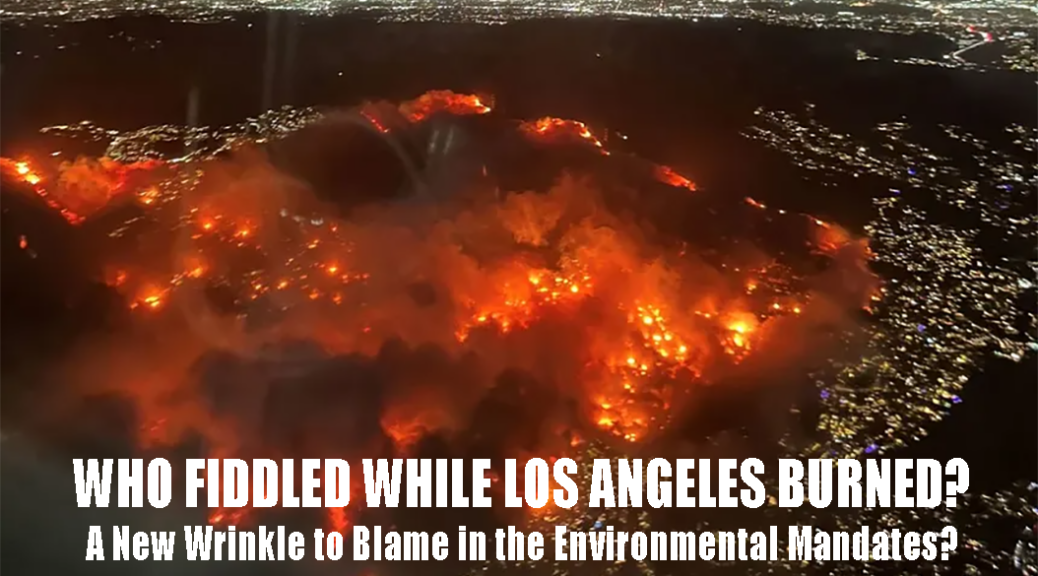
MARK: As far as fuels management — that’s something previous guests have said is sorely lacking nowadays. We certainly saw that down in Los Angeles with their fires, where they hadn’t been cleaning up fuel in those forests, and pretty soon large parts of the city were on fire. So why is there resistance to doing that, if it can prevent these massive, multi-million-acre fires?
DERRICK: There’s going to be all kinds of reasons — you hear there might be environmental reasons, or backlash. A lot of it is a capacity thing. I’ll be honest with you — I was on a fire this summer, and the person I was talking to wasn’t from Oregon, but was with an agency, and they mentioned they were getting paid twenty-four-hour shifts just to man their station. I said, “well, that’s probably really good from a management standpoint, because you could get out there and do some fuels management” — and they just kind of chuckled and said, “not if we’re getting paid twenty-four hours to sit at the station.” So even when there is money available, a lot of that work just doesn’t get done by the agencies. And obviously that’s not everybody — that’s probably just an isolated case, but it does happen.
MARK: Doesn’t sound like they’re doing much other than sitting there playing solitaire, on the off chance a spark starts somewhere. I don’t know — that sounds a lot like things we’ve heard happening here in Oregon. We were talking a little before the show — are our state and federal fire department resources incentivized to leave their jurisdictions to fight fire or pre-position elsewhere?
DERRICK: There is, and it’s kind of a dirty little secret. State and fire department resources have created a profit motive to leave their home jurisdictions. State agencies are a little more careful about covering their own ground first, but for many fire departments, this cash cow has begun to take precedence over local protection responsibilities. As government agencies, it’s reasonable to expect that the ordering jurisdiction reimburses the actual expenses and maybe some reasonable depreciation — most agreements cover this — but there’s also something called an “hourly rate,” which is extra money above and beyond that. If you think about a contractor: they’re paying payroll, payroll taxes, benefits, fuel, travel, maintenance, supplies — all of that is directly related to the incident and gets reimbursed to public agencies too. But a private contractor also has to purchase their own equipment, pay interest on those loans and lines of credit, carry all kinds of insurance, cover repairs and registrations and taxes — things that are usually covered by a department’s local tax base, or that they’re simply exempt from. So these hourly rates turn out to be almost pure profit. I put together a bit of an analysis last year and found that these public fire departments are making about two to four times the profit that a private company can make on these fires, after expenses.
MARK: Well — okay, we’re coming up on a break, so let’s go ahead and do that. We’ll continue our discussion with Derrick Holdstock, owner of Western Fire Resources. Oregon set a record this year for acres burned — Democratic environmental policies at work for you.
Segment 6 (41:00)
MARK: And welcome back. In our final segment, we’re talking today to Derrick Holdstock — he has more than twenty-five years of experience and is the owner of Western Fire Resources; his website, if you’d like to visit, is WesternFire.us. A previous guest, Dr. Bob Zybach, has said that between 1952 and 1987 — thirty-five years — Oregon had only one catastrophic wildfire, and he attributes that largely to forest management. So one of the things that’s never made sense to me is this idea of the roadless rule — how important is it, going out there fighting these fires, to have good road access? And yet we’ve decided not to have roads in a lot of these wilderness areas.
DERRICK: It’s huge — and it’s not just roads, but brushed-out roads, because roads create a mineral firebreak simply because there are no surface fuels on the ground. But beyond that, if you needed to use a road — say, to do a defensive firing operation — you need to take the side of the road you’re going to burn off of and remove the ladder fuels, because ladder fuels are what take a surface fire up into the canopy. You need to remove limbs, small trees, brush. The problem with roads in roadless areas is the roads are still there, and they’re still largely open on the surface, but all the brush has encroached — so they’re pretty useless as fire lines as they currently stand.
MARK: One of the things that seems to pervade so much of environmental thinking, certainly in places like Oregon, is this notion that we need to leave nature alone, and it’s okay that fires happen. There was a famous case back in — I think the eighties, maybe the nineties — up in Yellowstone, where they just let all those acres go up in flames, and defended it as a good thing: forests need fires. But in Oregon, we’ve decided not to touch our acres, supposedly in defense of the spotted owl. When you let millions of acres go up in flames, it tends to impact their habitat — and recently, Oregon State researchers have said the spotted owl is effectively extinct. So I don’t see how this idea of just letting the fires be, without access, is a good idea for fighting these forest fires, or even remotely a good idea environmentally.
DERRICK: Yeah — you hear the same thing in the climate change debate. One thing that’s absolutely irrefutable is that fuel cannot burn if it’s not there. So even if we give the climate-change claims the benefit of the doubt, properly managed fuels are still the only practical way to keep fires small. I don’t care how hot it is, how dry it is, how much wind there is, how much lightning there is — if the fuels lack the continuity and arrangement to sustain extreme fire behavior, extreme fire behavior can’t happen. And the way to get at that is either fuels mitigation, or allowing certain fires to burn at manageable levels — which, when there are houses in the way, is really hard to do in a lot of cases. In the past, there was so much low-intensity fire that there really weren’t a lot of extreme fires, because that undergrowth was kept managed. But as we’ve suppressed fires and taken management out of the system, the fuel has just grown up, and it’s hard not to have big fires now.
MARK: We only have a couple of minutes left, and you’ve laid out a lot of things that are broken — the fuels mitigation nobody’s doing, the dispatch system issues. So what are some of the solutions, from your perspective?
DERRICK: First, I think payments to government agencies should be limited to the true cost of response plus reasonable depreciation, because government agencies aren’t businesses, and removing the profit motive would stop them from acting like one. We should always order the closest resources first — and then, once you get into extended attack, some of those closer resources need to be returned to their home stations so they can cover new starts, while resources that responded later can handle the extended attack. Private resources don’t have a jurisdiction to cover, so that works for them. As far as fuels management — one of the highest-impact things we could do, year-round or at least during the snow-free season, is prep roads as fire lines. If you could order, say, private engines — there are seven hundred and thirty-three of them — for pre-position on initial attack, and have them spend their days prepping roads and doing priority fuels work in communities, you could get roughly a hundred feet on either side of primary and secondary roads on Forest Service and public lands done in a ten-to-fifteen-year timeframe, for only two to three percent of our current wildfire budget. That would result in a network of pre-prepped fire lines immediately available for direct attack or defensive firing, and it would lower suppression costs through smaller fires — it would pay for itself over time.
MARK: Derrick, unfortunately we’re up against the clock — this has really been fascinating, and thank you for what you do. You’re literally putting your life on the line to mitigate against stupid environmental policies.
DERRICK: Absolutely — I appreciate you having me on.
There’s an inherent problem with government and government spending. Government spends money to fix problems. But the problem with that thinking is that you need problems — if there aren’t problems, you don’t need to spend other people’s money. So if you solve the problems… you can probably figure that one out for yourself.
Getting back to this election: as I’ve watched politics from behind the curtain, I can tell you there are few things more frustrating than knowing there are people out there who could help — but don’t. So I hope you’ll take this election seriously. Find some candidates to get behind — if you need help finding those, we’ve got some identified for you. Remember, you don’t have to be in their district to help.
Take this election seriously, before it’s too late — because, as we say every week, the best information does you no good if you don’t use it. Reagan, what do you think?
Catch the show live
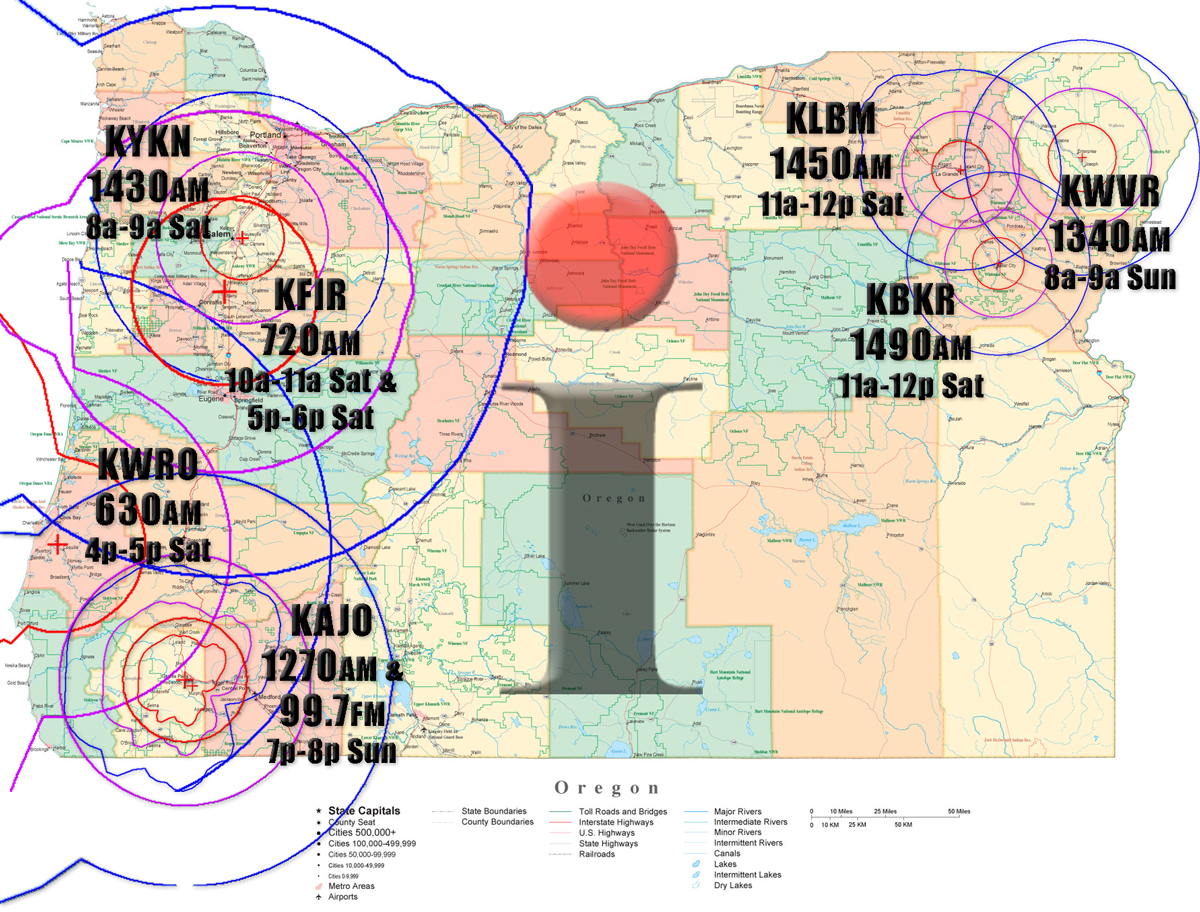
The I Spy Radio Show airs weekends — seven times across seven real radio stations, not internet-only streams. Listen anywhere through the stations’ live streams. See when, where, and how to listen for the full schedule.
Missed it? The podcast posts Mondays, after the broadcast stations air the show — here on this page or on your favorite platform.