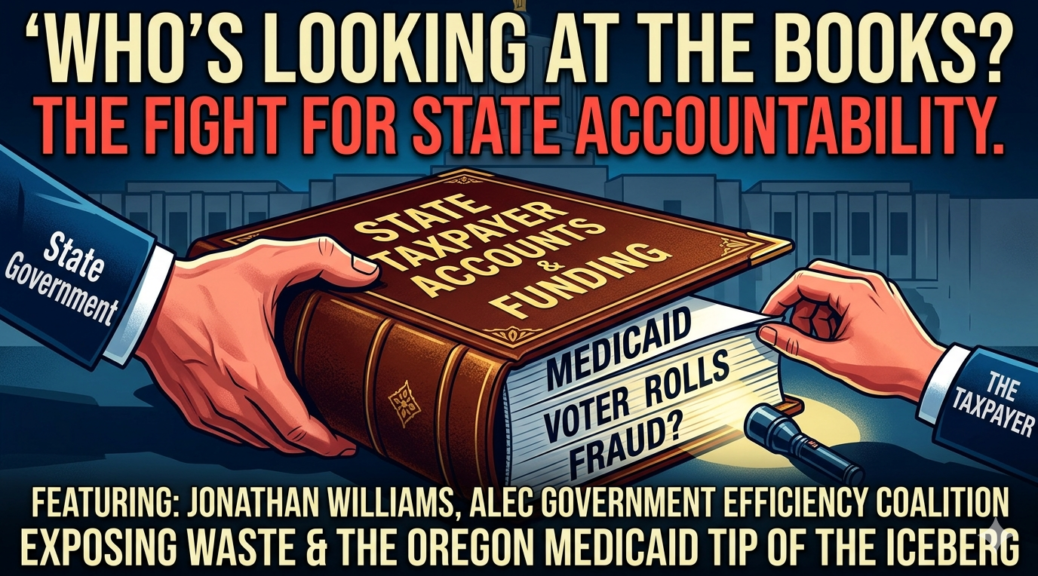
About This Episode
Government agencies are supposed to protect taxpayer dollars, so why are some states resisting efforts to examine spending records, voter rolls, and public assistance programs? And what happens when government agencies don’t want anyone looking at the books? On this episode, Mark Anderson sits down with Jonathan Williams, president and chief economist of the American Legislative Exchange Council (ALEC), to examine fraud, waste, and accountability in government spending.
They discuss ALEC’s Government Efficiency Coalition, major fraud investigations, improper Medicaid payments, and why some states are resisting efforts to verify public records and benefit programs. The conversation also explores how artificial intelligence, audits, and greater transparency could help uncover billions in waste and protect taxpayer dollars.
Could the fraud already uncovered be only the beginning? And what would it take for states like Oregon to truly clean up their fiscal house?
Transcript
(Opener)
Mark:
If your intention is to commit fraud — there is an easy, simple way to do it: make things complicated. The more complicated something is, the easier it becomes to hide what’s actually happening — with a lot of moving parts, interrelated systems, and, the number one means: make it hard for people to look. Make it complicated to look.
Because if there is no fraud, they would welcome your scrutiny. Here’s the checkbook! Take a look. And if you find fraud for heaven’s sakes let us know! We have a sacred duty to protect taxpayer dollars.
But they don’t do that they make things complicated and say you can’t look.
Take for example our voting rolls. Right now there are multiple lawsuits where states are pushing back against the federal government which is asking states to provide basic information about who is on the voter rolls. That should be simple. How many people are in your state? How many people are citizens — and of those citizens how many are registered to vote? Because we have a sacred duty to protect our elections and to make sure that only citizens vote. And only vote once. And only vote in one state.
But states are pushing back because they don’t want to provide that simple, straightforward data. They act as if the federal government has no right to obtain it — no right to look. Imagine telling the IRS ohh you can’t look at our books — everything is fine. You’ll just have to trust us.
When you complicate It’s something that ought to be simple — like a database — it opens the door to fraud even if that is not your intention. Allegedly not your intention.
Because here’s how voter rolls ought to work. Simply. The federal government maintains a single database of every person living in the United States. The various columns would include their name, their SS #, whether someone is a citizen yes or no. The address where they live. And the state where that address is.
States can then access that database and append data to. This person with this Social Security number has this voter ID and they live at this address in our state — or they’re currently living overseas — serving in the military, and so on.
Problem solved. We know where everybody lives we know where everybody ought to be voting and if there are multiple instances of that person then guess what — there’s your problem. Simple.
Government, like businesses using shell companies, can further complicate things by hiding the end recipient of money by hiding it behind a shield of nonprofits. You, the taxpayer, can see money going in but you can’t see who a “non-profit” getting 100s of millions of taxpayer dollars then gives that money to.
And even if they opened their books just a little, it’s still complicated because they can say ohh that $1,000,000 we got from the taxpayers we spent that on office space and utilities — we didn’t spend $1,000,000 on activists. We used our own funds for that. sure
But. Where government is uniquely positioned to help people commit fraud is the bureaucracy within government.
Again, it’s complicated, Multiple agencies multiple departments all getting money comingling it and shoving money out the door. Add to that, the layer of inherent laziness by far too many people in government.
For example so much fraud could have been prevented if bureaucrats handing out cash had just asked questions. Like looking up business addresses on google maps.
But that would depend on people taking initiative. And from where I sit far too many people in government don’t bother to ask questions about where that money comes from or where it goes.
To talk about fraud I’d like to welcome back Jonathan Williams to the show…